
.svg)




Schedule demo
Redeem Rewards

Sign in required
Back
Recognition


Perks & Benefits


Gifting & Celebrations


Sales Incentives & Commissions
.svg)
.svg)

.svg)

.svg)
.svg)
.svg)

.svg)
.svg)
.svg)
.svg)
.svg)


Back
Industry


Business Size

A large manufacturing and logistics organization operates across multiple plants and operational sites with more than 20,000 frontline and deskless employees. Most employees work in production environments with limited access to corporate systems, no company email accounts, and minimal exposure to internal engagement programs.
Historically, employee recognition within frontline operations was informal and inconsistent. Recognition typically occurred within small teams and rarely extended beyond immediate supervisors. As a result, large parts of the workforce had limited visibility into recognition initiatives available to office-based employees.
Leadership recognized that if recognition programs were to support workforce engagement at scale, they needed to be accessible to employees regardless of location, role, or access to corporate technology.
Traditional employee engagement platforms were designed primarily for desk-based workforces. Access often depended on corporate email authentication, desktop interfaces, and reward catalogs that did not resonate with operational staff.
For this organization, the result was a clear participation gap between office-based and frontline employees.
Key challenges included:
Together, these constraints meant that recognition programs reached only a portion of the organization, leaving the majority of operational employees outside the engagement ecosystem.
To address these challenges, the organization implemented the Empuls as a mobile-first recognition and engagement platform designed to support a deskless workforce.
Several capabilities were introduced to enable broader participation.
Mobile-First Access:
Employees accessed the platform using mobile numbers and OTP authentication. And for those who did not have access to mobile numbers - employee ID based SSO was configured, removing the dependency on corporate email. This allowed frontline workers to participate directly from their smartphones.
Real-Time Recognition on the Shop Floor
Supervisors were equipped with QR-based recognition cards, enabling instant recognition for performance, safety compliance, or operational milestones. This allowed appreciation to occur in real time within the workplace.
Gamified Leaderboards
Gamified leaderboards were introduced to highlight achievements related to attendance, safety, productivity, and performance milestones. The system created visibility into high-performing teams and encouraged healthy competition across locations.
Localized Reward Options
The rewards marketplace was configured with options more relevant to frontline employees, including grocery vouchers, fuel cards, and mobile recharge credits, ensuring rewards were practical and widely usable.
Multi-Channel Communication
Engagement campaigns were delivered through mobile notifications, SMS, and WhatsApp messaging, enabling HR and operations teams to communicate with employees through channels they used regularly.
Peer and Supervisor Recognition
The platform enabled both peer-to-peer and supervisor-led recognition, making appreciation more visible across teams and locations.
Multilingual Platform Experience
To support a diverse frontline workforce, the Empuls enabled a multilingual interface that allowed employees to access the platform in their preferred local languages. This ensured that frontline workers who were less comfortable with English could easily navigate the platform, understand recognition messages, and participate in engagement initiatives.
Within ten weeks of implementation, the organization saw measurable improvements in engagement and participation across its frontline workforce.
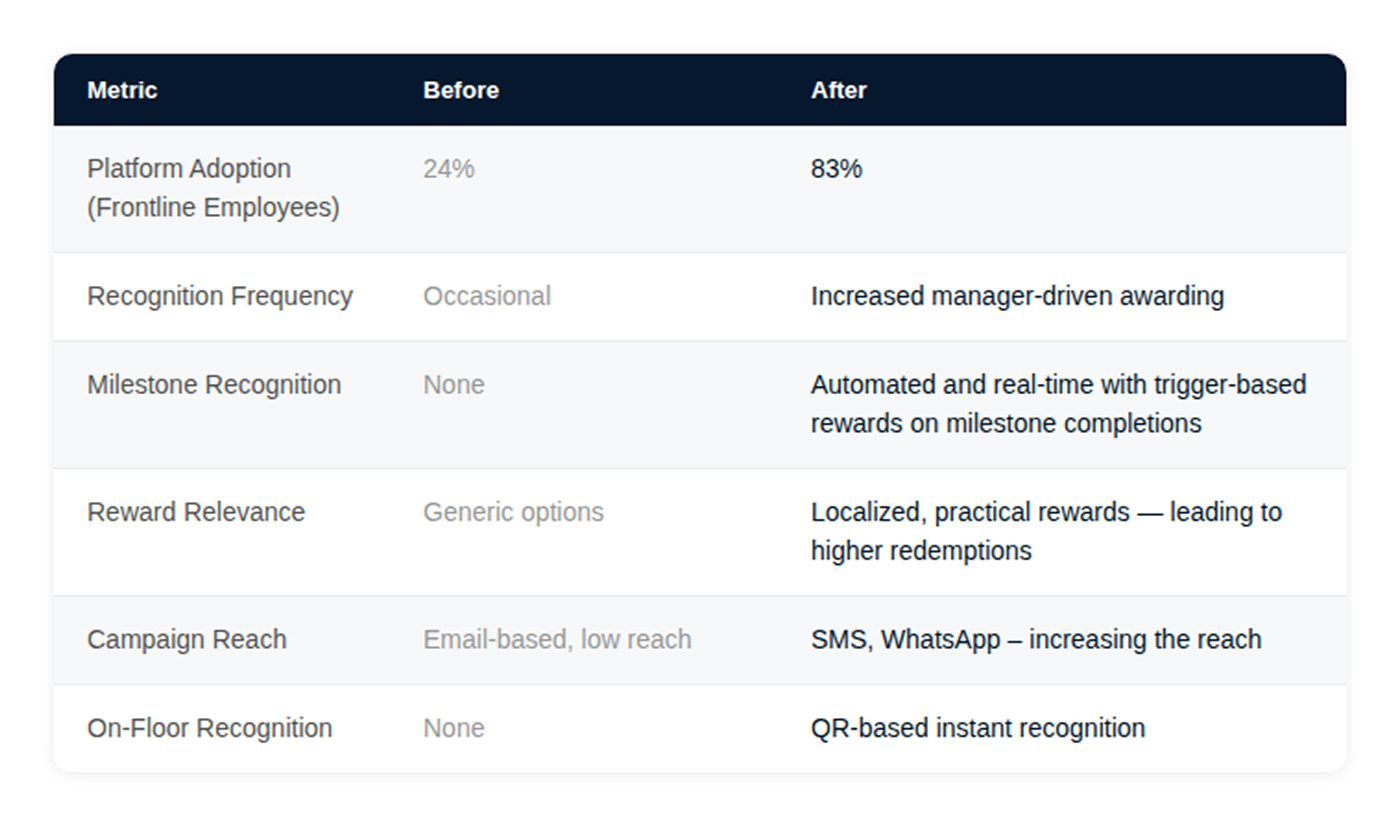
The increase in adoption was driven primarily by removing access barriers and aligning the platform with frontline work environments.
Supervisors were able to recognize performance immediately, while employees gained access to rewards and engagement programs through devices they already used daily.
By implementing a mobile-first recognition approach, the organization expanded its engagement strategy to include employees who had previously been outside its recognition ecosystem.
Within weeks, frontline participation increased significantly, recognition became more visible across operational teams, and engagement programs reached a much broader segment of the workforce.
The initiative demonstrated that recognition programs designed for operational environments can significantly improve workforce participation when accessibility, relevance, and real-time feedback are prioritized.


