
.svg)




Programme de démonstration
Échanger des récompenses

Connexion requise
Retour
Reconnaissance


Avantages et bénéfices


Cadeaux et célébrations


Engagement


Incitations commerciales et commissions
.svg)
.svg)

.svg)

.svg)
Incitations
.svg)
.svg)

.svg)
.svg)
.svg)
.svg)
.svg)


Retour
Industrie


Taille de l'entreprise

Une entreprise internationale présente en Amérique du Nord, en Europe et dans la région Asie-Pacifique gère ses effectifs à l'aide de Workday, son système de gestion des ressources humaines (SGRH) de référence.
Bien que l'entreprise ait mis en place plusieurs initiatives visant à renforcer l'engagement des employés – notamment des programmes de reconnaissance, des récompenses, des avantages et des actions de communication interne –, ces initiatives fonctionnaient indépendamment du système de gestion des ressources humaines (SGRH).
En conséquence, les équipes RH devaient gérer manuellement les données des employés sur plusieurs systèmes, ce qui entraînait des inefficacités opérationnelles et des retards dans la mise en œuvre des programmes d'engagement.
Afin de rationaliser ces processus et de garantir que chaque employé puisse participer sans difficulté aux initiatives d'engagement, l'entreprise a intégré Empuls Workday, permettant ainsi un engagement automatisé tout au long du cycle de vie professionnel de l'ensemble du personnel.
Avant l'intégration, les équipes RH géraient manuellement les données des employés entre Workday et la plateforme d'engagement. Chaque semaine, elles consacraient entre 5 et 8 heures à exporter des rapports du système de gestion des ressources humaines (SGRH), à mettre en forme des feuilles de calcul et à télécharger les mises à jour concernant les employés, ce qui rendait les opérations d'engagement de plus en plus difficiles à gérer à mesure que les effectifs augmentaient.
Plusieurs difficultés opérationnelles ont limité l'efficacité des initiatives de mobilisation de l'organisation.
Les principaux défis étaient les suivants :
Ensemble, ces contraintes opérationnelles ont rendu difficile pour les équipes RH de mettre en œuvre des initiatives visant à renforcer l'engagement du personnel en fonction des données en temps réel sur les effectifs.
Pour relever ces défis, l'organisation a intégré Empuls Workday, ce qui permet aux données relatives aux employés et aux mises à jour concernant leur parcours professionnel d'être transférées directement du système de gestion des ressources humaines (SGRH) vers la plateforme d'engagement.
Cela a permis de garantir que les programmes d'engagement, tels que la reconnaissance, les récompenses, les avantages, la communication, l'écoute et le retour d'information, fonctionnent en s'appuyant sur des données en temps réel concernant le personnel.
Plusieurs fonctionnalités ont permis cette transformation.
Empuls synchronisait Empuls chaque jour les dossiers des employés depuis Workday, garantissant ainsi que les programmes de fidélisation fonctionnent toujours à partir des données les plus récentes sur les employés, sans intervention des RH.
Les mises à jour telles que les changements de fonction, les mutations entre services, les changements de supérieur hiérarchique, les changements d'unité opérationnelle et le statut des employés ont été répercutées en temps réel dans Empuls, éliminant ainsi la nécessité de saisir manuellement les données.
Les événements marquants du parcours professionnel des employés, tels que les anniversaires et les dates d'ancienneté, ont été générés à partir des données des employés synchronisées depuis Workday.
Cela a permis de garantir que les célébrations des étapes importantes, les messages de reconnaissance et les récompenses soient transmis de manière systématique, sans nécessiter de configuration manuelle de la part des équipes des ressources humaines.
Les modifications apportées dans Workday concernant les supérieurs hiérarchiques, les services, les fonctions et les unités opérationnelles ont été répercutées dans Empuls.
Cela a permis de garantir que les programmes de reconnaissance, les processus de validation et les structures des équipes restaient en adéquation avec la hiérarchie actuelle de l'organisation.
Les nouveaux employés ont été invités à rejoindre la plateforme d'engagement dès que leur dossier a été créé dans Workday.
Cela a permis aux nouveaux employés de bénéficier dès leur arrivée des programmes de reconnaissance, des récompenses, des actions de communication et des initiatives visant à renforcer l'engagement.
Les départs d'employés ont été pris en compte dans Empuls leur statut professionnel a été modifié dans Workday.
L'accès à la plateforme d'engagement et les conditions d'éligibilité aux récompenses ont été mis à jour en conséquence, ce qui permet aux équipes RH de garantir la conformité tout en réduisant les tâches manuelles liées à la sortie de l'entreprise.
Grâce à l'intégration de Workday et Empuls, l'entreprise a considérablement amélioré l'efficacité et la précision des processus liés au cycle de vie des employés.
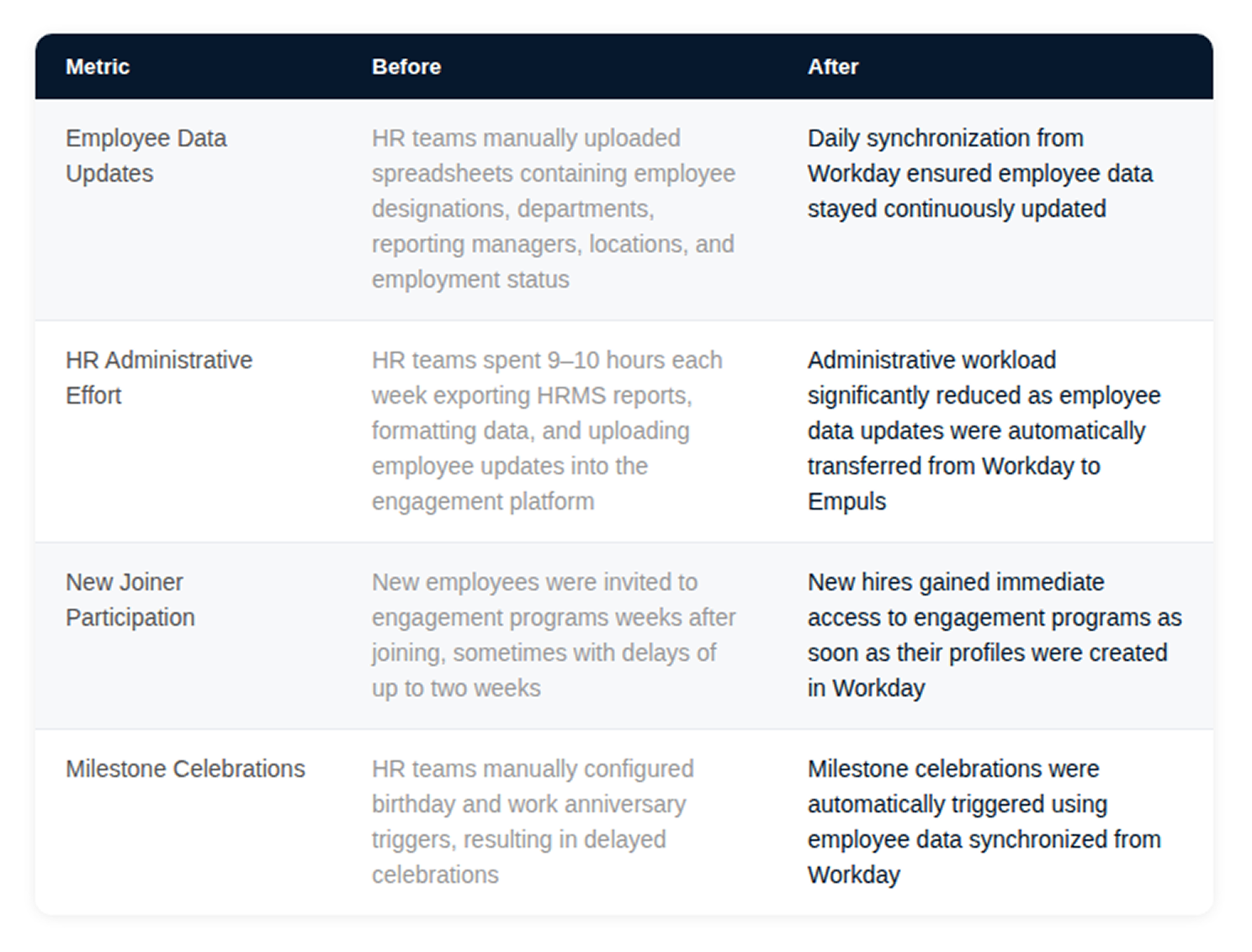
En intégrant Empuls Workday, l'entreprise a transformé ses processus d'engagement des employés, passant d'une gestion manuelle des données à un cycle de vie automatisé de l'engagement.
Désormais, tous les employés enregistrés dans Workday peuvent participer en toute transparence aux programmes de reconnaissance, de récompenses, de communication et de retour d'information, sans que les équipes RH aient à gérer manuellement les dossiers des employés.
Cette intégration a permis de réduire les frais administratifs, d'améliorer l'efficacité opérationnelle et de garantir que les initiatives visant à renforcer l'engagement s'appuyaient toujours sur des données précises et actualisées en temps réel concernant les employés.
Les équipes RH ont ainsi pu consacrer moins de temps à la gestion des tableurs et davantage à la mise en place d'un engagement significatif des employés à tous les niveaux de l'entreprise.


