Key Takeaways
Members who redeem rewards spend 3.1× more annually than non-redeemers
26.2% of loyalty points go unspent globally; 74% of members disengage within 2 months of joining
AI personalisation lifts redemption rates up to 35% and drives 37% higher customer spending
Every major airline, supermarket chain, and credit card issuer runs one. Billions of points are issued every day. Yet research from Bond Brand Loyalty consistently finds that fewer than half of loyalty programme members are active, and the gap between points earned and points redeemed widens every year.
The earn and burn loyalty program is simultaneously the most proven and the most misunderstood model in customer retention. Done well, it creates a measurable loop: customers spend, earn, redeem, and return. Done poorly, it becomes a points liability that sits on the balance sheet and does nothing for repeat purchase rates.
This guide covers how the earn and burn rewards model works, what makes programmes succeed or fail at redemption, how it compares to relational loyalty, and what CX leaders need to build a programme that actually drives revenue.
What is an earn and burn loyalty program?
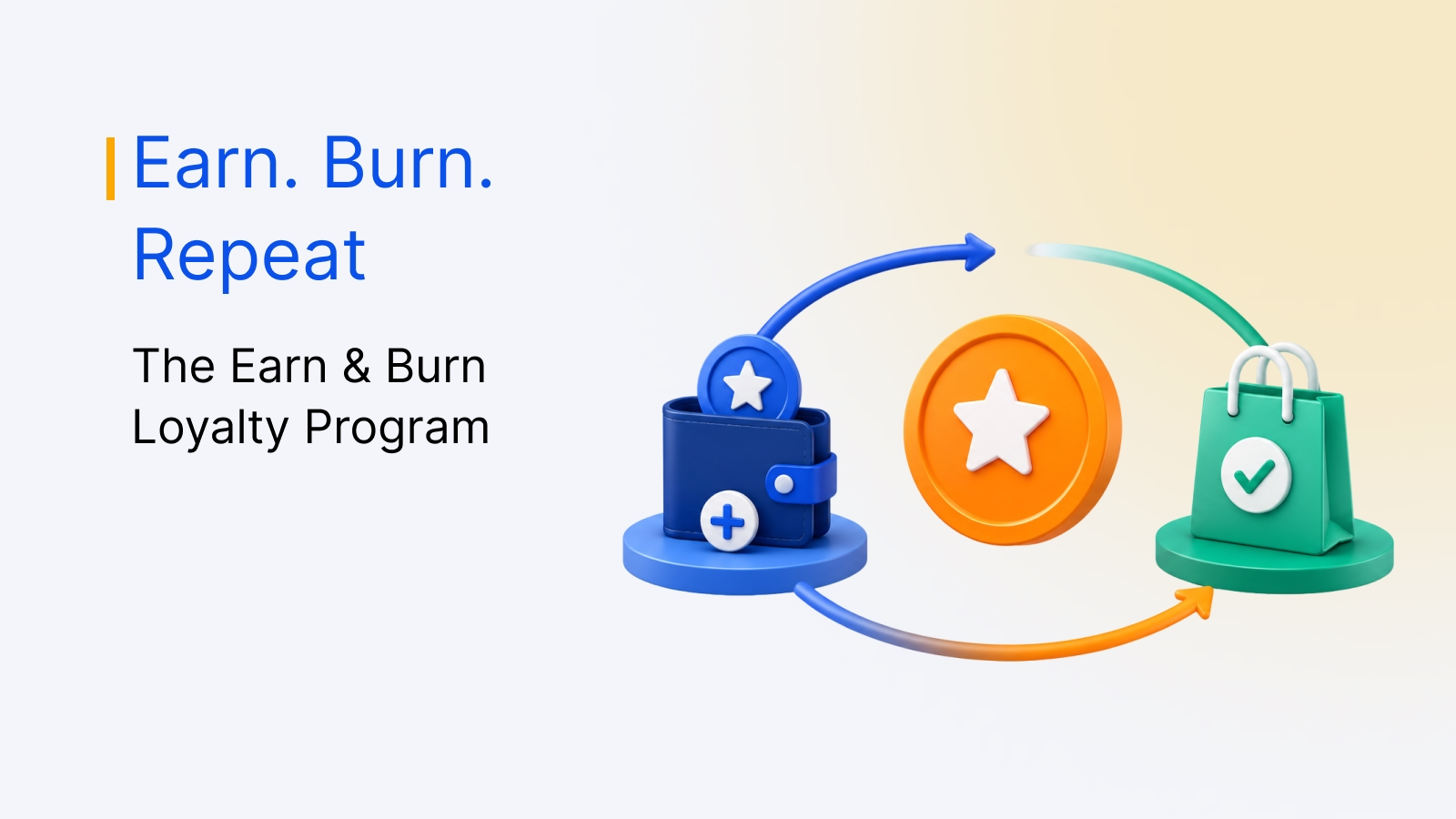
An earn and burn loyalty program is a transactional model built on two mechanics. Customers earn points, miles, or credits for defined actions, most commonly purchases. They then burn those points by redeeming them for rewards, discounts, free products, or experiences. The programme creates a closed loop designed to increase purchase frequency and brand stickiness.
The earn side rewards specific behaviours. The burn side is where most programmes lose momentum.
How the loop works in practice:
- Customer makes a purchase. Points are awarded at a defined earn rate, for example 1 point per $1 spent. Earn can also be triggered by referrals, reviews, social engagement, or profile completion.
- Points accumulate in a wallet. Points are held in a customer account, often with an expiry date. Visible balances and progress bars drive the psychological pull toward the next redemption threshold.
- Customer redeems points for rewards. Redemption happens against a catalogue: gift cards, product discounts, free items, experiences, or cashback. The breadth and relevance of this catalogue determines whether redemption actually happens.
- Redemption drives the next purchase. The loop closes when redemption resets the earn cycle. Customers who redeem are significantly more likely to purchase again within 90 days than those who accumulate without redeeming.
Why do most earn and burn programs fail at redemption?
The earn side of most programmes works. Points get issued. Balances grow. The failure almost always happens on the burn side. There are five structural reasons earn and burn programmes underperform at redemption:
- Thresholds set too high. When customers need 5,000 points to redeem a $5 reward, they never feel close enough to the goal to change their behaviour. The threshold must create urgency, not distance.
- Reward catalogues that miss the mark. A catalogue full of generic merchandise or brand-irrelevant gifts does not motivate redemption. Customers redeem when they want the reward, not when they have enough points.
- Complex redemption processes. If redeeming requires logging in, navigating to a separate portal, entering a code, and waiting 5 to 7 days for delivery, most customers will abandon the attempt.
- No communication at key moments. Most programmes send a welcome email and then go silent. Without prompts when customers are close to a threshold, or reminders when points are about to expire, redemption never gets triggered.
- Treating points as a cost, not an investment. Finance teams that optimise for low redemption rates are actively eroding loyalty. Low redemption means low engagement. High redemption, paired with the right earn economics, drives incremental revenue that exceeds programme cost.
Try Loyalife
Design, launch, and scale loyalty programs that drive repeat purchases and real customer lifetime value using Loyalife.
Talk to our ExpertTrusted by 5,000+ companies
Earn and burn vs relational loyalty: what is the difference?
The debate between transactional and relational loyalty is not an either/or question. Understanding the distinction helps CX leaders decide what to layer in and when.
| Dimension | Earn and burn | Relational loyalty |
|---|---|---|
| Core mechanic | Points per transaction | Emotional connection, community, recognition |
| Primary driver | Reward value | Brand affinity, trust, belonging |
| Switching risk | High - competitor can match on points | Low - emotional bond is harder to replicate |
| Time to value | Fast - measurable within 90 days | Slow - builds over months and years |
| Best for | Driving repeat purchase frequency | Building long-term lifetime value |
| Ideal combination | Layer earn and burn as transactional base | Add tiers, exclusive access, and personalisation as the programme matures |
Programmes that rely only on earn and burn are vulnerable to competitor point-matching. Adding relational layers - such as tiered status, early access, or personalised offers - builds switching costs that no competitor can immediately replicate.
What are the real limitations of earn and burn programs?
Understanding earn and burn program limitations is not a reason to abandon the model. It is a prerequisite for designing one that avoids the most common failure modes.
- Transactional loyalty does not equal emotional loyalty. Customers enrolled in earn and burn programmes will switch if a competitor offers better points. The model buys behaviour, not affinity. Affinity requires additional investment in experience and personalisation.
- Points liability accumulates fast. Every unspent point is a balance sheet liability. Programmes with low redemption rates face this silently until a regulatory or accounting review forces attention. The fix is not restricting earn; it is improving the burn experience.
- One-size earn rates ignore customer value differences. Giving the same earn rate to a customer who spends $50 a year as one who spends $5,000 is not just inefficient: it signals that the programme has no insight into who matters most.
- Data is captured but rarely activated. Earn and burn programmes generate rich purchase behaviour data. Most brands capture this data and never use it to personalise offers, adjust thresholds, or identify churn risk.
How to build an earn and burn loyalty program that drives real repeat purchases
The structural decisions made at programme design determine whether redemption becomes a growth driver or a cost sink. Six decisions that matter most:
- Set the earn rate against a purchase frequency target, not a cost ceiling. Work backwards from the purchase frequency you want to drive. If you want customers to return every 30 days, set a threshold that is reachable in 25 to 28 days of normal spend behaviour.
- Build the reward catalogue around what your customers actually want. Survey your top-spending customers. Not about what rewards they like in general, but what they would actually redeem right now. Localise by market - GCC customers want different rewards than customers in Manila or Jakarta.
- Make redemption happen in one click, not five steps. Every additional step in the redemption journey costs you active redeemers. Redemption must be available at the point of purchase, not hidden in a separate portal or sent by post.
- Send threshold nudges at 70% and 90% of the redemption target. Automated triggers at these two moments generate the highest incremental spend and the highest redemption conversion. Both nudges should show exactly what reward the customer is about to unlock.
- Differentiate earn rates by customer tier. Your top 20% of customers likely drive 60-80% of revenue. Accelerated earn rates for this cohort costs less than acquiring a new customer and materially reduces churn risk in the segment where churn is most expensive.
- Measure redemption rate monthly, not annually. Redemption rate should be a standing item on every CX review alongside NPS and churn. A monthly view catches declining redemption before it compounds into a retention problem.
How earn and burn loyalty works differently across regions
Programme design that works in the USA often underperforms in Southeast Asia or the Middle East. Redemption preferences, mobile penetration, and regulatory environments vary significantly.
| Region | Key dynamic | Design implication |
|---|---|---|
| GCC & KSA | High smartphone penetration, premium reward preference, Vision 2030 pushing digital loyalty adoption in retail and hospitality | Mobile-first redemption, premium experiences in catalogue, Arabic language support essential |
| India | Price-sensitive but reward-motivated. UPI dominance means digital vouchers outperform physical rewards. Tier-based status carries significant social weight. | Instant digital redemption via UPI-linked rewards. Tiered status to drive aspiration. Festival-calendar earn multipliers. |
| Philippines | High loyalty programme participation in FMCG and telco. Redemption preference: GCs and bills payment. Strong family orientation means group reward options drive uptake. | Bills payment as a redemption category. Group or family reward options. Post-redemption billing for brands to manage cash flow. |
| Indonesia | WhatsApp-native customer journeys. BNPL integration with loyalty is gaining traction. E-wallet redemption (GoPay, OVO) outperforms traditional gift card catalogues. | WhatsApp programme communication. E-wallet-linked redemption. BNPL earn integration for higher-value purchases. |
| Africa | Mobile money dominance (M-Pesa in East Africa). BFSI loyalty programmes growing fast. Airtime and data as rewards outperform merchandise. | Mobile money redemption. Airtime and data in reward catalogue. Gamification to drive engagement in early-stage markets. |
| USA | Loyalty fatigue in retail. Cashback and instant discounts outperform points in Gen Z and Millennial segments. | Cashback as a redemption option. Instant-gratification earn events. Omnichannel programme consistency across digital and in-store. |
How to measure the ROI of your earn and burn loyalty program
Proving ROI to stakeholders is one of the most common challenges CX managers face with loyalty programmes. The measurement framework is straightforward once the right metrics are in place.
| Metric | What it measures | Healthy benchmark |
|---|---|---|
| Redemption rate | % of issued points redeemed | 60%+ (below 30% = structural issue) |
| Active member rate | % of enrolled members who earned or redeemed in last 90 days | 40%+ of enrolled base |
| Repeat purchase rate uplift | Purchase frequency: members vs non-members | Members purchasing 20-30% more frequently |
| AOV uplift | Average order value: members vs non-members | 10-15% higher AOV among active members |
| LTV delta | 12-month CLV: members vs matched non-members | 1.5x to 2x CLV for active programme members |
| Programme cost per redemption | Total programme cost / number of redemptions | Should trend down as volume scales |
How Xoxoday Loyalife powers earn and burn programmes at enterprise scale
Xoxoday Loyalife is built for the specific challenge of making earn and burn programmes work across large customer bases, multiple markets, and complex redemption catalogues. Every design decision addresses one of the structural failure modes outlined above.
01 · Earn engine
Configurable earn rules
Set earn rates by customer tier, product category, channel, or time window. Bonus earn events for referrals, reviews, and milestone actions. No-code rule builder means marketing owns earn configuration, not IT.
02 · Redemption
1mn+ reward options across 175+ countries
Gift cards, cashback, travel, experiences, merchandise, and digital vouchers. Localised catalogues mean customers in Riyadh, Manila, Jakarta, and Chicago all see rewards they actually want.
03 · Automation
Threshold nudges and expiry alerts
Automated triggers at 70% and 90% of redemption thresholds. Points expiry reminders at 30 and 7 days. All triggered through the customer's preferred channel: email, SMS, push, or WhatsApp.
04 · Analytics
Loyalty ROI dashboard
Real-time view of redemption rate, active member rate, AOV uplift, and CLV delta by segment. Exportable for stakeholder reporting. Drill down by region, tier, or product category.
150+
Countries
with localised rewards
1mn+
Reward options
across catalogues
65M+
Users
across global teams
Your next step toward a loyalty programme that earns its keep
The earn and burn loyalty program model is not broken. The way most organisations implement it is. The mechanics are simple. The failure is almost always in redemption design, communication cadence, and catalogue relevance.
Start by pulling your current redemption rate. If it is below 40%, the programme is accumulating liability rather than loyalty. The diagnostic tables in this guide identify exactly where the break is. The fix is a programme structure problem, not a customer motivation problem.
Drive repeat purchases across every channel with one loyalty platform.
Book a demo