Key Takeaways
Employee incentive examples show how rewards can improve performance and engagement
The best employee incentive programs combine monetary and non-monetary rewards
Personalized employee incentives drive stronger participation and business outcomes
Free snacks, premium coffee, and ping pong tables stopped working years ago. According to Gallup, only 20% of employees worldwide were engaged in 2025, and disengagement cost the global economy an estimated $10 trillion in lost productivity.
For SaaS companies, the problem is sharper. People ops leaders running programs for 1,000 to 5,000 distributed employees keep hearing the same feedback in pulse surveys: the perks are nice, but the work has stopped feeling rewarding.
This post is a working list of employee incentive examples top SaaS companies actually use to drive performance, organized by what they move. No theory, no fluff, no perks-as-strategy.
What are employee incentives, and why do they matter for SaaS companies?
Employee incentives are structured rewards tied to specific behaviors, outcomes, or milestones. They are not the same as benefits, which are baseline entitlements like health coverage. Incentives are conditional, performance-linked, and designed to reinforce what the business is trying to grow.
SaaS companies feel the pressure more than most. Engineering and AE compensation is benchmarked aggressively, distributed teams blunt the impact of in-office culture, and OKR-driven environments demand sharper rewards than a stocked pantry can deliver. Without targeted incentives, the engagement gap shows up in eNPS scores, manager surveys, and regrettable attrition.
What are the main types of employee incentives, and which work best for SaaS?
Most employee incentive programs fall into two buckets: monetary and non-monetary. According to Deloitte, organizations with recognition programs experience 31% lower voluntary turnover and are 12 times more likely to have strong business outcomes. Yet Deloitte's 2025 Global Human Capital Trends survey also found that while 60% of workers expect their organization to increase their motivation, only 33% strongly believe their managers understand what motivates them. That gap is where most programs break.
The simplest framework SaaS teams can use:
| Type | Best for | SaaS example | Watch-out |
|---|---|---|---|
| Monetary | Performance, quota, milestones | Spot bonus on Q4 expansion deal | Becomes expected, not motivating |
| Non-monetary | Recognition, belonging, growth | Public peer recognition with reward points | Loses meaning without consistency |
The winning programs blend both, with the mix tuned by role.
Turn rewards into revenue growth with Xoxoday Plum
Launch reward campaigns for prospects, partners, and customers globally at scale.
Book a demoTrusted by 5,000+ companies
Which employee incentive examples do top SaaS companies actually use?
The strongest employee reward programs at SaaS companies combine repeatable monetary triggers with non-monetary recognition delivered in the moments that matter. Below are 12 employee incentive examples worth modelling.
- Performance bonuses tied to OKRs. Tie quarterly cash bonuses to two or three measurable outcomes per role. This keeps reward criteria transparent and removes manager bias.
- Equity refresh grants. Issue additional restricted stock units to high performers every 12 to 24 months. This is the most effective long-term retention lever at venture-backed SaaS companies.
- Annual learning and certification stipends. Allocate $1,000 to $2,500 per employee per year for courses, conferences, or certifications. Engineers, product managers, and AEs use it differently, and that is the point.
- Wellness and mental health allowance. A monthly or quarterly budget employees spend on gym, therapy, meditation apps, or fitness gear.
- Remote work setup budget. A one-off allowance for chair, monitor, and home office gear when an employee joins or moves to remote-first.
- Sabbaticals at tenure milestones. Paid leave of four to eight weeks at the five-year and 10-year mark. Strong signal that loyalty pays off.
- Charitable match programs. Match employee donations dollar-for-dollar up to a cap. Particularly motivating for Gen Z and millennial talent.
- Peer-to-peer recognition with reward points. Employees give and receive points that redeem against a global catalog. According to SHRM, companies with peer-to-peer recognition programs are 35% more likely to report lower turnover rates.
- Onboarding milestone rewards. Reward points at 30, 60, and 90 days reinforce momentum during the highest-risk attrition window.
- Customer success bonuses tied to NPS or retention. Pay quarterly bonuses to CS teams when NPS or net retention crosses defined thresholds.
- Hackathon and bug-bash prizes. Cash, gear, or experiential rewards for engineering teams that ship innovation projects on internal hack days.
- Personalized milestone rewards. Recognize work anniversaries, marriages, new babies, and home purchases with a reward of the employee's choice. Personalization is where mature programs separate themselves.
Deloitte's 2025 High-Impact Total Rewards research found that mature rewards organizations are 7.2 times more likely to use data and analytics to personalize recognition, and that personalization is the single biggest driver of perceived program fairness.
Which sales incentive examples work for SaaS revenue teams?
Sales teams need their own playbook. Aberdeen Group research on sales performance management found that 83% of best-in-class sales organizations had reps achieve annual quota, compared to 51% at average firms and just 22% at laggards. The difference is rarely the comp plan alone. It is the layered incentives that sit on top.
The most effective sales incentive examples for SaaS revenue teams:
- Accelerator kickers above 100% of quota to keep top performers pushing through Q4.
- SPIFFs on specific product lines, segments, or competitive displacements.
- President's Club trips for top 10% of reps, paid in full with a plus-one.
- Leaderboard contests with weekly or monthly prizes for activity metrics (meetings booked, demos run, multi-thread accounts).
- New logo bounties on closed-won deals in target accounts.
Why do most SaaS incentive programs fail?
Most SaaS incentive programs do not fail because the budget is too small. They fail because the design is generic and the delivery is slow. Gallup attributes 71% of voluntary exits to poor management, not pay, which means even the best-designed program will underperform if managers are not equipped to use it. Delayed rewards make the problem worse, since an incentive delayed is an incentive denied in the moments that matter most.
The five most common failure modes:
- One-size-fits-all rewards. An engineer and a CSM should not be motivated by the same merchandise.
- Slow fulfilment. Rewards delivered weeks after the achievement carry almost no behavioural lift.
- No measurement. If the program is not tied to attrition, eNPS, or quota, it is a cost line, not a lever.
- Manager opacity. Frontline managers without budget visibility cannot recognize work in real time.
- Geo and tax friction. Distributed teams hit currency, compliance, and fulfilment blockers that quietly kill participation.
How does Xoxoday Plum power global employee incentive programs for SaaS teams?
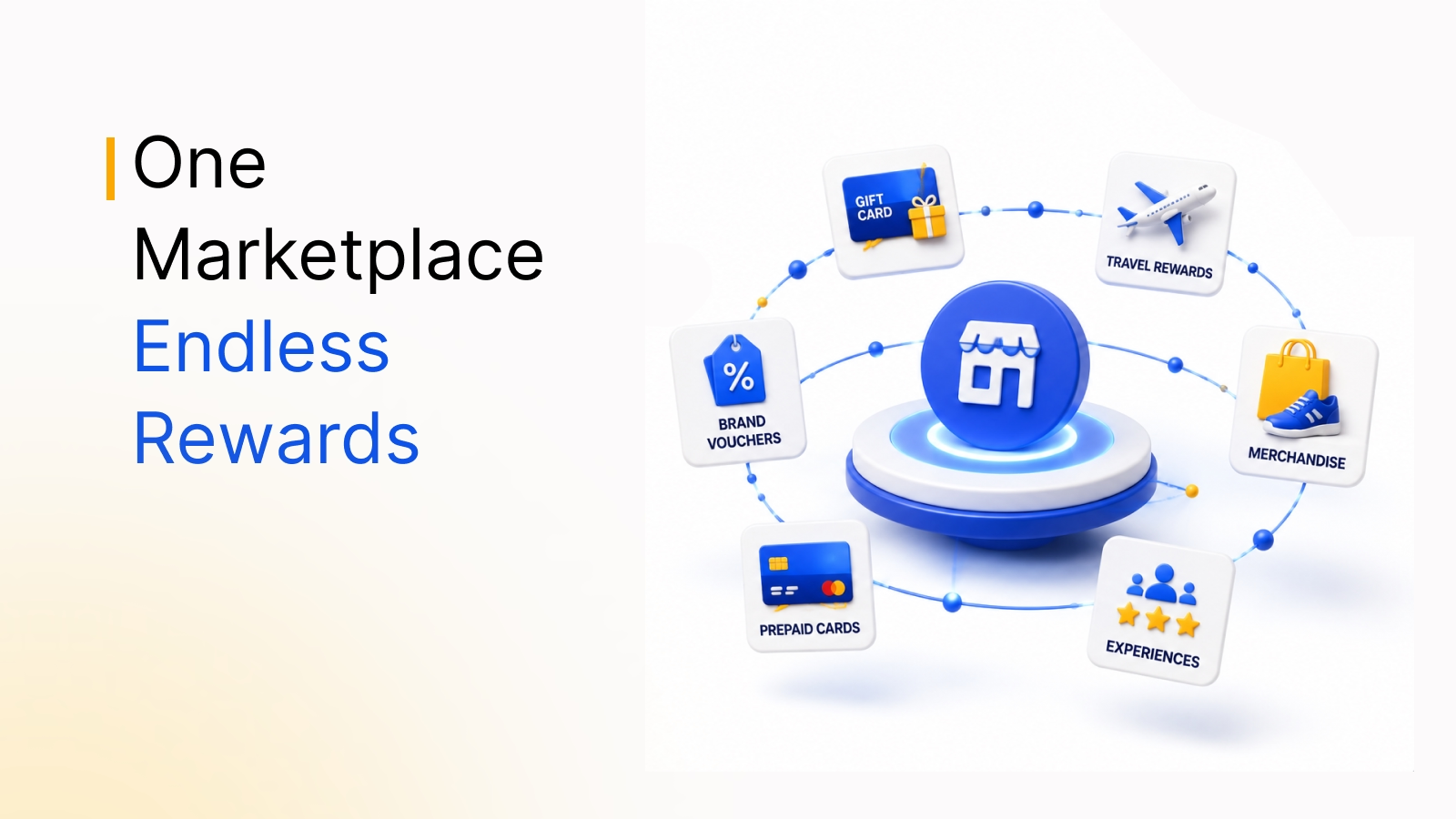
Xoxoday Plum is a global rewards marketplace built for the exact problem most SaaS people ops teams hit: send the right reward to any employee, in any country, instantly, without procurement chaos.
Three SaaS use cases where Plum closes the gap:
- Peer-to-peer recognition with global redemption. Points or vouchers redeemable across 10mn+ reward options in 150+ countries, so an engineer in Bengaluru and a CSM in Berlin both get a relevant catalog.
- Sales SPIFFs delivered the same day. Send a SPIFF reward in 30 seconds the moment the deal is closed, via API or bulk upload. Behavioural lift stays high.
- Milestone and onboarding rewards at scale. Automate 30 or 60 or 90-day milestones, work anniversaries, and personal life events with a single rule. No manager workflow needed.
For SaaS HR Managers tired of stitching together gift card stacks across 30 countries, Plum replaces the spreadsheet with one platform, one bill, and one report.
Your next step to better incentive programs
Generic perks do not move performance. Targeted, well-delivered employee incentive examples do. The companies winning on retention are not spending more, they are spending more thoughtfully and removing the friction between recognition and reward.
Run every incentive program from a single rewards platform.
Book a demo