
.svg)




Programar demostración
Canjear premios

Es necesario iniciar sesión
Volver
Reconocimiento


Ventajas y beneficios


Regalos y celebraciones


Compromiso


Incentivos de ventas y comisiones
.svg)
.svg)

.svg)

.svg)
.svg)
.svg)

.svg)
.svg)
.svg)
.svg)
.svg)


Volver
Industria


Tamaño de la empresa

Una empresa internacional con presencia en América del Norte, Europa y Asia-Pacífico gestiona su plantilla utilizando Workday como su sistema de gestión de recursos humanos (HRMS) oficial.
Aunque la organización había puesto en marcha varias iniciativas para fomentar el compromiso de los empleados —entre ellas, programas de reconocimiento, recompensas, beneficios y comunicación interna—, estas iniciativas funcionaban de forma independiente del sistema de gestión de recursos humanos (HRMS).
Como consecuencia, los equipos de RR. HH. se veían obligados a gestionar manualmente los datos de los empleados en múltiples sistemas, lo que generaba ineficiencias operativas y retrasos en la ejecución de los programas de fidelización.
Para agilizar estos procesos y garantizar que todos los empleados pudieran participar sin problemas en las iniciativas de compromiso, la organización integró Empuls Workday, lo que permitió automatizar el compromiso a lo largo del ciclo de vida laboral de toda la plantilla.
Antes de la integración, los equipos de RR. HH. gestionaban manualmente los datos de los empleados entre Workday y la plataforma de participación. Cada semana, los equipos dedicaban entre 5 y 8 horas a exportar informes del sistema de gestión de recursos humanos (HRMS), dar formato a hojas de cálculo y cargar las actualizaciones de los empleados, lo que hacía que las operaciones de participación fueran cada vez más difíciles de gestionar a medida que la plantilla crecía.
Varios retos operativos limitaron la eficacia de las iniciativas de participación de la organización.
Entre los principales retos se encontraban:
En conjunto, estas limitaciones operativas dificultaban que los equipos de RR. HH. pusieran en marcha iniciativas de compromiso alineadas con los datos en tiempo real sobre la plantilla.
Para hacer frente a estos retos, la organización integró Empuls Workday, lo que permitió que los datos de los empleados y las actualizaciones sobre su ciclo de vida se transfirieran directamente desde el sistema de gestión de recursos humanos (HRMS) a la plataforma de compromiso.
Esto garantizó que los programas de compromiso —como el reconocimiento, las recompensas, las ventajas, la comunicación, la escucha activa y la retroalimentación— funcionaran basándose en información sobre la plantilla en tiempo real.
Esta transformación se vio respaldada por varias capacidades.
Empuls sincronizaba Empuls los registros de los empleados desde Workday a diario, lo que garantizaba que los programas de fidelización funcionaran siempre con los datos más recientes de los empleados sin necesidad de intervención por parte del departamento de RR. HH.
Las actualizaciones, como los cambios de cargo, los traslados entre departamentos, los cambios en los superiores jerárquicos, los cambios de unidad de negocio y el estado de los empleados, se reflejaban en tiempo real en Empuls, lo que eliminaba la necesidad de introducir los datos manualmente.
Los hitos del ciclo de vida de los empleados, como los cumpleaños y los aniversarios laborales, se activaban utilizando los datos de los empleados sincronizados desde Workday.
Esto garantizó que las celebraciones de hitos, los mensajes de reconocimiento y las recompensas se enviaran de forma sistemática sin necesidad de que los equipos de RR. HH. tuvieran que realizar ninguna configuración manual.
Los cambios en los responsables jerárquicos, los departamentos, las funciones y las unidades de negocio realizados en Workday se reflejaron en Empuls.
De este modo, se garantizó que los programas de reconocimiento, los procesos de aprobación y las estructuras de los equipos se mantuvieran en consonancia con la jerarquía de mando vigente en la organización.
Se invitó a los nuevos empleados a la plataforma de participación tan pronto como se crearon sus perfiles en Workday.
Esto garantizó que los nuevos empleados pudieran participar en los programas de reconocimiento, las recompensas y las iniciativas de comunicación y compromiso desde el inicio de su trayectoria profesional.
Las bajas de empleados se reflejaban en Empuls cambiaba la situación laboral en Workday.
Se actualizaron en consecuencia el acceso a la plataforma de participación y los requisitos para optar a las recompensas, lo que ayudó a los equipos de RR. HH. a mantener el cumplimiento normativo y, al mismo tiempo, a reducir las tareas manuales relacionadas con la baja de los empleados.
Tras la integración de Workday con Empuls, la organización mejoró considerablemente la eficiencia y la precisión de los procesos relacionados con el ciclo de vida de los empleados.
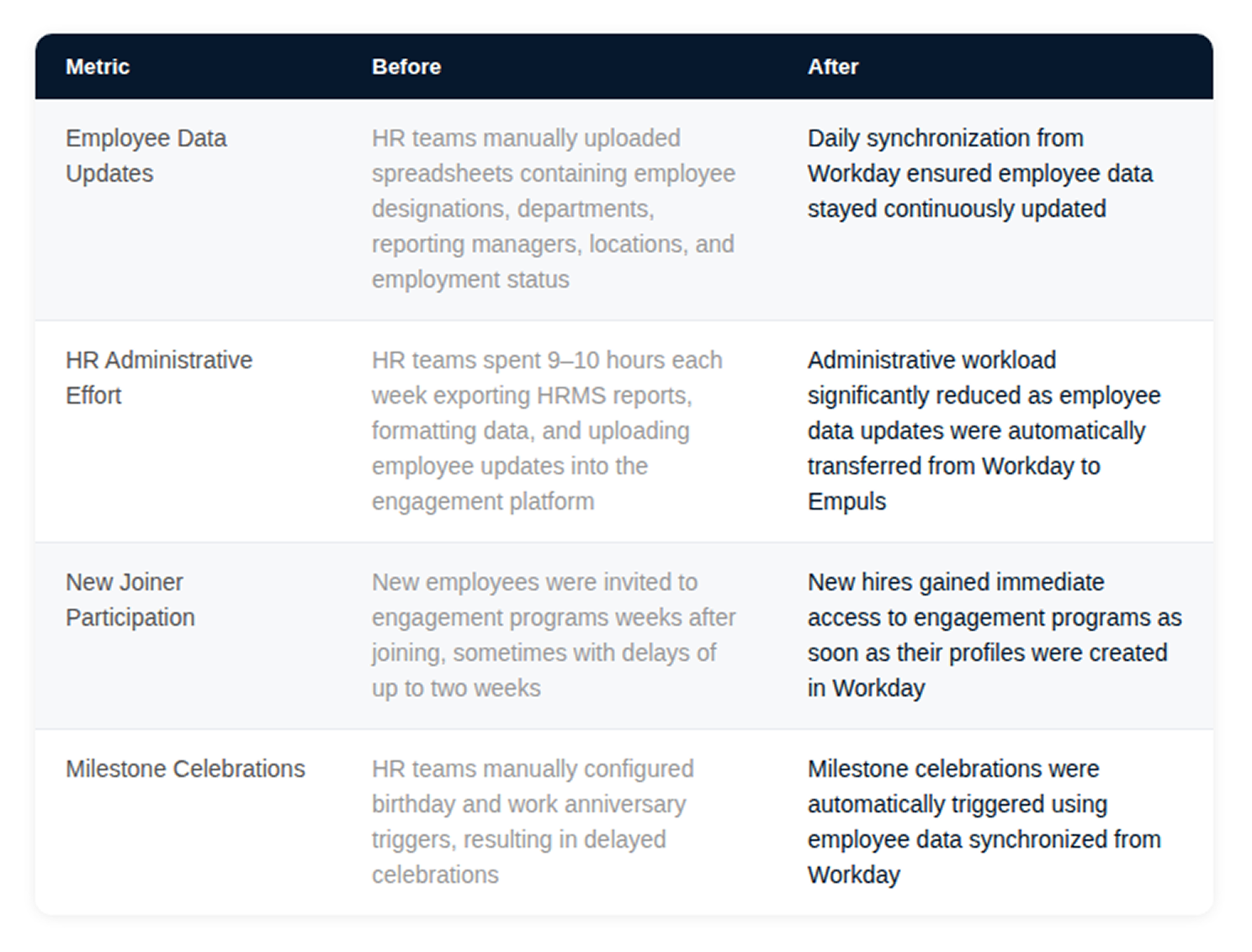
Al integrar Empuls Workday, la organización transformó las operaciones de compromiso de los empleados, pasando de una gestión manual de datos a un ciclo de vida automatizado del compromiso.
Ahora, todos los empleados registrados en Workday pueden participar sin problemas en programas de reconocimiento, recompensas, comunicación y retroalimentación, sin que los equipos de RR. HH. tengan que gestionar manualmente los expedientes de los empleados.
La integración redujo los gastos administrativos, mejoró la eficiencia operativa y garantizó que las iniciativas de compromiso con los empleados se llevaran a cabo siempre con datos precisos y en tiempo real.
Como resultado, los equipos de RR. HH. pudieron dedicar menos tiempo a gestionar hojas de cálculo y más a fomentar un compromiso significativo por parte de los empleados en toda la organización.


