Key Takeaways
Tax rules on employee gifts are country-specific, and gift cards are almost always treated as cash
Employer tax deductions and employee taxable income are separate - a gift can be deductible and still be fully taxable to the employee
Long-service and achievement awards get special treatment in several countries, but only for non-cash items presented formally
Employee gifts feel simple until tax season. A gift card that seems like a small thank-you can trigger income tax, payroll withholding, and reporting obligations you didn't plan for - and the rules change completely depending on where your employee sits.
There's no single global standard for gift tax. Each country decides independently what counts as a taxable gift, who reports it, and how much you can give before it stops being "just a gift." This guide breaks down the rules that matter most for HR and total rewards teams managing gifting across borders in 2026.
What counts as a taxable gift, and why "under $25 is fine" isn't universal
Most tax authorities draw a hard line between cash and non-cash gifts. Cash and cash-equivalents - gift cards, vouchers, prepaid cards - are treated as taxable income almost everywhere, regardless of the amount. Physical, non-cash gifts often get more lenient treatment, especially below a certain value.
Gift cards are where most employers get tripped up. They feel like a thoughtful, flexible gift, but tax authorities in the US, UK, Canada, and most of the EU treat them exactly like cash. There's rarely a small-value exception for them, even when the same country exempts physical gifts under a set threshold.
The other detail that trips people up: who's responsible for the tax. In some countries, the employer withholds and remits tax on the employee's behalf. In others, the employee reports the gift's value on their own return. Get this wrong, and you either under-withhold on payroll or leave your employees with a surprise tax bill.
Employer deductibility and employee taxability are two different questions
It's easy to assume that if a gift is tax-deductible for the business, it must be tax-free for the employee. That's rarely true, and conflating the two is one of the most common gifting mistakes.
Employer deductibility asks: can the business write this off as an expense? Employee taxability asks: does the value of this gift count as the employee's income? These thresholds are usually different numbers in the same country, and sometimes only one of them exists at all.
In the US, for example, a business can generally deduct only up to $25 per employee per year for gifts - but that $25 limit has nothing to do with what's taxable to the employee. A non-cash gift can be deductible and still be fully taxable income to the person who received it, depending on its value and form.
Automate tax-compliant gifting across borders
Xoxoday Plum helps you manage global employee gifting with built-in tax awareness. Track exemptions by country, automate payouts in local currencies, and keep your recognition programs compliant.
Explore PlumTrusted by 5,000+ companies
Gift tax rules by country: 2026 comparison
Tax authorities update thresholds often, and every country treats gifting differently. Here's where things stand for the markets most relevant to global employers, current as of 2026.
- India - Gifts from an employer are exempt up to ₹5,000 per employee per financial year. Anything above that gets added to the employee's salary income and taxed at their regular rate.
- United States - The IRS caps the employer's deduction at $25 per employee per year for business gifts. Cash and cash-equivalents (including gift cards) are always taxable to the employee as supplemental wages. Non-cash gifts under $100, given occasionally, generally qualify as non-taxable "de minimis" fringe benefits.
- United Kingdom - No general gift tax exemption, only a narrow "trivial benefits" exception: £50 or less, not cash or a cash voucher, not tied to performance, not part of the employment contract.
- Ireland - Small Benefit Exemption allows up to five non-cash benefits per year, totaling no more than €1,500. A separate long-service award of up to €50 per year of service is available after twenty years.
- Germany - Non-cash gifts tax-free up to €60 per occasion. Separate inheritance/gift tax regime for personal gifts uses allowances from €20,000–€500,000.
- France - Gift vouchers up to €169 per employee per year, tax-free, regardless of occasion. Higher exemptions apply for milestone gifts (wedding, birth, retirement).
- Spain - Non-cash gifts untaxed up to €300 per year.
- Poland - Tax-free gifting routed through the ZFŚS (Company Social Benefits Fund); mixed funding loses the exemption entirely.
- Netherlands - No dedicated employer exemption; general gift tax rules apply. Annual allowance €2,690 (2025) for non-family gifts.
- Denmark - Combined DKK 1,400/year for minor benefits; Christmas gifts carry a DKK 1,000 sub-allowance within that limit.
- Norway - Tax-free up to NOK 5,000/year across most occasions.
- Singapore - Tax-free under S$200 per gift, including bereavement gifts (exempt regardless of value).
- Australia - Non-entertainment gifts under AUD 300 (plus GST) exempt from fringe benefits tax; employer keeps the deduction and GST credit.
- New Zealand - Exempt up to NZD 300/employee/quarter; annual employer-side cap of NZD 22,500 across all staff.
- China - No employer gift exemption; gifts added to taxable income at standard rates.
- Indonesia - No distinct "gift tax"; employment-connected gifts treated as income.
- Philippines - 6% donor's tax on gifts exceeding PHP 250,000/year; donor is responsible for filing.
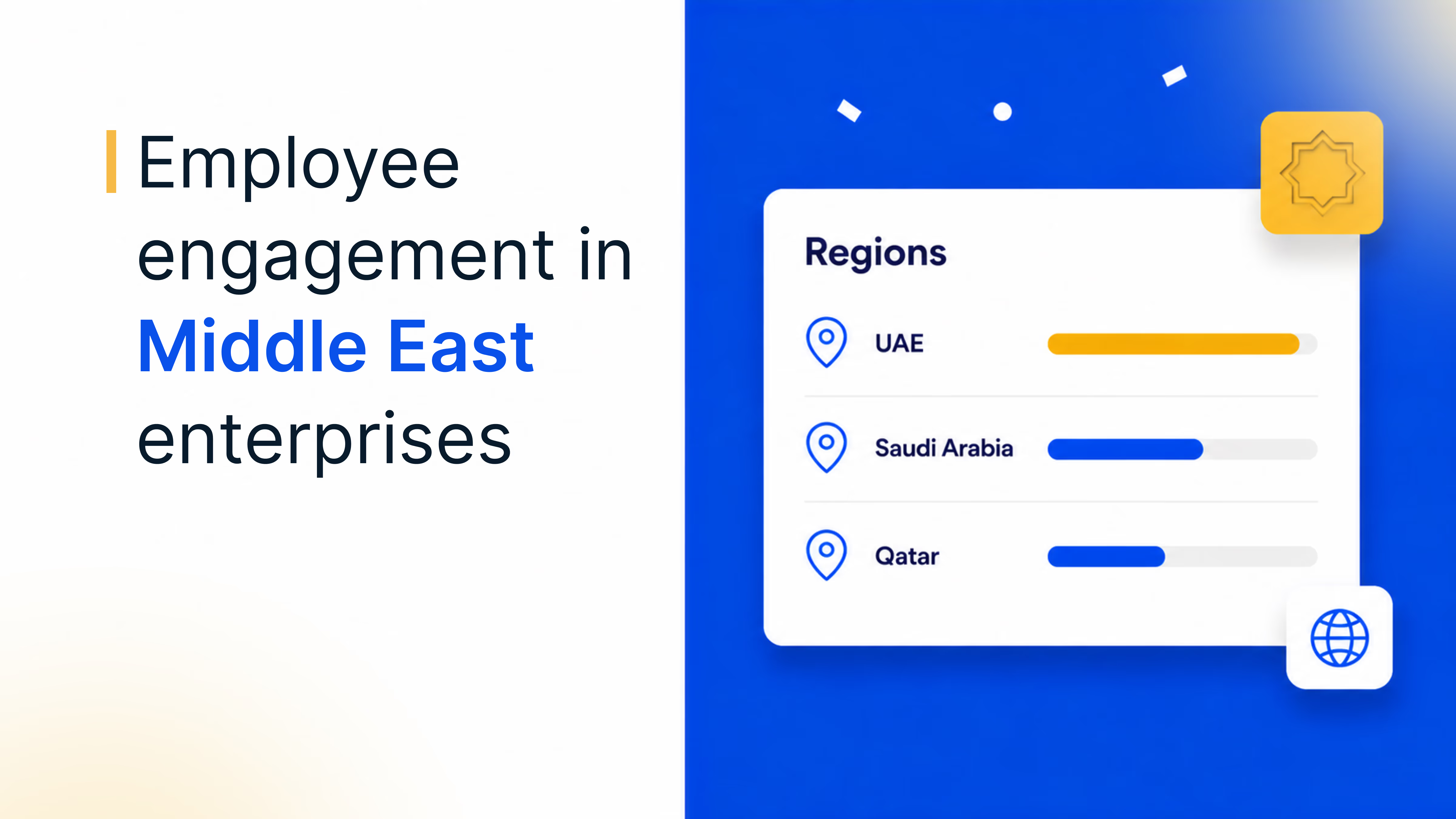
- UAE - No personal income tax, no gift or inheritance tax.
- Saudi Arabia - No personal income tax, no gift tax. Zakat doesn't extend to employer gifting.
- Canada - Non-cash gifts tax-free up to combined CAD 500/year; excess becomes a taxable benefit on the T4.
- South Africa - No de minimis threshold at all; taxable from the first Rand. Long-service award exemption: R5,000 after 15+ years.
- Kenya - Fringe benefits taxed at cost-to-employer or fair market value, whichever is higher. No specific gift carve-out.
| Category | Countries |
|---|---|
| No gift tax at all | UAE, Saudi Arabia |
| Capped tax-free allowance | India, US, UK, Ireland, Germany, France, Spain, Poland, Netherlands, Denmark, Norway, Singapore, Australia, New Zealand, Canada |
| No de minimis threshold | South Africa, China, Kenya |
| Value-based donor's tax | Philippines, Indonesia |
Achievement and long-service awards: the exception most guides miss
Several countries carve out a distinct exemption for awards tied to a real milestone - separate from general gift-giving rules entirely.
| Country | Exemption limit | Years required | Form required |
|---|---|---|---|
| United States | $1,600/year | No fixed minimum | Tangible property |
| Ireland | €50/year of service | 20 years | Tangible, physical item |
| South Africa | R5,000 total | 15 years | Tangible, non-cash |
The common thread: these exemptions apply only to genuine milestones, only to non-cash items, and only when presented formally, not folded into a routine paycheck. A long service awards program built around formal, tenure-triggered milestones is what qualifies for this treatment in the first place.
Gifting across distributed and remote teams: where compliance actually breaks
Tax treatment follows where the employee works, not where your company is headquartered. In federated countries like the US and India, state/local rules add another layer on top of national rules. A policy that's compliant for one employee can generate a withholding obligation for another, purely based on location.
How employers stay compliant without slowing down recognition programs
Manually tracking gift values against twenty different countries' thresholds doesn't scale. Good documentation - date, recipient, value, occasion - is the baseline safeguard.
Xoxoday Plum automates tax-aware payouts across multiple currencies and countries. The Plum Multi-Benefit Card adds India-specific tax-free spending across fuel, meals, wellness, and travel categories.
This article is for informational purposes only and doesn't constitute tax, legal, or financial advice. Tax thresholds and rules change frequently - confirm current requirements with your local tax authority or a qualified tax professional before finalizing any gifting policy.