Key Takeaways
The average insurer spends 5-7% of gross written premium on rewards - across 8-9 disconnected systems owned by 5-6 department heads
Voucher-based claim settlement saves 6-10% of claim value; one consumer-electronics insurer saved ₹13.3 Cr annually with 58% voucher adoption
A gamified persistency program moved 13th-month persistency from 78% to 82.3% - delivering ₹215 Cr of incremental renewed premium at under ₹6 Cr incremental compensation cost
An insurance company is, structurally, a rewards business.
The average insurer spends 5-7% of gross written premium on rewards, incentives, commissions, and recognition payouts - across customer benefits, advisor commissions, broker pay-outs, in-house sales gamification, claim settlements, employee R&R, and support-team incentives. For an insurer with ₹5,000 Cr in annual premium, that is ₹250-350 Cr - running through eight or nine disconnected systems, owned by five or six department heads.
The Chief Distribution Officer sees advisor commissions. The CMO sees customer benefits. Operations sees claim pay-outs. HR sees employee R&R. Finance signs the cheques. The CFO sees the line item - but never the lever.
The opportunity: Not to spend less, but to spend the same amount with proportionally better outcomes - by routing all seven programs through one rules engine, one catalog, one ledger, one audit trail.
| 5-7% | Of premium income spent on rewards |
| 7+ | Stakeholder groups rewarded |
| 8-9 | Disconnected systems today |
Why insurance is the most multi-channel rewards business in financial services
Insurance is sold through more independent channels than almost any other category - and each channel needs its own rewards logic. A bank-led, broker-led, advisor-led, and website-led customer all arrive at the same policy by very different routes, paid in very different ways.
| Structural cause | What it produces |
|---|---|
| Five distinct sales channels | Direct, bancassurance, broking, advisor, embedded - each with its own commission logic |
| Heavy regulatory constraints | India's IRDAI prohibits direct rewards to customers; programs must use benefits, not gifts |
| Long policy lifecycles | Persistency and renewals matter more than acquisition alone |
| Multi-product cross-sell potential | Life, health, motor, property, travel - a single customer can hold five policies |
| Two-sided commission economics | Pay-in to broker, pay-out to agent - both need to reconcile |
| Large captive sales workforces | 20,000-30,000 in-house reps at majors like LIC and SBI Life |
Each channel produces a different reward problem
The structure of insurance distribution determines the structure of its incentives. A modern rewards architecture has to accommodate all five channels at once - not pick a favourite and ignore the rest.
| Channel | What it is |
|---|---|
| Direct | Website, call centre, in-house outbound. Customer comes to the insurer directly. |
| Bancassurance | Banks sell own-brand or partner insurance products through their branch and digital channels. |
| Broking | Institutional brokers - Policybazaar, RenewBuy, InsuranceDekho - doing bulk distribution. |
| Advisors | IRDAI-registered individual agents and financial advisors selling to their personal networks. |
| Embedded | Travel insurance at flight checkout, device protection at purchase, gadget cover at e-commerce. |
The structural insight: The 5-7% spend is not the problem. The problem is that it is split across CMO-led benefits programs, CDO-led advisor commissions, ops-led claim settlements, and HR-led employee R&R - with no shared rules engine, no shared catalog, no shared liability ledger. Each silo optimises locally; nobody optimises the whole. The result is duplicated vendors, untracked unredeemed liabilities sitting on the books, and program ROI that nobody can defend at board level.
A separate note on India regulatory constraints
Under IRDAI guidelines, Indian insurers cannot offer cash or cash-equivalent inducements directly to customers in exchange for policy purchase. This is a hard rule. But - wellness benefits, service add-ons (free doctor consultations, eye and dental check-ups, mental wellness programs), and post-purchase loyalty points redeemable for ancillary services are permitted and increasingly expected. The rewards architecture for an Indian insurer must respect this line; for a GCC or SEA insurer the line is drawn differently. The platform handles both.
Seven plays, one platform, one CFO dashboard
The approach is not to add an eighth tool. It is to absorb the rewards logic of all seven programs into one rules engine - letting each department continue to own its program, while giving the company one shared catalog, one shared ledger, and one shared view of spend.
| # | Solution | Stakeholder | Owner | Connected system |
|---|---|---|---|---|
| 01 | Customer Benefits Program | Policyholders | Marketing / CX | Policy admin, partner APIs |
| 02 | Customer Loyalty Program | Multi-product customers | CRM / CX | CRM, policy admin, ERP |
| 03 | Advisor Commissions & Contests | Registered advisors | Distribution / Sales | POS, commission engine |
| 04 | Broker Loyalty & Pay-in/Pay-out | Institutional brokers | Distribution / Finance | Broker portal, GL, payouts |
| 05 | Voucher-based Claim Settlement | Claimants (low-ticket) | Claims / Ops | Claims system, catalog |
| 06 | In-house Sales Gamification | Captive sales reps | Distribution / HR | CRM, HRMS, dialer |
| 07 | Employee R&R + Support Teams | All employees + ops | HR | HRMS, Slack/Teams |
Seven programs, seven departments - running on one shared infrastructure that surfaces to leadership as a single dashboard. The shared layer comprises: a 20,000+ SKU catalog, a no-code rules engine, an audit ledger, comms via SMS, WhatsApp, and email, integrations to CRM, POS, and HRMS, and per-lever ROI analytics.
Solution 01 · Customer Benefits Program
*A managed marketplace of wellness, service, and lifestyle benefits that turns a policy from a piece of paper into a relationship*
Indian insurers cannot give customers cash rewards for buying a policy. But they can, and increasingly must, surround the policy with a curated set of benefits - free doctor consultations, annual eye and dental check-ups, mental wellness programs, sound therapy, preventive health camps - that the customer values and the insurer can deliver through a partner network. Across the GCC and SEA, the same logic extends to direct gifting at policy issuance.
The operational problem is not designing the benefits. It is delivering them - running 30 partners with 30 different login flows, 30 different validity rules, and 30 different ways of tracking usage. A unified benefits engine puts every offer on one URL, with one redemption flow for the customer and one analytics view for the insurer.
Typical benefits in a health/life insurance bundle
- Doctor consultations - Unlimited tele-consults via partner network - primary and specialist.
- Eye check-ups - Annual eye examination + discount on lenses, frames, and surgery.
- Dental cover - One free dental check-up, scaling, and discounts on procedures.
- Mental wellness - Counselling sessions, mindfulness programs, sleep therapy.
- Preventive checks - Annual full-body health screen at partner diagnostics chains.
- Sound & sleep therapy - Curated audio programs and white-noise libraries for wellness.
What the platform gives the insurer
- One URL - every partner offer surfaced through a single branded interface, accessed via the insurer's app or a customer microsite
- Partner self-service - suppliers add new offers, set validity, write descriptions, attach terms; the insurer's team approves and publishes
- API-based redemption - usage events flow back automatically so reconciliation is continuous, not quarterly
- Real-time analytics - which benefits drive engagement, which sit idle, which partners deserve renewal at better rates
- Sales-team visibility - every advisor sees the live benefit list per product, ready to use as a closing argument
Worked example: a health insurer's benefits program at scale
Day 0 · Policy issuance. Mrs Pillai buys a ₹10 L family floater health plan. Within an hour, a welcome WhatsApp lands: "Your benefits are live. Tap to activate." A single link opens her personalised benefits page on the insurer's branded URL.
Month 1 · First use. Her daughter has a sore throat. Mrs Pillai opens the benefits page, taps "Doctor on call", and gets a video consult in 14 minutes. The session is logged against her policy automatically. Cost to the insurer: ₹150. Cost to Mrs Pillai: zero. Impression created: "this insurer is actually useful."
Month 4 · Annual check-up. A reminder fires: her free preventive health screen is due. She books at the partner diagnostic chain through the same interface. The insurer pays the partner a pre-negotiated rate; Mrs Pillai gets a 14-page report. Her father's blood pressure flag is caught early.
Month 7 · Mental wellness. A workplace stress program is added by the insurer for the festive quarter. Push notification goes out; 18% of the policyholder base engages with at least one session in the first 30 days.
Month 11 · Renewal conversation. The persistency team calls. The call script now references her actual benefit usage: 4 doctor consults, 1 health check, 2 wellness sessions. Renewal conversion lifts measurably versus the control cohort - and Mrs Pillai upgrades to the ₹20 L cover.
Why this changes the persistency conversation: Most renewal calls are awkward because the customer hasn't experienced any value since they paid. The benefits program creates a continuous stream of small positive interactions - each one logged, each one available as a talking point at renewal. The same call has a different texture when it can start with "you've used four of your benefits this year - let's make sure you keep them next year."
A live dashboard of partner-level activation rates, top redeemed benefits by region, dormant benefits that should be retired, and engagement scoring per policyholder feeds directly into cross-sell models. The Q1 conversation with the chief marketing officer is no longer "what should we offer?" but "what's working and what should we replace?"
See how one platform runs all seven insurance rewards programs
Book a 60-minute discovery call to identify your highest-ROI anchor program - advisor commissions, broker pay-in/pay-out, or voucher claim settlement.
Request a demoTrusted by 5,000+ companies
Solution 02 · Customer Loyalty Program
*A structured points-and-tiers program that compounds across products and renewals - turning a one-policy customer into a five-policy household*
An insurer typically sells across at least three product lines - and many customers hold policies from the same insurer in two or three. They should hold five. The gap between three and five is closed by giving the customer a reason to consolidate: a loyalty program where every product they hold and every action they take earns points, and where reaching higher tiers unlocks benefits worth concentrating with one provider.
How customers earn
| Earn moment | What it rewards |
|---|---|
| Policy purchase | Welcome points sized to the premium - and to the product line |
| Multi-product cross-hold | Bonus points when a second, third, fourth product is taken with the same insurer |
| On-time renewal | Persistency points - large credit for unbroken renewal streaks |
| Personal milestones | Birthdays, anniversaries, household additions - automated, never missed |
| Referrals that convert | Large credit on the referred customer's first premium, larger on renewal |
| Health & wellness actions | Steps, screenings, vaccinations - points that also lower the insurer's claim risk |
How customers redeem
The redemption catalog is what makes or breaks a loyalty program. For insurance, the highest-engagement currencies are:
- Premium cashback on renewal - applied directly against the next year's payment; the most psychologically powerful redemption
- Premium cashback on a new policy - funds a cross-sell into a product they don't yet hold
- Catalog redemption - vouchers, gold coins, lifestyle and family experiences from a 20,000+ SKU library
- Family transfer - points gifted to a parent or child; meaningful for life and health products
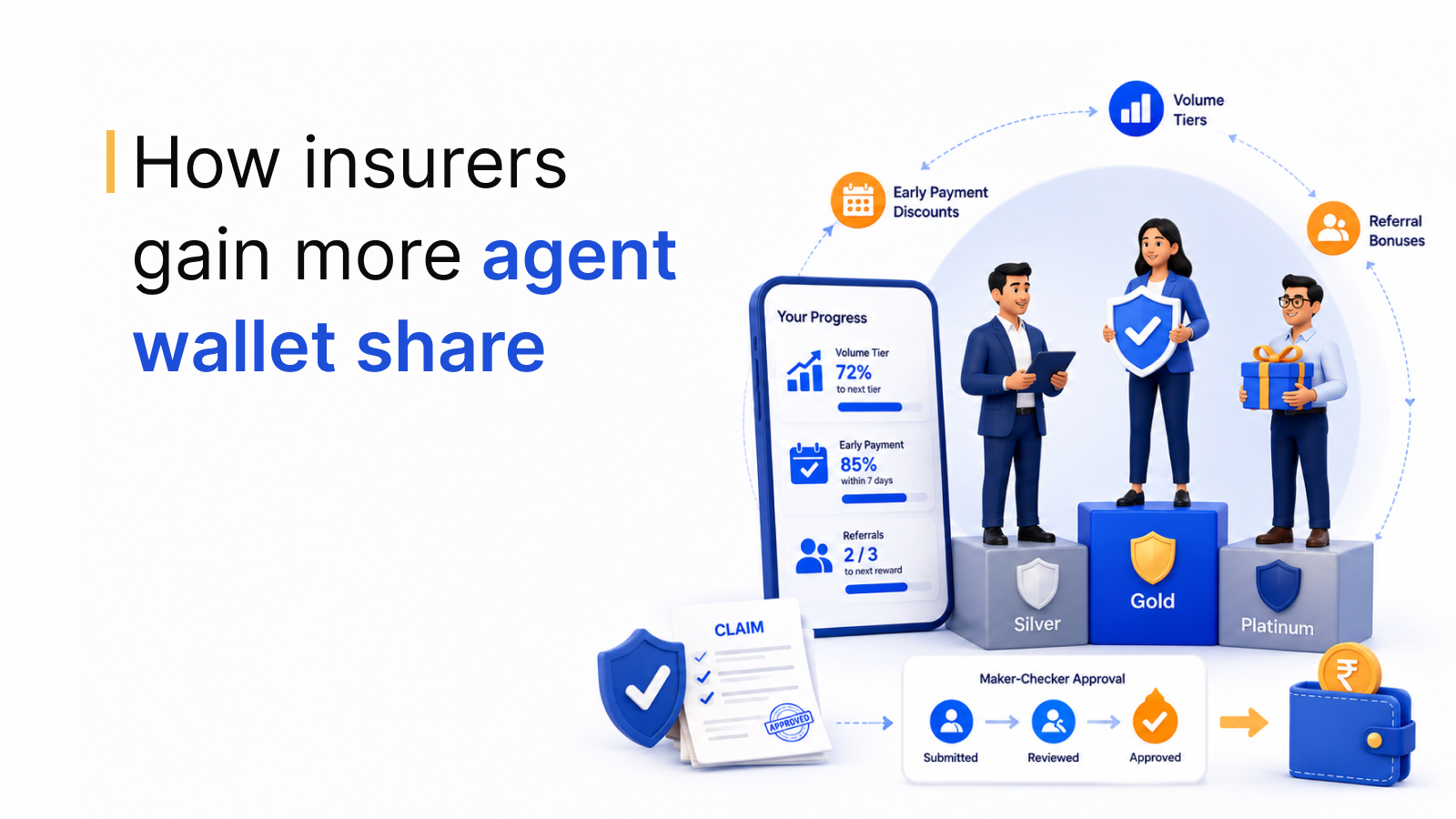
A structured tier arc - Year 1 Silver with one product, Platinum by Year 3 with three products, locked in by Year 4 - turns a single-policy relationship into a multi-product flagship household.
Solution 03 · Advisor Commissions & Contests
*Gamified commission management for the people who actually sell the policies - including contests, overriding commissions, and booster schemes - replacing the spreadsheet that runs all of it today*
Registered advisors are paid heavily - and across multiple layers: base commission, contest payouts, overriding commissions on team production, persistency bonuses, recruitment bonuses. In most insurers, all of this is calculated in spreadsheets passed between distribution, finance, and HR - which means errors, delays, and advisors who don't trust their pay. A modern advisor program puts all of it - earnings, contests, leaderboards, scheme communications - into a single app the advisor checks every morning.
What the engine handles, beyond what spreadsheets cannot
| Capability | Why it matters |
|---|---|
| Multi-layer commission | Base + contest + overriding + persistency - all calculated, attributed, and reconciled in one pass |
| Real-time contest visibility | MDRT progress, regional rank, club qualification - updated nightly, not quarterly |
| Booster & PIP schemes | "+2× commission on health this weekend" or PIP boosters for bottom quartile - live in minutes |
| Automated TDS & audit | Section 194D, GST, maker-checker workflows; full audit trail for IRDAI inspection |
A representative advisor dashboard shows, on one screen: this month's NB premium (₹18.4 L, up 22% vs last month), commission pipeline (₹2.76 L, payout in 4 days), path to MDRT (68%, ₹14 L premium to go), live booster scheme (2× commission on health policies this weekend), and team overriding commissions. All of it on the phone the advisor opens every morning.
Solution 04 · Broker Loyalty & Pay-in/Pay-out
*An engine that calculates and reconciles the two-sided commission economics of broker channels - and rewards both the institution and the individual selling for it*
Brokers like Policybazaar, RenewBuy, and InsuranceDekho can be larger than mid-tier insurers themselves - with thousands of sales employees and bulk distribution across products from many carriers. The commercial relationship is two-sided: the insurer pays a commission in to the broker; the broker pays a commission out to the individual who closed the sale. Both sides have to reconcile - and historically, almost nobody does it cleanly.
The cost-sheet problem nobody talks about
Every insurer sends every broker a periodic cost sheet - what they will pay for each product, each variant, each customer segment, for the next quarter or half. A broker selling motor insurance might receive different cost sheets from six insurers for the same Mahindra XUV variant. The cost sheets change quarterly. The broker's sales reps then have to price the policy, decide their margin, and quote - manually, in a hurry, while a customer waits on the line. Errors are routine. Disputes downstream are routine. The reconciliation cycle becomes a finance team's worst week of the quarter.
A unified pay-in/pay-out engine
One engine ingests every insurer's cost sheet, calculates the broker's margin, and disburses the rep's commission - the manual price-and-pay spreadsheet disappears. For example: Bajaj Allianz pays the broker 14.2% on Motor TP comprehensive (pay-in). The rules engine combines all carrier cost sheets, applies broker margin, and calculates rep commission. The rep earns 5.5% (broker keeps 8.7%); auto-posted to rep wallet within 24 hours of clearance (pay-out).
Two parallel loyalty layers
| Layer | Audience | What it rewards |
|---|---|---|
| Institutional | The broker firm | Volume tiers, share-of-wallet bonuses, exclusive product launches, marketing co-investment |
| Individual | The broker's sales reps | Direct bonus from the insurer to the rep - bypassing the broker's payroll for performance spikes |
Why both layers matter: An institutional loyalty deal motivates the broker's commercial leadership to push your products. A rep-level program motivates the person actually quoting on the phone. The reps who go home thinking about your product the next morning are the reps you paid directly - even if the cheque was small.
Worked example: a motor insurer's broker channel after pay-in/pay-out automation
Q1 baseline: A mid-sized motor insurer works with 14 brokers, each receiving quarterly cost sheets across 23 product variants. Reconciliation is run by a 6-person finance team. Average dispute backlog: 340 cases. Time-to-close on a dispute: 27 days. Brokers complain about delayed payouts at every QBR.
Q2 · After pay-in/pay-out engine goes live: Cost sheets are digitised - published directly into the engine each quarter, no PDF, no email, no broker confusion about which version is current. Real-time quote validation confirms prices against the live cost sheet; out-of-band quotes are blocked at source. Automated reconciliation matches every policy issued to pay-in and pay-out automatically - disputes drop 78% in one quarter. Each rep at the broker sees their commission in their wallet within 24 hours of policy clearance; they start preferring the insurer's product when a customer is indifferent.
What changed for the CFO: The 6-person reconciliation team moved to higher-value work like broker margin optimisation and channel mix analysis. The finance close moved from 18 days to 7. And the share of voluntary motor business written through the top three brokers lifted by 4-6 percentage points within two quarters, because reps started quoting this insurer first when the price was tied.
Brokers don't love a tool the insurer forces on them. They love a tool that makes their finance team's life easier - and a pay-in/pay-out engine does. The broker's own reconciliation problem mirrors the insurer's. A jointly-deployed engine, branded for the broker on their side and for the insurer on theirs, becomes the single source of truth both parties refer to in every commercial conversation. The dispute meeting becomes a five-minute review of edge cases rather than a four-hour spreadsheet duel.
Solution 05 · Voucher-based Claim Settlement
*For low-ticket, high-volume claims, replacing the bank transfer with a curated voucher - saving 6-10% of the claim value while improving the customer's experience*
A phone gets dropped. A washing machine fails. A laptop is stolen. A travel-insurance baggage claim is filed. These are small-ticket, high-volume claims - the bulk of the modern non-life book. Today, almost every one of them settles by bank transfer or cheque, at the full claim value. There is a smarter way that benefits both sides.
The mechanic
Offer the claimant a choice: take the ₹40,000 by NEFT - or take a ₹42,000 voucher from a chosen retail partner (Croma, Amazon, Flipkart, Reliance Digital). Most claimants who are about to buy a replacement device anyway choose the voucher, because they net ₹2,000 more. The insurer pays the partner - and gets a 4-8% commission rebate from the partner. The voucher has a 12-month expiry, so a small percentage will go unredeemed and revert. Net savings to the insurer: 6-10% of the claim value, at scale.
Where the savings come from
| Source | Typical range |
|---|---|
| Partner commission rebate | 3-8% of voucher face value |
| Voucher expiry breakage | 2-4% across a portfolio of small-ticket claims |
| Faster issuance (no NEFT cycle) | Working-capital efficiency, not a direct margin |
| Float on issued-but-unredeemed | Treasury benefit on the gap between issuance and redemption |
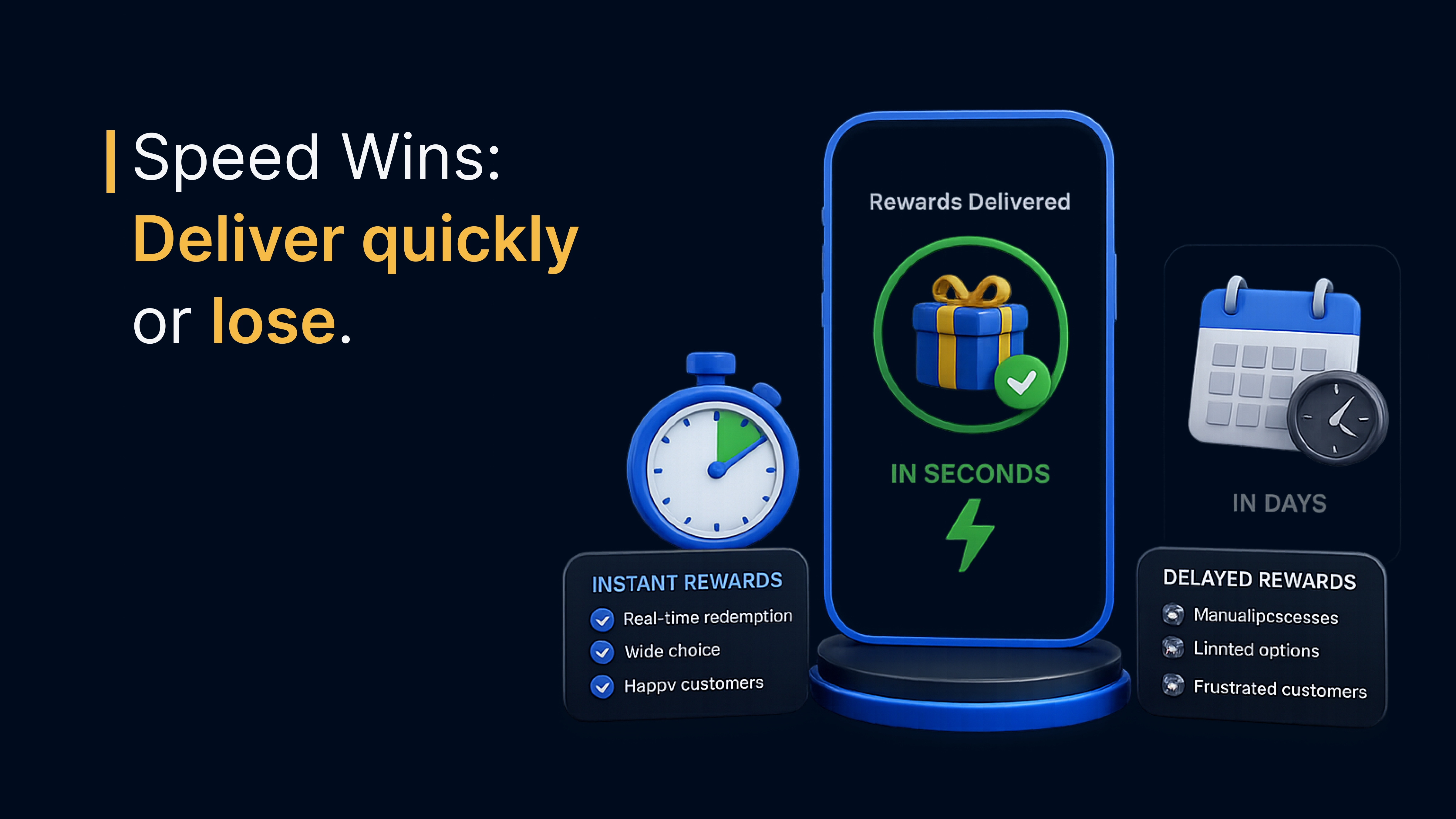
The experience side of the equation: The customer gets more value, instantly, with no NEFT delay. The NPS lift on claim resolution is substantial - and the insurer has now started a transactional relationship with a retail partner the customer was about to deal with anyway. That partner becomes the natural place to source benefits for the customer-benefits program too. The economics compound.
Worked example: a consumer-electronics insurer's annual claim book
Baseline - pre-voucher: Claim portfolio: 120,000 claims/year across phones, laptops, and white goods. Average claim value: ₹22,000. Total annual settlement: ₹264 Cr - all by NEFT.
Year 1 - after voucher option launched: Voucher adoption rate: 58% of claimants choose the voucher option (because the voucher value is higher than the cash value). Voucher portfolio: 69,600 claims totalling ₹153 Cr in voucher face value. Partner rebates: weighted average 5.5% across Croma, Amazon, Flipkart, Reliance Digital → ₹8.4 Cr saved. Breakage: 3.2% of vouchers expire unredeemed → ₹4.9 Cr reverted to insurer. Net annual saving: ₹13.3 Cr - equivalent to a 5% margin improvement on the entire claim book. And: Claim-settlement NPS lifted 18 points. Renewal conversion on policies where a claim was filed rose 7 points. The customer who got more than they expected stays.
Why this is a rewards problem, not a claims problem: From the inside, this sits in the claims department. From the outside, it is a rewards play - the catalog, the partner contracts, the issuance engine, the expiry and reconciliation logic are all rewards infrastructure. Routing it through the rewards platform means claims teams don't need to negotiate retail partnerships, manage expiry, or chase reconciliation. They just choose a settlement option from the same console they use for everything else.
Voucher settlement is most powerful for replacement-driven claims under ₹2 L, where the customer is about to spend the money on a discrete category of goods anyway. It is weaker on health-claim reimbursements (the spend has already happened), travel evacuation (urgent cash needed), or motor-repair settlements above ₹50,000 (the workshop wants cash). A good engine offers voucher settlement as an option only where it makes sense - and quietly defaults to NEFT everywhere else.
Solution 06 · In-house Sales Gamification
*Turning the monotony of a 20,000-rep captive sales floor into a daily game - with live incentives, instant boosters, and contests that show up where the rep already works*
The largest Indian insurers - LIC, SBI Life, HDFC Life, Bajaj Allianz - each operate captive sales workforces of 20,000 to 30,000 people. They work the website chat, the inbound call queue, the cold outbound dialer, the branch counter. The work is repetitive. Attrition is heavy. The standard incentive plan - monthly target, monthly payout - does very little to keep them present on a Wednesday afternoon.
A gamified overlay on the same incentive plan transforms the experience without changing the cost. The rep sees, in real time, where they are on the daily leaderboard, what contests they are eligible for, what booster schemes are live this hour, and what their projected month-end commission is. The same engine pushes performance-improvement programs to the bottom quartile and elite recognition to the top decile - both at the same time.
What gamification looks like on a captive sales floor
| Mechanic | What it does for the rep |
|---|---|
| Live daily target tracker | The dialer screen shows real-time progress vs target - no waiting for the end-of-day MIS |
| Hour-by-hour boosters | "+₹500 per Health policy in the next 2 hours" - surfaced by the system, accepted by the rep |
| Tournament structure | Daily, weekly, monthly contests with cumulative leaderboards across regions |
| Spot recognition | Manager-issued spot bonuses - ₹500 to ₹5,000 - credited instantly, visible to peers |
| PIP nudges (gentle) | "You're 18% behind plan with 9 days left - try this 3-policy push to catch up" |
| Wallet, not pay-slip | Earnings visible and spendable continuously - not bottled up until the 7th of next month |
Where it lives - inside the tools the reps already use
The platform integrates with the dialer (Ozonetel, Exotel, Genesys), the CRM (Salesforce, LeadSquared), the chat tool (Freshchat, WhatsApp Business, in-house), and the HRMS. The rep never opens a separate app. The gamification surfaces on the screen they were going to look at anyway - and the manager sees the team view of the same data on theirs.
The attrition arithmetic: A captive sales floor at a top-5 insurer churns 35-50% annually. The fully-loaded cost of replacing one rep - recruitment, IRDAI certification, on-boarding, productivity ramp - is ₹40,000-60,000. A 5-point attrition reduction across a 20,000-rep workforce is 1,000 fewer departures a year - ₹5 Cr in avoided replacement cost alone, before counting the productivity lift of a more tenured floor.
Solution 07 · Employee R&R + Support Team Rewards
*An always-on R&R engine for the corporate workforce - and specialised programs for two support functions whose performance directly moves the P&L: persistency and claims*
Insurance has a layered employee landscape - corporate (technology, marketing, finance, legal), distribution (regional and zonal managers), and the two operational teams that touch the customer most often: the persistency team (renewals) and the claims processing team. The first group needs a standard, well-designed R&R program. The second two need something more specialised - because every percentage point of performance translates directly into the P&L.
Corporate R&R - the standard layer
| Recognition moment | Example application |
|---|---|
| Monthly & quarterly performance | Top product manager, top actuary, top campaign analyst |
| Spot & trigger-based | Major launch shipped, critical incident handled, audit aced |
| Long-service awards | 3, 5, 10, 15-year - automated, never missed, public recognition |
| Birthdays, festivals | Diwali, Eid, regional festivals - auto-fire from HRMS calendar |
| Peer-to-peer | Any employee recognises any other with a small reward - micro-budget, large cultural impact |
The persistency team - a specialised program
The persistency team calls every customer whose policy is approaching its anniversary. Every percentage point of persistency saved is, mechanically, a percentage point added to the next year's premium income. For a ₹5,000 Cr book, one point is ₹50 Cr. The right program rewards completed renewals, not call volume - with bonus structures favouring the harder-to-save customers over the easy renewals. Ticket-level dashboards show each agent how many of their assigned customers renewed, downgraded, lapsed, with a clear monetary reward attached to the saved ones.
The claims processing team - the other specialised program
Claims processors live and die by ticket queues. The right program rewards a combination of throughput, accuracy, and customer satisfaction - not just speed. Ticket-level analytics flag the processor who clears 40 a day but generates 6 escalations versus the one who clears 25 with zero. Spot bonuses reward the second. Long-tenure recognition rewards processors who stay - because institutional knowledge of complex claim categories takes years to build.
Why these two teams deserve their own program: Persistency and claims processing are the two functions where individual performance translates most directly into P&L and NPS. A specialised program - same platform, own metrics, own catalog - costs the same and delivers measurably better outcomes on both axes.
Worked example: a life insurer's persistency program - six months in
Baseline: Team: 380 persistency agents across 4 regional centres. Average 13th-month persistency: 78%. Compensation: fixed salary + flat ₹150 per renewal saved.
Six months after the gamified program launches: Difficulty-weighted incentive - customers are scored Easy/Medium/Hard at handoff (based on payment behaviour, prior complaints, multi-product status). Save bonuses become ₹100 / ₹250 / ₹500. Live dashboard updated every 15 minutes - each agent sees their queue, saved-vs-lapsed split, team rank, and projected month-end commission. Daily streaks - agents who save at least one Hard customer a day for 5 consecutive working days earn a ₹2,000 bonus. Manager spot bonuses - team leads can fire a ₹500 spot reward for an unusually long, well-handled save; it shows up in the agent's wallet within 30 seconds, visible to the team.
Result: 13th-month persistency moves from 78% to 82.3% - 4.3 points. On a ₹5,000 Cr renewal book, that is ₹215 Cr of incremental renewed premium. The incremental compensation cost is under ₹6 Cr.
The compounding effect: Persistency improvements compound. A customer saved at year-2 is more likely to be present at year-3, year-5, year-10. The mechanical lift on next year's renewed premium book is real and immediate; the cumulative effect on the lifetime value of the in-force book - across new business and renewals together - is materially larger. This is why insurers who invest seriously in renewal-team programs almost always renew the investment.
Run the same gamification on the claims processing floor and the numbers move in two directions simultaneously: ticket-clearance throughput rises 15-25%, and complaint-rate falls because the bonus structure rewards quality over speed alone. The claim-processor who hands you both increases is the one you want to keep - and a well-designed long-service program does exactly that.
The CFO & CEO command center - seven levers, one control room
This is the part that moves the C-suite. Each of the seven programs is, in CFO terms, a lever - a budget input with a measurable commercial output. A modern rewards architecture turns each lever into an instrument the leadership can read, compare, and adjust. The command center sits above all seven.
| Capability | What it means in practice |
|---|---|
| Per-lever ROI | For every ₹ spent on each program - bookings influenced, persistency lifted, attrition reduced, claims saved |
| Live budget controls | Adjust caps, multipliers, or thresholds on any lever in real time - no IT ticket required |
| Scenario simulator | "What if I move 5% from advisor contests into persistency incentives?" - modelled before committing |
| AI recommendations | Pattern-based nudges - flagging under-performing spend, identifying high-leverage shifts |
| Liability ledger | Unredeemed points, pending payouts, accrued obligations - live, auditable, ready for finance close |
| Drill-down to source | From a portfolio number down to a single advisor, branch, or transaction in two clicks |
| IRDAI & audit-ready | Every payout traceable to a documented rule; maker-checker on material changes |
AI recommendations - reviewed weekly
| Insight | Recommendation |
|---|---|
| High confidence | Shift 4% from advisor contests to persistency incentives for Q4. Projected: +1.2 pp 13th-month persistency, +₹60 Cr renewed premium. |
| Opportunity | Voucher settlement adoption in motor claims is 28% - half the consumer-electronics rate. Pilot in workshop network. Potential: ₹8 Cr annual saving. |
| Under-performer | Bangalore South in-house sales spend is 23% above benchmark; conversion is flat. Review booster scheme calibration - ₹40 L potential reallocation. |
Most insurers find, within 90 days of a centralised command center, that 10-15% of rewards spend is going to programs with no measurable impact - usually historical, departmentally inherited, unreviewed. The AI recommendation engine surfaces these systematically. Reallocating that 10-15% to higher-ROI levers more than covers the platform cost in year one - and the voucher-settlement savings alone often do.
A platform that already runs each of these plays at enterprise scale
Xoxoday is the only platform in India that operates all seven programs on shared infrastructure. The catalog, rules engine, ledger, and reconciliation that power customer benefits at a health insurer also power advisor commissions at a life insurer and pay-in/pay-out at a broker.
| Dimension | Xoxoday |
|---|---|
| Years in market | 13 (founded 2012) |
| Enterprise customers | 5,000+ |
| End-users served | 60M+ |
| Countries served | 100+ |
| Catalog SKUs | 20,000+ - vouchers, experiences, gold, electronics, lifestyle, premium cashback |
| Integrations | 40+ HRMS, 25+ CRMs, leading POS/policy admin systems, Slack/Teams/WhatsApp, ERP |
| Compliance | SOC 2 Type II · ISO 27001 · GDPR · India data residency · IRDAI-aware payout flows |
| Reward delivery | API-first, instant fulfilment, multi-country reconciliation |
Leading life and non-life insurers, brokers, and aggregators across India and the GCC work with Xoxoday on one or more of the seven programs covered in this paper - including HDFC Life, Tata AIG, Bajaj Allianz, ICICI Lombard, Max Life, SBI General, Policybazaar, and RenewBuy. Engagements range from a single anchor program - typically advisor commissions or employee R&R - to multi-program deployments running on shared infrastructure. We are happy to facilitate direct reference conversations under mutual NDA.
The reason an insurer needs one platform across seven programs - rather than seven tools - is the same reason a CFO needs one P&L rather than seven departmental ledgers. The whole is more informative than the sum.
Insurance-specific capabilities
- Policy-admin agnostic - pre-built integrations with leading core systems and CRMs (Salesforce Financial Services, Microsoft Dynamics, LeadSquared, in-house POS)
- Pay-in/pay-out engine - ingests carrier cost sheets, calculates broker margins and rep commissions, disburses via wallet within 24 hours of policy clearance
- IRDAI-aware reward flows - benefits and wellness programs that comply with Indian regulatory constraints; GCC/SEA programs on the same platform with different rule sets
- Voucher settlement module - partner contracts, catalog, issuance, expiry tracking, and reconciliation - all within the claims console
- Dialer, CRM, and HRMS integration - gamification surfaces inside the tools reps already use; no separate app required
- Maker-checker and full audit trail - every payout rule documented, every disbursement traceable, IRDAI inspection-ready
A phased path - start with one program, expand as ROI proves out
The right starting point depends on which department's pain is most acute, and which lever has the cleanest measurement. For most insurers, we recommend anchoring with one program, proving the operating model, then expanding in a structured 12-month sequence.
Phase 01 · Anchor program · Months 1-3
Pick the highest-pain lever. For most insurers, this is one of three: advisor commissions (the largest single line), broker pay-in/pay-out (the messiest reconciliation), or voucher-based claim settlement (the fastest payback). Joint design workshop, integration with the relevant system, pilot launch in one zone or one product line. Baseline measurement before launch - so the post-launch numbers are defensible.
Phase 02 · Second & third program · Months 4-7
Add adjacent programs that share data. Advisor commissions + in-house sales gamification share the distribution data model. Customer benefits + customer loyalty share the policyholder identity. Broker pay-out + claim settlement share the partner network. Pick the pair that compounds - shared catalog, shared comms, shared reporting.
Phase 03 · Employee layer + CFO dashboard · Months 8-12
Light up the command center. Add employee R&R, persistency team incentives, and claims-team gamification. Light up the CFO/CEO dashboard once at least five levers flow through the platform. First annual review with full per-lever ROI - and the first AI-driven reallocation recommendations on the table.
Suggested next steps
- A 60-minute discovery call with the cross-functional team - Chief Distribution Officer, CMO, COO/Head of Claims, CHRO, and CFO representative - to identify the right anchor program
- A live platform walk-through with one or two reference customer stories from the insurance vertical
- A one-page scoping recommendation at the end of discovery - phasing, integration scope, commercials
*Insurance companies do not have a rewards problem. They have a rewards architecture problem - and that one is worth solving.*
Run every incentive program from a single rewards platform.
Book a demo