Key Takeaways
42% of voluntary turnover is preventable - and that's where CHROs create impact
Recognition-rich cultures see up to 43% lower turnover, but most CHROs still treat it as a nice-to-have
Attrition clusters by tenure band - and treating all departures the same wastes budget
High attrition is not a workforce problem. It is a leadership signal. When people leave in patterns - same tenure band, same manager, same quarter - the data is telling you something a resignation letter never will.
According to Gallup, roughly 42% of voluntary turnover is preventable. For a CHRO managing a workforce of 5,000 people, even modest attrition at preventable rates compounds into a material budget line. Each preventable exit carries a replacement cost of anywhere from half to twice the departing employee's annual salary, once you factor in recruiting, ramp time, and the institutional knowledge that walks out the door with them.
This playbook covers eight levers: what causes attrition, how to measure it, how to fix it, and where most organizations go wrong.
What employee attrition really costs your organization
42%
of voluntary turnover is preventable
Gallup
75%
of all departures trace to preventable causes
Work Institute 2025 Retention Report
0.5–2x
annual salary per mid-level replacement
Work Institute 2025
4M+
Americans quit their jobs every month
US Bureau of Labor Statistics
Employee attrition refers to the reduction of your workforce through exits that are not replaced, whether through resignation, retirement, or role elimination. It is often used interchangeably with employee turnover, but the distinction matters: turnover captures all exits, replaced or not, while attrition reflects net headcount shrinkage.
Not all attrition is a problem. Someone retiring after a long career, or a consistently low performer moving on, is healthy organizational change. The crisis is unwanted attrition - your high performers, critical skill holders, and future leaders choosing to leave for reasons you could have addressed.
The financial case is clear. According to the Work Institute's 2025 Retention Report, based on analysis of more than 120,000 exit interviews, 75% of all employee departures are preventable. Replacing a mid-level employee costs between 0.5 and 2 times their annual salary. Multiply that across dozens of preventable exits per year and attrition stops being an HR metric - it becomes a line item the CFO tracks.
The root causes CHROs most often misdiagnose
Most attrition analyses stop at the wrong level. Asking "why did people leave?" is the right question. The problem is that exit interview answers often differ from the real drivers that live in your engagement data months earlier.
The Work Institute's research identifies the top preventable causes of attrition as lack of career development, inadequate compensation, poor management, work-life balance challenges, and inflexible policies. What surprises most CHROs is how differently these manifest by tenure band.
| Tenure band | What it signals |
|---|---|
| First 90 days (0–90d) | Almost always an onboarding or expectation-setting failure. Fix the first week before fixing anything else. |
| Around the 12-month mark (12mo) | Typically signals a growth or compensation issue. High performers need to see a path forward by this point. |
| Three to five years in (3–5y) | Often traces to a manager quality problem or stalled career path. Treating this the same as early attrition leads to the wrong fix. |
Understanding why high-potential employees leave requires looking beyond exit interviews to leading indicators: engagement score trends, pulse survey participation rates, and recognition frequency data.
How to calculate your employee attrition rate
Before you can fix attrition, you need to measure it accurately. The standard formula is:
Attrition rate (%) = (Employees who left ÷ Average headcount) × 100
Calculate this monthly and quarterly, not just annually. Then segment by department, manager, tenure band, and role level. A company-wide attrition rate of 14% can look acceptable until you see it is 38% in one team's first 90 days.
According to SHRM, a healthy annual attrition rate for most industries sits between 10 and 15%, though this varies by sector - technology and retail typically run higher, manufacturing and financial services run lower. Use your industry benchmark as a floor, not a target. The real goal is reducing preventable attrition in your specific workforce.
See how Empuls reduces preventable attrition
AI-powered recognition, predictive analytics, and continuous listening - all built to help CHROs turn attrition data into action.
Book a demoTrusted by 5,000+ companies
7 strategies to reduce employee attrition
Seven evidence-based levers, in the order most organizations should act on them.
| Lever | Root cause addressed | Who owns it | Time to impact |
|---|---|---|---|
| Onboarding (90-day) | Early-tenure exits | HR + Hiring manager | 30–90 days |
| Manager quality | Mid-tenure exits | HR + L&D | 3–6 months |
| Career path visibility | High-performer exits | HR + Team leads | 2–4 months |
| Compensation benchmarking | Pay-driven exits | HR + Finance | 1–2 months |
| Recognition and rewards | Disengagement-driven exits | HR + Managers | 1–3 months |
| Workload and flexibility | Burnout-driven exits | HR + Ops | 2–4 months |
| Feedback loops | Unheard / invisible exits | HR | Ongoing |
1. Fix onboarding past the first week
According to Gallup, only 12% of employees strongly agree their organization does a great job of onboarding. Replace orientation with a structured 30-60-90 day plan: tool access and key introductions in week one, role-specific training in weeks two to four, and formal check-ins at days 30, 60, and 90.
2. Invest in manager quality first
People leave managers, not companies. Equip managers with structured check-in cadences, coaching frameworks, and visibility into their team's engagement signals. Tie a portion of manager performance outcomes to people metrics - engagement scores, attrition, and internal mobility.
3. Build visible career paths
Ambiguity about what comes next is one of the fastest routes to passive job hunting. Document growth paths for every role, including lateral moves, and hold quarterly career conversations rather than waiting for the annual review cycle.
4. Benchmark and communicate compensation
Pay below market is a strong attrition driver; pay at market is a hygiene factor. Audit internal equity annually and communicate how pay decisions are made. Address gaps before they appear in exit interviews.
5. Build recognition into daily team practice
Recognition is not an annual awards program. High-performing retention cultures build it into the rhythm of the week. The data on this is substantial and covered in the next section.
6. Design for workload and flexibility
According to Stanford research, hybrid work arrangements reduce resignations by approximately 33%. Monitor workload at the team level and address systemic overload before it becomes burnout-driven attrition.
7. Use proactive feedback loops
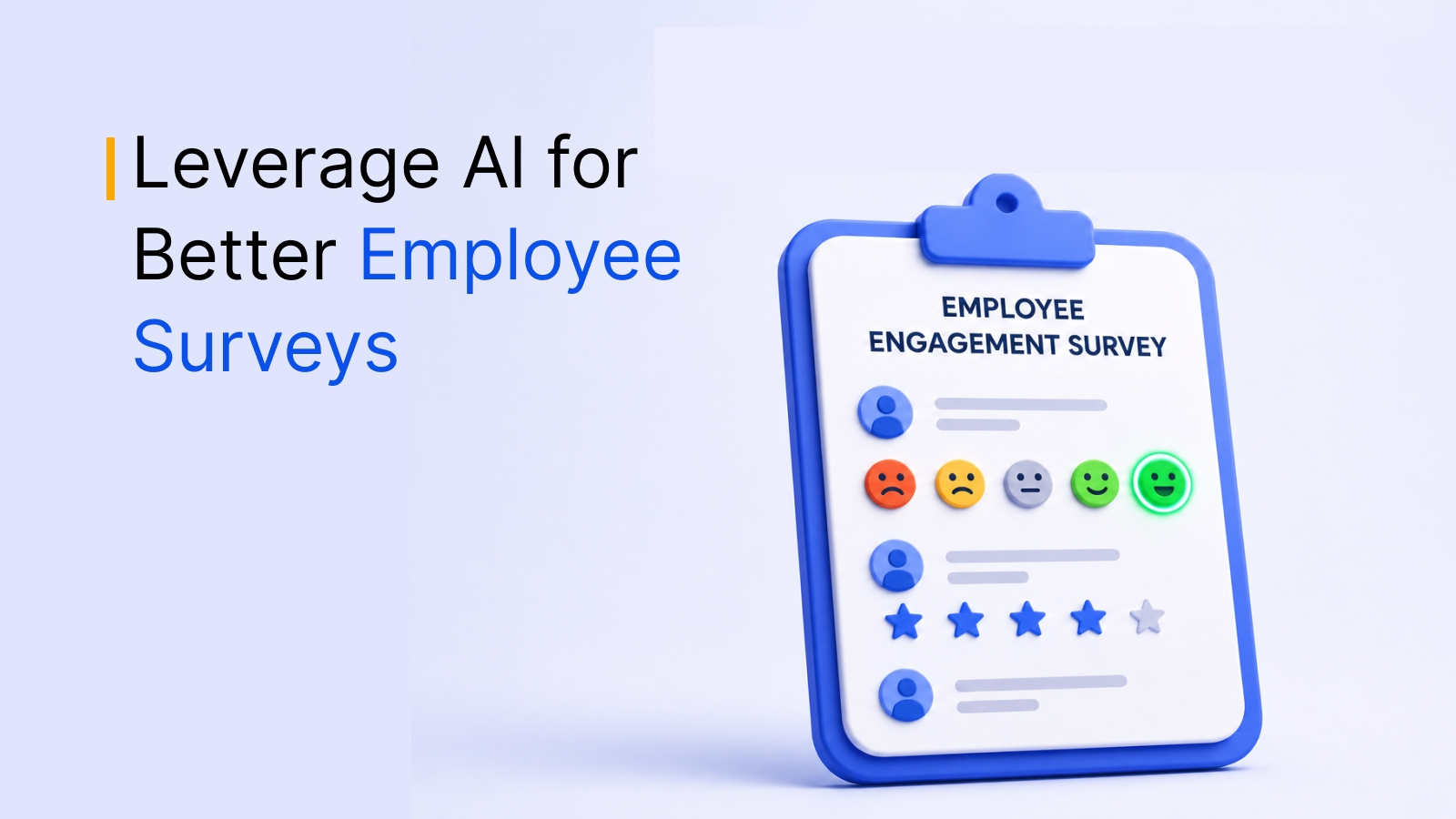
Exit interviews tell you why someone already left. Pulse surveys, stay interviews, and continuous listening tools tell you who is at risk while you can still act - but only if you close the loop by acting on what you hear.
Why recognition and rewards are the most underused retention lever
Recognition appears in most attrition lists as a bullet point. It rarely gets its own strategy. The data argues it should.
The gap is not a motivation problem. It is an infrastructure problem. Most organizations depend entirely on managers to drive recognition, but managers are the last to know when someone is disengaging and the first to deprioritize recognition when workloads spike. Without a structured system, recognition becomes infrequent, top-down, and invisible to the broader team.
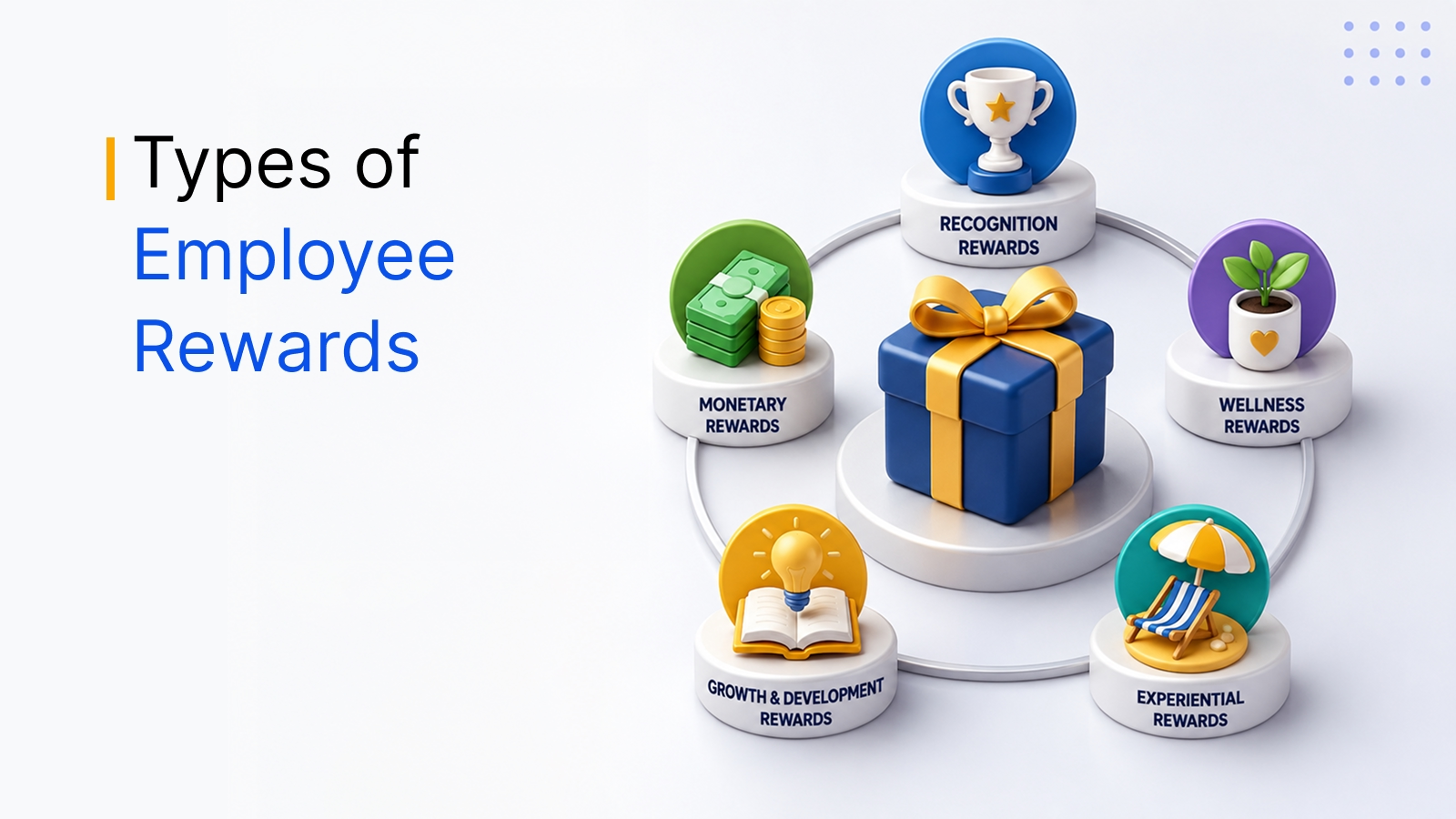
What works is recognition that is frequent, peer-driven, tied to company values, and connected to meaningful rewards. Creating a culture of recognition and understanding the importance of employee rewards and recognition are both practical starting points.
How Xoxoday Empuls helps CHROs build a recognition-driven retention culture
Most recognition programs fail for one reason: they rely entirely on managers to remember. Xoxoday Empuls replaces that dependency with a system.
01 · AI Copilot
Proactive recognition prompts
Identifies who has not been recognized recently and prompts managers before the gap widens - before disengagement sets in.
02 · Predictive analytics
Attrition risk forecasting
Forecasts attrition risk and program impact so HR teams have lead time to act, not react, to flight risk signals.
03 · Pulse surveys
Continuous listening
Always-on pulse surveys and eNPS tracking across email, Slack, Teams, and WhatsApp - with AI-generated insights and action plans.
04 · Global rewards
10M+ rewards in 150+ countries
Peer-to-peer and manager recognition tied to a global rewards catalog - meaningful recognition regardless of where an employee works.
5,000+
enterprises
150+
countries
10M+
rewards options
$5B+
rewards distributed
Empuls integrates with Workday, SAP SuccessFactors, HiBob, UKG, and 20+ HRIS platforms, sitting inside the workflows your teams already use rather than asking employees to log into another tool.
The mistakes that make attrition worse
Even well-intentioned attrition strategies fail for the same reasons.
- Treating all attrition the same. Preventable and healthy attrition require entirely different responses. Chasing every departure with equal urgency burns budget on exits you could not have stopped anyway.
- Leading with perks instead of root causes. Free lunches do not fix a bad manager or an unclear growth path. Employees see through the gesture quickly, and it can accelerate cynicism rather than reduce it.
- Relying on exit interviews alone. By the time someone is in an exit interview, the decision is already made. Proactive listening tools catch problems while there is still time to change course.
- Applying one program company-wide. A retention initiative designed for desk-based knowledge workers rarely works for frontline employees. Segment your approach by role, tenure, and location.
Using HR analytics to stay ahead of attrition
The shift from reactive to proactive attrition management comes down to knowing which signals to watch before someone starts job hunting.
Leading indicators to track at the manager level:
- Declining engagement scores across two or more consecutive pulse surveys
- Reduced participation in learning programs or internal initiatives
- Withdrawal from team communications - fewer messages, skipped meetings
- Stagnant performance ratings with no documented career development conversation
According to 2026 retention data, AI-powered tools can now identify flight risks with up to 95% accuracy before an employee makes a decision to leave. The governance principle matters here: analytics should trigger supportive conversations, not punitive ones. Employees who know their data is used to help them stay are more likely to engage honestly in the feedback loops that make the system work.
Employee engagement strategies and a structured approach to improving employee retention both work best when they are built on real-time signals rather than annual survey data.
Your next step to reducing attrition
Attrition at scale is not solved by any single initiative. It is the outcome of dozens of small moments compounding over time: a confusing first week, a manager who never checks in, a high performer who cannot see where they are going.
The CHROs who move the number treat retention as a system to design, not a fire to put out. Start with the lever most likely to move fastest in your specific organization - for most, that means onboarding or manager quality. Then build the recognition infrastructure that makes people feel seen between annual reviews.
Both together create the conditions where people choose to stay.