Key Takeaways
42% of employees doubt their employer acts on survey feedback, making the action gap the most critical failure point
Survey fatigue has become a structural risk, with response rates dropping from 30% to 18% in just six months
The solution is not fewer surveys but four layers working together: annual, pulse, lifecycle, and eNPS
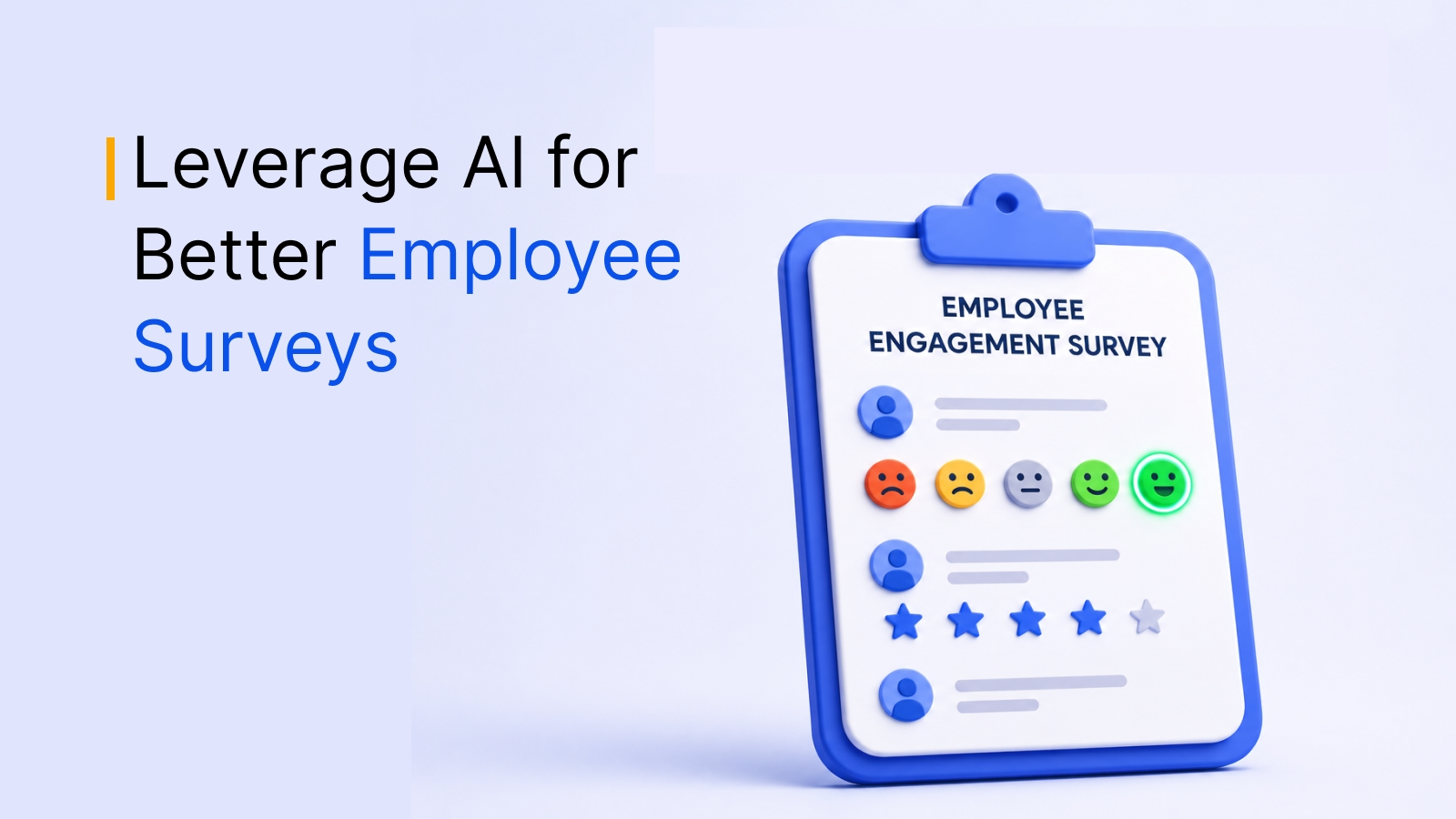
Most organizations run an annual engagement survey. They spend weeks designing questions, distribute it to thousands of employees, and wait. Results arrive. Someone builds a deck. The deck lands in a shared folder. Three months later, employees are still waiting to hear what happened.
This is not a process problem. It is a structural one. And until you understand exactly why annual surveys fail, adding more questions to next year's survey will not help.
The Annual Survey Was Built for a Different Era
The logic of the annual survey made sense when workplace change was slow. Collect data in bulk once a year, analyze, set strategy. It was efficient. It was enough.
That world is gone.
According to Gallup's 2026 State of the Global Workplace report, only 21% of employees globally are engaged at work – with the US sitting at 31%, an 11-year low. Organizations have never surveyed their people more. They have rarely listened to them less effectively.
The core problem is latency. Research cited by HR and L&D analysts in 2026 shows that annual survey data reflects sentiments formed six to nine months before HR has any chance to act. By the time a CHRO reviews results and approves an action plan, the employees who flagged the issue may already be gone.
Six Reasons Annual Employee Surveys Keep Failing
The failure is rarely one thing. It is usually a combination of structural, behavioral, and organizational factors working against each other at once.
Survey fatigue
Annual surveys are typically 30 to 60+ questions long and can take up to 45 minutes to complete. According to SurveySparrow's 2026 survey fatigue benchmarks, response rates dropped from 30% to 18% in just six months across many organizations, with 70% of respondents abandoning surveys entirely due to exhaustion. HR-related survey volumes rose 85% in 2025, deepening the fatigue cycle.
The action gap
Completing a survey creates an expectation. When employees share honest input, they expect something to change. According to research cited by SurveyConnect referencing a 2024 Bureau of Labor-linked study, 42% of US employees doubt their employer acts on survey feedback at all. When nothing visibly changes, participation drops the next cycle. Trust erodes. The data gets worse.
Point-in-time bias
A survey completed on one Tuesday captures one emotional snapshot. It does not capture the eight months that preceded it. An employee who burned out quietly in January but had a better Q4 will answer based on what is top of mind that day. Understanding employee feedback mistakes to avoid starts with recognizing how fragile single-point measurement really is.
Anonymity concerns
In many organizations, employees still do not fully trust that responses are anonymous. In politically charged or high-visibility environments, they self-censor. The result is a survey that tells HR what employees are willing to say, not what they actually think. The data looks healthy. The attrition data tells a different story.
No leadership ownership
When survey results land exclusively on an HR director's desk with no path to line managers or the executive team, the data stalls. As Stribe's Big HR Check-in Report 2025-2026 found, 50% of organizations run surveys regularly but have no clear plan for acting on the results. The survey becomes a data collection exercise, not a listening mechanism.
No closed loop
Employees hear about the survey before it launches. They complete it. Then silence for months. No summary of findings, no explanation of what will or will not change, no update when action has been taken. The employee engagement action plan that should follow the survey is often the piece that never gets built.
See how Xoxoday Empuls closes the gap between survey data and manager action.
Automated pulse surveys, AI sentiment analysis, and team-level action plans – all in one platform.
Book a free 30-min demoTrusted by 5,000+ companies
What the Data Says About Survey Participation and Trust
21%
of employees globally are engaged at work
Gallup 2026
42%
of employees doubt employers act on their feedback
SurveyConnect, 2024
$8.8T
annual cost of disengaged employees globally
Gallup, cited 2026
30% → 18%
response rate drop in just six months
SurveySparrow 2026
The numbers point to the same conclusion. Organizations are not failing to survey. They are failing to close the loop between listening and action.
Research from Gallup cited by HR analysts in 2026 puts the annual cost of disengaged employees at $8.8 trillion globally, driven by productivity loss and attrition in critical roles. Despite that, Stribe's 2025-2026 report found that 36% of HR leaders still consider engagement surveys their most effective feedback tool. Most organizations know surveys matter. The problem is execution.
What Annual Surveys Can Still Do Well
Here is the contrarian position: do not kill the annual survey.
Annual surveys are the only tool that gives organizations a comparable, comprehensive baseline year over year. They capture dimensions of the employee experience that short pulse surveys cannot carry: leadership trust, cultural alignment, career trajectory, total compensation perception. These are slow-moving signals that genuinely need a slower measurement cadence.
The mistake is treating the annual survey as the complete listening strategy. It should be the foundation, not the roof. Every other listening mechanism sits on top of it, fills the gaps between cycles, and provides the real-time context that annual data lacks.
Think of it as a diagnostic framework. The annual survey tells you what the chronic conditions are. The layers above it tell you how the patient is doing right now.
The Listening Architecture That Actually Works
The most effective people teams do not choose between annual surveys and pulse surveys. They build a layered listening architecture where each layer serves a distinct purpose.
| Layer | Cadence | Length | Purpose |
|---|---|---|---|
| Annual survey | Once a year | 25-30 questions | Strategic baseline, year-on-year benchmarking, board-level metrics |
| Pulse survey | Monthly or quarterly | 5-10 questions | Real-time sentiment tracking, initiative check-ins, team-level mood |
| Lifecycle surveys | Event-triggered | 5-15 questions | Onboarding, 90-day, post-promotion, exit |
| eNPS | Always-on or bi-monthly | 1-3 questions | Continuous loyalty signal, early attrition warning |
Each layer answers a different question. Annual surveys answer "how are we doing overall." Pulse surveys answer "how are things right now." Lifecycle surveys answer "what happened at this specific moment." eNPS answers "would this person recommend working here today."
Together, they eliminate the blind spots any single survey type creates on its own. For HR leaders managing distributed teams across the GCC, Southeast Asia, or the US, multi-channel delivery matters as much as cadence. Email-only surveys miss large populations. The listening architecture needs to reach employees where they already are – WhatsApp, Slack, Microsoft Teams, or SMS.
You can explore specific approaches in our guide to employee pulse surveys and what makes them work alongside annual programs.
How Xoxoday Empuls Turns Survey Data Into Consistent Action
Most platforms help you collect data. Very few help you act on it reliably.
Xoxoday Empuls is built on Self-Determination Theory, a research-validated framework that measures engagement across five dimensions: autonomy, competence, relatedness, well-being, and trust. Rather than asking employees how they feel in general, it measures the intrinsic drivers of motivation – the factors most predictive of sustained engagement and retention.
01 · Continuous listening
Full survey lifecycle in one place
Annual, pulse, lifecycle, and eNPS surveys all run from one interface, with anonymous emoji-based responses and adaptive follow-ups.
02 · AI-powered analysis
Attrition predictor and heat maps
AI sentiment analysis surfaces risk segments before they start searching elsewhere. Heat maps show where engagement is weakest across teams and regions.
03 · Action plans
Owner, deadline, progress tracker
Every finding maps to an owner and a deadline. Managers get team-level results, not averages. HR sees which teams have closed the loop.
04 · Multi-channel delivery
WhatsApp, Teams, Slack, SMS, email
Reaches employees where they are – not just inboxes. Fully anonymous where required, feeding the same analysis layer.
5,000+
enterprises
150+
countries
10M+
rewards options
G2 Leader
2026
A global IT and professional services firm that replaced its annual-only listening model with Xoxoday Empuls saw survey participation rise from 39% to 88%. Pulse response rates tripled. Time from survey close to actionable insight dropped from eight to ten weeks down to real time. The share of teams with an active improvement plan in place climbed from 24% to 72%.
You can also review employee engagement survey questions and how to increase employee NPS to build out your listening program alongside the platform.
Your Next Step Toward a Listening Program That Actually Sticks
The shift from annual-only listening to a continuous architecture does not require a full redesign. The practical path is additive.
Keep the annual survey intact. Layer in a quarterly pulse on three to five focused questions. Add lifecycle surveys at onboarding and exit first, then expand to mid-year check-ins and post-promotion milestones. Set eNPS as an always-available signal running between cycles.
The internal communication strategy matters as much as the survey design itself. Employees need to know why the cadence is changing, how anonymity is protected, and what happened as a direct result of the last round of feedback. Before the survey launches, tell people what you are measuring and why. After it closes, publish a summary of what you heard. After action is taken, confirm that the feedback drove it.
This is how listening programs rebuild trust. Not by surveying more often – by visibly connecting feedback to change. The organizations that do this consistently are the ones that end up with the participation rates, the eNPS scores, and the attrition numbers that make the board pay attention.