Key Takeaways
Dealers produce sell-in data, end users produce sell-through data, and only a program that pays both can reconcile the two.
Serialized tools make registration possible, which makes it worth rewarding: a rebate sheet cannot tell you which unit reached a real job site.
Duration beats reward value: incentive programs running a year or longer average a 44% performance lift, versus 30% for six months or less.
A cordless drill leaves the dealer counter and vanishes.
The dealer's invoice records the sale. Everything after that – which job site the drill ends up on, whether the tradesperson who owns it registers it, refers a colleague, or replaces it in eighteen months with a competitor's tool – happens off the brand's radar. Most power tool manufacturers run a channel loyalty program that rewards the dealer for moving volume and stops there, leaving the end user's actual usage, loyalty, and word of mouth entirely unmeasured.
That gap is a design problem, not a data problem. Dealers produce sell-in data. End users produce sell-through data. A program built to reward only the first will never see the second – and the second is what tells a brand whether the tool it sold is still in circulation, still branded, and still earning referrals.
The dealer record and the end user record
A dealer's relationship with a brand is transactional and recorded on paper (or an ERP line item): invoice number, SKU, quantity, date. It answers "what moved through this channel." It says nothing about who is holding the tool six months later, whether it is still functioning, or whether that person would buy the same brand again.
The end user's relationship with the same brand starts at a completely different data point: a serial number. Once a tradesperson registers a tool against that serial number, the brand has a record tied to an actual person and an actual job, not just a channel. That single record is the foundation for warranty service, counterfeit detection, and any reward program aimed at the person actually using the tool.
Running both records inside one system – rather than a dealer incentive spreadsheet on one side and a warranty database on the other – is the difference between a channel loyalty program for power tool manufacturers and a rebate scheme that happens to include a website. Our channel loyalty program guide covers the broader mechanics of rewarding distributors and dealers; this post focuses on what changes when the same platform also has to reward the person who buys the tool off the shelf.
What a rebate sheet cannot tell you
A rebate sheet tells a brand what a dealer bought. It cannot tell a brand what happened to the tool after that, and in a category where counterfeit and grey-market tools move through the same channels as genuine ones, that blind spot has a cost attached to it.
The OECD and EUIPO estimate that counterfeit and pirated goods accounted for USD 467 billion in global trade in 2021, or roughly 2.3% of world imports. The Power Tool Institute has separately flagged unauthorized sellers and counterfeit units moving through the same retail and online channels that carry genuine inventory – tools that look identical on a shelf or a listing page but were never meant to reach that market.
Serialized product registration does not police the channel by itself. A brand cannot stop a counterfeit unit from being manufactured. What it can do is make the genuine population of tools self-report: every registered serial number, tied to an invoice and an owner, becomes part of an auditable trail. A duplicated serial number, or a serial number with no matching invoice, is a signal worth investigating. A rebate sheet has no equivalent signal, because it was never built to capture one.
The real cost of running dealer and trade loyalty separately
Most power tool brands that reward both audiences do it with two disconnected systems: a dealer incentive platform or spreadsheet, and a separate warranty or registration database that nobody thinks of as a loyalty tool. Keeping them apart costs more than the obvious integration overhead.
A dealer's loyalty and a tradesperson's loyalty to the same brand are not independent signals. A dealer who consistently pushes a brand is also the dealer whose customers are most likely to register their tools and come back for the next purchase. When those two records live in separate systems, a brand can see one half of that reinforcing loop and not the other – so it ends up managing dealer incentives and end-user warranty data as if they belonged to two different businesses, and misses the connection between the two entirely. Our post on B2B channel loyalty program design goes deeper on what that split costs a brand operationally, beyond the loyalty program itself.
See how Loyalife runs dealer and end user loyalty from one platform
Role-based logins, one member layer, real-time accrual for both audiences.
Book a free 30-min demoTrusted by 5,000+ companies
How each side actually earns points
The dealer path: invoice to wallet
A dealer's earning path has to be fast enough that it doesn't add friction to a sale they're already closing, and auditable enough that finance trusts the numbers without a manual review queue.
| Step | What happens |
|---|---|
| 1. Upload | Dealer uploads the invoice, or it syncs directly from a connected POS/ERP feed |
| 2. Validation | SKU, quantity, and price are checked against pre-set earn rules for that product line |
| 3. Accrual | Points post to the dealer's wallet automatically once validation clears |
| Outcome | Dealer sees the balance update in real time, with no separate reconciliation step |
Real-time visibility matters more to a dealer than the reward catalog does. A dealer who has to wait weeks to see whether a sale counted has no reason to prioritize a brand's incentive scheme over a rival's; a dealer who sees the balance move the same day the invoice clears has an immediate reason to keep uploading.
The end user path: serial number to digital toolbox
The tradesperson's path starts after the sale, not during it. They select the product they bought, scan or photograph the purchase invoice, enter the tool's serial number, and submit the claim. Once it clears validation, the tool lands in a digital toolbox tied to their profile – warranty coverage, registration date, and the tool's service history all attached to that one record.
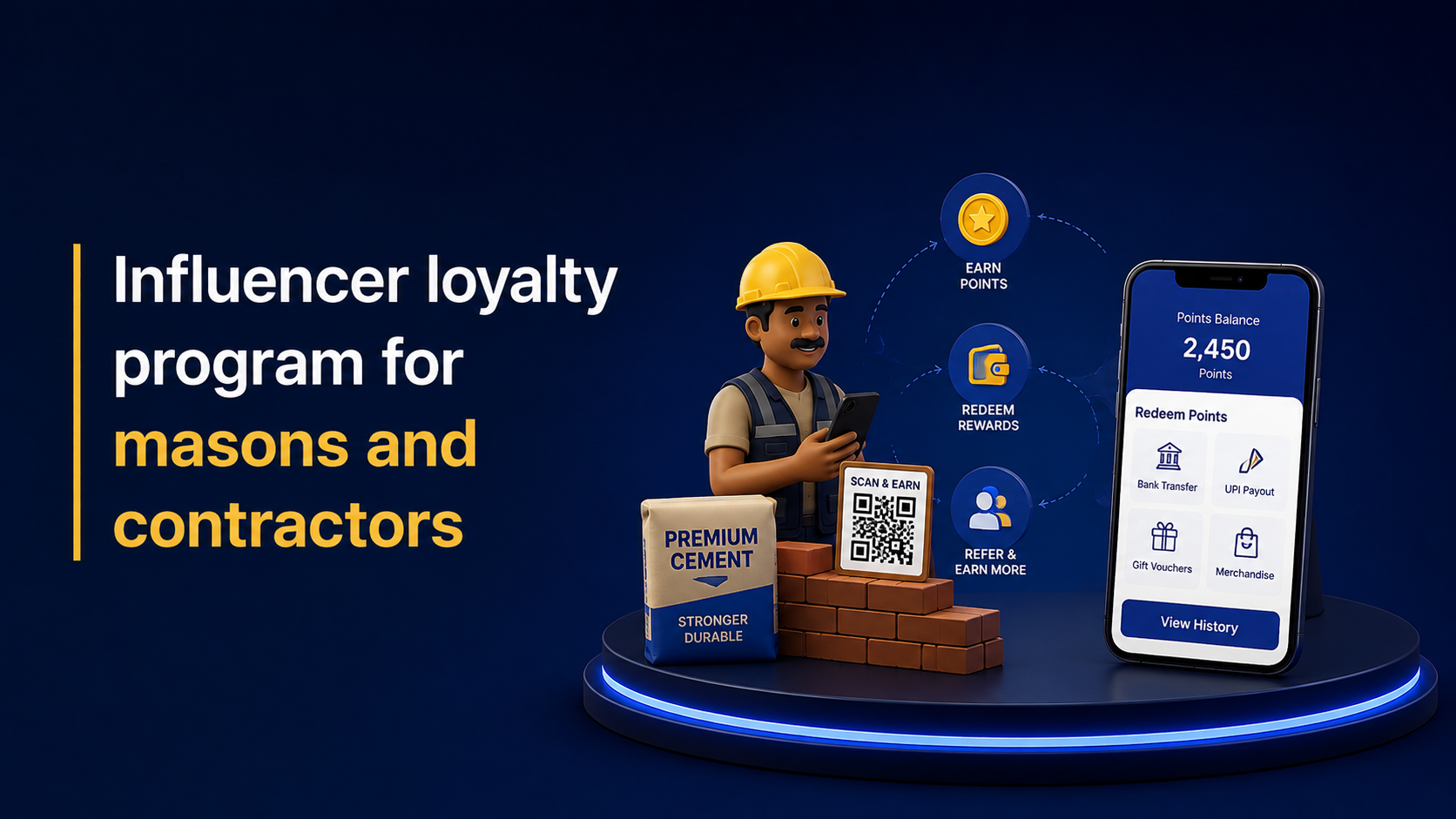
From there, the program can extend past a one-time registration bonus. Points for uploading a short clip of the tool in use on a job site, or for watching a product training video, keep the relationship active between purchases rather than resetting it every time. The same referral mechanics that work well in influencer loyalty programs for plumbers and dealers apply here: a tradesperson who refers a colleague is doing the brand's distribution work for free, and the program should treat that referral as an earning event, not an afterthought.
One program, two earning paths
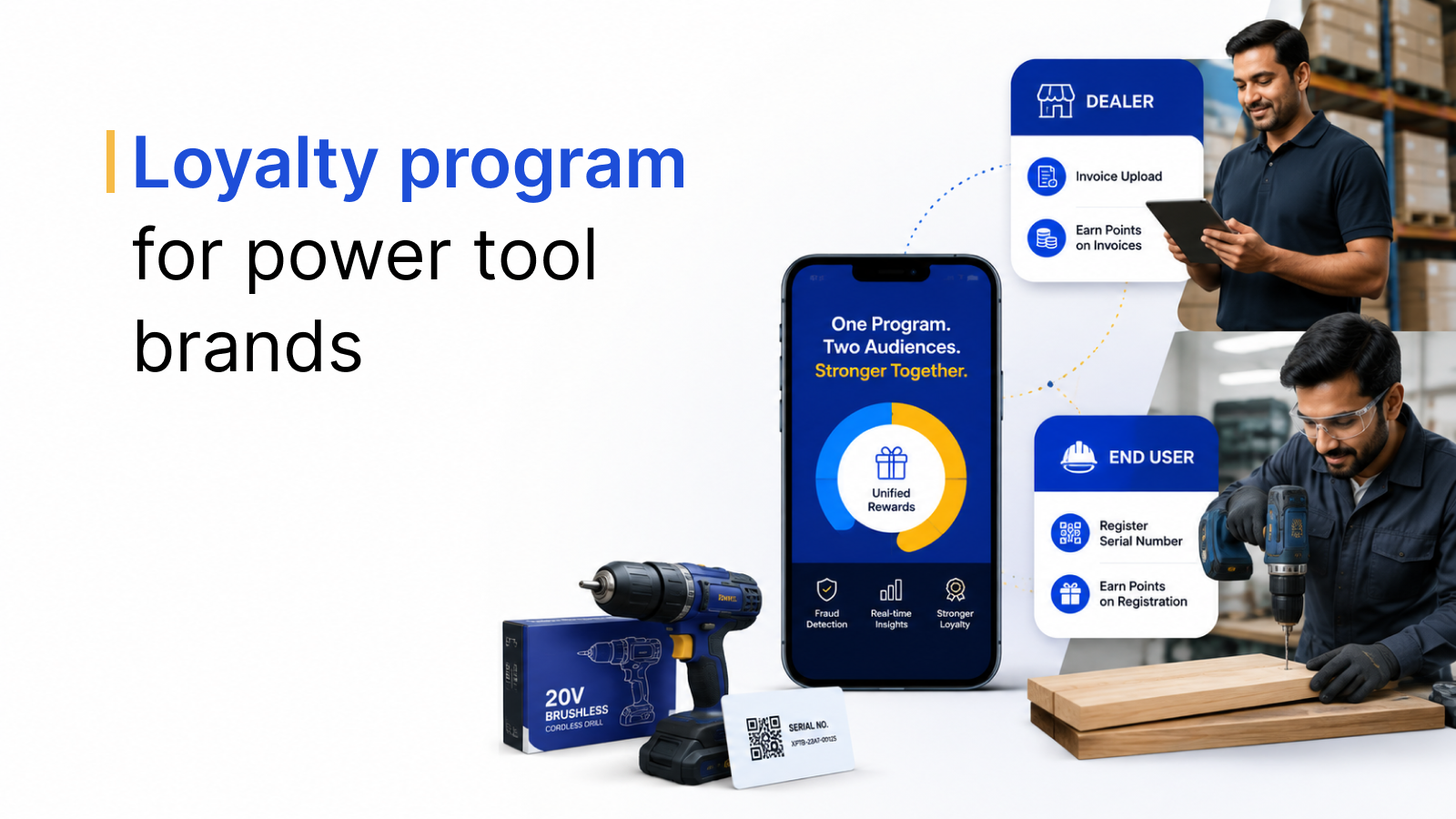
Dealer invoices and end user tool registrations, running in the same app
Uploads the invoice, watches it clear
Claim states are visible at every step, so a rejected receipt never becomes a phone call to the sales rep.
Claims
Registers the tool, then keeps earning
Serial number registration opens a second earning path: demo uploads, product videos, tier progression.
Upload Video
Tiers & Achievements
Both paths accrue to one wallet and one reward catalog
Running both audiences in Xoxoday Loyalife
Both paths run on the same member layer, with role-based logins that show a dealer their invoice history and wallet, and show an end user their digital toolbox and referral status – without either side seeing a system built for the other.
| What happens | What the dealer does | What the end user does | What the brand learns |
|---|---|---|---|
| Purchase proof | Uploads invoice or syncs via ERP | Scans invoice, enters serial number | Which SKUs are moving, and to whom |
| Accrual | Points post on validated invoice value | Points post on validated registration | Real sell-in vs. real sell-through |
| Progression | Moves through volume/tier thresholds | Builds a warranty and service history | Which dealers and end users are actually active |
| Engagement | Scheme participation, training completion | Video views, tool-in-use uploads | Where brand advocacy is strongest |
| Redemption | Rebates, co-marketing funds, tier perks | Rewards catalog, warranty extensions | What each audience actually values |
Referral points only release once the referred person registers a tool, not on signup alone – that single condition keeps the referral mechanic tied to an actual sale instead of a vanity metric. Redemption is deliberately different by role: a dealer redeeming co-marketing funds or tier-based rebates is solving a different problem than a tradesperson redeeming points for a reward catalog item, and forcing both into one redemption flow tends to satisfy neither.
Keeping accrual honest and proving the spend worked
A program that pays two audiences on two different signals needs controls that catch problems before they become a payout, not after.
- Validation before credit – no invoice or serial number clears without matching a pre-set rule; nothing accrues on an unverified claim
- Anomaly thresholds – unusual patterns, like the same serial number submitted twice or a claim volume that spikes outside a dealer's normal range, get flagged automatically
- Maker-checker approval – higher-value claims route through a second approver before payout, rather than accruing on a single validation pass
- Admin logs – every accrual, adjustment, and approval is logged, so a dispute can be traced back to the exact rule and record that produced it
On the reporting side, the same platform gives a brand five views it would otherwise have to stitch together manually: scheme participation by region, registrations by product line, redemption patterns, content engagement, and referral conversion. Those five views are also where duration proves its value over reward size. The Incentive Research Foundation has found that incentive programs running twelve months or longer average a 44% performance lift, compared with roughly 30% for programs of six months or less.
| Metric | Value | Source |
|---|---|---|
| Average performance lift, money/tangible awards | 22% | Incentive Research Foundation |
| Team incentive performance lift, upper bound | 44% | Incentive Research Foundation |
| Performance lift, programs running 12+ months | 44% | Incentive Research Foundation |
| Performance lift, programs running 6 months or less | 30% | Incentive Research Foundation |
The gap between 44% and 30% is a duration effect, not a bigger-reward effect. A brand deciding where to spend the next incentive budget increase gets more from keeping a program running longer than from raising the reward value on a short one. Building that kind of dual-audience system in-house typically runs 6 to 9 months on Xoxoday's implementation estimates; pre-built modules for both the dealer and end-user paths can bring that down to inside a quarter, with the main variable being how deep the integration needs to go into a brand's existing ERP or CRM.
Where to start on a two-audience program
The dealer side of a channel program is usually already partly built, even if it's just a spreadsheet and a quarterly rebate check. The end user side rarely exists at all. Starting with tradesperson tool registration – a simple serial-number-to-wallet flow – gives a brand its first real sell-through data before a single dealer incentive rule changes. The dealer program can layer onto the same member spine once that registration flow is live, so the two audiences end up on one system instead of two that were never meant to talk to each other.