Your manager hasn't recognized you in three months. Your peer on the adjacent team just shipped something brilliant, but you have no easy way to say thank you. The recognition happening in your company lives in spreadsheets, manager inboxes, and annual reviews, exactly where it doesn't drive engagement or retention.
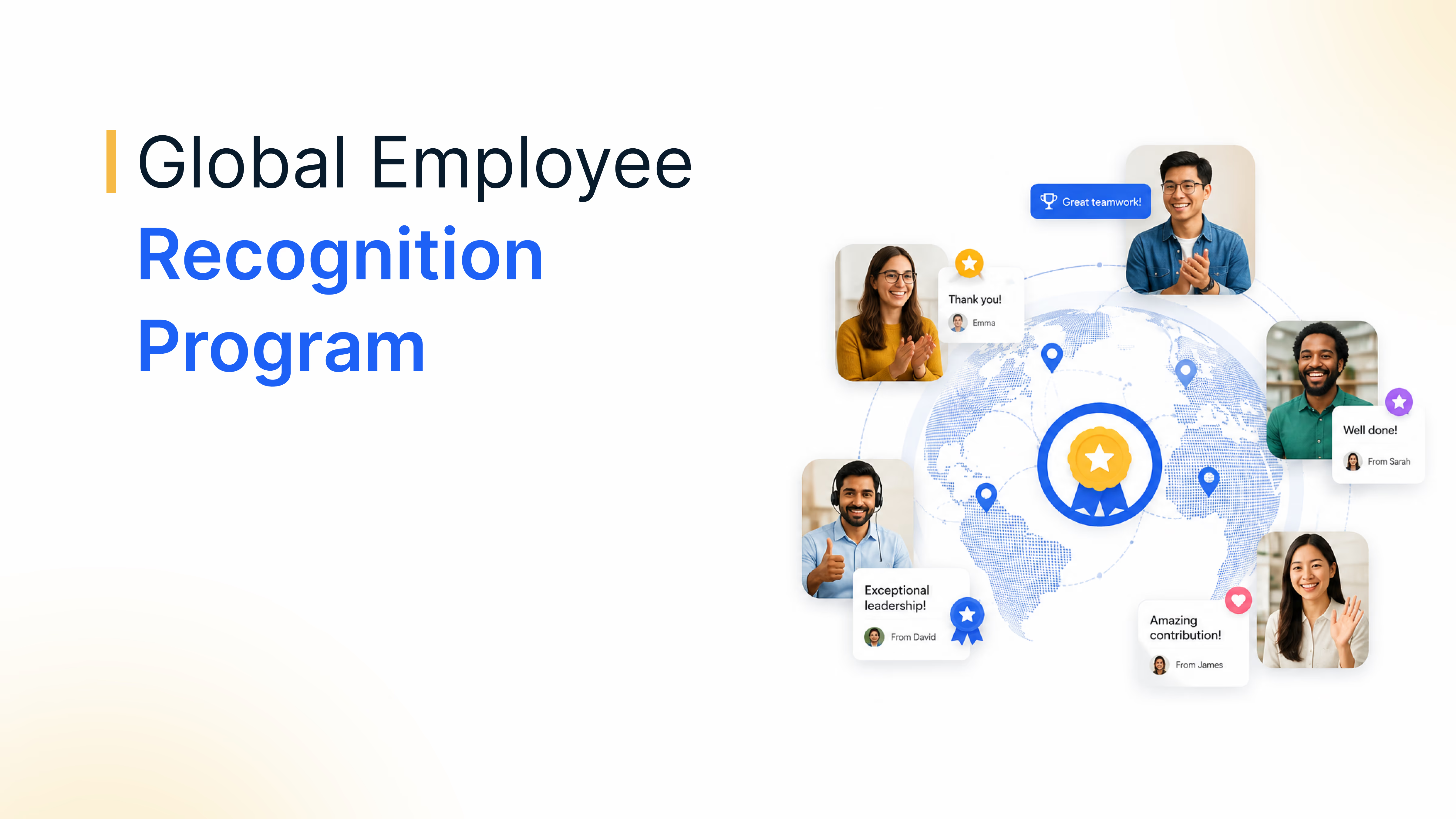
That's where peer-to-peer recognition changes everything. It lets employees recognize each other in real time. Great work gets noticed immediately, not buried in performance review season. When peers can celebrate each other's wins directly and publicly, they recognize more of each other's work.
Building a peer recognition culture at scale requires the right platform. Not every tool solves the core friction points: low adoption, weak integration with daily tools, recognition fatigue, or misaligned rewards. This guide ranks the 10 best peer-to-peer recognition platforms of 2026, focused on which ones actually get peers recognizing each other and which ones sit idle.
What is peer-to-peer employee recognition software?
Peer-to-peer recognition software lets employees recognize each other for contributions, effort, or behavior, typically outside the formal manager-led recognition flow. Instead of waiting for an annual review or a manager's 1:1, peers send recognition instantly through a centralized platform, often tied to company values or specific behaviors.
These platforms typically include:
- Real-time recognition feeds where employees see who was recognized and for what
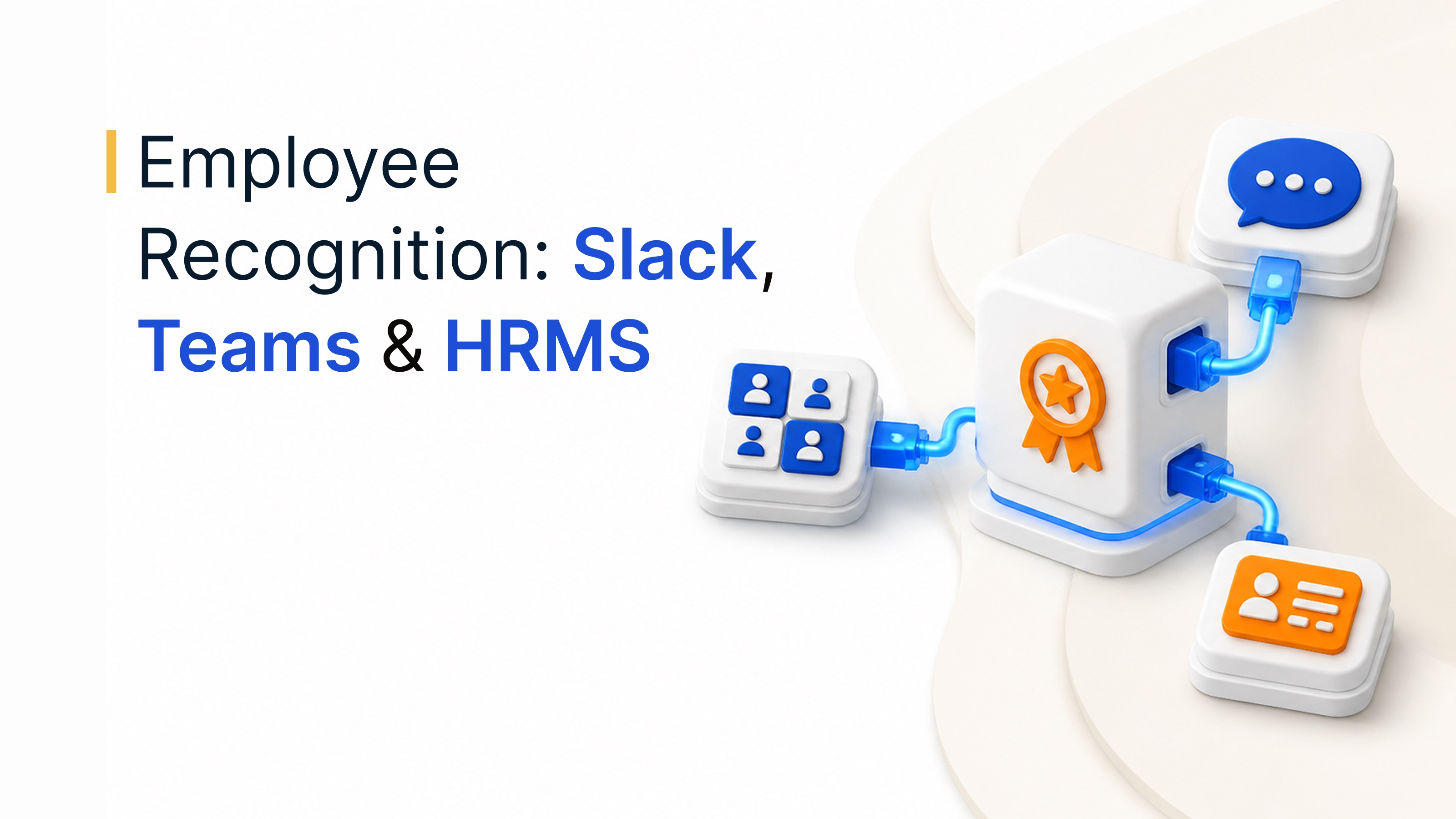
- Integration with Slack, Teams, or email so recognition doesn't require a separate login
- Points, badges, or currency redeemable for rewards or charitable donations
- Analytics showing recognition patterns by team, geography, or demographic
- Customizable recognition templates tied to company values or competencies
The key difference from manager-led recognition is speed and volume. Peer recognition happens constantly, from many people, about specific recent work, not periodically from one manager about annual performance. Speed and volume are the difference.
Why peer recognition matters for engagement and retention
45% - Recognition could prevent nearly half of voluntary turnover. Research from Gallup, conducted with Workhuman, found that employees receiving high-quality recognition are significantly less likely to leave their roles. *(Source: Gallup)*
Here's why peer recognition actually works: when employees feel recognized by their peers, they stay longer, perform better, and collaborate more effectively.
Peer recognition works because it fills a gap manager-led recognition alone can't. Managers see only a fraction of the work their direct reports actually do. They miss the cross-functional collaboration, the unplanned support, the 20-minute teaching moment. Peers see all of it.
When peers can recognize that work, employees feel seen more often and more authentically.
The effect compounds. High-recognition cultures see lower voluntary attrition and higher engagement scores.
For CHROs and HR leaders, peer recognition also solves a scaling problem: manual recognition via email or spreadsheet works at 50 people, but breaks at 500 or 5,000. A platform that integrates with Slack removes that friction and scales to any headcount.
How to prevent bias in recognition programs covers practical frameworks for making sure peer recognition reaches everyone fairly.
How we evaluated these platforms
We ranked these 10 platforms on what matters most to mid-market and enterprise buyers: ease of adoption, integration depth, recognition flexibility, analytics clarity, and reward relevance.
We excluded platforms requiring heavy custom implementation, platforms with weak adoption in live deployments, and platforms focused mainly on sales commissions or surveys without strong peer recognition functionality. We also prioritized vendors with transparent, predictable pricing. That focused our evaluation.
See how Empuls supports peer-to-peer recognition with AI-powered gap detection and native Slack integration, turning recognition into a measurable engagement lever.
See how Empuls supports peer-to-peer recognition
AI-powered gap detection and native Slack integration turn recognition into a measurable engagement driver.
Book a demoTrusted by 5,000+ companies
The top 10 peer-to-peer recognition platforms, ranked (2026)
1. Empuls
Empuls is Xoxoday's recognition platform-built so peer recognition feels as easy as a social-media reaction. Slack integration is the standout: peers recognize each other without leaving their daily workflow. Empuls also includes eNPS surveys, a rewards marketplace, and analytics that flag recognition gaps by team or demographic, useful for leaders working to prevent recognition bias.
One tradeoff: if you only need recognition, the added sales-automation features create unnecessary complexity. For 500 to 10,000-person organizations in tech or financial services, it's a strong fit. See Empuls in action.
Callout: recognition gap alerts flag when certain teams or demographics receive less recognition than peers.
2. Workhuman
Workhuman (formerly Globoforce) is the category pioneer, and often the first name enterprise HR leaders think of. The platform offers deep customization and a large global rewards marketplace. It shines in large organizations with complex recognition workflows and real investment in embedding recognition into performance management.
The tradeoff is implementation time; deployment can take several months, and adoption can stall without dedicated change management. Best suited to enterprises with dedicated HR ops teams.
Callout: deep customization built for complex, enterprise-wide recognition programs.
3. OC Tanner
OC Tanner pairs peer recognition with culture consulting. If your organization wants to define its values first and build recognition around them, OC Tanner's advisory model helps. The platform is mid-market friendly and includes strong pulse survey functionality alongside recognition.
What's unique: OC Tanner doesn't force points or gamification, so recognition can run on pure social visibility. That makes adoption simpler in traditional industries where points can feel trivial.
Callout: values-based recognition without mandatory gamification or points.
4. Achievers
Achievers targets mid-market companies and competes on simplicity. The platform is intentionally minimal: recognition, comments, and a rewards store. Onboarding tends to be fast, and adoption tends to be high because there's less to learn.
Achievers' Slack integration isn't as prominently featured as some competitors, and analytics depth lags behind more enterprise-focused tools. For organizations of 500 to 2,000 people wanting recognition software with minimal setup, it's a solid choice.
Callout: minimal design built for fast rollout and low training overhead.
5. Bonusly
Bonusly is the approachable option for mid-market teams that want peer recognition without enterprise complexity. Recognition feels casual, closer to Slack reactions than a formal HR workflow, and tends to spread team by team without a top-down mandate.
The tradeoff: Bonusly's analytics are thinner than some competitors. Great for culture-first organizations; less ideal for analytics-driven engagement leaders.
Callout: Slack-native UX where peers recognize each other via emoji-style reactions.
6. Award.co
Award.co is the lightweight specialist. If you want peer recognition only, without surveys, commissions, or complex reporting, Award.co delivers cleanly, with straightforward Slack integration and simple setup.
Use it to pilot peer recognition in one department before a wider rollout. It's a weaker fit if you need recognition to feed into compensation or people analytics.
Callout: peer recognition only, with no bundled HR analytics or survey modules.
7. Vantage Circle
Vantage Circle is built for global, distributed teams, supporting many languages and multiple currencies and time zones at once. Recognition feeds are designed to be culturally aware, helping recognition land well across different markets.
For mid-market organizations expanding internationally, Vantage Circle's global-first design is a genuine differentiator. For single-region organizations, that extra internationalization adds less value.
Callout: broad language support, purpose-built for global, distributed teams.
8. Reward Gateway
Reward Gateway is strongest as a total rewards platform, where peer recognition is one piece alongside a benefits marketplace, wellbeing programs, and employee discounts. It prioritizes integration with payroll and benefits ecosystems.
If your organization already has a Reward Gateway benefits contract, adding recognition is a natural extension. If you're buying standalone peer recognition, other tools here have simpler, more focused implementations.
Callout: recognition bundled into a broader total-rewards ecosystem.
9. Motivosity
Motivosity takes a values-first approach: you define your company values upfront, and every recognition maps to one of them. That prevents recognition from feeling random and builds a more intentional culture.
For organizations where culture work is the primary driver, this is powerful. For teams treating recognition as a purely tactical tool, the values-first requirement can feel like friction.
Callout: every piece of recognition mapped to a stated company value.
10. Leapsome
Leapsome combines peer recognition with frequent feedback and 1:1 note-taking. For organizations that want continuous feedback rather than annual reviews alone, folding recognition into that cycle is useful.
The tradeoff: Leapsome leans more on manager-led feedback loops, so it requires stronger manager buy-in. For peer-only recognition needs, simpler tools may fit better; for feedback-driven cultures, Leapsome makes sense.
Callout: recognition integrated directly into a continuous feedback cycle.
| Platform | Best for | Standout feature | Slack integration |
|---|---|---|---|
| Empuls | Mid-market to enterprise | Recognition gap detection | Native |
| Workhuman | Large enterprise | Deep customization | Native |
| OC Tanner | Values-driven orgs | Culture consulting | Available |
| Achievers | Mid-market, fast rollout | Simple UX | Limited |
| Bonusly | Mid-market, casual culture | Emoji-style reactions | Native |
| Award.co | Department pilots | Lightweight, focused | Native |
| Vantage Circle | Global distributed teams | Broad language support | Native |
| Reward Gateway | Existing benefits users | Total rewards suite | Native |
| Motivosity | Culture-first orgs | Values mapping | Native |
| Leapsome | Feedback-first cultures | Continuous feedback | Native |
How Empuls approaches peer-to-peer recognition
Empuls prioritizes adoption speed and frictionless recognition. Recognition happens directly in Slack, so teams don't context-switch to a separate platform. Its recognition gap detector alerts leaders when peer recognition patterns skew by team, geography, or demographic. Surfacing potential bias early prevents it from becoming a culture problem.
Empuls pulls in data from pulse surveys and eNPS to show whether teams with the highest peer recognition also show the highest engagement scores, so you can measure whether the program is actually moving retention and performance.
What is recognition equity explains how to build fair recognition systems that work across employee populations.
Rewards stay flexible: points, merchandise, charitable donations, or a hybrid, because different teams value different outcomes. Book a demo to see the gap detector on your own team's data.
Rolling out peer recognition successfully
Peer recognition only works if peers actually use it. Here are the adoption patterns that separate successful rollouts from abandoned platforms.
Start with a high-engagement group. Don't roll out company-wide on day one. Pick a team with an engaged manager and run it there for four to six weeks. Early wins make broader rollout easier and build confidence in the tool.
Tie it to values, not arbitrary points. Generic points for good work feel hollow. Recognition tied to specific values or behaviors gets used far more often, so it's worth articulating what you actually want to recognize before launch.
Make Slack integration mandatory. Platforms that require a separate login see adoption stall. Pick a tool where recognition happens in the channel where work already lives.
Celebrate recognition publicly. Highlight standout recognition in all-hands or team meetings so being recognized feels like something worth talking about.
Employee recognition program covers a fuller implementation roadmap.
Send nudges when recognition stalls. The best platforms remind managers when recognition drops below a healthy cadence, helping teams restart the habit naturally.
See how Empuls removes the adoption friction that stops peer recognition, with Slack-native recognition and AI gap detection built for teams from 500 to 10,000 employees.