
Key Takeaways
AI in HR uses machine learning, natural language processing and generative AI to automate people processes and support decisions across hiring, onboarding, engagement and planning.
SHRM's 2026 research found 39% of organizations use AI in HR, and 87% of HR professionals using it report improved efficiency.
Gartner reported in 2025 that 88% of HR leaders had not yet seen significant business value from AI tools, so every use case needs a measurable outcome.
Start with high-value, lower-risk uses such as policy assistants, interview scheduling and survey comment analysis before resume screening or prediction.
Bias audits, privacy controls and human review are now expected, with rules such as NYC Local Law 144 and the EU AI Act covering AI in employment.
AI in HR is the use of machine learning, natural language processing and generative AI to automate people processes and support better decisions across hiring, onboarding, engagement, performance and workforce planning. Used well, it removes repetitive admin from HR teams and gives employees faster answers, while people stay in charge of judgment calls. This guide covers how AI is used in human resources today, the benefits and risks, real examples, a use-case readiness matrix and where AI in HR is heading.
Artificial intelligence was predicted to transform almost every industry, and human resources is no exception. HR and talent teams at companies such as IBM and Chipotle now run AI in their daily workflows to answer employee questions, schedule interviews and cut administrative work. Yet adoption is uneven, value is hard to prove and the rules on fair use are tightening, so the gap between teams that use AI well and teams that only experiment with it is widening.
What AI in HR means
Artificial intelligence in human resources refers to applying machine learning (ML), natural language processing (NLP) and other AI technologies to automate HR tasks and aid decision-making. It allows a data-based approach to talent acquisition, employee development and retention that aims to reduce bias and improve the experience of candidates and employees alike.
AI tools can assist HR teams across employee records management, payroll processing, recruitment, onboarding and performance management. Until recently, HR was seen as a purely administrative department. HR analytics introduced a more evidence-based way of managing people, replacing intuition with data on turnover, absenteeism and staff demographics to find patterns and guide decisions.
With advanced analytics and AI, the role of HR has evolved again. HR departments now use data more strategically to predict trends and contribute to organizational performance, which is why organizations increasingly treat HR as a strategic partner that shapes business strategy. Our guide to the role of HR in employee engagement covers how that strategic role plays out day to day.
While traditional AI applications streamline HR tasks, generative AI goes further by creating new content and insights. In HR it adds value in four main ways:
- Content creation: Drafting job postings, policies and personalized candidate communications.
- Data summarization: Extracting insights from unstructured data such as survey comments and review notes.
- Employee support: Chat assistants that answer policy questions and recommend learning.
- People analytics: Analyzing large datasets to flag attrition risk and inform workforce planning.
The state of AI adoption in HR today
AI in HR is growing, but more slowly and less evenly than the headlines suggest. In the SHRM State of AI in HR 2026 research, based on more than 1,900 HR professionals, 39% of organizations had implemented AI in their HR functions, while 62% were using AI somewhere in the business. Recruiting (27%), HR technology (21%) and learning and development (17%) were the most common HR uses.
39%
of organizations use AI in HR
62% use AI somewhere in the business (SHRM, 2026)
87%
of HR professionals using AI
report improved efficiency (SHRM, 2026)
88%
of HR leaders
have not yet seen significant business value from AI tools (Gartner, 2025)
AI in HR: wide efficiency gains, limited proven business value
The people using it see a difference: SHRM found that 87% of HR professionals using AI reported improved efficiency and 75% reported better work quality. Business value is harder to show. Gartner reported in October 2025 that 88% of HR leaders said their organizations had not realized significant business value from AI tools, and SHRM found that 56% of HR functions do not formally measure the success of their AI investments. The lesson is simple: pick use cases with a measurable outcome and track them from day one.
How AI is used in human resources
AI is changing human resources by automating repetitive tasks, improving decision-making and personalizing the employee experience. These are the seven most common applications, from recruitment through to everyday HR content:
- Recruitment and talent acquisition: AI screens resumes, ranks candidates, matches people to jobs and handles interview scheduling.
- Employee engagement and support: Chatbots and virtual assistants answer questions in real time, which improves satisfaction and saves HR time.
- Onboarding and training: AI tools personalize onboarding and recommend learning paths tailored to each role and goal.
- Performance management: AI analyzes performance data, summarizes feedback and helps spot high-potential employees for succession planning.
- Workforce planning: Predictive analytics forecast hiring needs, flag flight risks and test workforce scenarios.
- Diversity and inclusion: NLP detects biased wording in job descriptions and suggests inclusive language to widen the candidate pool.
- Policy and content creation: Generative AI drafts consistent HR documents such as job descriptions, training manuals and performance summaries.
With these applications, AI helps HR teams become more agile, proactive and employee-centric. For a deeper look at the engagement side, see our guide to AI in employee engagement.
Benefits of AI in HR
The benefits of AI in HR show up for HR teams, managers and employees at once. The five below are ordered by how quickly most organizations see results, with recruitment and employee self-service usually first.
1. Faster, more consistent recruitment
AI algorithms analyze large volumes of candidate data, which speeds up recruitment and makes screening more consistent. Structured, criteria-based evaluation can reduce the effect of unconscious bias, provided the model and its training data are audited. AI can also forecast workforce needs by combining organizational strategy, market trends and performance data. Chipotle reported that its AI hiring assistant cut the average time from application to starting work from 12 days to four.
2. Instant answers for employees
AI assistants answer routine questions about pay, leave and policy at any hour and pass complex cases to a person. This is often the fastest return on AI in HR, because it removes a large share of repetitive tickets and gives employees answers in seconds rather than days.
3. Smoother, personalized onboarding
AI automates routine onboarding tasks such as account setup, document collection and reminders, so HR teams can focus on the human side of welcoming people. It can also personalize the experience to each role, which helps new hires settle into the culture faster. Pair it with a structured new employee onboarding checklist so nothing important depends on the tool alone.
4. Better engagement and performance insight
AI tools track goals and feedback continuously and help managers give timely, specific input. By analyzing performance data, AI can highlight trends early, which supports talent planning and fairer reviews when the criteria are clear and measurable. Our guide to employee performance management covers how to build that process.
5. Strategic workforce planning
AI supports strategic workforce planning by mapping current capabilities and predicting future talent needs. With data-driven insight, HR can identify skill gaps, forecast turnover and plan targeted hiring or reskilling. For instance, AI can show which roles emerging technology will change most, so reskilling starts before the gap becomes urgent.
See responsible AI at work in recognition and surveys
Recognition suggestions, survey sentiment in 20 languages and a copilot that respects each user's permissions.
Talk to our ExpertTrusted by 5,000+ companies
AI HR tools and technologies to know
Five families of AI HR tools cover almost every use case on the market. Chatbots and generative AI are the easiest to start with, while predictive analytics and AI agents need cleaner data and stronger governance.
1. Chatbots and virtual assistants
HR chatbots answer frequently asked questions, explain company policies and handle basic requests such as leave balances. They shorten response times and lift employee satisfaction. Virtual assistants go further, automating repetitive tasks across onboarding, leave and benefits administration and offering personalized suggestions on training and career development.
2. Predictive analytics
Predictive analytics tools examine employee data to estimate outcomes such as attrition risk, likely performance or readiness for promotion. They support succession planning by identifying internal talent and help HR intervene before valued people leave. Because predictions can encode past bias, treat them as prompts for a conversation, never as automatic decisions.
3. Natural language processing
NLP analyzes unstructured text such as resumes, emails and open-ended survey comments. HR teams use it to extract skills from resumes and match them to job descriptions, to read sentiment and themes in feedback, and to detect biased wording in job postings. For survey use, our guide to the AI employee engagement survey shows how it works in practice.
4. Generative AI
Generative AI creates content such as job descriptions, training materials, policy drafts and performance review summaries. It can produce onboarding material tailored to each role and turn rough manager notes into clear, consistent feedback. Every output still needs a human review for accuracy, tone and fairness.
5. AI agents
AI agents are the newest category: assistants that do not just answer but take action across systems, such as raising a request, updating a record or routing a case to the right team. They promise the biggest efficiency gains, but they also need clear permissions, audit trails and limits on what they can change without approval.
Real examples of AI in HR
Two current, well-documented examples show what AI in HR looks like at scale. Both put AI on high-volume, repetitive work and keep people in charge of decisions.
IBM: AskHR for employee self-service
IBM uses AskHR, built on watsonx Orchestrate, to answer employee questions and automate HR tasks such as letters, vacation requests and payroll access, with complex cases passed to human advisors. According to IBM's AskHR case study, the assistant contains 94% of common questions, handled more than 11.5 million employee interactions in 2024 and contributed to a 40% reduction in HR operational costs over four years.
Chipotle: Ava Cado for high-volume hiring
In 2024, Chipotle rolled out a conversational AI hiring assistant called Ava Cado that chats with candidates, answers their questions, collects basic information, schedules interviews and sends offers to candidates that managers select. Chipotle reported that it lifted application completion rates to over 85% from about 50%. The hiring decision itself stays with the restaurant manager.
Challenges and ethical considerations of AI in HR
AI in HR handles sensitive data and decisions that shape people's careers, so the risks deserve as much attention as the benefits. These five are the ones HR leaders should plan for before buying any tool, with bias and privacy at the top.
1. Data privacy and security
AI tools often process sensitive employee and candidate data, so privacy and security concerns grow with every new use case. Companies must handle that data carefully and comply with data protection laws such as GDPR and CCPA. Ask every vendor whether your data is used to train its models, how personal information is anonymized and who can see what. Strong access controls, encryption and multi-factor authentication help maintain trust and protect against breaches.
2. Bias, fairness and regulation
AI models can reproduce social biases in the data they are trained on, which can lead to discriminatory outcomes based on gender, race, age or other characteristics. Regulators are responding. New York City's Local Law 144 requires a bias audit and candidate notice before employers use automated employment decision tools, and the EU AI Act treats AI used for recruitment, promotion, termination, task allocation and performance monitoring as high-risk. SHRM found that 57% of HR professionals in US states with workforce AI rules were not aware of them, so check which rules apply to you before rollout.
3. One-size-fits-all decisions
AI-driven HR systems offer standard answers to common issues. That improves efficiency, but it can miss the individual context behind a request. Every employee brings different strengths, needs and experiences, and relying only on AI for performance and development removes the human connection needed to understand and grow talent.
4. The need for human-centered AI
A human-centered approach ensures AI augments human decision-making rather than replacing it. That means systems that are transparent and explainable, and outputs that HR professionals can question. For example, an AI recruitment tool should show why it ranked a candidate, so recruiters can understand and challenge the result. Human-centered design also builds the trust employees need to actually use AI tools.
5. Workforce disruption and skills
AI changes job roles and the skills they need. SHRM found that 39% of organizations saw shifts in job responsibilities after implementing AI, 57% saw more upskilling and reskilling opportunities and only 7% reported job displacement. Manage the transition openly: communicate changes early, provide reskilling and involve employees in redesigning their work, so adaptability becomes part of the culture.
AI in HR use-case readiness matrix
Use this matrix to decide where to start. It rates common AI in HR use cases by typical value, risk and the human oversight each one needs, so you can begin with high-value, lower-risk work and add sensitive use cases once your governance is ready.
| Use case | Typical value | Risk level | Human oversight needed | Start when |
|---|---|---|---|---|
| HR policy and FAQ assistant | High: fewer tickets, instant answers | Low | Review answer sources and escalation paths | Now |
| Interview scheduling and candidate FAQs | High: faster time to hire | Low | Recruiter owns all hiring decisions | Now |
| Drafting job descriptions and HR content | Medium: time saved, consistency | Low | Edit every draft for accuracy and inclusive language | Now |
| Survey comment and sentiment analysis | High: themes from thousands of comments | Medium | Aggregate results only, never single out individuals | Now, with privacy thresholds |
| Recognition and feedback suggestions | Medium: fairer, more frequent appreciation | Low to medium | Managers choose who and what to recognize | Now |
| Resume screening and candidate ranking | High: speed at volume | High | Bias audit, explainable criteria, human review | After a bias audit and legal review |
| Attrition and performance prediction | High: earlier intervention | High | Use as a prompt for conversation, not a decision | When data is clean and governance is in place |
| Promotion, pay or termination decisions | Variable | Very high | Human decision with documented rationale | Only with strict controls, if at all |
Before you sign with any AI HR tools vendor, get clear written answers to these eight questions:
- Data use: Is our data ever used to train your models or shared across customers?
- Privacy: How is personal information anonymized, and what is retained after processing?
- Bias testing: How do you test for bias, how often, and can we see the latest results?
- Explainability: Can users see why the AI made a recommendation?
- Human control: Can admins switch each AI feature on or off and require approval before actions?
- Access: Do AI answers respect each user's role and permissions?
- Compliance: Which regulations do you support, such as GDPR, NYC Local Law 144 or the EU AI Act?
- Measurement: Which metrics will show us the value, and how do we track them in the product?
How to implement AI in HR in six steps
A phased rollout avoids the most common failure: buying AI HR tools before deciding what problem they solve. Follow these six steps in order, because each one depends on the one before.
- Start with a problem, not a tool: Pick one or two processes with clear pain and a measurable outcome, such as time to hire or ticket volume.
- Audit your data: Check that the HR data the use case needs is complete, accurate and lawfully held.
- Set governance early: Agree on guardrails with Legal, IT and Risk, and consider a small AI center of excellence that sets standards, reviews vendors and shares what works.
- Pilot with a baseline: Run a time-boxed pilot with one team, measure against the baseline and collect user feedback.
- Train managers and employees: Build AI literacy so people know what the tools do, where they fail and when to override them.
- Scale and review: Expand what works, retire what does not and re-audit for bias and accuracy at least once a year.
Manager readiness is often the weak link. Gartner found that only 8% of HR leaders believe their managers have the skills to use AI effectively, so budget time for training alongside the technology.
The future of AI in HR
The future of AI in HR is closely tied to how organizations organize work, not only to better software. Four shifts are already visible, and each one changes what HR teams do day to day.
- From assistants to agents: AI will increasingly complete multi-step tasks across HR systems, with people approving the steps that matter.
- Skills-based talent decisions: AI that infers skills from everyday work data will help match people to roles, projects and learning, not just to job titles.
- New HR roles: Positions such as HR AI product managers and AI ethics leads are emerging to own AI tools, data quality and fair use.
- Stronger governance: As regulation spreads, responsible AI frameworks, bias audits and transparency to employees will become standard practice.
AI will not replace the need for HR professionals. Employee relations, ethical judgment and culture depend on human perspective and experience. The organizations that benefit most will strike the right balance between technology and human interaction. Our guide to the AI employee experience explores what that balance looks like for employees.
How Empuls brings AI to engagement and recognition
Empuls applies AI to the parts of HR where speed and fairness matter most for employees: recognition, feedback and everyday questions. Its AI features are built with people in charge, so outputs are starting points that managers and admins review.
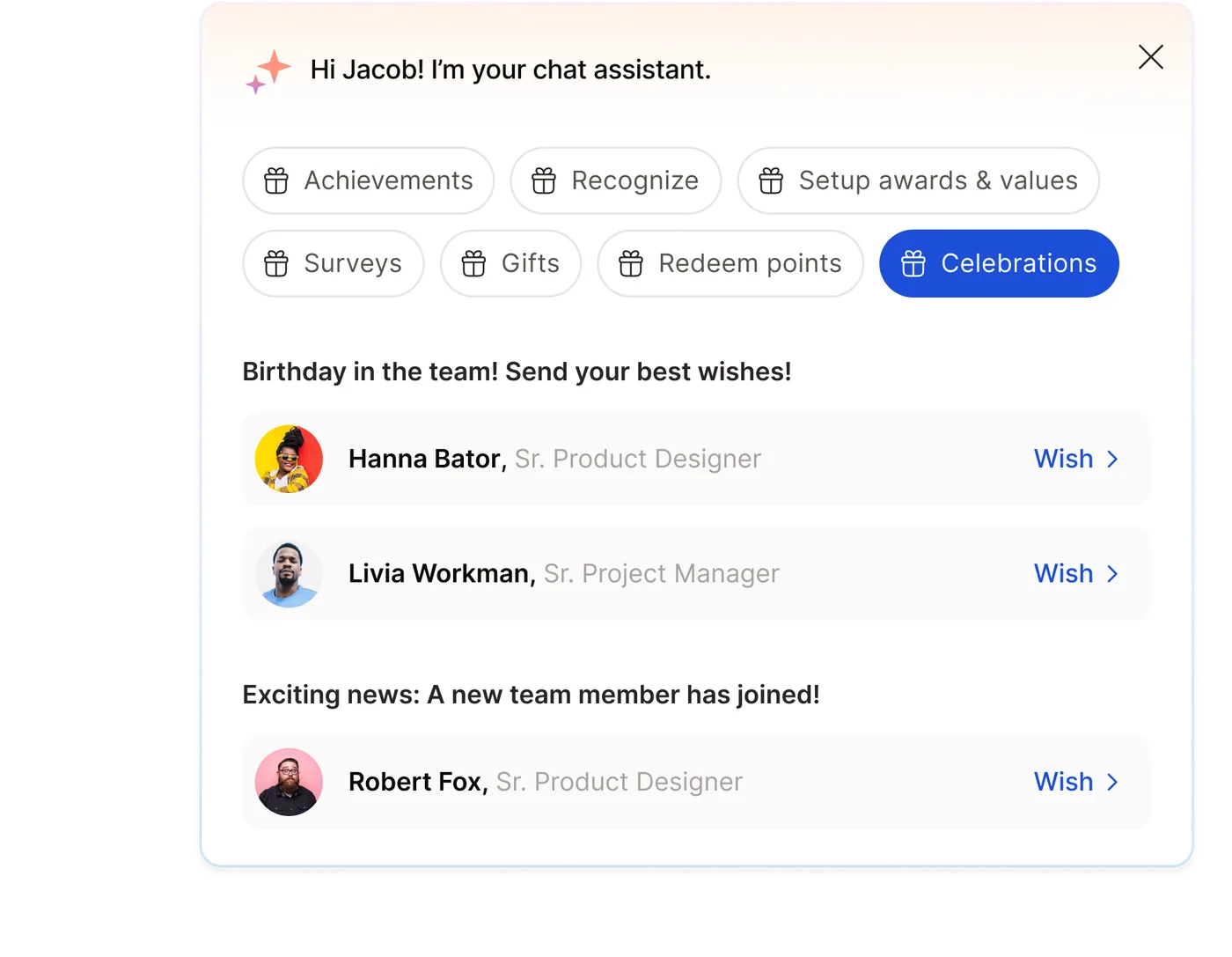
- Recognition Coach and Citation Studio: Suggest who to appreciate, flag people who have not been recognized in a while and draft award messages in the tone you choose.
- Approver Intelligence: Recommends nominees with a transparent rationale, so high-volume awards are decided faster and more fairly.
- Survey Sentiment Engine: Summarizes open comments in 20 languages into themes and tone and shows which cohorts need attention, with results shown only for groups.
- Em, the Empuls AI copilot: Answers questions in plain English from your own data, limited to what each person is allowed to see.
- Responsible AI controls: Data is never used to train public models, personal information is anonymized before processing and admins can switch each AI feature on or off.
Explore Empuls AI, see how AI sentiment analysis reads survey comments and how Empuls recognition keeps appreciation timely and fair. Comparing wider HR platforms too? Our list of the best HR software covers payroll, HRIS and engagement tools.
Getting AI in HR right
AI in HR can make hiring faster, answer employees instantly, surface insight from feedback and free HR teams for strategic work. The gains are real but not automatic. Start with high-value, lower-risk use cases, measure them against a baseline, audit for bias and keep people responsible for decisions that shape careers. Done that way, AI improves the employee experience, supports retention and helps HR earn its place as a strategic partner.
Book your Empuls demo
Frequently asked questions
AI in HR automates repetitive work and supports decisions across recruitment, onboarding, employee support, performance management and workforce planning. It screens and schedules candidates, answers employee questions, summarizes feedback and flags trends such as attrition risk. Its role is to give HR teams time and insight, while people keep responsibility for decisions that affect careers.
No. AI can take over routine tasks such as answering policy questions, scheduling interviews and drafting documents, but employee relations, ethical judgment, culture and complex cases need human perspective. SHRM's 2026 research found only 7% of organizations reported job displacement from AI, while far more saw shifts in responsibilities and new upskilling opportunities.
SHRM's State of AI in HR 2026 research, based on more than 1,900 HR professionals, found that 39% of organizations had implemented AI in their HR functions and 62% used AI somewhere in the business. Recruiting was the most common HR use at 27%, followed by HR technology and learning and development.
Common examples include HR chatbots that answer policy and payroll questions, AI that screens resumes and schedules interviews, sentiment analysis of survey comments, personalized learning recommendations and attrition prediction. IBM's AskHR contains 94% of common employee questions, and Chipotle's AI hiring assistant cut the average time from application to start from 12 days to four.
The main risks are biased outcomes from biased training data, privacy and security breaches involving sensitive employee data, decisions nobody can explain and over-reliance on standard answers. Regulatory risk is growing too, with bias audit and notice rules in places such as New York City. Reduce risk with audits, privacy controls, explainable tools and human review.
Pick one process with clear pain and a measurable outcome, such as ticket volume or time to hire. Check the data it needs, set guardrails with Legal and IT, then run a time-boxed pilot against a baseline. Train managers and employees on how the tool works, and scale only what shows results.
Yes, in most places, but rules are tightening. New York City requires a bias audit and candidate notice before using automated employment decision tools, the EU AI Act classifies AI used in recruitment as high-risk, and several US states have passed employment-related AI laws. Anti-discrimination law applies to AI-assisted decisions, so check local rules first.
AI improves engagement by making recognition timelier and fairer, summarizing survey comments so leaders act faster and giving employees instant answers to everyday questions. Tools such as Empuls suggest who to appreciate, draft award messages and analyze open feedback by theme and tone, while managers decide what to send and what action to take.





































































































































































































































































































































































































































































































































































