
Key Takeaways
Employee performance management is the continuous process of setting goals, giving feedback, developing skills and reviewing results so individual work supports company objectives.
The performance management process has five stages: plan, monitor, develop, review and reward, and it fails when goals are set and never revisited.
Mercer found just over half of US employers still hold formal performance discussions only once a year, while Gallup found employees who get valuable feedback are five times as likely to be engaged.
SMART goals are specific, measurable, achievable, relevant and time-bound, and pairing one results goal with one development goal per person works well.
Recognition is part of performance management: Gallup found well-recognized employees are 45% less likely to have left two years later.
Employee performance management is the continuous process of setting goals, giving feedback, developing skills and reviewing results so each person's work supports the organization's objectives. It has moved beyond the annual appraisal: the best practices today are clear SMART goals, regular check-ins, frequent feedback and recognition, and development plans tied to each person's strengths.
Managing employee performance today focuses on real-time feedback, goal alignment and team collaboration rather than one-off individual assessments. Yet many organizations still rely on once-a-year conversations. Mercer's 2025 performance management survey of more than 500 US employers found that at least three in four have a formal goal-setting process, but just over half still hold formal performance discussions only once a year.
This guide explains what employee performance management means, the performance management process, its benefits, how continuous performance management compares with annual reviews, how to set employee performance goals with ready-to-use examples and 12 performance management best practices to improve results.
What is employee performance management
Employee performance management is not just about measuring and improving how employees perform. It is also about aligning individual objectives with the organization's goals, and the organization's support with each person's needs.
The performance management process is continuous rather than an annual review. Its goal is to build employees' ability to do their work better, so skills improvement and professional development are essential parts of it.
Performance management is also a two-way street. You need to gauge whether an employee fits their job and whether the job uses their skills to the fullest. In other words, it aligns each person's assignments and skills with the goals of their team and the organization.
The performance management process
Most effective performance management systems follow the same five-stage cycle. Planning comes first because every later stage, from feedback to rewards, depends on clear, agreed goals.
- Plan: Agree role expectations and SMART performance goals that connect to team and company objectives.
- Monitor: Track progress through regular one-on-ones, check-ins and shared dashboards, and adjust goals when priorities change.
- Develop: Give feedback, coaching and learning opportunities to close skill gaps and build strengths.
- Review: Summarize performance at set points, such as quarterly or twice a year, using goals, feedback and evidence rather than memory.
- Reward: Recognize and reward results and behaviors, and link reviews to development, career moves and pay decisions fairly.
The cycle then repeats. Because each stage feeds the next, a weak link, such as goals nobody revisits, undermines the whole system.
Benefits of employee performance management
Management expert Peter Drucker is often credited with the idea that what gets measured gets managed. You cannot manage something you do not understand, so measuring employee performance is the first step to improving it. There are five main performance management benefits, and growth and development usually matter most to employees.
1. Opportunities for staff growth and development
As a manager, you influence your organization's performance by paying close attention to the performance of the people working with you. Without a performance management system to record and compare your observations against growth targets, you are making uninformed guesses.
With good data, you can spot improvement opportunities and plan each employee's career path. For example, if an employee struggles with numerical tasks but has excellent communication skills, you can either train them in analysis or steer them toward a path that makes the most of their strengths.
2. More accurate goal alignment
Before setting goals, assess your team's skills, availability and performance. Measuring performance shows what your team can realistically achieve, so you can adjust goals to fit its strengths or add resources to reach your targets.
It starts with putting the right person in the right role. Then set performance goals with each employee with the organization's larger goals in mind. This is harder when people work remotely, but regular check-ins and alignment sessions make clear how you will track performance during the review period.
3. A better understanding of business performance
People make organizations, and their collective performance drives growth. Measuring individual performance helps you understand organizational performance. This is especially true for small businesses, where the output of a few people can make the difference between profit and loss.
Performance reviews help you identify top performers and those who need support. They also reveal knowledge gaps that hold the business back and capabilities you can build on in the future.
4. Better business policies
To build a culture that attracts and retains great people, combine performance data with employee experience data collected at touchpoints across the employee lifecycle, such as employee satisfaction surveys and exit interviews.
Analyzing the two together shows how one affects the other. If several employees say in exit interviews that they wanted more flexible work, and their performance had dipped, you can test whether a lack of flexibility is holding performance back. Use these insights to build a workplace that helps people perform well while keeping a healthy work-life balance.
5. A culture of fair recognition
Performance reviews help you build a culture of fair recognition. Identifying and rewarding top performers shows everyone that hard work is noticed. Recognition matters for retention too: Gallup's recognition research found that well-recognized employees are 45% less likely to have left their organization two years later.
Employees who are struggling need closer support. Spot them early so you can agree a development plan to build their skills. If performance still does not improve, be clear and fair about the consequences. Our guide to the performance reward system explains how to link results to rewards.
Reward goals the moment your teams hit them
See how Empuls connects to your performance tools to recognize and reward results automatically.
Talk to our ExpertTrusted by 5,000+ companies
Continuous performance management vs annual reviews
Continuous performance management replaces the once-a-year appraisal with frequent conversations, flexible goals and real-time feedback. The table below compares the two approaches, and the biggest difference is how often people get useful feedback.
| Element | Annual review approach | Continuous performance management |
|---|---|---|
| Goals | Set once a year and rarely revisited | Set quarterly and updated as priorities change |
| Feedback | Saved for the review meeting | Given weekly or after key work, in both directions |
| Conversations | One formal meeting a year | Regular one-on-ones and check-ins |
| Focus | Rating past performance | Coaching, development and future performance |
| Recognition | Tied to year-end results | Given in the moment, by peers and managers |
| Data | One manager's memory | Goals, feedback and recognition logged through the year |
The evidence favors frequent, useful feedback. Gallup's 2024 research found that employees who strongly agree they receive valuable feedback are five times as likely to be engaged, yet only one in four strongly agree that they do. Most organizations keep an annual or twice-yearly review for pay decisions but add continuous check-ins in between. For a structured way to collect input from several sources, see our guide to 360-degree feedback.
How to set employee performance goals
Employee performance goals are specific, measurable targets that guide a person's daily work and long-term development. They define what success looks like in a role and keep people focused, motivated and aligned with company objectives. Goals can cover results, such as sales or project delivery, or skills, such as collaboration and leadership.
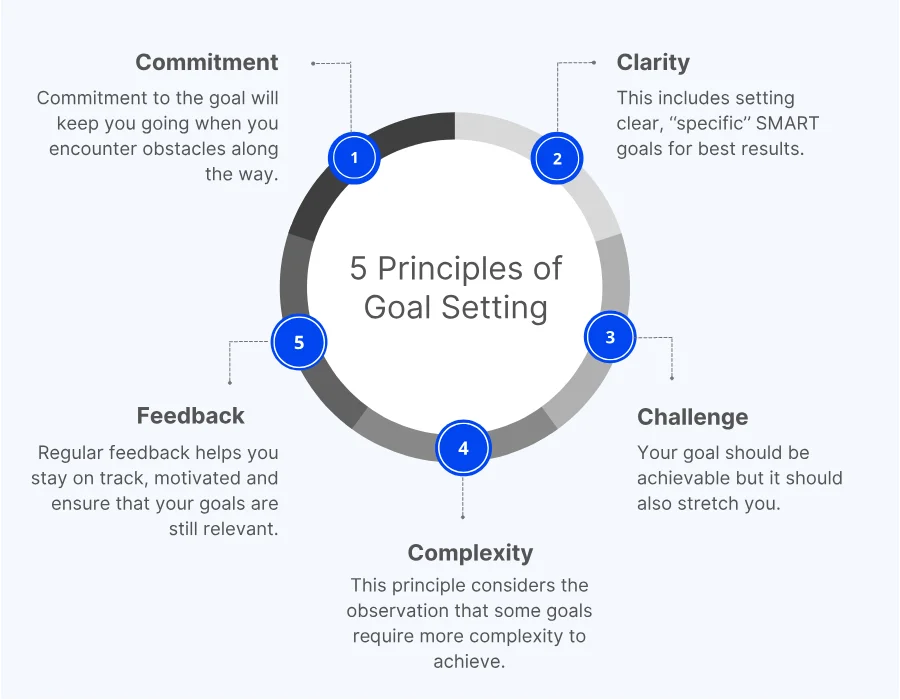
When done right, performance goals for employees provide clear direction, improve accountability and ownership, encourage development and connect individual work to company outcomes. Five principles make goals work, and clarity comes first because people cannot commit to a goal they do not understand.
Use the SMART criteria to write each goal
SMART goals give your performance objectives structure and clarity. Check every goal against these five questions:
- Specific: What exactly do you want to accomplish, and what are the steps to get there?
- Measurable: Which metric or key performance indicator will show progress?
- Achievable: Is the goal realistic, and does the employee have the skills and resources to reach it?
- Relevant: Does it fit the employee's role, aspirations and the company's priorities?
- Time-bound: What is the deadline, and what milestones come before it?
Goal setting matters for every team, but it is even more crucial for remote teams, which can feel lost without clear direction because they do not talk with the core team every day. Goals also depend on the line of work: for graphic designers you might measure quality and adherence to brand guidelines, while for a data team you might use data quality metrics.
Choose a goal-setting framework
SMART is the most common approach, but other frameworks help in different situations. Many teams combine SMART goals for individuals with OKRs for teams.
| Framework | How it works | Best for |
|---|---|---|
| OKRs | Ambitious objectives with three to five measurable key results; Google's re:Work guide suggests 60% to 70% achievement is a healthy score | Stretch goals and team alignment |
| Backward goal setting | Start with the big goal and break it into supporting goals and tasks, like reverse engineering | Long projects with a fixed end date |
| BHAG (big, hairy, audacious goal) | One bold, long-term goal that gives people a sense of mission | Company vision and team inspiration |
| Think big, act small, move quickly | Define the goal, set small milestones and commit to a short timeline | Building momentum fast |
| Goal pyramid | Big goals at the top, supporting goals below and daily tasks at the base | Visualizing how daily work adds up |
| One-word goal | Choose one word, such as focus or growth, as the theme for the year | Personal development goals |
Whichever framework you use, follow four steps: review company objectives, invite employees to draft their own goals, refine them together using SMART and track and update them at least quarterly.
Employee performance goals examples
Use these SMART goals examples for work as templates and adjust the numbers and dates to each role. They cover ten common goal areas, and pairing one results goal with one development goal per person usually works best.
| Goal area | SMART goal example | How to measure it |
|---|---|---|
| Collaboration | Hold at least three joint sales and marketing meetings a month and exchange weekly pipeline reports throughout Q3 | Meetings held, reports shared, lead handoff time |
| Peer support | Help a colleague finalize the mid-year sales pitch script by reviewing past scripts together, joining three test calls and giving feedback after each | Script approved by the end of the month |
| Professional development | Spend 90 minutes a week this quarter completing a paid marketing certification | Certificate earned by quarter end |
| Self-management | Use two focused work blocks a day for the next 20 days to plan and deliver three customer education webinars on time | Webinars delivered on schedule |
| Communication | Create and follow a two-month plan to improve presentation skills, presenting at two team meetings and gathering feedback each time | Feedback scores, presentations given |
| Emotional resilience | Practice a pause-before-responding routine in at least two difficult conversations this quarter and document the outcome | Self-review and manager check-in notes |
| People management | Lead at least one cross-team project each quarter and hold fortnightly one-on-ones with each direct report | Projects led, one-on-ones held |
| Sales | Increase qualified pipeline from new accounts by 15% by the end of Q4 | Pipeline value in the CRM |
| Customer service | Raise the team's customer satisfaction score from 82% to 88% within six months | Monthly CSAT |
| Productivity | Cut average report turnaround from five days to three by the end of Q2 by automating two recurring steps | Average turnaround time |
These employee goal setting examples also work as performance review goals examples: at each review, assess progress against last period's goals and set the next ones together. Development goals, such as communication or self-management, are as important as results goals, because they build the skills that make future results possible.
12 performance management best practices to improve employee performance
Good performance management takes more than a productive workplace. It requires leadership, strong social skills, constructive feedback and teamwork. These 12 performance management best practices follow the employee's experience from goals to growth, and regular feedback is the one with the biggest impact on engagement.
1. Set clear goals and objectives
Without well-defined goals, neither you nor your team can tell how much progress you have made or how much ground is left. Use the SMART criteria and the examples above, and revisit goals at least quarterly.
2. Use software for performance management
You need a way to track progress efficiently, and the information should be visible to the people it concerns. Spreadsheets are common, but dedicated performance management software makes tracking easier and more consistent. When you choose a tool, consider:
- Cost: Enterprise suites may be beyond a small company's budget; tools built for smaller teams can cover the essentials.
- Features and integrations: Look for integration with your HRIS, payroll and employee recognition tools so employees and HR get one experience.
- Ease of use: Performance tools have many moving parts. Favor simplicity and try demos before you decide.
3. Provide regular performance feedback
Relevant, regular feedback is the heart of performance management. It can flow from managers to employees, from employees to managers and between peers. The way you give it changes the result:
- Explain the why: Instead of saying something did not work, explain why and place it in the context of the business.
- Be specific about success: Instead of "good job," say what worked.
- Look forward: Instead of dwelling on what went wrong, discuss what the person can do better next time.
Talk like a teammate, not a boss, and avoid judgmental phrasing. Our culture of feedback guide and employee feedback examples show how to make this a habit.
4. Provide the right work equipment
The right resources lift efficiency and performance. Missing or poor equipment slows people down, lowers morale and, in physical roles, raises injury risk. Reliable hardware, licensed software and good communication tools are basics, not perks.
5. Address behavior that drains the team
Some people drain the energy of everyone around them. They may not underperform themselves, but they undermine morale every day, and their effect on coworkers can be larger than it first appears. They are hard to spot because colleagues are reluctant to complain and the person's own results may look fine.
Build a feedback system and enough trust that employees feel safe raising these issues. Once you identify the problem, address the behavior directly with clear expectations and support. If it continues, follow your performance process to its conclusion, because protecting the team matters more than avoiding a hard conversation.
6. Show your team that you care about them
One of the best ways to show people they matter is to make time for them. Regular one-on-ones help you agree priorities, address concerns and show that their contributions are valued. Simple actions, such as asking about a project, remembering personal details or backing your team when a customer is unreasonable, build loyalty that no policy can.
7. Match rewards to effort
People are motivated by different things. Many care about pay, so a raise is compelling. Career-focused employees value the chance to move up. Short-term rewards, such as a bonus after a major project, remind people why the extra effort was worth it, especially when another big project starts right away.
8. Invest in employee development
More skilled employees mean a more productive workforce. Courses, workshops and mentoring help people grow professionally and keep pace with change. It can seem costly, but it pays back in performance and retention. See our guide to employee engagement through learning and development.
9. Motivate with incentives
Incentives reward strong performers and show the whole team that hard work is valued. They can range from paid time off, bonuses and raises to team activities where people can relax and get to know each other better.
10. Hold regular performance reviews
Scheduled reviews give managers a chance to give each team member structured feedback. They are also a chance to learn what is getting in employees' way and what would help them commit fully to their work. Reviews work best when they summarize conversations you have already had, so nothing comes as a surprise.
11. Communicate openly and stay in the loop
Improving engagement and performance takes long-term attention. Keep in regular contact with your team so people understand their assignments, know the priorities and can raise problems early. Our guide on how to improve employee engagement covers more ideas.
12. Build a strong team and community
Loyalty to colleagues is a powerful motivator. People who respect their teammates work hard not to let them down, and peer validation can mean more than praise from a manager. Building this takes effort:
- Create shared moments: Offer team-building activities and chances to connect outside daily work.
- Make friendship easy: Build a workplace where people can get to know each other, not one where they feel constantly watched.
- Reward teamwork: Recognize collaboration, not only individual wins, so rivalry and point-scoring never pay off.
How Empuls helps improve employee performance
Empuls is an employee engagement platform, not a performance review tool, and it works alongside the goal and review systems you already use. It strengthens performance management where engagement makes the difference: recognition, rewards and listening.
- Reward goals the moment they are hit: Project and goal completion rewards sync with OKR and performance platforms such as Workboard, Betterworks, Lattice and Profit.co, so teams are rewarded automatically when a goal or milestone is marked complete.
- Recognize performance every day: Peer and manager recognition with points-based rewards and values-tagged awards reinforces the behaviors your goals call for.
- Check goal clarity and support: Pulse surveys show whether people understand their goals, have what they need and feel supported by their managers.
- See trends by team: Reports and analytics show recognition and engagement patterns so leaders can act where performance is at risk.
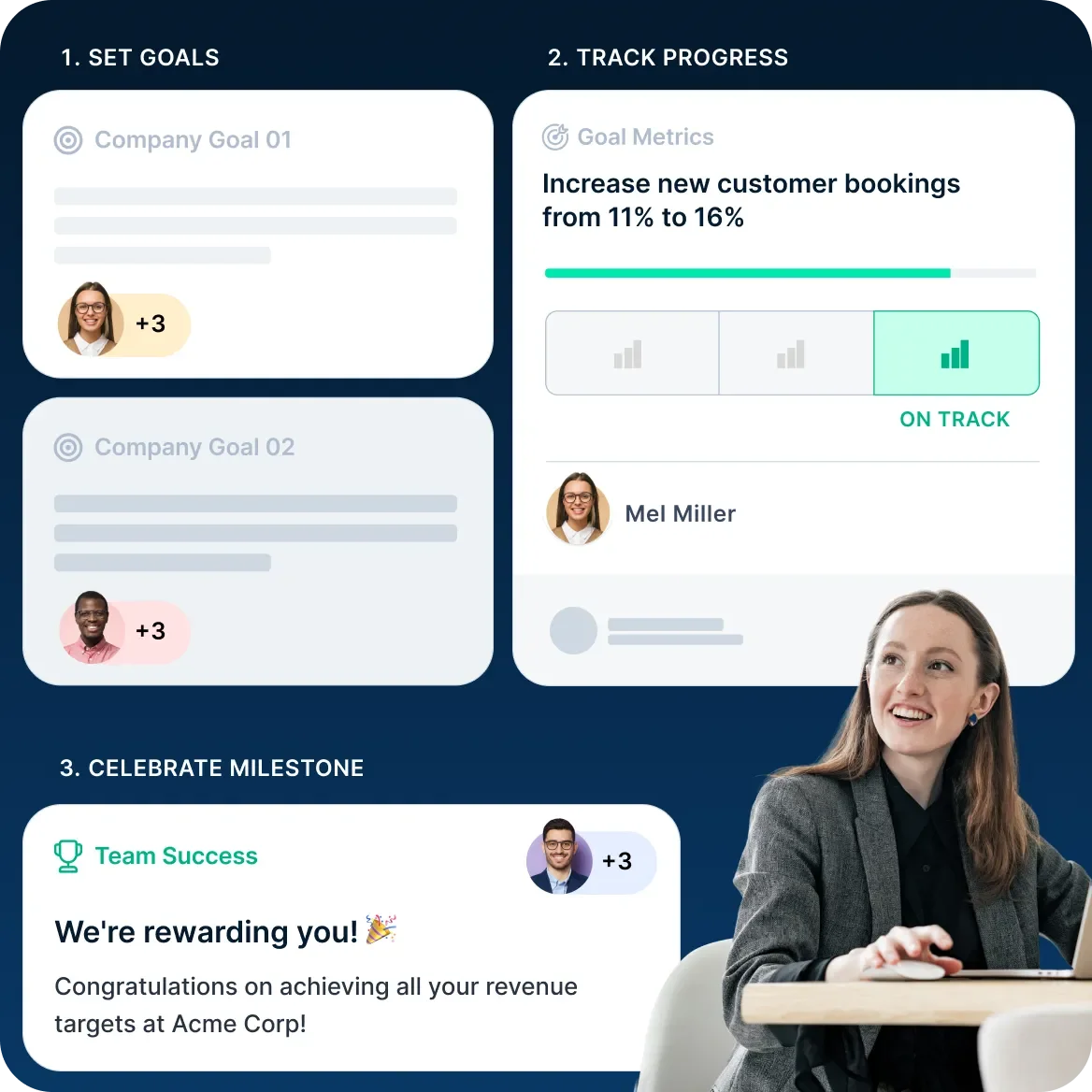
The benefits of managing employee performance well reach every part of the workplace: employee growth, stronger manager relationships, better teamwork and targets met. Make the process as continuous as it is meant to be, and pair clear goals with regular feedback and recognition.
Book your Empuls demo
Frequently asked questions
The five stages of performance management are planning, monitoring, developing, reviewing and rewarding. You agree goals and expectations, track progress through check-ins, support growth with feedback and training, review results at set points and recognize or reward performance. The cycle then repeats, with each review feeding into the next round of goals.
Good performance goals are SMART: specific, measurable, achievable, relevant and time-bound. Examples include raising customer satisfaction from 82% to 88% within six months, completing a certification by quarter end or leading one cross-team project each quarter. Pair one results goal with one development goal so employees grow while delivering.
Continuous performance management replaces the single annual review with ongoing goal updates, regular one-on-ones and real-time feedback and recognition. Managers coach throughout the year, so the formal review summarizes conversations already held rather than surprising anyone. It helps people correct course quickly and keeps goals relevant as priorities change.
Most organizations hold a formal review once or twice a year for pay and promotion decisions, with quarterly goal check-ins and one-on-ones every one to two weeks in between. The right rhythm depends on how fast work changes, but feedback should never wait for the formal review, because delayed feedback is much harder to act on.
Performance goals focus on the actions and standards a person controls, such as making 40 customer calls a week or finishing a course. Outcome goals focus on the end result, such as closing a set amount of revenue. Using both helps employees see the big picture while working on the behaviors that lead to it.
Performance management gives employees clear goals and growth opportunities, aligns individual work with company objectives, helps leaders understand business performance, improves policies by linking performance with employee experience data and builds a culture of fair recognition. Done continuously, it also raises engagement, because people get regular, useful feedback on their work.
Measure employee performance against agreed goals and key performance indicators for the role, such as sales, quality, output or customer satisfaction. Add evidence from regular check-ins, peer and manager feedback and observed behaviors like collaboration. Combining results with how the work was done gives a fairer picture than numbers or opinions alone.





































































































































































































































































































































































































































































































































































