
Key Takeaways
Start planning an employee rewards and recognition program about six months before launch, while morale is steady rather than after engagement drops.
Goals and budget come first because they shape the platform, reward categories, scope and award levels you choose later.
Gallup's 2024 research found only 22% of employees get the right amount of recognition, and well-recognized employees were 45% less likely to leave within two years.
Build the budget bottom-up from headcount and award values, then add platform, launch and tax costs, since gift cards are taxable wages in the US.
A recognition calendar with everyday, milestone and annual moments keeps the program alive after the launch event is over.
Start employee rewards and recognition program planning about six months before you want to launch, and start it while morale is steady, not after engagement has already slipped. Six months gives you time to set goals, win a budget, pick a platform, test it and train managers. This guide gives you a month-by-month timeline, a budget worksheet and a planning checklist you can copy.
Employee rewards and recognition program planning is the work that happens before launch: deciding what the program should achieve, who owns it, what it will cost, which rewards and tools it will use and when each piece must be ready. Get this stage right and the launch, rollout and measurement that follow become far easier.
When to start planning your employee rewards and recognition program
The best time to start is when things are going reasonably well. It helps to know when not to wait until you start planning:
- When your employees are already disengaged: A program launched into a disengaged workforce looks like a quick fix and is met with suspicion.
- When the office grapevine is buzzing with discontent: Rewards cannot paper over unresolved problems with pay, workload or managers.
- When the company is losing money: Budgets get cut mid-way and the program dies quietly, which does more harm than never launching.
General Motors is a well-known cautionary tale. In the investigation that followed its 2014 ignition-switch recall, a culture that discouraged employees from raising safety concerns emerged as one of the underlying causes. GM's environment did not reward people for being conscientious, and its approach to rewards and accountability was overhauled only after the damage was done.
The lesson is simple: the behaviors you reward are the behaviors you get. Your employee rewards and recognition program must be built into the fabric of your company culture from the time it is envisioned, not bolted on in a crisis. If you are still building the case for investment, start with why employee rewards and recognition matter.
Why careful planning pays off
Recognition programs often fail quietly because they are rushed. Employee perceptions of a rewards system tend to weaken the further down the organization you go, usually because the program launched without clear criteria, enough budget or managers who knew how to use it. Gallup's 2024 research shows how much is at stake when recognition is done well or badly:
22%
of employees get the right amount of recognition
Unchanged since 2022
45%
less likely to leave within two years
Well-recognized employees
9x
as likely to be engaged
When recognition meets four of Gallup's five pillars
Source: Gallup, Employee Retention Depends on Getting Recognition Right, September 2024
These figures come from Gallup's 2024 study of nearly 3,500 employees, which also found 55% of US employees receive no recognition or recognition that meets none of the five pillars. Planning is how you make sure your program lands in the well-recognized group rather than adding to that 55%.
Planning your first recognition program?
See how teams configure awards, budgets and approvals in weeks, not months, and launch on schedule.
Talk to our ExpertTrusted by 5,000+ companies
Employee rewards and recognition program timeline: a chronology of events
If this is your company's first time setting up an employee rewards and recognition program, planning it can feel like an uphill task. The seven milestones below run from six months out to launch day, and the first two matter most because goals and budget shape every later decision.
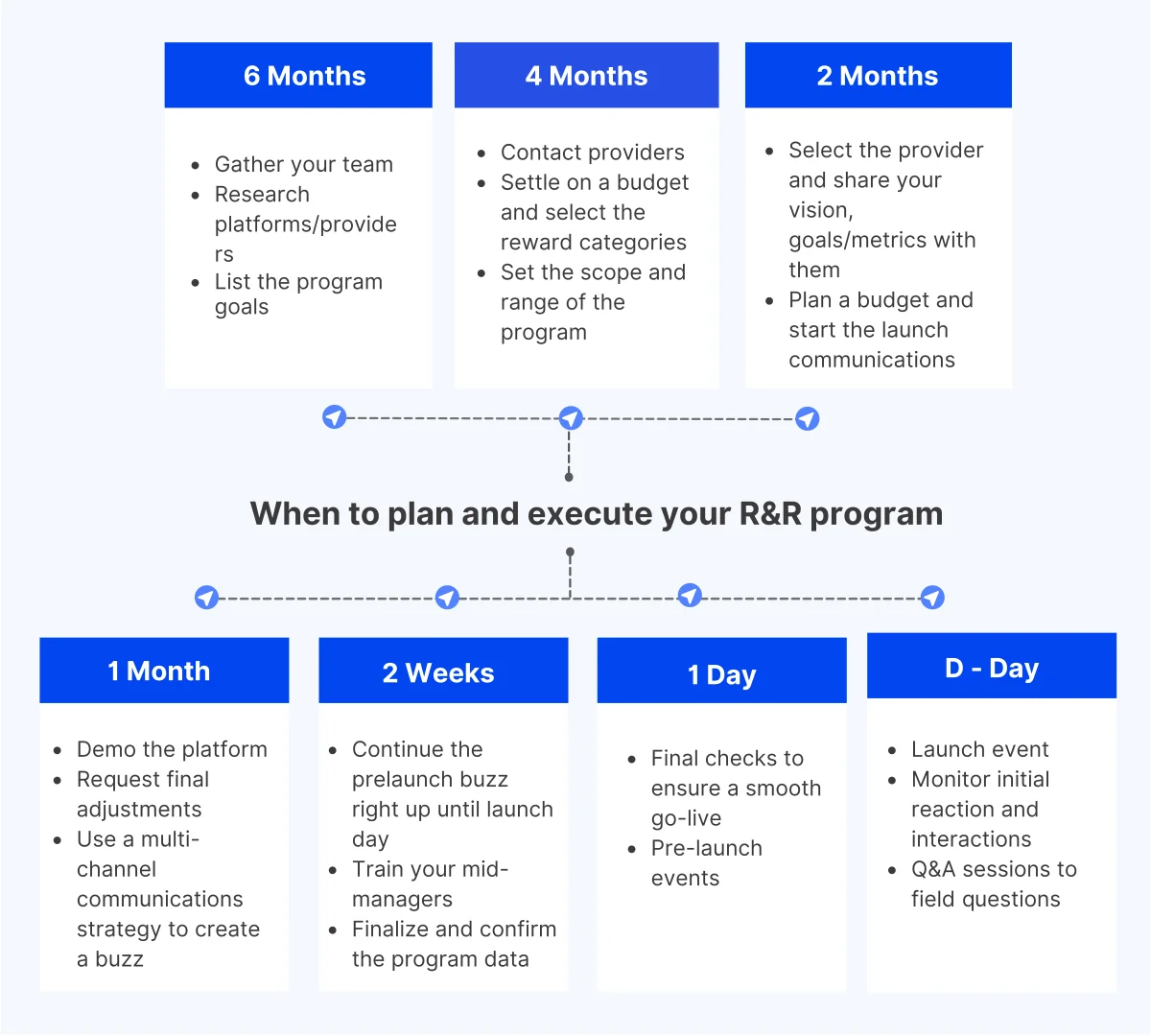
1. The 6-month plan
- Once you have aligned leadership to the idea of a rewards and recognition program, set your plan in motion about six months ahead of launch.
- Start with the goals you want to accomplish. Evaluate your business objectives, your employees' needs and how the program will serve both.
- Prepare a rough timeline and check it regularly to keep the launch on track.
- Put together the right team to research, execute and implement the program, including an executive sponsor.
- Research employee recognition platforms and providers. Look at the recognition, incentive and reward options they offer and make sure they align with your business objectives.
2. The 4-month milestone
- Contact providers for quotations and make internal decisions on program logistics.
- Compare providers on licensing fees, features and the level of customization. This guide to choosing the right employee rewards and recognition platform includes a scoring sheet.
- Set a budget and choose the reward categories that fit within it.
- Create a list of KPIs to measure the program's success. List your employee goals and set reward categories that help employees meet them.
- Run a comparative analysis of providers using demos, sample programs, references and pricing.
- Decide the scope and range of the program. Will it be company-wide, or start with a specific location or department? What will the highest and lowest rewards be?
3. The 2-month mark
- Choose your provider based on your evaluation and share the KPIs and metrics you want built into the program.
- Hand over program goals, reward categories, company values, branding, guidelines, employee lists and reporting requirements. Detailed consultations with your provider help configure the platform for launch.
- Finalize the budget and the communications plan. Promote both the launch and the benefits of the program, using this guide to communicating the launch of an employee recognition program.
4. One month before launch
- Your platform should be ready to preview. HR and senior leaders should test every feature before it goes live.
- Test links, look for bugs, check custom features and keep a clear line to your provider for final adjustments. A shared issue log saves time here.
- Step up launch communications across channels: email, chat tools, posters, town halls and your intranet, so employees see the program's value before day one.
5. Two weeks to go
- Your platform should now be up and running in a test environment.
- Hold regular touchpoints with your provider to fine-tune the platform and validate program data, including employee details from your HR system.
- Train HR teams and mid-level managers with short guides and Q&A sessions so they know the tool and its reports.
- Hold stakeholder meetings to iron out last-minute wrinkles.
- Keep giving employees previews of the rewards, how to earn them and what the program means for their growth.
6. One day left
- Run final checks with your provider to confirm everything is ready.
- Build anticipation with a pre-launch moment, such as a team event or a teaser from the CEO, that shows the program is for employees.
7. Launch day
- Announce the program at a town hall or launch event and unveil its full features.
- Monitor the first interactions, hold a Q&A session and keep the program team available for the questions that follow.
- Review the platform at regular intervals to keep pace with change. The step-by-step guide to implementing an employee rewards and recognition program covers rollout and the first 90 days.
Recognition program planning checklist
Use this table as your working plan. Each row lists what must be decided, who owns it and the deliverable that proves it is done, so you can share it with your planning team and track progress week by week.
| When | Decide or do | Owner | Deliverable |
|---|---|---|---|
| 6 months out | Goals, executive sponsor, planning team, success metrics | HR lead and sponsor | One-page program charter |
| 6 months out | Employee input on what recognition they value | HR | Short survey or focus group summary |
| 5 months out | Shortlist of platforms and providers | HR and IT | Shortlist with requirements |
| 4 months out | Budget, reward categories, scope and award levels | HR and finance | Approved budget and award matrix |
| 4 months out | Eligibility, criteria and approval rules | HR and legal | Program policy draft |
| 3 months out | Provider selection after demos and references | Planning team | Signed agreement |
| 2 months out | Configuration: values, branding, budgets, integrations | HR and provider | Configured test environment |
| 2 months out | Communications plan and launch date | HR and internal comms | Comms calendar |
| 1 month out | User testing with HR and leaders | HR | Issue log closed |
| 2 weeks out | Manager training and data validation | HR and managers | Trained managers, clean employee data |
| Launch day | Launch event, Q&A, monitoring | Sponsor and HR | Day-one adoption report |
How to set a recognition program budget
Your budget has four parts, and the reward pool is usually the largest. Build it bottom-up from your headcount and the award levels you set, then add platform, launch and tax costs so finance is not surprised later.
| Budget line | What it covers | How to estimate it |
|---|---|---|
| Reward pool | Points, gift cards, experiences and award values | Headcount x planned annual reward value per employee |
| Platform | Software license, setup and integrations | Quotes from your shortlisted providers |
| Launch and communications | Launch event, design, swag, training time | A fixed amount for the first year |
| Taxes and fees | Payroll tax on taxable awards, shipping, currency fees | Ask payroll how awards will be reported |
Check the tax rules before you finalize award values. In the US, the IRS treats cash and cash equivalents such as gift cards as taxable wages that can never be excluded as de minimis fringe benefits, whatever the amount. Rules differ by country, so involve payroll early. For help deciding which rewards to fund, see this guide to building an employee rewards program.
Who should be on your planning team
A program owned by HR alone tends to stay an HR initiative. These five roles turn it into a company program, and the executive sponsor matters most because visible leadership support drives manager participation.
- Executive sponsor: Secures budget, launches the program and models recognition in public.
- HR or people team: Owns design, policy, vendor management and day-to-day running.
- Finance and payroll: Approves the budget and decides how awards are taxed and reported.
- IT: Handles single sign-on, HR system integration, data security and chat tool connections.
- Managers and employee champions: Test the program, shape reward choices and spread it in their teams. Include frontline and remote employees, not only head office.
Champions are worth the effort. In O.C. Tanner's 2026 State of Employee Recognition report, a survey of more than 4,200 employees in 10 countries, employees at companies with recognition champions were three times more likely to regularly recognize coworkers.
How to time your program for your company size and stage
The six-month timeline is an average. Companies that succeed with rewards and recognition adjust it to their size, structure and how fast employee needs are changing, so treat the four profiles below as starting points.
- Startup: Start simple once you pass about 20 to 30 people, when founders can no longer see everyone's work. Peer recognition and a few core awards can be planned in eight to 12 weeks.
- Small company: Plan for three to four months. One person can own the program, but involve managers early so recognition does not depend on the founder.
- Mid-sized company: Plan for four to six months. Multiple locations and departments mean more stakeholders, budget approvals and integrations.
- Established enterprise: Plan for six months or more, especially if you are replacing regional programs with one global program. Pilot with one business unit first.
Whatever your size, take an agile approach. Measure the value, cost and impact of each reward after launch and scale it up, scale it down or remove it. The guide to measuring employee recognition programs explains which metrics to track.
Plan your recognition calendar for the first year
A launch is one day, but recognition has to run all year. Map these recurring moments into your plan before launch so the program has a rhythm, and give the always-on everyday recognition the most attention because it carries the program between big events.
- Everyday: Peer-to-peer and manager recognition tied to company values, as in a values-based recognition program.
- Monthly or quarterly: Nominated awards, such as team or employee of the quarter, with clear criteria and a review panel.
- Milestones: Work anniversaries, birthdays and project completions, supported by these employee milestone gift ideas.
- Annual moments: Employee Appreciation Day on the first Friday of March, year-end awards and your company anniversary. These Employee Appreciation Day ideas help you plan ahead.
- Reviews: A 90-day review after launch and an annual program review to reset budgets and rewards.
How Empuls helps you plan and launch faster
Empuls brings recognition, rewards and reporting into one platform, which shortens the configuration stage of your plan. You can set up award types and budgets per team, add approval rules for high-value awards and connect your HR system and Slack or Microsoft Teams, so recognition reaches people where they already work.
- Benchmark before you plan: Take the free recognition program scorecard to see where your current recognition stands.
- Build the business case: Estimate returns for your budget request with the recognition ROI calculator.
- Configure the program: Empuls recognition covers peer, manager and spot awards, budgets, approvals and real-time reports.
- Automate milestones: Milestone rewards handle anniversaries, birthdays and other recurring moments from your calendar.
Time is of the essence
Planning your employee rewards and recognition program is an exciting journey from vision to go-live, but it does not end there. The most important part comes after launch, when you monitor adoption, usage and participation and adjust the program to make it valuable for your employees and your business.
Plan six months ahead, start while morale is steady and give every decision an owner. You will retain skilled people, attract new talent and support business growth. For the full picture of what recognition is and how it works, read the complete employee recognition guide.
Book your Empuls demo
Frequently asked questions
Start about six months before your planned launch date, and ideally while engagement is stable rather than after it has dropped. Six months covers goal setting, budget approval, platform selection, configuration, testing and manager training. Small companies with simple programs can plan in eight to 12 weeks, while global enterprises replacing regional programs often need more than six months.
Most companies take three to six months from approval to launch. The longest steps are budget approval, choosing a provider and integrating the platform with HR and single sign-on systems. A pilot with one team can go live faster, often within a few weeks, and gives you real usage data before a company-wide launch.
There is no single current benchmark, so build the budget bottom-up. Multiply headcount by the annual reward value you plan per employee, then add platform fees, launch and communication costs and taxes on awards that count as wages. Review spending after 90 days and shift money toward the rewards employees actually redeem and value.
Include an executive sponsor, HR, finance and payroll, IT and a group of managers and employee champions. The sponsor secures budget and models recognition, HR owns design and operations, finance handles budget and taxes, and IT manages integrations. Employee champions from frontline and remote teams make sure the program works for everyone, not just head office.
A complete plan includes program goals and KPIs, eligibility and award criteria, reward types and values, a budget, an approval process, the platform and integrations, a communication plan, manager training and a launch timeline. It should also include a recognition calendar for the first year and a review date to adjust the program after launch.
Launch when employees are not stretched by peak season, year-end closing or a major reorganization. Many companies align the launch with a new fiscal year, a company anniversary or Employee Appreciation Day on the first Friday of March, which gives the program a natural announcement moment and a full year of budget to run on.
Small businesses benefit from some structure once founders can no longer see everyone's work, often around 20 to 30 people. A formal program does not need to be complex: clear values, an easy way for peers to recognize each other, a small reward budget and a few milestone awards are enough to make recognition consistent and fair.
Tie the program to a business problem leaders already care about, such as turnover, engagement or productivity. Show the cost of losing employees, cite current research such as Gallup's finding that well-recognized employees are 45% less likely to leave, and present a clear budget, timeline and set of KPIs so leaders can see how success will be measured.





































































































































































































































































































































































































































































































































































