
Key Takeaways
Commission in healthcare is variable pay for medical device, pharmaceutical, health technology and other healthcare sales, usually paid on top of a base salary.
Medical device reps are usually paid commission on territory revenue, while pharmaceutical reps typically earn a bonus on territory goals because prescriptions are filled elsewhere.
The BLS reports a May 2025 median wage of $104,920 for sales reps of technical and scientific products, which include pharmaceuticals and medical instruments.
Under the US Anti-Kickback Statute, paying anything of value to induce federal health program business is a felony, so commission plans need compliance review.
The employee safe harbor protects pay to bona fide employees, while percentage commissions to independent reps need legal review because they vary with sales volume.
Commission in healthcare is the variable pay that medical device, pharmaceutical, health technology and other healthcare sales professionals earn for the sales they drive, usually on top of a base salary. It can be a percentage of revenue, a fixed amount per unit, a tiered rate or a bonus tied to territory goals. Because many healthcare products are paid for by government health programs, commission plans also have to respect rules such as the US Anti-Kickback Statute. This guide covers healthcare sales commission structures, how to calculate them with worked examples, territory design, compliance and strategies that motivate medical sales teams.
The healthcare sector relies on more than quality care. Effective sales and marketing make sure essential products and services reach the clinicians, hospitals and patients who need them, and commission plans are how most organizations motivate those sales teams. With pay expectations rising and good reps hard to keep, the design of that plan matters to both cost and retention.
What commission in healthcare means
Sales commissions in healthcare are financial incentives tied to the successful sale of medical devices, pharmaceuticals, healthcare technology, diagnostics, insurance plans or other healthcare products and services. They can be a percentage of the sale's value, a fixed amount per sale or unit, or a combination of both, and they are usually paid on top of a base salary.
Their goals are the same as in any industry: motivate sales professionals, grow revenue and align selling with company priorities. Pay levels reflect the technical nature of the work. The US Bureau of Labor Statistics reports a May 2025 median annual wage of $104,920 for sales representatives of technical and scientific products, a group that includes pharmaceuticals and medical instruments, against $72,080 for other wholesale and manufacturing sales reps, and notes that most employers pay salary plus commission or salary plus bonus.
What healthcare sales reps sell and how that shapes commission
Healthcare sales covers very different products, and the product decides how commission works. Pharmaceutical sales comes first in the table because it differs most from other sales roles: the rep persuades the prescriber, but the sale happens later at a pharmacy, so pay usually follows territory results rather than individual orders.
| Segment | Main buyers | How variable pay is usually tied |
|---|---|---|
| Pharmaceuticals and vaccines | Physicians and other prescribers, pharmacies, hospitals and health systems | Bonus on territory goals, such as prescription volume or market share, paid quarterly |
| Medical devices and implants | Surgeons, hospital departments and purchasing teams | Commission on territory revenue, often tiered, plus bonuses for new accounts |
| Capital equipment | Hospital executives, value analysis committees and purchasing | Commission on closed deals, often split with clinical specialists |
| Medical disposables and supplies | Hospitals, clinics, distributors | Percentage of revenue or a fixed amount per unit on high-volume products |
| Health technology and software | Health systems, payers, clinics | Base plus commission on contract value, like other software sales |
| Health insurance plans | Employers and individuals | Commission per policy or member, set by the carrier's contract |
Like reps in any industry, healthcare sales professionals need education and training to talk credibly about what they sell, and specialty products such as vaccines or controlled medicines need extra training. For how health insurance agents are paid, see this guide to insurance agent commission.
Types of healthcare sales commission structures
Six structures cover almost every healthcare sales commission plan, and most plans mix two or three of them. Base salary plus a percentage of revenue comes first because it is the most widely used, especially in medical device sales; the others adapt it to volume products, prescribers and team selling.
| Structure | How it works | Example | Best for |
|---|---|---|---|
| Percentage of revenue | The rep earns a share of the revenue from each sale or from total territory revenue; high-demand products may carry different rates from slower ones | 6% of quarterly territory revenue | Medical devices, equipment, health technology |
| Unit-based | A fixed amount for every unit sold, set by the organization | $15 per box of surgical supplies | Established, high-volume products with steady demand |
| Tiered commission | Higher rates unlock as the rep passes set sales targets, so top sellers earn the most | 5% to quota, 8% above it | Teams with clear, reachable quotas |
| Territory goal bonus | A target bonus paid in line with territory goal attainment, often weighted across several measures | $8,000 a quarter at 100% of goal | Pharmaceutical sales, where reps influence but do not take orders |
| Gross margin commission | Commission on profit rather than revenue, so discounts reduce pay | 20% of gross margin on each deal | Distributors and teams with pricing authority |
| Bonuses and SPIFFs | Extra pay for exceeding quota, launching a product or hitting a milestone, as a lump sum, tiered payout or increment | $2,000 for the first 10 accounts on a new product | Launches and short-term priorities |
Base salaries are paid on the normal payroll cycle, while commissions and bonuses are usually paid monthly or quarterly. For the formula mechanics of each structure in any industry, see these sales commission structures.
Factors to build into a healthcare sales compensation plan
A healthcare sales compensation plan needs six design decisions on top of the structure itself. The first four come from general sales practice; the last two matter more in healthcare than almost anywhere else, because one product can involve several reps and federal payers.
- Quotas: Specific sales goals that set expectations, act as benchmarks for performance and determine where rates and bonuses change.
- Accelerators: Higher rates once a rep exceeds quota, which reward top performers and encourage high-volume selling.
- Decelerators: Lower rates below a threshold, so weak performance does not earn full rates and reps are prompted to improve.
- Clawbacks: Provisions that recover commission when a sale is cancelled, refunded, returned or reversed, with the amount depending on company policy and the time since the sale.
- Crediting and splits: Rules for sharing credit between territory reps, clinical specialists and key account managers, agreed before the sale.
- Compliance gates: Measures that can never earn pay, such as anything tied to inducing a clinician's referral, and conditions such as completed compliance training before payout.
A well-designed plan balances motivation with fairness, so reps are rewarded for their effort while the company protects its margins and its compliance record.
Run compliant, accurate medical sales commissions
Calculate commission by product, territory and role, with an audit trail behind every payout.
Talk to our ExpertTrusted by 5,000+ companies
How to calculate healthcare commission with examples
The core formula is Commission = Sales × Commission rate, with tiers, unit amounts or goal weights added as the plan requires. The five examples below cover the calculations healthcare sales operations teams run most often; every figure is illustrative, so replace it with your own plan's numbers.
| Plan | Calculation | Result |
|---|---|---|
| Flat percentage (device rep) | $800,000 monthly sales × 2% | $16,000 commission |
| Tiered (device rep, quarterly) | $400,000 quota at 5% = $20,000, plus $60,000 above quota at 8% = $4,800 | $24,800 on $460,000 of sales |
| Unit-based (disposables) | 1,200 boxes × $15 per box | $18,000 |
| Weighted goal bonus (pharma rep) | $8,000 target × (70% weight × 110% prescription goal + 30% weight × 90% second goal) = $8,000 × 1.04 | $8,320 |
| Clawback (returned equipment) | $40,000 return × 5% rate recovered from the next payout | $2,000 deducted |
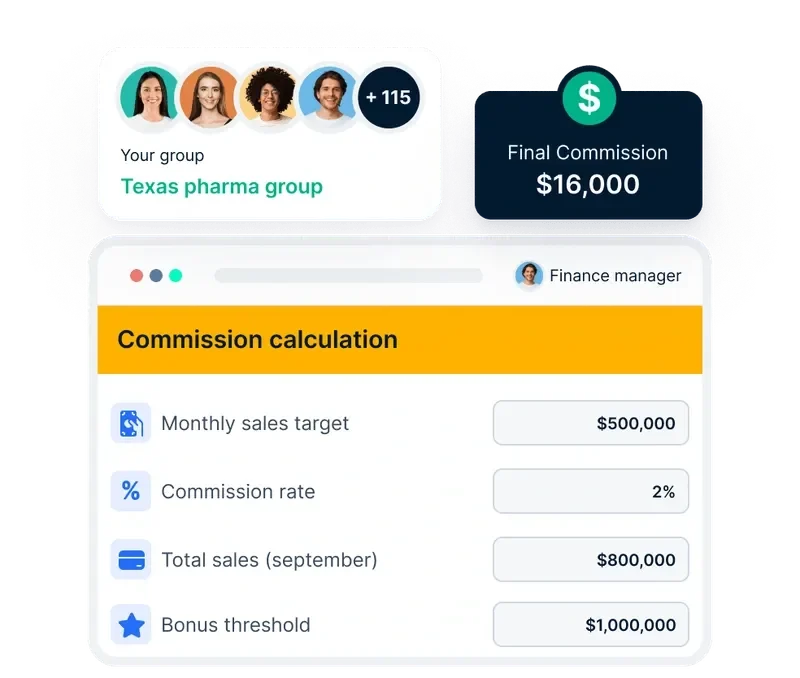
Apply the same logic to bonuses by changing the criteria for earning them. For more complex plans with splits and multiple measures, this guide shows how to calculate sales commissions step by step.
How to map healthcare sales territories for a fair commission plan
Commission is only fair if territories are. A sales territory is a group of potential clients divided by location, product or customer type, and in healthcare there are three common ways to draw them, each with a different effect on pay:
- Geographic territories: Often the simplest method, grouping accounts by region, state, county, city or postal code. Companies define them differently depending on their size, the number of reps and the density of healthcare providers, and they account for how far reps travel and what it costs.
- Account or specialty territories: Dividing by product type or medical specialty, for example a cardiology territory that targets cardiologists. Reps build deep product knowledge and better strategies, and the revenue from specialization can offset higher travel costs.
- Combined territories: Mixing geography with specialty, such as a rep selling heart medicines to every cardiologist on the West Coast, which balances travel cost with expertise.
Balance territories on potential, not just size, before you set quotas. A rep with a territory full of high-volume hospitals and one with scattered rural clinics need different quotas to have the same chance of earning their target pay.
Compliance rules for commission in healthcare sales
Healthcare is one of the few industries where how you pay sales reps can create legal risk. In the US, the main rule is the federal Anti-Kickback Statute, and three points matter most for commission design.
- What the law prohibits: OIG's General Compliance Program Guidance explains that it is a criminal offense to knowingly and willfully offer or pay anything of value to induce referrals or purchases of items paid for by federal health care programs such as Medicare and Medicaid. A violation is a felony with a maximum fine of $100,000, up to 10 years in prison, or both, and leads to exclusion from those programs.
- Employees and independent reps are treated differently: The safe harbor regulations protect amounts paid by an employer to a bona fide employee. Independent sales agents and distributors fall under the personal services safe harbor instead, which requires compensation set in advance, consistent with fair market value and not tied to the volume or value of federal program business, so percentage commissions to contractors need legal review.
- Incentive goals themselves are a risk: The same OIG guidance asks compliance committees to check whether sales goals may encourage reps to offer clinicians things of value in exchange for prescribing or ordering products.
Strategies to motivate healthcare sales teams
Pay is only one lever. Medical sales cycles are long, buyers are expert and compliance limits what reps can do, so these five strategies keep teams motivated between payouts:
- Make earnings visible: Show reps their attainment and projected commission in real time, so there is no uncertainty about payouts.
- Pay accurately and on time: Late or wrong payments erode trust quickly; automate calculations wherever you can.
- Recognize the right behaviors: Celebrate clinical knowledge, compliant selling and customer outcomes, not only revenue, and use sales SPIFF ideas for short-term pushes such as launches.
- Invest in training: Product and clinical education helps reps sell with credibility and is a reason good reps stay.
- Build engagement into the culture: Leaderboards, contests and team recognition keep spread-out field teams connected. For ideas, see employee engagement in the pharma industry and employee engagement in healthcare.
For the full range of incentives beyond commission, read the sales incentives guide.
How Empuls helps healthcare sales teams manage commission
Empuls includes sales incentive and commission software that handles the product, territory and hierarchy complexity of healthcare sales, with a full record behind every payout. Four capabilities matter most for medical and pharma sales teams:
- Plans by product, territory and role: Build commission, target and milestone plans in a no-code builder, with product-mix weighting, tiers, split credits for overlay specialists, roll-ups for managers and clawbacks for returns.
- An audit trail for every number: Every plan change, calculation run, exception, approval and payout is logged, with multi-level approvals and commission records that support ASC 606 accounting.
- Payouts in every country: Approved incentives flow to payroll, bank transfer or rewards, tax compliant, with payouts in 50+ currencies for employees and channel partners.
- Motivation on the go: Reps see earnings and progress to the next milestone on web and mobile, and sales gamification adds leaderboards and contests.
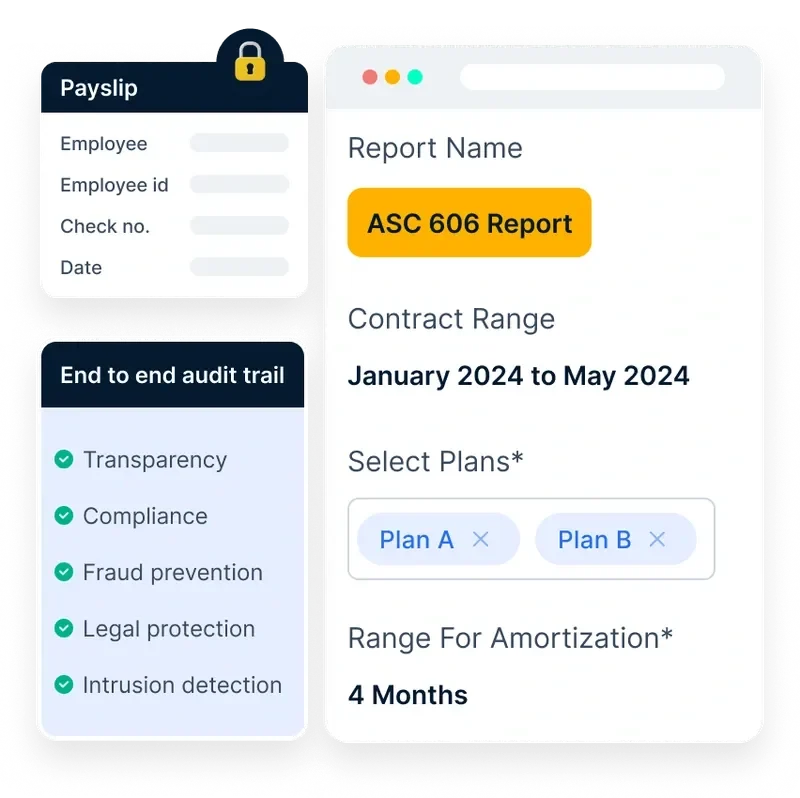
To estimate what manual commission work costs your team, try the sales incentive ROI calculator.
Book your Empuls demo
Frequently asked questions
Most healthcare sales reps earn a base salary plus variable pay. Medical device and equipment reps usually earn a percentage of territory or deal revenue, often with higher rates above quota, while pharmaceutical reps typically earn a quarterly bonus based on territory goals. Commission plans also include clawbacks for returns and rules for splitting credit between reps.
There is no single normal rate, because it depends on the product, deal size, margin and how much of pay is base salary. High-volume disposables pay lower rates per sale than capital equipment or implants, and pharma reps often earn goal-based bonuses instead of a percentage. Set rates by dividing target variable pay by quota for each role.
Pay varies by segment and experience. The US Bureau of Labor Statistics reports a May 2025 median annual wage of $104,920 for sales representatives of technical and scientific products, a category that includes pharmaceuticals and medical instruments. Experienced device and specialty reps with strong territories can earn well above the median through commission and bonuses.
Pharmaceutical sales reps usually receive a base salary plus a bonus paid quarterly. Because doctors prescribe and pharmacies fill the prescriptions, reps rarely take orders directly, so their bonus is tied to territory goals such as prescription volume or market share, sometimes weighted with other measures. Some plans add contests or recognition for launches and compliant selling.
Yes, but it needs care. In the US, the Anti-Kickback Statute bans paying anything of value to induce federal health program business. Pay to bona fide employees is protected by a safe harbor, while percentage commissions to independent agents or distributors fall outside it and need legal review. Never tie rep pay to inducements for clinicians.
A clawback recovers commission already paid when a sale is cancelled, refunded, returned or reversed. For example, if a hospital returns $40,000 of equipment that earned a 5% commission, $2,000 is deducted from the rep's next payout. The plan should state which events trigger a clawback and how long after the sale it can apply.
Base salary is paid on the normal payroll cycle, while commission and bonuses are usually paid monthly or quarterly. Device and equipment commission is often monthly once revenue is recognized or the invoice is paid, and pharmaceutical bonuses are typically quarterly because prescription data needs time to arrive and be validated.





































































































































































































































































































































































































































































































































































