
Key Takeaways
Frontline employees are workers who deliver products or services directly, usually in person and away from a desk, so engagement programs must work on mobile.
After pay, schedule flexibility is the second most important factor in whether frontline employees stay or leave, according to a 2025 UKG survey of more than 8,000 workers.
Timely, specific recognition that reaches every shift is one of the cheapest ways to improve frontline engagement and retention.
Financial wellbeing support, such as earned wage access and rewards that need no bank account, matters because many frontline workers live paycheck to paycheck.
Track turnover, absence, recognition coverage and mobile adoption by site and shift to see where frontline engagement is working.
To motivate frontline employees, pay and reward them fairly, recognize their work where it happens, give them predictable and flexible schedules, keep them safe and informed on mobile, and show them a path to grow. Frontline employee engagement fails when programs are built for desks, so every tactic has to reach people on the shop floor, the shop counter, the ward or the road.
Frontline employees are the driving force behind day-to-day operations. They serve customers, care for patients, make products and move goods, and they shape how the public sees your company. Despite that critical role, they are often overlooked in engagement initiatives, which leads to burnout, absenteeism and turnover. Motivating frontline employees is not just about individual performance: it strengthens the whole workforce and the results it delivers.
This guide explains who frontline employees are, the challenges of engaging frontline workers, 13 practical ways to motivate them and the metrics that show whether it is working. For the psychology behind motivation in general, see our pillar guide on what employee motivation is.
Who frontline employees are and where they work
Frontline employees are workers who deliver a company's products or services directly, usually in person, and who rarely work at a desk or in an office. They are often the first point of contact with customers and are also called deskless workers, field teams, mobile workers or blue-collar workers. A large share of the world's workforce is frontline, across almost every essential industry:
| Sector | Typical frontline roles |
|---|---|
| Health and social care | Nurses, doctors, paramedics, care workers, pharmacy and lab staff |
| Retail and hospitality | Store associates, cashiers, hotel and restaurant staff, cinema crews |
| Manufacturing and utilities | Machine operators, plant technicians, line supervisors, field engineers |
| Transport and logistics | Drivers, delivery executives, warehouse staff, airline crew and ground staff |
| Education and childcare | Teachers, teaching assistants, childcare workers |
| Public services and safety | Police, fire and rescue, municipal and sanitation workers |
| Financial and essential services | Bank branch staff, field agents, postal and telecom workers |
Each group has its own pressures. For industry-specific playbooks, see our guides on motivating airline employees, motivating last-mile delivery executives and employee engagement in retail.
Why frontline employee engagement matters
Frontline employees decide whether customers get the experience you promise, so their engagement shows up directly in service quality, safety and sales. Engagement is low everywhere: Gallup's State of the Global Workplace report found that only 20% of employees worldwide were engaged in 2025, and estimated that low engagement costs the global economy about $10 trillion in lost productivity.
Frontline workers are also clear about what keeps them. A 10-country UKG survey of more than 8,000 workers found that, after pay, schedule flexibility is the second most important factor in whether frontline employees stay or leave, and 56% said they live paycheck to paycheck. Frontline employee retention depends on getting those basics right before anything else.
Challenges in engaging frontline workers
Keeping frontline employees safe, healthy and aligned with company goals is hard for organizations everywhere. These five challenges come up most often, and safety is first because no engagement program works if people do not feel protected at work:
- Employee safety: Frontline work often carries physical risk, especially in healthcare, manufacturing and logistics. US private employers reported about 2.5 million nonfatal workplace injuries and illnesses in 2024, according to the Bureau of Labor Statistics, and health care and social assistance had one of the highest rates at 3.4 cases per 100 full-time workers.
- Stress, burnout and financial worry: Long shifts, demanding customers, short staffing and tight budgets leave many frontline employees exhausted and anxious about money, which drags down focus and morale.
- No instant communication: Many frontline workers have no corporate email and rarely sit at a computer. Without a mobile channel, updates, safety alerts and recognition never reach them, which causes mistakes and leaves people feeling out of the loop.
- No single source of truth: Frontline staff rely on timely information, such as policies, schedules, procedures and updates, but complex enterprise systems make it hard to find on the go.
- Distance from managers: Office teams stay connected through digital tools, but frontline employees spread across sites, shifts and routes often see their managers rarely, and feedback in both directions gets lost.
Reach every frontline employee on their phone
Recognize, reward and hear from deskless teams in their own language with Empuls.
Talk to our ExpertTrusted by 5,000+ companies
How to motivate frontline employees: 13 strategies
The 13 strategies below cover pay, flexibility, wellbeing, recognition, growth and belonging, and they work across industries even though each sector has its own pressures. Financial incentives come first because fair pay is the foundation frontline workers name most often, and the rest build on it.
1. Provide financial incentives and bonuses
Frontline workers often work long hours in high-pressure environments, which makes financial incentives one of the most effective ways to motivate them. Performance bonuses, attendance rewards, peak-season premiums and milestone incentives boost morale and encourage consistent effort.
Link incentives to metrics employees can influence, such as customer satisfaction, safety, quality or productivity, keep the rules simple and pay out quickly. Our guide on how incentives influence behavior explains why timing and fairness matter as much as the amount.
2. Offer flexible and predictable schedules
Flexibility looks different on the frontline. Most people cannot work from home, but they can have more control over when they work: posting schedules weeks in advance, letting employees swap shifts through an app, offering self-scheduling or compressed weeks and avoiding last-minute changes.
Predictability matters as much as choice. A stable schedule lets people plan childcare, study and second jobs, which reduces absence and makes them more likely to stay.
3. Invest in wellbeing and support programs
Prioritizing the physical and mental wellbeing of frontline workers shows you value them as people. Offer access to wellness programs, counseling and mental health support, health checks, proper rest breaks and quiet spaces to recover during long shifts.
Make support easy to reach on a phone and available outside office hours, since frontline workers often need it during nights and weekends. Recognizing healthy habits, like completing a wellness challenge, helps make wellbeing part of the culture.
4. Build structured recognition programs
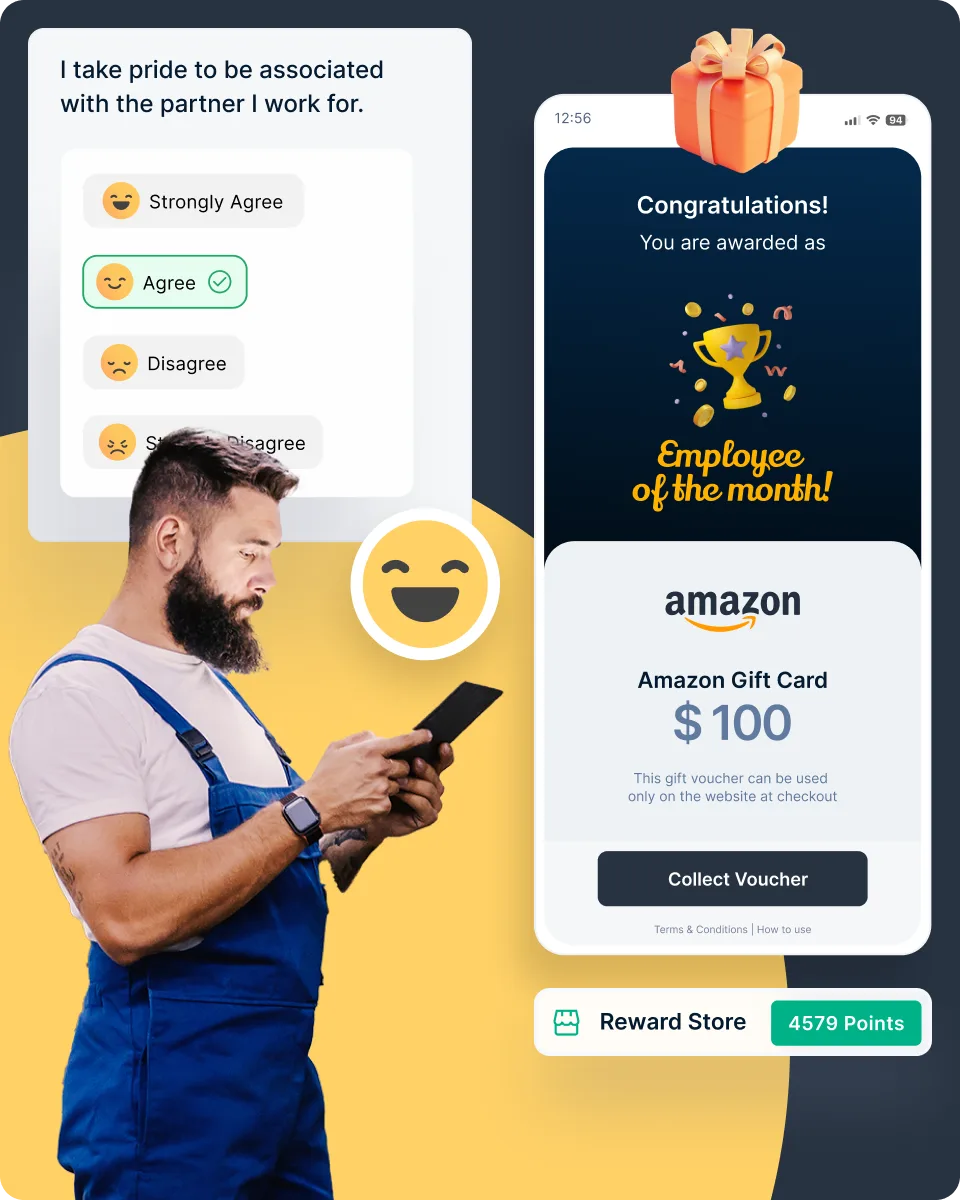
Recognition helps frontline workers feel valued for hard work that is often invisible to leadership. Employee of the month awards, public shoutouts in team huddles and small rewards for outstanding contributions all build a culture of appreciation.
Frontline worker recognition works best when it is timely, specific and reaches every shift. A Gallup and Workhuman study found that employees whose recognition meets at least four of five quality pillars are nine times as likely to be engaged, and that well-recognized employees were 45% less likely to have left after two years. Mobile recognition, QR reward cards and points that can be redeemed without a bank account make that possible for deskless teams.
5. Support employees' families
The families of frontline workers also make sacrifices, from missed holidays to night shifts. Family support programs show appreciation for the whole support system: childcare help, scholarships for employees' children, family health cover, family days and rewards that the whole household can enjoy.
6. Create career advancement opportunities
Many frontline workers leave because they cannot see a future in the job. Offer skill development, certifications and clear pathways from frontline roles to team lead, supervisor, trainer or specialist positions, and share the criteria openly.
Promoting from within rewards your best people, keeps their knowledge in the business and shows everyone else that growth is possible without leaving.
7. Host appreciation events and celebrations
Appreciation events create memorable experiences and a sense of belonging. They can be as simple as a shift-wide meal or as large as a company celebration. Hilton, for example, runs an annual Team Member Appreciation Week to celebrate the people who run its hotels.
Schedule celebrations so every shift can take part, including nights and weekends, and mark personal milestones like work anniversaries and birthdays as well as team wins.
8. Build peer support networks
Frontline workers often feel isolated, especially when they work alone, across sites or on different shifts. Peer support networks let employees share experiences, offer advice and solve problems together, which reduces stress and improves job satisfaction.
A mobile social intranet gives these networks a home, so people can connect, ask questions and share updates in real time, even if they never meet in person.
9. Encourage peer recognition and rewards
Peers often see great work before managers do. Letting frontline employees recognize and reward each other builds teamwork and camaraderie, and it makes recognition far more frequent than it could be if it depended only on supervisors.
Keep peer recognition simple: a few taps on a phone, a small points budget for everyone and a shared feed where shoutouts are visible across the team.
10. Offer community and volunteer opportunities
Volunteering on behalf of the company gives frontline workers a chance to give back to the communities they serve and shows the company's commitment to social responsibility. Offer paid volunteer time and let teams choose causes that matter to them.
11. Share ownership and profits
Giving frontline workers a stake in the company's success builds a strong sense of ownership. Publix Super Markets, which is majority owned by its employees, is a well-known example of a frontline-heavy business that shares its success through stock ownership.
Profit sharing, team bonuses tied to store or site results and employee stock plans all connect daily effort to the company's results.
12. Offer early wage access for financial flexibility
Many frontline workers live paycheck to paycheck, and money worries lead to stress and disengagement. Earned wage access lets employees withdraw part of the wages they have already earned before payday, so they can handle unexpected expenses without high-interest loans.
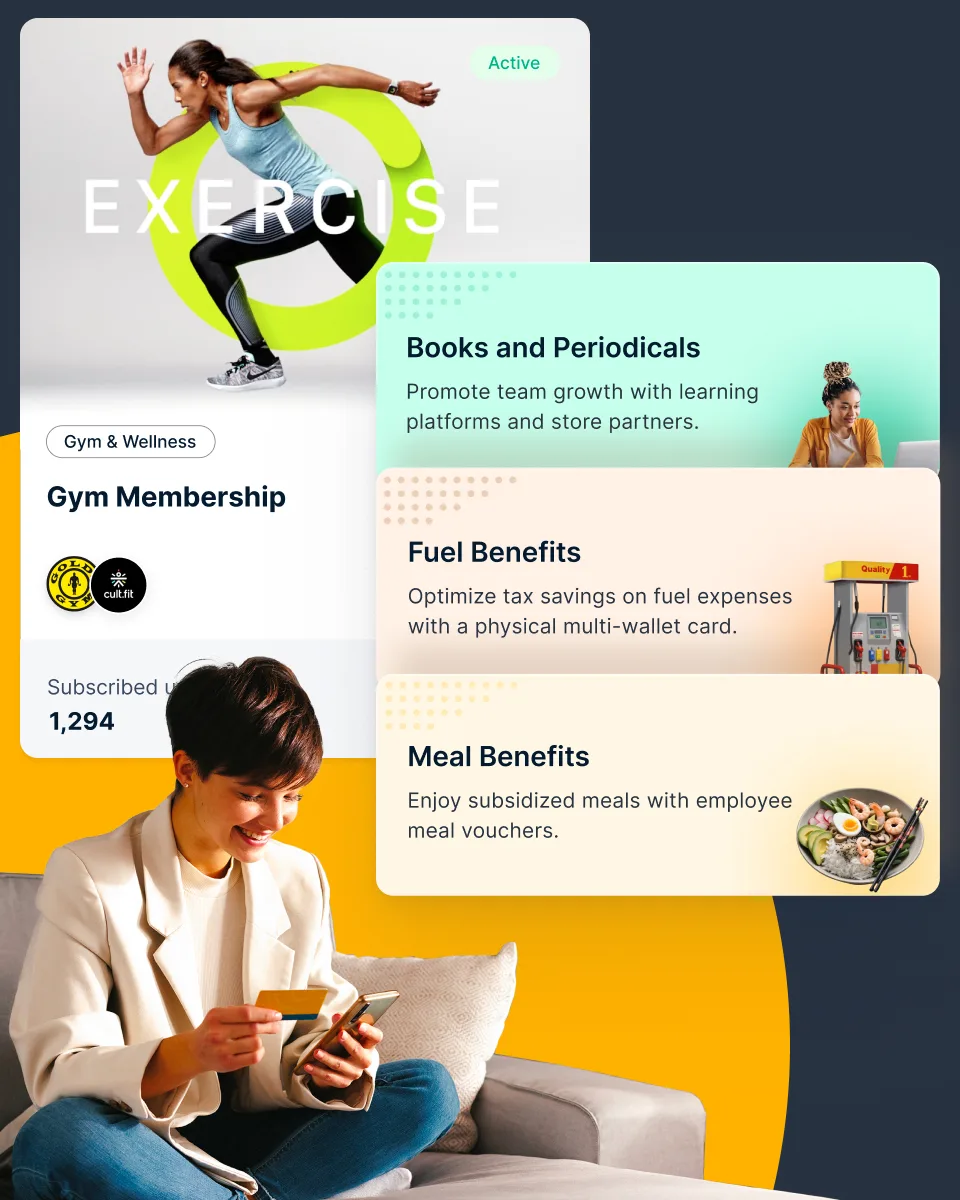
Pair it with tax-saving benefits, such as meal, fuel and telecom allowances where local rules allow, discounts on everyday purchases and simple financial education. For more on the cost of disengagement, see our guide to employee disengagement.
13. Make frontline employees feel part of the team
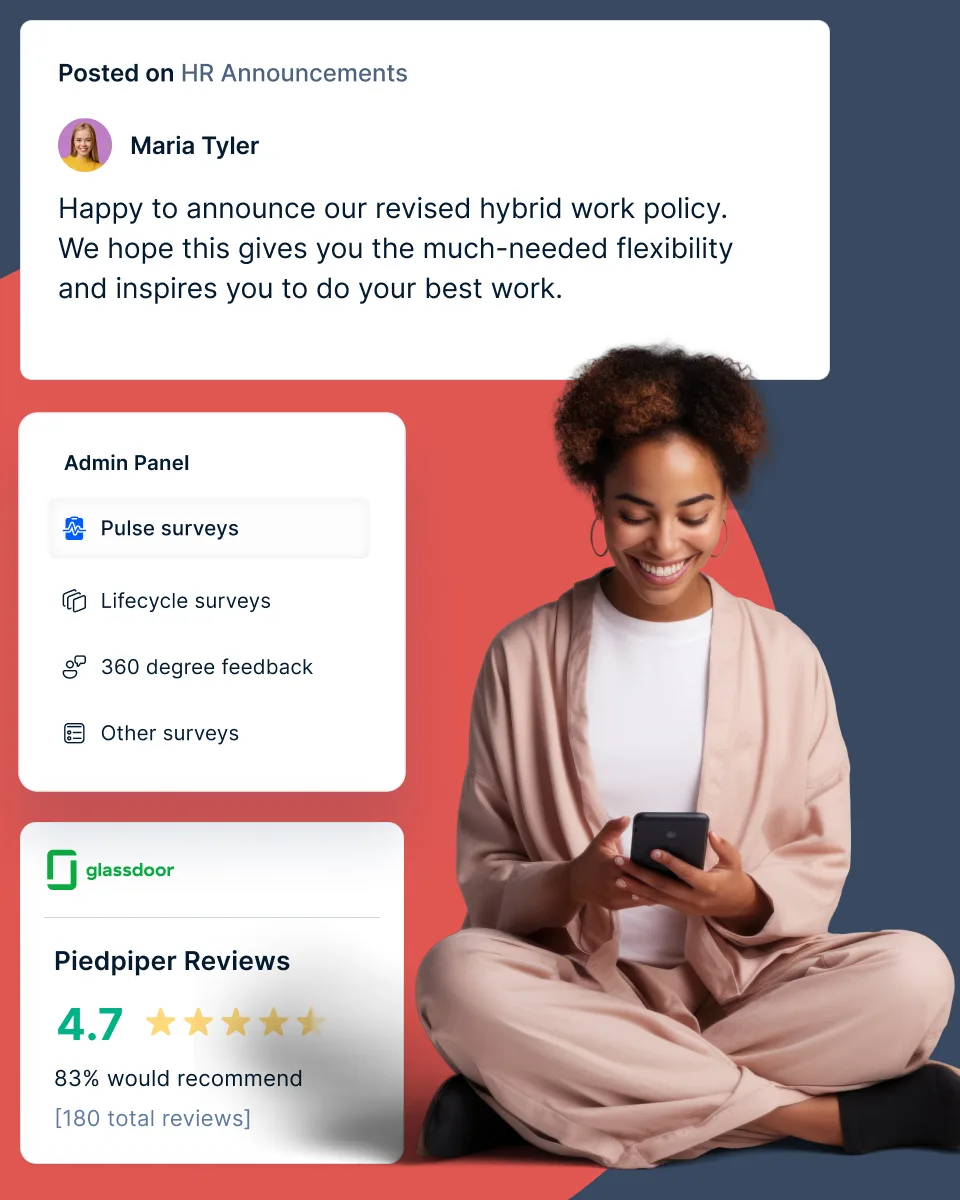
Frontline workers may work far from head office, but they should never feel like outsiders. Start with your communication strategy: include frontline stories in company updates, share news on mobile instead of email and account for shifts, time zones and languages.
Give them a voice too. Short pulse surveys, suggestion channels and visible follow-up show that their input changes things, which is what turns a job into a team.
Common mistakes when engaging frontline workers
Most frontline programs fail for the same few reasons. Avoid these and your program is far more likely to reach the people it is meant for:
- Building for desks: Tools that need a laptop, a corporate email or a VPN never reach the floor.
- Relying only on supervisors: If recognition depends on one manager's habits, some teams get plenty and others get none.
- Rewards that are hard to redeem: Rewards that need bank details or office visits stall, and trust in the program falls.
- Forgetting shifts and languages: Night, weekend and multilingual teams miss out unless you design for them from the start.
- Asking without acting: Surveys with no visible follow-up teach people that their feedback does not matter.
Metrics to track frontline engagement and retention
Track a small set of metrics by site, shift and role, so you can see where engagement is working and where it is not:
| Metric | What it tells you |
|---|---|
| Voluntary turnover, including first 90 days | Whether onboarding and early experience keep people |
| Unplanned absence rate | Burnout, scheduling problems or disengagement |
| Recognition coverage | Share of frontline employees recognized at least once a month |
| Program adoption on mobile | Whether your tools actually reach deskless staff |
| Pulse survey scores and eNPS | How people feel and why other metrics are moving |
| Internal promotions from frontline roles | Whether career paths are real |
| Safety incidents and customer satisfaction | The business impact of engagement |
How Empuls helps you motivate frontline employees
Empuls, Xoxoday's employee engagement platform, is built to reach deskless teams. It runs on iOS, Android, WhatsApp and SMS, works on entry-level smartphones and supports more than 20 regional languages. Managers can send recognition in seconds or hand out QR reward cards on the floor, and employees redeem points for groceries, fuel, mobile recharges and gift cards without needing a bank account. Milestone rewards mark anniversaries and achievements, surveys give frontline staff a voice and benefits such as tax-saving allowances and salary advances support financial wellbeing. Learn more about Empuls for the frontline workforce.
SPI Cinemas, a multiplex operator with a 1,200-strong, largely frontline workforce working weekends and holidays, used Empuls to replace manual, manager-dependent engagement. It cut the time to run its rewards and recognition programs by 90% and reduced workdays lost to absence from 400 to 350 a year by linking attendance to reward points. Read the full SPI Cinemas case study, or see how a large manufacturing and logistics enterprise raised frontline recognition adoption from 24% to 83%. For tool comparisons, see our list of the best recognition software for frontline and field workers.
Book your Empuls demo
Frequently asked questions
Fair pay comes first for most frontline employees, followed by predictable, flexible schedules, recognition for their work, safe working conditions and a visible path to grow. Financial security also matters, since many live paycheck to paycheck. Programs that address these basics, and that work on a phone rather than a desk, motivate far more than one-off perks.
Frontline employees are workers who deliver a company's products or services directly, usually in person and away from a desk. They include nurses and care workers, retail and hospitality staff, factory and warehouse workers, drivers and delivery executives, airline crew, teachers, police and field technicians. They are often the first and main point of contact with customers.
Engage frontline workers without email by using a mobile app, WhatsApp or SMS for updates, recognition and surveys, with login by phone number or employee ID. Physical QR reward cards, digital screens in break rooms and short team huddles also help. Keep messages brief, translate them into the languages your teams speak and time them around shifts.
Managers can recognize frontline workers effectively by doing it promptly, naming the specific action and its impact, and making it visible to the team, for example in a shift huddle or on a mobile feed. Small rewards that are easy to redeem add weight. Recognition should reach every shift and site, not just the people managers see most often.
Frontline employee retention is difficult because pay is often modest, schedules are unpredictable, the work is physically and emotionally demanding and career paths are unclear. Many frontline workers also feel overlooked compared with office staff. Small pay differences can tempt people to switch, so employers that combine fair pay with flexibility, recognition and growth keep people longer.
Good rewards for frontline employees are practical, flexible and easy to redeem: points for groceries, fuel and mobile recharges, gift cards, extra paid time off, meals for the team, family experiences and branded gear. Cash bonuses work well for clear targets. Choice is important, so a rewards catalog that employees can use from a basic smartphone is ideal.
Measure frontline employee engagement with short mobile pulse surveys and eNPS, combined with behavioral data such as turnover, early attrition, unplanned absence, recognition coverage and program adoption. Break results down by site, shift and role to find hotspots. Customer satisfaction and safety incidents show the business impact of changes in engagement.
Frontline employees should receive some form of recognition at least every week or two, with formal awards monthly or quarterly. Frequent, small acknowledgments from managers and peers matter more than rare, large ones, because they reinforce good work while it is still fresh. Tracking recognition coverage helps make sure no team or shift is left out.





































































































































































































































































































































































































































































































































































