
Key Takeaways
Sales incentive compensation is the variable pay a company offers sellers on top of base salary to reward specific results and behaviors.
A good plan is built from the sales strategy, fitted to each role and limited to three measures or fewer, so every rep can explain how a deal changes their pay.
Inaccurate quotas, opaque pay and late or wrong payouts do the most damage to trust, so fix quota setting, visibility and payout accuracy first.
Simulate every new plan on last year's deals and write crediting, clawback and change rules into a signed plan document before launch.
Measure incentive ROI as margin gained over a baseline minus the full cost of the plan, and review measures and quotas every quarter.
Sales incentive compensation best practices come down to five habits: design the plan from your sales strategy, keep it simple enough for every rep to explain, set quotas from data, govern changes and disputes in writing, and pay accurately and on time. The 12 practices below cover each stage of the plan, from design to measurement, with a worked ROI example and a plan health check you can run on your current plan this week.
Sales incentive compensation is the variable pay a company offers sellers on top of base salary to reward specific results and behaviors, such as closing deals, hitting quota or selling a priority product. Done well, it aligns what reps do every day with what the business needs. Done badly, it costs a fortune and pushes people toward the wrong deals.
What a sales incentive compensation plan includes
A sales incentive compensation plan is the written set of rules that decides who earns what, for which results, and when it is paid. A representative might earn a commission on every deal or a bonus for reaching a target, and most of that is paid as cash as part of the overall compensation plan. But incentive compensation is also designed to stimulate specific behaviors, so it doubles as a tool for motivation and recognition.
It has value that extends beyond the money. Recipients often see an incentive as a celebration of their work, which makes it more memorable than salary. That is why many plans include noncash rewards such as trips, event tickets or a family holiday alongside commissions. The most common components are:
- Commission: A percentage of revenue or margin on each deal, the core of most sales plans.
- Quota bonus: A fixed amount paid for reaching a target in a period.
- Accelerators: Higher rates paid on results above 100% of quota.
- SPIFs and contests: Short-term rewards for a specific product, deal type or activity.
- Noncash rewards: Incentive travel, President's Club, experiences and reward points.
For the full landscape of incentive types and how they fit together, start with this guide to sales incentives. For the formulas behind each pay structure, see these sales commission structures.
Why sales incentive compensation best practices matter now
Most companies change their plans every year, yet few are confident the plans work. The Alexander Group 2026 Sales Compensation Trends Survey found 97% of companies changed their 2026 plans, while only about one in five rated their 2025 plans very effective. The same survey found 57% struggle to set accurate quotas and 65% say they need to improve compensation governance and program management.
97%
of companies changed their 2026 sales comp plans
Alexander Group, 2026
1 in 5
rated their 2025 plans very effective
Alexander Group, 2026
64%
had at least one commission payout error
CaptivateIQ, 2026
74%
of reps want more transparency in pay calculations
Salesforce, 2026
The gap between how often plans change and how well they work
Execution is the other half of the problem. In CaptivateIQ's 2026 State of Incentive Compensation research with 200 leaders, 64% reported payout errors and 93% said reps raise payout questions every pay period. A plan can be well designed on paper and still lose the team's trust if the numbers arrive late or wrong.
Three principles of sales incentive plan design
Before you look at individual practices, check the plan against three principles. They are a quick way to judge any sales incentive plan design, and every best practice in the next section serves at least one of them.
| Principle | What it means | What it looks like in the plan |
|---|---|---|
| Organizational | The plan links pay to company goals and can adapt when the market or strategy changes | Each measure is weighted by its importance to the annual plan, and the plan states how mid-year changes are made |
| Motivational | Rewards fit the person and the role, and carry emotional value as well as cash | Targets set from each territory's potential rather than the same percentage increase for everyone, plus recognition for achievement |
| Behavioral | The plan pays for the behavior you want, not just the number | Credit for lead quality, retention or lower customer complaints, not only bookings |
Sales leadership and sales operations usually own the plan, with input from finance, HR, marketing and IT. Expect to revise the draft several times as you test it against disputes, buy-in from the wider sales team and the business environment. For a step-by-step build, read how to create a sales incentive program.
Test your next plan before it goes live
Model payouts on real deals, then calculate and pay them automatically.
Talk to our ExpertTrusted by 5,000+ companies
12 sales incentive compensation best practices
These 12 practices follow the life of a plan: design, governance, communication, administration and measurement. If you can fix only a few this cycle, start with practices 4, 10 and 11, because inaccurate quotas, opaque pay and late or wrong payouts do the most damage to trust.
1. Start from the sales strategy, not last year's plan
A plan should answer one question: what must the sales team do this year for the business to hit its goals? If the strategy is to grow a new product line, win new logos or improve retention, the plan has to pay for that. Copying last year's plan with a higher quota quietly rewards last year's strategy.
Write down the two or three outcomes that matter most, then design pay around them. The Alexander Group survey found sales strategy shifts were the top reason companies changed plans for 2026, which is the right trigger for a redesign.
2. Fit the plan to each sales role
No two sales roles are the same, and their incentive plans should not be either. An SDR who books meetings, an account executive who closes new business and an account manager who grows renewals influence different results, over different cycle lengths.
Set the pay mix, measures and payout frequency by role. Roles with short cycles and a lot of influence over the sale can carry more variable pay, while long, complex cycles need a higher base for stability. This guide to the sales compensation plan covers pay mix and OTE in detail.
3. Keep the plan to three measures or fewer
The best sales incentive plan is simple enough for reps to understand how it works, so they can act on it. If a rep cannot explain in one minute how their next deal changes their pay, the plan is too complex to change behavior.
Limit each role to three measures at most, weight them clearly and avoid stacking several multipliers on the same deal. Use separate SPIFs or contests for short-term priorities instead of adding a fourth measure to the core plan.
4. Set quotas from data, and set them on time
Quotas decide whether a plan feels fair. Base them on territory potential, account history, pipeline and ramp time, rather than a top-down number split evenly across the team. Predictive models can estimate individual targets better than the same percentage increase for everyone.
Timing matters as much as the number. In CaptivateIQ's 2026 State of Sales survey of 500 US sales professionals, 71% started the fiscal year without assigned quotas, and 42% waited a month or longer. Reps who do not know their target in January cannot plan their year.
5. Reward overachievement instead of capping it
Caps tell your best sellers to stop selling once they hit the ceiling. Accelerators, which raise the rate above 100% of quota, do the opposite: each extra deal is worth more than the last. Pair them with a large-deal review for genuine windfalls rather than a hard cap on everyone.
Decelerators below a threshold, such as a lower rate under 50% of quota, protect margin without punishing reps who are close. For the math behind tiers and accelerators, see how to calculate sales incentives.
6. Balance cash with noncash rewards and recognition
Cash is the foundation, but its pull has limits. A 2025 Incentive Research Foundation study of 500 reward-eligible employees and channel partners found willingness to put in extra effort rises with reward value only up to a threshold, and that clear objectives, personalization and choice also make programs more appealing.
Recognition fills the gap between payouts. Gallup's 2024 research with Workhuman found well-recognized employees were 45% less likely to have left after two years. Name the deal and the behavior publicly, and add trips or experiences for top performers, which people remember long after a bonus is spent.
7. Model and simulate payouts before launch
Run every new plan against last year's actual deals before anyone signs it. Simulation shows what each rep would have earned, what the plan costs at 80%, 100% and 120% attainment, and where a rule produces an odd result, such as a rep earning more for a smaller deal.
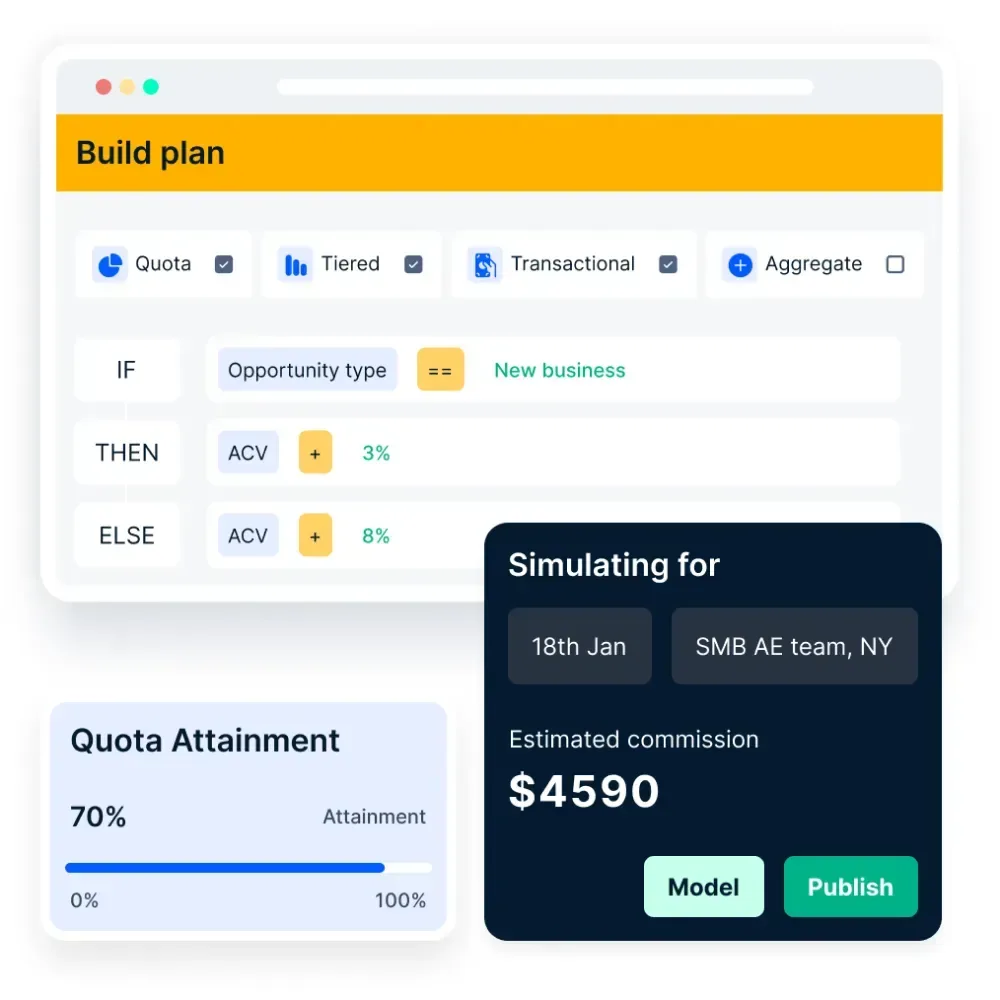
Check the cost of sales against your budget at each attainment level, and test the extremes: one giant deal, a cancelled deal and a rep who joins mid-quarter. Problems found here cost nothing to fix; problems found at the first payout cost trust.
8. Write a plan document with clear crediting rules
Every plan needs a document each rep signs. It should state the measures, rates, payout timing and the rules for the situations that cause most disputes:
- Crediting and splits: Who gets credit when several people work a deal, and in what proportion.
- Clawbacks: What happens to commission when a customer cancels or does not pay.
- Windfalls: How unusually large or unplanned deals are reviewed.
- Changes: When and how quotas, territories or rates can change mid-cycle, and how much notice reps get.
- Leavers and joiners: How pay is prorated for people who start, move roles or leave.
9. Set up plan governance and a dispute process
Governance is how incentive compensation management best practices hold up after launch. Form a small committee from sales, finance, HR and sales operations that approves plan changes, exceptions and large-deal reviews, and keeps a record of every decision.
Give reps one channel to raise a dispute and a published response time, such as five working days. When the same dispute keeps coming up, treat it as a design flaw and fix the rule, not just the individual payout.
10. Communicate the plan and give reps live visibility
Poor communication of a great plan is worse than good communication of a mediocre plan. Launch with a short session, a one-page summary with worked examples for each role, an FAQ document and an open channel for questions.
Then keep it visible. Salesforce's 2026 Trends in Sales Compensation report found 74% of reps want more transparency in how compensation is calculated and 47% say their pay does not always seem fair. A live view of attainment and earnings stops shadow accounting, where reps rebuild the calculation in their own spreadsheets instead of selling.
11. Automate calculations and pay on time
Manual calculation is bound to produce errors with many roles, large data sets and changes tracked across teams. Inaccuracy cuts both ways: overpayment is a direct financial loss, while underpayment erodes trust, lowers performance and can end in a legal dispute. When reps doubt their pay, the time they should spend selling goes into checking it.
Automation fixes three things at once. It reduces the people and days needed for each cycle, it lowers the risk of disputes, and it makes cost data available on demand, so finance does not wait until month end to see incentive spend and can forecast faster. This is why teams that automate the sales commission process usually see the fewest payout questions.
12. Measure ROI and review the plan every cycle
Incentive compensation is one of the largest costs in sales, so measure what it returns. In money terms, compare the revenue, margin or new customers gained over a baseline with the full cost of the plan, including payouts and administration. For the softer effects, set the metrics before launch, such as rep retention, training adoption, absenteeism and satisfaction scores in surveys.
| Line | Example value | How to get it |
|---|---|---|
| Revenue this year | $12,000,000 | Actual bookings or recognized revenue |
| Baseline revenue without the new plan | $10,800,000 | Last year plus expected market growth |
| Incremental revenue | $1,200,000 | Revenue minus baseline |
| Gross margin on incremental revenue (60%) | $720,000 | Incremental revenue x margin |
| Incremental incentive cost | $240,000 | New payouts plus administration over last year |
| Incentive ROI | 200% | (Margin gained minus cost) / cost |
Review the plan at least once a year and check measures, quotas and payout patterns every quarter. If an element did not change the behavior it was meant to drive, it was a cost rather than an incentive, so change it or retire it.
Sales incentive compensation plan health check
Use these 12 checks to score your current sales incentive compensation plan before the next planning cycle. Give one point for each healthy sign; a score below 9 points to the practices to fix first.
| Check | Healthy sign | Red flag |
|---|---|---|
| Strategy fit | Each measure maps to a stated business goal | The plan is last year's with a higher quota |
| Role fit | Pay mix and measures differ by role | One plan covers SDRs, AEs and account managers |
| Simplicity | Three measures or fewer per role | Reps cannot explain how a deal changes their pay |
| Quotas | Set from territory data and assigned before the year starts | Top-down split, issued weeks late |
| Upside | Accelerators above 100% of quota | Hard caps on earnings |
| Reward mix | Cash plus recognition and noncash rewards | Cash is the only lever |
| Simulation | Plan tested on last year's deals and extremes | First real test is the first payout |
| Plan document | Signed, with crediting, clawback and change rules | Rules live in email threads |
| Governance | Committee approves changes and exceptions | Exceptions decided case by case |
| Visibility | Reps see attainment and earnings live | Reps keep shadow spreadsheets |
| Accuracy and timing | Payouts are automated and on schedule | Frequent corrections and late payouts |
| Measurement | ROI and behavior change reviewed each cycle | Nobody can say what the plan returned |
If several red flags sit in design, revisit the plan before the next cycle; this look at the cost of a bad sales incentive plan shows what happens when they are left alone. If the red flags are in administration, the fix is usually process and tooling, covered in sales incentive automation.
How Empuls puts these best practices into action
Empuls sales incentives covers the plan from design to payout on one platform. Admins build commission and incentive plans, including tiers, slabs, splits and clawbacks, in a no-code plan builder, and calculations run automatically from CRM, ERP and HRMS data validated at the source. Every result can be traced back to the data and rules behind it.
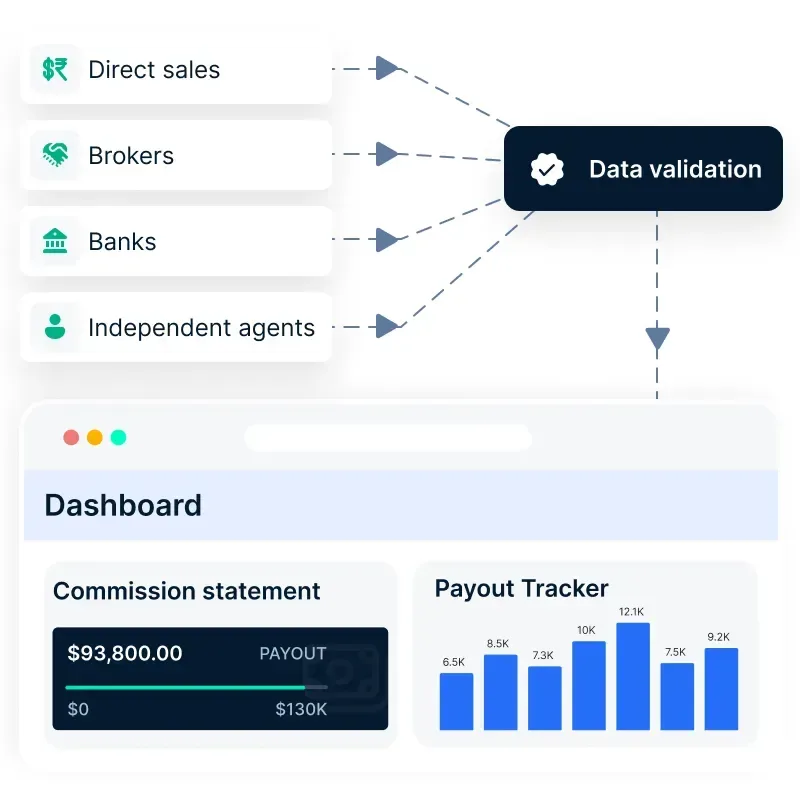
Finance gets multi-level approvals and pre-payout anomaly checks, and approved incentives flow to payroll systems such as ADP, Workday and SAP SuccessFactors. Sales professionals see a KPI scorecard, an earnings estimator and how far the next slab is, which answers the visibility questions above. Mercedes-Benz India used Empuls to automate incentives across 33 franchises and reached 99.9% calculation accuracy with a 40% reduction in payment disputes, according to the Mercedes-Benz India case study.
Explore plans and calculations, payouts and disbursal, sales intelligence for plan comparison and payout accuracy, and the sales incentive ROI calculator to estimate what better incentives could return.
Build plans your sales team trusts
Sales incentive compensation best practices are less about clever formulas and more about discipline: a plan tied to strategy, quotas set from data, rules written down, pay that reps can see and payouts that arrive right and on time. Each one builds the trust that makes variable pay work.
Run the health check on your current plan, fix the red flags with the biggest effect on trust first, and review the results every cycle. A plan that keeps improving will keep motivating.
Book your Empuls demo
Frequently asked questions
The three main methods are salary only, commission only, and base salary plus commission. Salary only gives stability but little performance pull. Commission only ties all pay to results, which suits independent or high-volume sellers. Base plus commission combines a fixed salary with variable pay, which is why it is the most common choice for employed sales teams.
A good sales incentive plan is clear, motivating and aligned with company goals. It rewards the few results and behaviors that matter most for each role, uses quotas set from real territory data, pays more for overachievement, and gives reps live visibility of earnings. It is also paid accurately and on time, because errors undo even a well-designed plan.
A 70/30 compensation plan means 70% of a salesperson's target earnings come from fixed base salary and 30% from variable pay such as commissions, bonuses or incentives. It gives financial stability while still rewarding performance, and it suits roles with longer sales cycles or more team selling, where a rep has less direct control over each deal.
Incentive compensation management, or ICM, is the process and software used to design, calculate, approve, pay and report on variable pay such as commissions, bonuses and SPIFs. Modern ICM tools pull data from CRM and ERP systems, calculate payouts automatically, route approvals, keep an audit trail and give sales reps real-time visibility of their earnings.
Redesign the plan once a year, aligned with the annual sales strategy, and check it every quarter. Quarterly reviews should look at quota attainment spread, payout cost against budget, disputes and whether each measure is driving the intended behavior. Make mid-year changes only through a governance process and with clear notice to reps.
In most cases, no. Caps discourage your best sellers once they reach the ceiling and can push deals into the next period. Use accelerators to reward overachievement and a large-deal or windfall review for unusual, unplanned deals instead. If budget certainty is the concern, model plan costs at high attainment levels before launch.
Compare the incremental revenue or margin generated over a baseline with the full incremental cost of the plan, including payouts and administration. ROI equals margin gained minus cost, divided by cost. Add nonfinancial measures set before launch, such as top performer retention, quota attainment spread and the behavior the plan was designed to change.





































































































































































































































































































































































































































































































































































