
Key Takeaways
Sales incentives are monetary or non-monetary rewards, on top of base pay, tied to measurable sales results or behaviors.
The most effective sales incentive programs pair cash on core targets with non-cash rewards such as recognition, experiences and career growth.
Modern deals involve several people and longer cycles, so incentives should reward supporting roles, split credit by clear rules and pay some reward before the close.
Sales incentive ROI equals incremental gross profit minus program cost, divided by program cost, measured against a baseline period or control team.
Fast, accurate payouts matter as much as plan design, because a late or wrong payout erodes trust faster than a generous plan builds it.
Sales incentives are the rewards a company offers salespeople, on top of base pay, for hitting specific targets or showing specific behaviors. Done well, they point effort at the results the business needs most, such as new customers, margin or a product launch, and they keep good sellers motivated and loyal. This guide covers what sales incentives are, the types that work, how to design a plan, how to measure its return and the mistakes to avoid.
A sales incentive is any monetary or non-monetary reward tied to a measurable sales outcome, such as a commission, a bonus, a SPIFF, a contest prize, a trip or public recognition. Base salary pays people for doing the job. Sales incentives pay them for doing it better, faster or in a particular direction, which is why the design matters as much as the budget.
What sales incentives are and how they differ from base pay
Every sales compensation package has three layers. Base salary gives security, commission pays a share of the revenue a rep brings in, and incentives add targeted rewards that change what reps focus on in a given period. Many people use "sales incentives" loosely for all variable pay, but it helps to separate the layers when you design them, because each one does a different job.
| Layer | What it pays for | Typical form | Time horizon | Main job |
|---|---|---|---|---|
| Base salary | Doing the role | Fixed monthly pay | Ongoing | Security and retention |
| Commission | Revenue or margin generated | Percentage of each sale | Each deal or month | Ongoing selling effort |
| Bonus | Hitting a defined target | Fixed amount at a threshold | Quarter or year | Quota attainment |
| Sales incentives | Specific results or behaviors | SPIFFs, contests, rewards, recognition, trips | Days to a year | Steering focus and lifting motivation |
For the formula side of commission, read how to calculate sales commissions. For how commission and bonus differ in practice, see commission vs bonus.
Why sales incentives matter more than ever
Selling has changed. Buyers arrive better informed and expect proof for every claim, products are more complex and need deeper expertise to explain, more stakeholders sign off on each purchase and buying cycles are longer, which makes forecasts and goals harder to set. A plan built for a single rep closing a quick deal does not fit this reality.
Recent data shows how much pressure sales teams are under. The Ebsta and Pavilion 2025 GTM benchmark report found 78% of sellers missed quota, and Salesforce's 2026 State of Sales research, based on 4,050 sales professionals, found sellers spend only 40% of their time actually selling. On the design side, 44% of firms in the Alexander Group's 2025 sales compensation survey named setting accurate quotas as a top challenge.
78%
of sellers missed quota
Ebsta and Pavilion, 2025
40%
of seller time is spent selling
Salesforce, 2026
44%
of firms struggle to set accurate quotas
Alexander Group, 2025
64%
of companies had a commission payout error
2026 survey of 200 leaders
The pressure that sales incentives are designed to relieve
Execution is the other half of the problem. In a 2026 survey of 200 sales and finance leaders, 64% reported at least one commission payout error in the past year. A plan that pays late or wrongly damages trust faster than a generous plan builds it, so delivery deserves as much attention as design.
Types of sales incentives
Sales incentives fall into two broad groups: monetary rewards paid as cash, and non-monetary rewards such as recognition, experiences and growth. Most effective programs use both, with cash on the core targets and non-cash rewards for short bursts, behaviors and milestones.
| Type | Monetary or not | How it works | Best for |
|---|---|---|---|
| Commission | Monetary | A percentage of revenue or margin on each sale | Ongoing selling effort |
| Accelerators | Monetary | A higher commission rate above quota | Rewarding overachievement |
| Bonus | Monetary | A fixed amount for hitting a target | Quota and annual goals |
| SPIFF | Monetary or gift card | A short-term reward for one product or action | Launches, slow stock, quick pushes |
| Sales contests | Either | Prizes for top results in a set window | Energy and friendly competition |
| Profit sharing | Monetary | A share of company or team profit | Long-term alignment |
| Recognition | Non-monetary | Awards, badges, shout-outs, leaderboards | Morale between payouts |
| Experiences and travel | Non-monetary | Trips, events, dinners, VIP access | Top performers and annual clubs |
| Merchandise and gift cards | Non-monetary (still taxable) | Points or cards redeemed from a catalog | Personal choice of reward |
| Career development | Non-monetary | Training, certifications, mentoring, promotion paths | Retention and future leaders |
| Time off and flexibility | Non-monetary | Extra leave days or flexible schedules | Burnout prevention |
For short-term rewards specifically, see these sales SPIFF ideas. For 25 ready-to-run options sorted by the goal they drive, see these sales incentive ideas.
Cash and non-cash sales incentives work best together
Cash is simple, flexible and universally valued, and it should stay the backbone of pay for core targets. But cash blends into the paycheck and is quickly forgotten. A well-chosen non-monetary reward is visible, personal and memorable: a trip, a piece of equipment the rep wanted or an award presented in front of peers reminds them of the achievement long after the money would have been spent, and it shows the company took the time to find something that fits the person.
Value still matters, but only up to a point. The Incentive Research Foundation's 2025 study of 500 reward-eligible employees and channel partners found that willingness to put in extra effort rises with reward value only up to a threshold, and that clear objectives, personalization and choice also strengthen a program. Recognition has a retention payoff too: Gallup found that well-recognized employees are 45% less likely to have left after two years.
Speed matters as much as the reward itself. An incentive delayed is close to an incentive denied: the closer the reward lands to the win, the stronger the link the rep makes between the behavior and the result.
Design and pay sales incentives in one place
Build plans without code, simulate payouts and give every rep live earnings visibility.
Talk to our ExpertTrusted by 5,000+ companies
Sales incentive structures for how teams sell today
Because modern deals involve more people, longer cycles and several channels, the classic one-rep, one-commission model needs adjusting. These six structures address the gaps, starting with credit sharing because it causes the most disputes when it is left unclear.
1. Reward the supporting roles
Solution architects, technical consultants, product specialists and customer success managers often sway a buying decision at key moments. Core sales should keep its commission and quota framework, so top sellers never feel diluted, while supporting roles can earn a flexible bonus based on their involvement in deals, frontline feedback on their impact and overall team results.
2. Split credit by clear rules
When several people close a deal, write the split down before the deal starts. A common pattern is 10% of the deal incentive to the SDR who sourced it, 70% to the account executive who closed it and 20% to the sales engineer. Clear governance removes arguments about account allocation and individual contribution.
3. Pay something before the close on long cycles
Long buying cycles drain morale. There are three proven ways to keep momentum. Pay a smaller incentive at mid-cycle milestones such as a technical win or a signed proposal, while holding the larger share for the close. Mix each rep's book with short and long cycle deals so some wins keep landing. Or build separate teams for short and long cycles, with a higher base salary for the long cycle specialists.
4. Credit sales across digital channels
A rep may run the demo and answer countless questions, only for the buyer to complete the purchase online. Measure sales influence across the funnel, including digital and self-serve channels, and credit reps in proportion to their contribution. Otherwise they learn that only the last touch counts.
5. Co-create goals and rewards with the team
Let reps take part in choosing their account mix, setting stretch targets and suggesting rewards, within the quarter's business goals. People work harder for goals they helped set, and asking reps what they want removes the guesswork from reward selection.
6. Design for different performance tiers
Every sales team has top performers, a steady middle and people who are new or struggling. Each group responds to different incentives, so one plan for everyone leaves most of the team unmoved.
01 · Top performers
Do not cap their upside
Caps tell stars to stop selling once they hit target. Use accelerators above quota and premium rewards such as travel. Finance may resist, but the extra margin usually covers the cost.
02 · Core middle
Use tiered milestones at their level
The middle is often the most responsive to incentives. Set targets between their own average and best, with frequent, granular milestones, and do not rank them against the stars.
03 · New and struggling
Pair small wins with coaching
Reward activity and early milestones, add coaching and use weekly leaderboards scoped to peers. Gamification nudges effort without public humiliation.
For the full set of commission plan types, OTE and pay mix, read about sales commission and incentive plans and the sales commission structures behind them.
How to create a sales incentive plan in 7 steps
Here is how to create a sales incentive plan that pays for itself. The seven steps run in order, and the first two matter most: a plan without one clear objective and the right measures rewards activity instead of results.
- Set one objective: Pick the single business result the plan must move this period, such as 20% revenue growth, 50 new logos or a margin target.
- Choose two or three measures per role: SDRs on qualified meetings, account executives on closed revenue, account managers on renewals and expansion. More than three measures dilutes focus.
- Fix the budget: Estimate the incremental gross profit the plan should create, and keep total reward cost well below it.
- Pick the incentive types: Combine a core cash element with short-term SPIFFs or contests and recognition, using the types table above.
- Write the rules on one page: Eligibility, timeframe, deal crediting, splits, payout timing, clawbacks and how disputes are handled.
- Communicate with a worked example: Show every rep exactly what they would earn at 80%, 100% and 120% of target, and give them live visibility of progress.
- Pilot, then review every cycle: Test with one team or run the plan in parallel for a cycle, then adjust between cycles, not in the middle of one.
Use the one-page planner below to capture the decisions. For the detailed build, with 12 program formats and a payout template, follow this guide on how to create a sales incentive program.
| Planner field | Question to answer | Example |
|---|---|---|
| Objective | What single result must this plan move? | Grow new-customer revenue 20% in Q1 |
| Participants | Which roles and regions are eligible? | All account executives in North America |
| Measures | Which two or three numbers decide the payout? | New-customer revenue, number of new logos |
| Incentive mix | Which cash and non-cash rewards apply? | Bonus at target, SPIFF per new logo, quarterly award |
| Thresholds | Where does each reward start and stop? | Bonus from 90% of target, accelerator above 110% |
| Budget | What is the maximum total cost? | $60,000, capped at 10% of incremental gross profit |
| Rules | How are splits, clawbacks and disputes handled? | Written one-pager signed off by sales and finance |
| Tracking | Where do reps see progress? | Live dashboard and weekly leaderboard |
| Review | When is the plan checked and changed? | Mid-quarter check, full review at quarter end |
How to measure the ROI of sales incentives
A sales incentive program should earn more than it costs. The cleanest test compares the incremental gross profit the program produced with everything it cost to run, including rewards, taxes, platform fees and admin time.
Sales incentive ROI = (incremental gross profit minus program cost) / program cost x 100. Incremental means above what you would have sold anyway, so compare against the same period last year, a control team or the pre-launch run rate.
| Line | Value | How it is calculated |
|---|---|---|
| Baseline new-customer revenue | $1,000,000 | Same quarter last year |
| Revenue during the program | $1,200,000 | Actual result |
| Incremental revenue | $200,000 | $1,200,000 minus $1,000,000 |
| Gross margin | 60% | Company figure |
| Incremental gross profit | $120,000 | $200,000 x 60% |
| Program cost | $30,000 | $24,000 rewards plus $6,000 tax gross-up and admin |
| Sales incentive ROI | 300% | ($120,000 minus $30,000) / $30,000 x 100 |
Beyond ROI, track a short set of health signals each cycle:
- Participation: The share of reps who earn at least one reward. If only the top 10% ever earn, the targets are too steep for everyone else.
- Behavior change: Movement in the specific measure the incentive targeted, such as new logos or attach rate, not just total revenue.
- Payout accuracy and speed: Disputes raised, errors found and days from result to payment.
- Retention: Turnover among high performers compared with the previous year.
- Rep sentiment: A two-question pulse at the end of each cycle on whether the plan felt fair and clear.
For incentive calculations beyond commission, including bonuses, SPIFFs and multipliers, read how to calculate sales incentives.
Common sales incentive mistakes to avoid
Most failing sales incentive programs fail for a handful of predictable reasons. Check your plan against this list before launch:
- Capping top performers: Caps make stars coast once they hit target. Use accelerators and model the cost instead.
- Too many measures: Five or six KPIs in one plan leave reps unsure what matters. Keep two or three per role.
- One plan for everyone: Stars, the middle and new hires respond to different rewards and targets.
- Slow or wrong payouts: Manual spreadsheets cause delays and errors that destroy trust in the plan.
- Ignoring supporting roles: Engineers and specialists who help close deals disengage if only the closer is rewarded.
- Changing rules mid-cycle: Unannounced changes feel like broken promises. Adjust between cycles.
- Rewarding volume over value: Paying on revenue alone can push heavy discounting. Add margin or deal quality where it matters.
For a deeper look at what goes wrong and what it costs, read about the bad sales incentive plan and why sales incentives fail.
How Empuls helps you run sales incentives
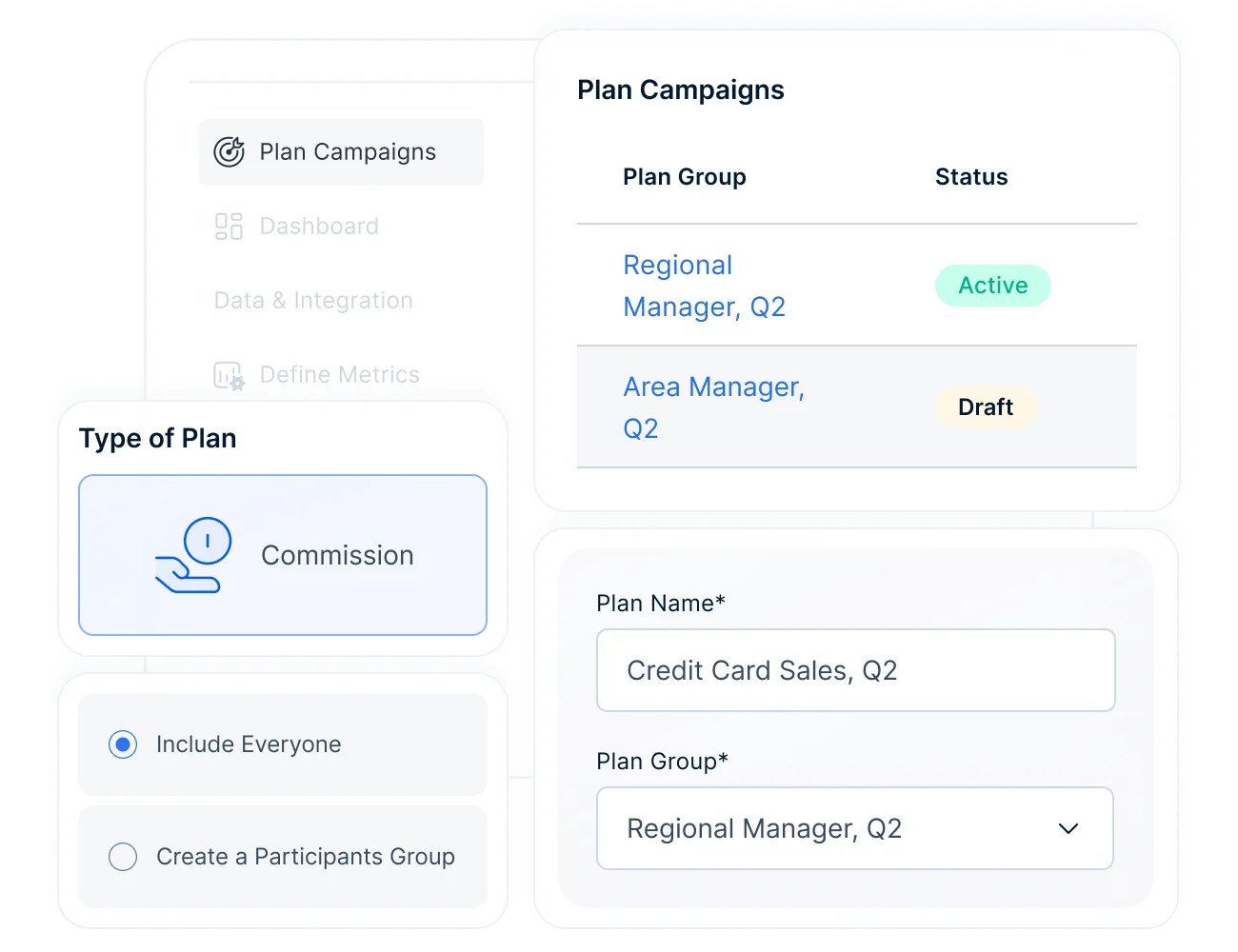
Empuls includes sales incentive and commission management that covers the full cycle, from plan design to payout. Admins build commission, target and milestone plans in a no-code plan builder, with tiers, slabs, splits and clawbacks, and can simulate the payout impact before a plan goes live. Calculations run on data from your CRM, ERP and HRMS, so reps and finance see the same numbers.
Sales professionals get a KPI scorecard, an earnings estimator and leaderboards, and short-term pushes run as SPIFFs and contests on top of the base plan. Approved incentives can be paid through payroll, bank transfer, UPI or rewards in 50+ currencies. Mercedes-Benz India used Empuls to automate incentives across 33 franchises with 99.9% calculation accuracy, as described in the Mercedes-Benz India case study.
Explore Empuls sales incentives, the plan builder and calculations, leaderboards, SPIFs and contests and the sales incentive ROI calculator.
Rethink sales incentives as a system, not a payout
The strongest sales incentive programs share a few traits. Rewards match the size of the achievement, fit the person who earned them and arrive quickly. Plans treat stars, the middle and new hires differently, credit everyone who helped win a deal and change based on data rather than habit.
Remember that incentives sit inside a culture. A sense of belonging, work that feels meaningful and managers who coach rather than chase are powerful motivators that no commission rate can replace. Build sales incentives on that foundation, review them every cycle and they will keep paying for themselves.
Book your Empuls demo
Frequently asked questions
Common examples include commissions, accelerators above quota, target bonuses, SPIFFs on a specific product, sales contests, incentive trips, gift cards and merchandise, public awards, extra paid time off and paid training or certifications. Most companies combine a cash commission or bonus for core targets with short-term SPIFFs and non-cash recognition to keep motivation high between payouts.
A commission is one type of sales incentive: a percentage of the revenue or margin a rep generates, paid on every eligible sale. Sales incentive is the broader term and also covers bonuses, SPIFFs, contests, trips, recognition and other rewards. Commission drives ongoing effort, while other incentives steer attention toward specific goals for a set period.
There is no universal figure. Work backward from the incremental gross profit you expect the program to generate and keep total cost, including taxes and admin, well below it. Then model payouts at 80%, 100% and 120% of target so finance knows the worst case. Short-term SPIFFs and contests usually take a small, fixed slice of that budget.
Yes, when they are chosen well. Non-cash rewards such as trips, experiences and public awards are more memorable than cash and show personal effort. Incentive Research Foundation research from 2025 found that clear objectives, personalization and choice strengthen a program alongside reward value. Use them alongside cash, not instead of fair core pay.
In the US, cash incentives and cash equivalents such as gift cards are taxable wages, and IRS guidance says they are never excludable as de minimis benefits. Bonuses and similar supplemental pay are commonly withheld at a flat 22% federal rate. Non-cash prizes such as trips are generally taxable at fair market value. Check local rules in each country you pay.
Review the core plan once a year, aligned with quotas and the budget cycle, and refresh short-term incentives such as SPIFFs and contests every quarter so they stay fresh. Avoid changing rules in the middle of a cycle unless the written plan allows it, because unannounced changes feel like broken promises and damage trust.
Use both. Individual incentives reward personal results and suit roles with clear ownership of deals. Team incentives build collaboration and suit complex deals that need several contributors. A common design pays individual commission on core targets and adds a team bonus or shared reward when the region or team hits its goal.





































































































































































































































































































































































































































































































































































