
Key Takeaways
Sales commission and incentive plans decide how salespeople earn variable pay: the commission plan sets the core structure and incentive programs push specific goals on top.
The most common commission plans are base plus commission and tiered commission, with gross margin, draw, team, residual and multiplier structures for specific situations.
A commission rate can be set by dividing target variable pay by quota, so $80,000 of target variable on a $1,000,000 quota means an 8% rate.
Pay mix should lean toward a higher base for long, team-based sales cycles and toward a higher variable share when the rep clearly drives the result.
Reps trust plans that are simple, reward middle performers and pay accurately and on time, which matters as much as the amount paid.
Sales commission and incentive plans decide how salespeople earn variable pay. The commission plan sets the core structure, such as base plus commission, tiered or gross margin commission, and incentive programs such as SPIFs, contests and bonuses sit on top to push specific results. This guide compares the main plan types with examples, shows how to set pay mix and OTE, and lists the practices that make reps trust the plan.
Keeping a sales team motivated is no small feat. Many assume sales reps are driven only by money, but like all employees they also want purpose, recognition and fairness. A well-designed plan is one of the most powerful tools to inspire performance, retain top talent and drive growth, while outdated processes, unclear rewards and slow payouts lead to disengagement, turnover and missed revenue.
What sales commission and incentive plans are
A sales commission plan is the set of rules that turns a salesperson's results into variable pay, usually a percentage of revenue or margin on the deals they close. A sales incentive plan is broader: it rewards specific goals and behaviors, such as new customers, a product launch or pipeline activity, with cash or non-cash rewards. Three terms are worth separating:
- Compensation: The total earnings of a salesperson, including base salary, commissions and bonuses.
- Commission: Variable pay calculated from sales results, usually a percentage of revenue or margin.
- Incentive: An additional reward, monetary or non-monetary, for meeting a specific goal beyond core revenue.
Salespeople were paid through incentives long before economists wrote about the principal-agent problem, for three reasons. First, short-term sales output is easy to measure. Second, reps often work with little direct supervision, so incentive pay gives managers some control over where effort goes. Third, many salespeople have a larger appetite for risk than other workers, so variable pay appeals to them.
Plan design is getting harder, not easier. The Alexander Group 2025 Sales Compensation Trends Survey found that 52% of firms named driving productivity as their top sales compensation objective, 44% struggle to set accurate quotas and 41% have started using AI in sales compensation workflows, while total sales expense was projected to rise 6%.
52%
say driving productivity is the top comp objective
44%
struggle to set accurate quotas
41%
use AI in sales comp workflows
6%
projected rise in total sales expense
Sales compensation priorities in 2025. Source: Alexander Group Sales Compensation Trends Survey
Why most sales commission plans do not work
Many sales commission plans fail to deliver because of a few common pitfalls. These five come up again and again, and each one is a design choice you can fix:
- One-size-fits-all plans: Every sales team is different, yet many companies use the same structure for every rep. Plans tailored to each role and goal perform better.
- A pay mix that does not fit the role: If the balance between base salary and variable pay is wrong, it either demotivates reps or drives unhealthy competition.
- Delayed payouts: When commission arrives late, motivation drops and trust in the system erodes.
- Only top performers are motivated: Plans that reward only high achievers leave mid-level performers disengaged, even though they carry much of the number.
- No intermediate recognition: Without rewards along the way, reps lose momentum long before they reach big targets.
For the cost of these mistakes in numbers, read about the bad sales incentive plan, and for how a broken plan shows up in payouts and trust, see why sales incentives fail.
Sales commission plan types with examples
There are nine common sales commission plans, and most companies combine two or three of them. Base plus commission and tiered commission are the most widely used starting points, so they come first, followed by structures for margin, ramping reps, teams and recurring revenue.
| Commission plan | How it works | Example | Best for |
|---|---|---|---|
| Base salary plus commission | Fixed salary plus a percentage of sales | $50,000 base plus 5% of revenue: $400,000 sold earns $20,000 commission | Most B2B roles with steady pipelines |
| Straight commission | No base, all pay comes from commission | 10% of revenue: $300,000 sold earns $30,000 | Independent agents, high-volume transactional sales |
| Tiered commission | Rate rises as attainment rises | 5% up to quota, 8% from 100% to 150%, 10% above 150% | Teams that need reps to exceed quota, not just meet it |
| Quota-based bonus | Fixed bonus at set attainment levels | $5,000 at 80% of quota, $10,000 at 100% | Simple plans and new teams |
| Gross margin commission | Percentage of margin rather than revenue | 20% of margin on a $100,000 deal at 30% margin earns $6,000 | Businesses where discounting hurts profit |
| Draw against commission | An advance paid against future commission | $3,000 monthly draw; earning $2,000 leaves $1,000 to recover if the draw is recoverable | Ramping reps and long sales cycles |
| Territory or team commission | Commission on a shared territory or team result, split among members | 3% of territory revenue shared across a four-person pod | Team selling and account-based models |
| Residual and renewal commission | Higher rate on new business, lower ongoing rate on renewals | 10% of first-year value, 3% on each renewal | Subscription, insurance and recurring revenue |
| Multiplier commission | Commission multiplied by a factor for attainment or product mix | 1.2x commission on a strategic product line | Steering effort toward priority products |
A simple way to set a commission rate is to divide the target variable pay by the quota. A rep with $80,000 target variable pay and a $1,000,000 quota needs an 8% rate to earn their target at 100% attainment. For step-by-step formulas and worked examples for each structure, read how to calculate sales commissions, and for how commission differs from a bonus, see commission vs bonus.
Run any commission plan without spreadsheets
Configure tiers, draws, splits and SPIFs, simulate payouts and pay through payroll.
Talk to our ExpertTrusted by 5,000+ companies
Sales incentive programs that sit on top of the commission plan
Commission pays for results, but incentive programs steer effort in the weeks between payouts. Here are nine sales incentive programs to layer on top of the core plan, starting with target-based and competition-based programs because they reach the most reps.
1. Target-based incentives
Target-based incentives reward predefined goals over different timeframes, and every member of the sales team should have one that fits their role, experience, sales cycle and deal type:
- Daily targets: Encourage specific daily objectives, such as calls, demos or orders, supported by territory assignments and daily tracking.
- Short-term targets: Weekly, fortnightly or monthly goals with a reward for meeting them, which create excitement and immediate results.
- Long-term targets: Quarterly or yearly goals rewarded with milestone bonuses or trips, which recognize sustained performance.
2. Competition-based incentives
Sales contests create healthy competition while staying aligned with business goals. There are three main types: direct competition, where reps compete for a single winner; team competition, where groups work toward a shared goal; and goal-based competition, where anyone who reaches a milestone wins. Goal-based contests are the safest default because they do not limit rewards to one person. For contest formats, see this guide to sales gamification.
3. Programs by performance level
Cascading programs give every rep a structured path to improve. High performer programs offer exclusive rewards and stretch goals that keep top salespeople motivated. Programs for tail-end performers set clear goals, growth metrics and coaching support, often as a time-bound improvement plan with weekly milestones. Middle performers need their own milestones too, because they are the biggest group on most teams.
4. Special, seasonal and opportunistic schemes
Special schemes target a specific business need. KPI-based programs set award rules around chosen indicators and make the program's success easy to analyze. Seasonal programs offer limited-time rewards during peak periods such as holiday sales. Opportunistic programs, such as stock-clearance contests or end-of-quarter pushes, move excess inventory or close the gap to a target. A combined scheme can mix sales numbers, productivity and other standards depending on goals.
5. Sales performance incentive funds (SPIFs)
A SPIF is a short-term incentive used to drive immediate results on a particular product, service or behavior within a set period. SPIFs are often spontaneous rather than mapped out in the annual plan. They can be monetary, such as a $500 cash prize for the first rep to close 10 deals of a new product, or non-monetary, such as a team dinner for every team that beats its retention benchmark.
6. Behavior-based rewards
Behavior-based rewards motivate salespeople to do more of a particular activity, such as client meetings, discovery calls or complete CRM records. They are useful when the outcome takes months to arrive but the activities that lead to it can be measured now.
7. Quarterly and annual performance bonuses
A quarterly bonus is a milestone toward the yearly target and gives the team more checkpoints along the way. Goals should be realistic yet challenging and aligned with company strategy. An annual performance bonus rewards prolonged, consistent performance over the full year, beyond normal wages and commission.
8. Trips and conventions for top performers
Large sales teams often reward top performers with a fully sponsored domestic or international trip or convention, such as a President's Club. These rewards motivate salespeople to rank among the best of their peers and are remembered long after a cash bonus is spent. Keep the qualification rules visible all year so the trip motivates more than the few people already in the lead.
9. Non-monetary incentives
Non-monetary incentives, such as recognition, flexible schedules, extra time off or a team outing, are cheaper to run but can have a big effect on morale. They work best as frequent, small rewards between commission payouts. For a full list of ideas by budget, see these sales team incentives. If you also reward resellers, distributors or influencers, these channel incentive programs cover that audience.
How to set the pay mix and OTE in your sales incentive plan design
On-target earnings (OTE) is the total pay a salesperson can expect when they hit their quota: base salary plus target variable pay. The pay mix is the split between the two, written as base to variable, such as 50/50 or 70/30. This worked example shows how an account executive's OTE plays out at different attainment levels.
| Attainment | Revenue closed | Commission (8% to quota, 12% above) | Base salary | Total earnings |
|---|---|---|---|---|
| 80% of quota | $800,000 | $64,000 | $80,000 | $144,000 |
| 100% of quota (OTE) | $1,000,000 | $80,000 | $80,000 | $160,000 |
| 120% of quota | $1,200,000 | $80,000 plus $24,000 = $104,000 | $80,000 | $184,000 |
The right mix depends on how much the rep controls the sale. Use these factors to decide whether a role should lean toward a higher base or a higher variable share:
| Factor | Lean toward a higher base | Lean toward a higher variable share |
|---|---|---|
| Sales cycle | Long, complex cycles of several months | Short, transactional cycles |
| Rep influence on the outcome | Brand, product or team drive the sale | The rep's skill and effort drive the sale |
| Role | Account management, sales engineering, team selling | New business hunting, field sales |
| Results visibility | Hard to credit to one person | Clearly measurable per rep |
| Rep experience | Ramping or new to the role | Established, proven performers |
Three things sales reps expect from their incentive plan
How you pay is just as important as what you pay. If reps do not trust the plan, the amount will not matter, because they will never feel valued. These three expectations come first:
- A simple plan that is easy to follow: If a plan is confusing, accurate numbers will not matter, because reps still will not know whether they are paid correctly. Make it easy to understand, easy to track and transparent, so reps focus on selling instead of calculating.
- Rewards for middle performers: Middle performers are the most underused capital in a sales team. Some reps close huge deals, others sell your best products and others are best at managing clients. A plan reps love rewards every type of contributor fairly.
- Meaningful, timely rewards: Spreadsheets can produce a final incentive value, but they cannot release payments. Generic cash or brand vouchers are hard to administer and may not be relevant to every rep, so pay through payroll or let reps choose rewards they value.
Best practices for sales commission and incentive plans
A well-structured plan motivates the team and keeps its effort aligned with business goals. These seven best practices apply whichever commission plan types and incentive programs you choose, and the first two have the biggest effect on whether reps believe the plan is fair.
- Balance base salary and incentives: Choose the pay mix by role. Short cycles suit a commission-heavy plan, while long cycles need a higher base for stability.
- Set clear, attainable goals: Base targets on territory potential and data, not a top-down number split evenly, and give regular feedback on progress.
- Avoid arbitrary commission caps: Top performers should have high earning potential. Use accelerators and a large-deal review instead of a ceiling that tells your best people to stop selling.
- Offer meaningful rewards: Combine financial pay with personalized rewards, such as development opportunities or experiences, to reach both financial and intrinsic motivators.
- Align rewards with role complexity: Reflect deal size, sales cycle length and client complexity in each role's plan.
- Reinforce the right behaviors: Reward relationship building, retention and market expansion as well as immediate sales, so short-term wins do not hurt long-term results.
- Communicate and review regularly: Publish the plan with worked examples, give reps live visibility of earnings and review the plan at least once a year against market shifts and team feedback.
To turn these practices into a working program, follow this guide on how to create a sales incentive program, and for incentive formulas beyond commission, see how to calculate sales incentives.
How Empuls runs sales commission and incentive plans
Empuls includes sales incentive and commission management that handles the structures above in one engine. Admins build commission, target and milestone plans in a no-code plan builder, with tiers, slabs, splits, roll-ups, overrides, draws and clawbacks, and an estimator and simulation show payout impact before a plan goes live. Calculations run from CRM, ERP and HRMS data, and every result can be traced back to the data and rules behind it.
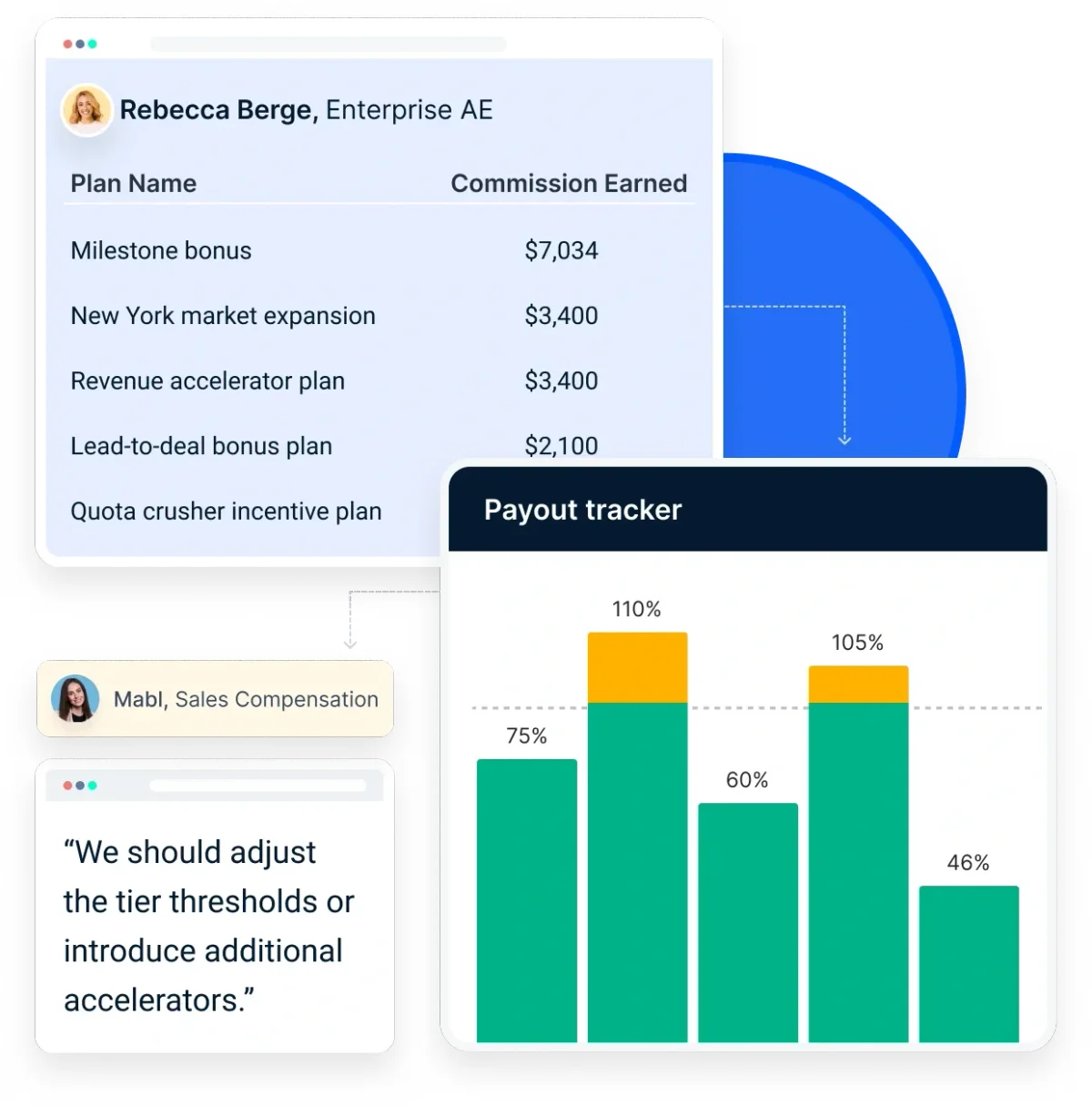
SPIFs and contests run on top of the base plan with their own rules and leaderboards, and approved earnings go to payroll in any country, or by bank transfer, UPI or rewards. Mercedes-Benz India used Empuls to automate quarterly base incentives, performance multipliers and achievement bonuses across 33 franchises, reaching 99.9% calculation accuracy, as described in the Mercedes-Benz India case study.
Explore plans and calculations, payouts and disbursal, sales gamification or estimate what manual commission work costs today with the sales incentive ROI calculator.
Build plans your sales team trusts
A strong set of sales commission and incentive plans is about more than paying the team: it creates an environment where everyone is motivated to do their best work. Choose commission structures that fit each role, layer incentive programs on top for specific goals and set a pay mix that reflects how much each rep controls the sale.
Then keep the plan simple, pay accurately and on time, recognize progress along the way and review the plan regularly with the team. Clear communication and regular check-ins keep everyone aligned and focused on the same goals.
Book your Empuls demo
Frequently asked questions
Base salary plus commission is the most common sales commission plan, because it gives reps income stability while still rewarding results. Many companies add tiers or accelerators so the commission rate rises above quota. Straight commission is more common for independent agents and short, transactional sales where the rep fully controls the outcome.
A common example is a tiered commission plan: a rep earns 5% of revenue up to quota, 8% between 100% and 150% of quota and 10% above that. Many plans add a quarterly bonus for hitting target and short SPIFs for priority products, so the rep is rewarded for both overall results and specific goals.
Commission is variable pay calculated from sales results, usually a percentage of revenue or margin on deals closed. An incentive is a broader reward, cash or non-cash, for meeting a specific goal, such as winning new customers, selling a new product or completing training. Commission rewards the core sale, while incentives steer effort toward particular priorities.
There is no universal rate, because it depends on margin, deal size and pay mix. A practical method is to divide each role's target variable pay by its quota: $80,000 of target variable on a $1,000,000 quota gives an 8% rate. Then check the rate against gross margin to make sure the business still profits at high attainment.
OTE, or on-target earnings, is the total pay a salesperson can expect when they reach 100% of quota: base salary plus target variable pay. For example, an $80,000 base with $80,000 target commission is a $160,000 OTE on a 50/50 pay mix. Actual earnings are higher or lower depending on attainment and accelerators.
Most companies avoid hard caps, because a ceiling tells top performers to stop selling once they reach it. A better approach is uncapped commission with accelerators, plus a review rule for unusually large or unexpected deals. That protects the budget from windfalls while keeping strong upside for reps who consistently outperform.
Review the plan at least once a year, usually before the new fiscal year, and make major changes only at that point. Mid-year changes erode trust unless the plan's rules allow them, such as quota adjustments for territory changes. Short-term incentives such as SPIFs and contests can change every quarter without disrupting the core plan.
A draw against commission is an advance paid to a salesperson against future commission, often for new reps or long sales cycles. With a recoverable draw, any shortfall between the draw and earned commission is repaid from future commission. With a non-recoverable draw, the rep keeps the advance even if commission falls short.





































































































































































































































































































































































































































































































































































