
Key Takeaways
Non-taxable employee benefits are perks and payments that do not count as taxable income for the employee, within limits set by each country's tax rules.
In the US for 2026, key limits are $4,400 and $8,750 for HSAs, $3,400 for health FSAs, $340 a month for transit and parking, $5,250 for educational assistance and $7,500 for dependent care.
In the UK, HMRC treats trivial benefits of £50 or less, one mobile phone, workplace parking, annual parties up to £150 a head and employer pension contributions as tax-free.
In India from 1 April 2026, meals up to ₹200 per meal and gifts below ₹15,000 a year are nil-value perquisites under the Income-tax Rules, 2026.
Cash and gift cards are taxable in the US however small, so non-cash, plan-based benefits deliver the most tax-free value.
Non-taxable employee benefits are perks and payments that employers provide without them counting as taxable income for the employee, within limits set by each country's tax rules. In the US, the nine most useful are employer health coverage and HSAs, retirement plans, flexible spending accounts, commuter benefits, educational assistance, certain meals, employee stock purchase plans, dependent care assistance and adoption assistance. The UK and India have their own lists, covered below.
When it comes to employee compensation, salary is just one piece of the puzzle. Organizations are going beyond base pay to offer benefits that improve the employee experience while also providing financial relief, and tax-free employee benefits are one of the most valuable yet often overlooked parts of a total rewards package. Employees receive more value without a matching increase in taxable income, and employers improve retention, engagement and morale.
This guide defines non-taxable benefits, walks through the nine main US benefits with their 2026 limits, summarizes the tax-free employee benefits in the UK and non-taxable perks in India, and explains what to check before you offer them. Each rule names the country it applies to and links to the official source.
What non-taxable employee benefits are
Non-taxable employee benefits are perks and incentives that are exempt from income tax, and sometimes payroll or social security taxes, up to set limits. Some are fully excluded from income, some are paid from pre-tax salary so they reduce taxable pay, and some are tax-deferred, meaning tax is paid later, for example on retirement withdrawals.
They are an integral part of a comprehensive compensation package, complementing salary and other benefits. By reducing the taxable portion of income, they help employees stretch their pay further toward retirement savings, education or daily expenses. The main advantages are:
- Higher take-home value for employees: The same spend on a non-taxable benefit is worth more to the employee than the same amount paid as salary.
- Lower employer costs: In many cases, the employer also avoids payroll taxes or social security contributions on the benefit.
- Satisfaction and wellbeing: Benefits such as health cover, commuting help and family support address real needs.
- Talent attraction and retention: A tax-efficient package competes better without a matching rise in salary budgets.
Deliver tax-saving benefits on one platform
Run tax-saving cards, lifestyle accounts and discounts in Empuls, with limits enforced automatically.
Talk to our ExpertTrusted by 5,000+ companies
9 non-taxable employee benefits in the US
The nine benefits below apply to the United States, with 2026 limits from IRS guidance, mainly IRS Publication 15-B (2026). The first six are the most widely offered, led by health benefits because they cover the most employees, and the last three are lesser-known options that many employers overlook.
1. Health insurance and health savings accounts
Employer-provided health insurance is the most widely offered tax-advantaged benefit. The employer's share of premiums is excluded from the employee's income, and the employee's share can be paid pre-tax through a cafeteria plan, which reduces taxable income. Employers can also deduct the cost as a business expense.
Health savings accounts (HSAs) add another layer for employees enrolled in a high-deductible health plan. Contributions go in pre-tax, funds grow tax-free and withdrawals for qualified medical expenses are also tax-free. For 2026, the HSA contribution limit is $4,400 for self-only coverage and $8,750 for family coverage, per IRS Revenue Procedure 2025-19.
2. Retirement benefits
Retirement plans such as 401(k) and 403(b) plans let employees save for the future with tax advantages. Traditional contributions are tax-deferred: they are not taxed in the year they are made, and tax is paid on withdrawal in retirement. The IRS 2026 limit announcement puts the employee deferral limit at $24,500.
Employer matching contributions are also not taxed when they go in and are usually deductible for the employer. Roth 401(k) contributions work the other way: they are made with after-tax dollars, but qualified withdrawals, including earnings, are tax-free in retirement.
3. Flexible spending accounts (FSAs)
A health flexible spending account lets employees set aside pre-tax salary for eligible medical expenses such as co-pays and prescriptions. Contributions are not subject to income or payroll taxes. For plan years beginning in 2026, the health FSA salary reduction limit is $3,400.
FSAs usually work on a "use it or lose it" basis, so unused funds at the end of the plan year may be forfeited. Some plans allow a limited carryover or a grace period, so check your plan design.
4. Transportation benefits
Employers can provide tax-free qualified transportation benefits: transit passes, vanpooling in a commuter highway vehicle and qualified parking. For 2026, the limit is $340 a month for transit and vanpooling and a separate $340 a month for parking. These benefits reduce taxable income and are especially valuable where transit or parking is expensive.
Two points often trip employers up. Fuel allowances are not qualified transportation benefits and are taxable, and Publication 15-B for 2026 confirms that the exclusion for bicycle commuting reimbursements has been permanently eliminated.
5. Educational assistance programs
Many employers support ongoing education through tuition reimbursement or direct payment of course fees. Under an educational assistance program, employees can receive up to $5,250 a year tax-free for tuition, fees, books and supplies. Employer payments toward an employee's qualified student loans also count toward this limit, and the 2025 tax law made this exclusion permanent.
6. Employer-provided meals
Meals can be non-taxable in two situations. Occasional meals of small value, such as food for a team working late, can be excluded as de minimis benefits. Meals furnished on the employer's business premises for a substantial business reason, such as employees who must stay on call, can be excluded as meals for the employer's convenience.
Cash meal allowances, regular meal money based on hours worked and meals given mainly to boost morale do not qualify and are taxable wages. Note also that from 2026, employers can no longer deduct the cost of providing these meals, even though the exclusion for employees still applies. For how meals and meal vouchers work in other countries, see the UK and India sections below.
7. Employee stock purchase plans (ESPPs)
A qualified employee stock purchase plan lets employees buy company stock at a discount through payroll deductions, which are made after tax. Under IRS guidance on stock options, employees generally do not include any amount in income when they receive or exercise the option.
The benefit comes when the stock is sold. If the holding-period requirements are met, the gain is treated mainly as a capital gain rather than ordinary income, which can mean meaningful tax savings.
8. Dependent care assistance programs (DCAPs)
A dependent care assistance program lets employees pay for eligible childcare or adult dependent care with pre-tax dollars or receive employer-paid care tax-free. For 2026, the exclusion rose to $7,500 a year ($3,750 if married filing separately), up from $5,000, and it cannot exceed the earned income of the employee or their spouse.
9. Adoption assistance programs
Employers can support employees growing their families through adoption by paying or reimbursing qualified adoption expenses, such as adoption fees, court costs and attorney fees. For 2026, up to $17,670 per eligible child can be excluded from income tax, although adoption assistance is still subject to social security and Medicare taxes and must be reported on Form W-2.
| US benefit | Tax treatment | 2026 limit |
|---|---|---|
| Employer health coverage | Excluded from income; employee share pre-tax via cafeteria plan | No fixed cap |
| Health savings account | Pre-tax in, tax-free growth and qualified withdrawals | $4,400 self-only, $8,750 family |
| 401(k) or 403(b) | Tax-deferred (Roth: tax-free qualified withdrawals) | $24,500 employee deferral |
| Health FSA | Pre-tax salary reduction | $3,400 |
| Transit and vanpooling; parking | Excluded from income | $340 a month each |
| Educational assistance | Excluded from income, includes student loan payments | $5,250 a year |
| Dependent care assistance | Excluded from income | $7,500 ($3,750 married filing separately) |
| Adoption assistance | Excluded from income tax only | $17,670 per child |
| Group-term life insurance | Cost of coverage excluded | Up to $50,000 of coverage |
| Achievement awards (non-cash) | Excluded from income | $1,600 qualified plan awards, $400 otherwise |
Remember that cash and cash equivalents, including gift cards, are never excludable as de minimis benefits in the US, however small. For a deeper look at structuring pay around these benefits, read about tax saving benefits for employees, and for the difference between taxable and non-taxable fringe benefits, see these types of fringe benefits.
Tax-free employee benefits in the UK
In the United Kingdom, HMRC lists the payments and benefits that employees do not pay tax on in its HS207 helpsheet on non-taxable payments or benefits. The most useful for employers are:
| UK benefit | Condition or limit |
|---|---|
| Employer pension contributions | Contributions to a registered pension scheme are not taxable earnings, per HMRC EIM01570; they count toward the annual allowance |
| Trivial benefits | £50 or less each, not cash or a cash voucher, not a reward for work and not in the contract; £300 a year cap for directors of close companies |
| One mobile phone | One employer-provided phone, including line rental and calls paid directly by the employer |
| Workplace parking | At or near the place of work, for cars, motorcycles or bicycles |
| Cycles and safety equipment | Loaned by the employer, available to employees generally and mainly used for commuting |
| Annual party or function | Open to staff generally and no more than £150 a head in total |
| Health screening | Up to one health screening and one medical check-up a year |
| Canteen meals | Reasonable scale and available to all staff, not through salary sacrifice |
| Homeworking costs | Up to £6 a week without evidence, where homeworking is agreed with the employer |
| Work-related training | Training and related costs paid or reimbursed by the employer |
| Welfare counselling | Available to all employees on similar terms |
| Long service awards | At least 20 years' service, tangible item or shares, up to £50 per year of service |
Benefits provided through salary sacrifice are generally taxed on the higher of the salary given up and the benefit's value, except for a few protected benefits such as pension contributions and cycle to work schemes, so design these carefully.
Non-taxable perks in India
In India, perquisites are valued under Rule 15 of the Income-tax Rules, 2026, which apply from 1 April 2026 under the Income-tax Act, 2025. Several common benefits are valued at nil or excluded within limits:
| India benefit | Tax treatment from 1 April 2026 | Regime note |
|---|---|---|
| Meals at work or meal vouchers | Not a perquisite up to ₹200 per meal (was ₹50); tea and snacks excluded | Perquisite rule, no separate regime condition |
| Gifts, vouchers or tokens | Nil when below ₹15,000 in aggregate in the tax year (was ₹5,000) | Perquisite rule, no separate regime condition |
| Telephone and mobile expenses | Excluded from the valuation of other benefits | Perquisite rule |
| Use of laptops, computers, tablets and mobiles | Excluded from the movable asset perquisite | Perquisite rule |
| Car running costs, own car, mixed use | Taxable only above ₹5,000 a month (₹7,000 above 1.6 litres), plus ₹3,000 for a driver, with journey records | Perquisite rule |
| Interest-free or concessional loans | Nil up to ₹2,00,000 in aggregate, or for specified medical treatment | Perquisite rule |
| Children education allowance | ₹3,000 a month per child, up to two children; hostel allowance ₹9,000 a month per child | Old regime only |
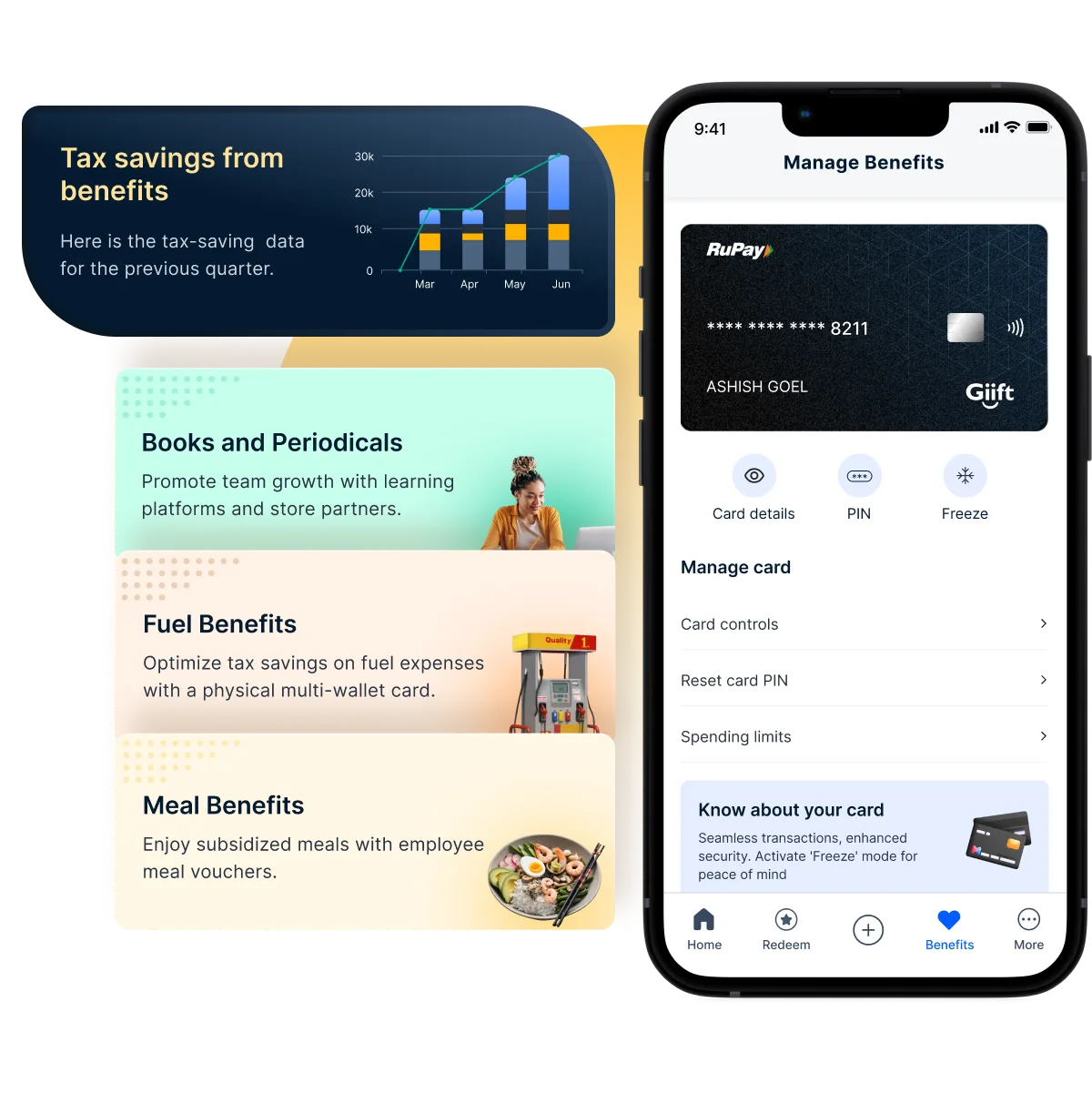
Employees who choose the new tax regime can claim only a narrow set of exempt allowances, mainly duty-related travel and conveyance (Rule 280(3)), so allowances such as children education allowance help only under the old regime. The perquisite rules in the table do not carry that restriction. The easiest way to deliver these tax saving employee benefits is a multi-benefit card with a wallet for each one.
What to consider before offering tax-exempt perks for employees
Non-taxable benefits only deliver value when they are set up and run correctly. Keep these points in mind:
- Eligibility and nondiscrimination: Many exclusions require that benefits be offered on similar terms to all eligible employees, not only to senior or highly paid staff. Health plans and FSAs also have enrollment windows, so communicate deadlines clearly.
- Reporting obligations: Report benefits correctly, for example on Form W-2 in the US, through payroll or the P11D in the UK and in salary and perquisite statements in India. Stay current with guidance and involve a tax professional.
- Impact on other benefits: Pre-tax salary reductions lower reported pay, which can slightly affect pay-linked items such as some social security benefits or salary-based contributions. Explain this to employees.
- Leaving a job: Some benefits stay with the employee and some do not. An HSA balance is portable, while unused health FSA money is usually forfeited, so remind employees before their last day.
- Limits change every year: Inflation adjustments and new laws, such as the 2025 US tax law and India's 2026 rules, change limits regularly.
How Empuls helps you offer tax saving employee benefits
Empuls, Xoxoday's employee engagement platform, helps you deliver flexible, compliant, tax-efficient benefits at scale, so employees get more take-home value without a higher cost to company. Here is what it offers:
01 · India
Tax-saving multi-benefits card
One RBI-compliant card with wallets for meals, fuel, telecom, books, learning, gifts and more, with each limit enforced automatically.
02 · Choice
Lifestyle spending accounts
Budgets for fitness, wellness, upskilling and family care that employees spend their own way.
03 · Savings
Discounts and financial wellness
Everyday discounts on 6,000+ brands and earned wage access to ease money stress.
04 · Control
Automation and analytics
Automated disbursal, real-time tracking and utilization reports to measure uptake and value.
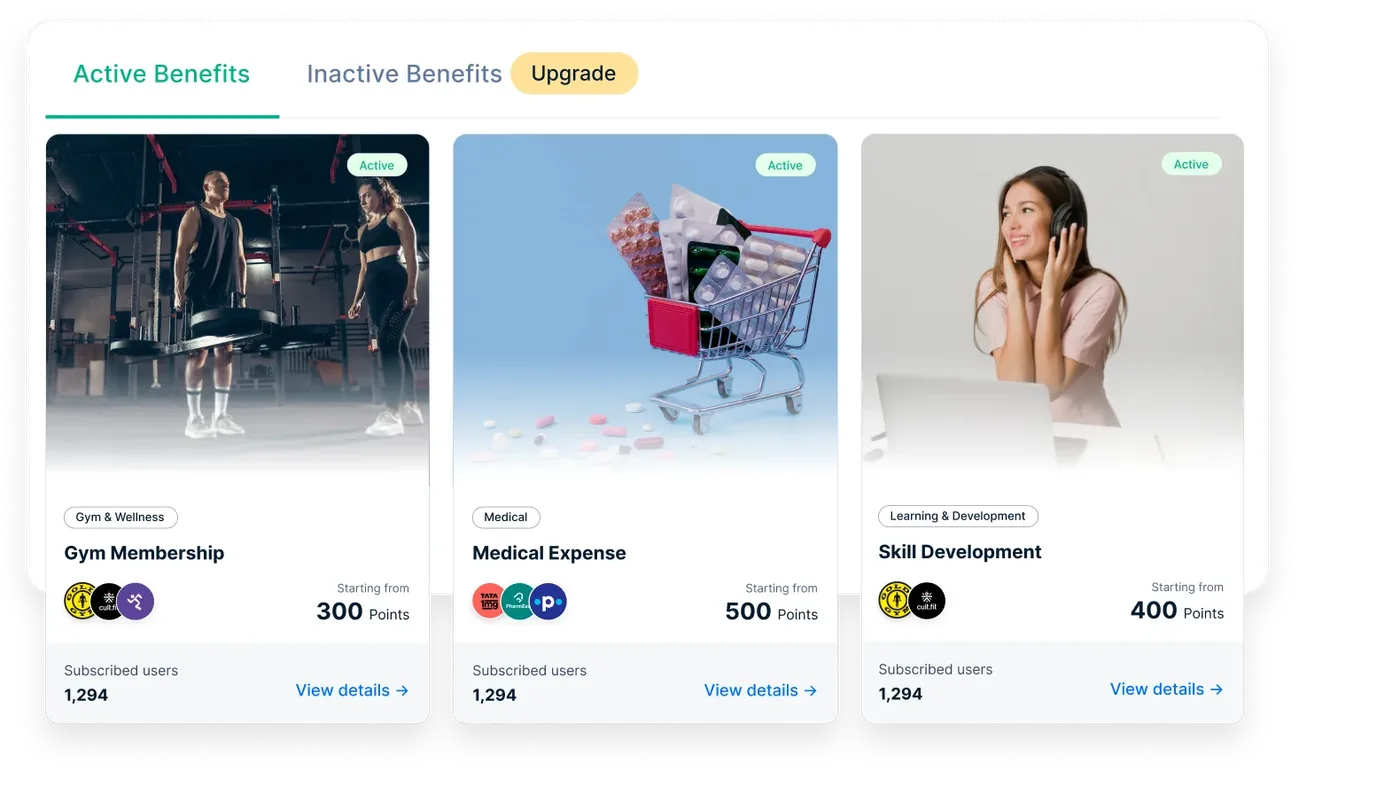
Explore tax-saving benefits, lifestyle spending accounts and financial wellness to see how each fits your package.
Make every benefit dollar and rupee count
Non-taxable employee benefits are a win-win. Employees enjoy higher take-home value and better wellbeing, while employers attract and retain talent and often save on payroll taxes.
Start with the benefits that match your employees' needs in each country, follow the official limits and review them every year. For more ways to build a package people value, explore these employee benefits ideas.
Book your Empuls demo
Frequently asked questions
In the US, common non-taxable benefits include employer health coverage, HSA and health FSA contributions, dependent care assistance up to $7,500, educational assistance up to $5,250, transit and parking benefits up to $340 a month each, group-term life insurance up to $50,000 of coverage, adoption assistance and certain employer-provided meals. Retirement plan contributions are tax-deferred rather than tax-free.
No, not in the US. IRS Publication 15-B says cash and cash equivalents, including gift cards, are never excludable as de minimis benefits, whatever the amount. In the UK, trivial benefits up to £50 cannot be cash or a cash voucher. In India, gifts and vouchers from an employer are a nil-value perquisite only when they total below ₹15,000 in the tax year.
Under India's Income-tax Rules, 2026, non-taxable perks include meals at work or meal vouchers up to ₹200 per meal, gifts and vouchers below ₹15,000 a year, employer-paid telephone and mobile expenses, use of laptops and mobiles, interest-free loans up to ₹2,00,000 and limited car running costs. Children education allowance is exempt only under the old regime.
In the UK, tax-free employee benefits include employer pension contributions, trivial benefits of £50 or less, one mobile phone, workplace parking, loaned bicycles for commuting, annual parties up to £150 a head, one health screening and one check-up a year, canteen meals available to all staff, homeworking payments up to £6 a week and work-related training.
It depends on the country and form. In the US, cash meal allowances are taxable, while occasional de minimis meals and meals provided on premises for the employer's convenience can be excluded. In the UK, canteen meals available to all staff are tax-free. In India, meals at work or meal vouchers usable only at eating joints are tax-free up to ₹200 per meal.
Usually, yes. Many tax exclusions require that benefits be offered on similar terms to all eligible employees and not favor highly paid staff, such as nondiscrimination rules for US cafeteria plans and fringe benefits. In the UK, canteen meals and annual parties must be open to staff generally. Check the conditions for each benefit before limiting eligibility.
Tax-free benefits are never taxed if used as intended, such as qualified commuter benefits, educational assistance or HSA withdrawals for medical costs. Tax-deferred benefits postpone tax until later, such as traditional 401(k) contributions, which are taxed when withdrawn in retirement. Both reduce taxable income today, but only tax-free benefits avoid tax permanently.
Yes. Many US limits, such as HSA, FSA, commuter and 401(k) limits, are adjusted for inflation each year, and new laws can change others, as the 2025 US tax law did for dependent care. India's limits changed with the Income-tax Rules, 2026, and HMRC updates UK guidance each tax year, so review your benefits policy annually.





































































































































































































































































































































































































































































































































































