
Key Takeaways
Employee rewards and recognition matter because people repeat the behaviors that get noticed, valued and rewarded.
Well-recognized employees were 45% less likely to have left their jobs after two years in Gallup and Workhuman's 2022 to 2024 study.
High-quality recognition makes employees nine times as likely to be engaged, and engaged teams show 23% higher profitability in Gallup's 2024 meta-analysis.
Only 22% of US employees get the right amount of recognition, so most organizations have an easy, low-cost gain available.
The simplest business case multiplies headcount, turnover rate, exits prevented and replacement cost, then compares the result with the recognition budget.
The importance of employee rewards and recognition comes down to one fact: people repeat what gets noticed. Rewards and recognition raise engagement, productivity and retention, and current research puts numbers on it, with well-recognized employees 45% less likely to have left their jobs two years later in a Gallup and Workhuman study.
Employee rewards and recognition is the practice of acknowledging employees' contributions with praise, awards or something of value, so that the behaviors an organization needs are seen, valued and repeated. Here is the business case, the ten benefits behind it and the numbers that support it.
When HubSpot topped Glassdoor's list of Best Places to Work for 2020, surpassing giants like Facebook and Google, many in the industry reacted with disbelief. For Katie Burke, then HubSpot's Chief People Officer, it was not a surprise. It was the result of years of focus on a culture where employees feel valued, motivated and engaged, not an overnight miracle.
That culture is written down in HubSpot's Culture Code and its HEART values: Humble, Empathetic, Adaptable, Remarkable and Transparent. The Culture Code was never only about defining values. It was about building a mission-driven organization where employees felt connected, supported and empowered.
Defining a culture is one thing, and getting people to rally around it is another. This is where the importance and benefits of employee rewards and recognition come in. Recognition is how a company shows, day after day, which behaviors its values actually mean, and it is how appreciation turns into motivation, collaboration and long-term engagement. When employees feel genuinely valued, they do not just work. They thrive, innovate and contribute to the company's continued success.
Why HubSpot chose recognition
It is overused to the point of cliché, but it holds: people do not quit their jobs, they quit managers. The desire to feel valued and appreciated is among the oldest human needs. As the psychologist William James put it, "The deepest principle in human nature is the craving to be appreciated."
We all want to matter, and employees are no exception. Like everyone, they dislike environments where appreciation is scarce and they have to think hard to remember the last time someone gave them a warm, encouraging pat on the back. And that is still the norm: Gallup and Workhuman research found only 22% of US employees say they get the right amount of recognition, unchanged between 2022 and 2024.
It is hardly a surprise that, like HubSpot, business leaders and experts are never short of words in praise of recognition. Oprah Winfrey is a well-known example. In her 2013 Harvard commencement speech she said that after more than 35,000 interviews, the common thread she found was that people want to be validated and understood. Presidents, heroes, homemakers and celebrities all asked her some version of the same question once the cameras stopped: was that okay? For more on why that need sits at the heart of work, read this guide to employee appreciation.
Turn recognition into measurable retention
See how Empuls makes recognition frequent, fair and visible, with reports leadership can act on.
Talk to our ExpertTrusted by 5,000+ companies
The importance and benefits of employee rewards and recognition
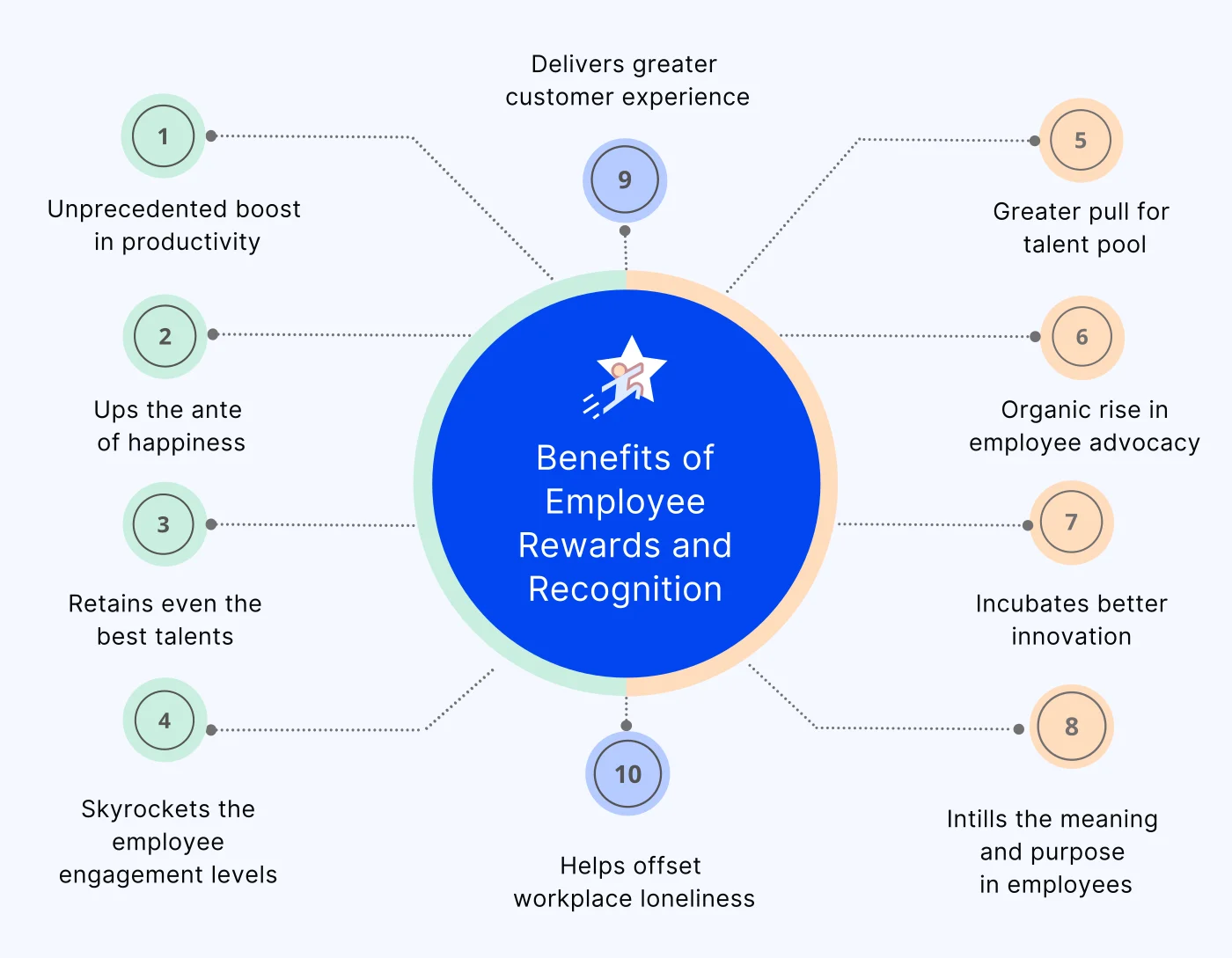
Employee rewards and recognition strengthen organizational values, encourage friendly competition, improve employee happiness and satisfaction, lift customer satisfaction and motivate employees to go the extra mile. Below are ten benefits of rewards and recognition that apply regardless of an organization's industry or size, starting with productivity because it is the one leaders feel first.
1. A real boost in productivity
A glance at our personal and professional lives reveals a simple rule: what gets rewarded gets repeated. Rewards and recognition acknowledge that a contribution was right and effective, and it is natural to repeat what works. That is the core of the impact of recognition on performance.
The numbers back it up. The O.C. Tanner Institute's 2026 State of Employee Recognition report, based on 4,243 employees in 10 countries, found that employees who experience integrated, community-building recognition are:
- 25x more likely to produce great work.
- 21x more likely to be personally invested in the organization's success.
- 26x more likely to still be working at the organization a year later.
The company's bottom line benefits too. Recognition drives engagement, and Gallup's 2024 Q12 meta-analysis of 183,806 business units found that top-quartile engaged teams show 23% higher profitability and 18% higher sales productivity than bottom-quartile teams. To make productivity gains stick, pair recognition with these employee motivation strategies.
2. Ups the ante on happiness
Full-time employees spend 40 or more hours at work each week, roughly 2,000 hours a year. Their state of mind in those hours decides whether they are an asset or a liability. One reliable route to happiness at work is recognition. Here is how it works:
- Recognition is a social reward: Being recognized and appreciated activates the brain's reward system, the same circuitry that responds to other rewards.
- Dopamine follows: That system releases dopamine, the chemical associated with pleasure and motivation, which is why praise feels good and makes us want to repeat what earned it.
- Happiness compounds: Regular recognition keeps that loop active. Since happiness keeps people more alert, satisfied, engaged and motivated, it lifts employee morale over time.
3. Retains the best talent
From posting a job description and screening piles of resumes to interviewing candidates and negotiating packages, finding the right employee is expensive. All that effort goes up in smoke if an employee quits without a hint, and the turnover cost is a double blow. Gallup estimates that replacing an employee costs about 40% of salary for frontline workers, 80% for technical roles and up to 200% for leaders and managers.
The link between employee recognition and retention is now well measured. In a study that followed nearly 3,500 employees from 2022 to 2024, Gallup and Workhuman found that well-recognized employees were 45% less likely to have left after two years. Employees whose recognition met at least four of the five pillars of strategic recognition were 65% less likely to be looking for another job. For a broader playbook, read these employee retention strategies and this guide to reducing employee attrition.
4. Lifts employee engagement
Employee recognition and employee engagement share a two-way relationship. The more recognition employees get, the more engaged they become, and the more engaged they are, the more they do that earns recognition. Recognition gives meaning to the effort and ideas people put in, keeping them emotionally and intellectually connected to their work.
Gallup and Workhuman found that employees whose recognition met at least four of the five pillars were nine times as likely to be engaged as those whose recognition met none. That matters because engagement is scarce: Gallup's State of the Global Workplace report puts global engagement at 20% in 2025, the lowest level since 2020. Engaged teams also deliver measurably better results, as the chart below shows. For practical steps, see how to improve employee engagement.
5. Greater pull for the talent pool
Top-performing employees want more than salary. They look for a complete package: rewards, recognition, compensation, benefits and a healthy working environment. Recognition programs are one of the reasons professionals choose to join a company, and failing to plan and run a proper R&R program can make it harder to attract top talent.
Big pay packages and exciting job roles are not the only pull factors. Candidates also judge company culture and the depth of relationships between employees, managers and peers, often through employee reviews before they ever apply. Since there is no better or more humane way than recognition to strengthen workplace relationships, it can become a magnet for the best talent in local and international markets. If you are ready to build one, start with planning an employee rewards and recognition program.
6. An organic rise in employee advocacy
Employees who are not recognized enough find it hard to explain what makes their organization worth talking about. Consistently ignored hard work can make them believe favoritism is rampant and fairness does not exist.
Recognition that feels deliberate reverses this. O.C. Tanner's 2026 research found that when appreciation and awards feel intentional, employees are 8x more likely to trust their organization, and employees with integrated recognition are 13x more likely to give a high Net Promoter Score. Only people who believe the company is fair will become the megaphone for its employer brand. To keep recognition fair, use these steps to prevent bias in recognition programs.
7. Incubates innovation
The better employers treat their employees, the more ideas those employees are willing to share. Innovation is an organic phenomenon that has to be coaxed rather than extracted. It grows in a positive, safe, encouraging and appreciative environment where people are not afraid that a failed experiment will count against them.
Recognition ticks those prerequisites when it celebrates effort and smart risks as well as wins. When people see colleagues praised for trying a new approach, even one that did not work, they learn that thinking differently is welcome.
8. Instills meaning and purpose
People have a lasting need to take part in something that makes a tangible difference, and employees are no exception. The best way to build that sense is to show people, through timely recognition, how their contributions shape the bigger picture of the organization.
It is easy to get caught up in the daily grind of work and family. Rewards and recognition remind employees that they are all moving toward the same mission and that every individual's part counts.
9. Greater and better customer experience
Richard Branson famously argues that if you take care of your employees, they will take care of your customers. Employee experience shapes customer experience: when people are treated well, they engage with their work, go beyond the drafted call of duty and pass that feeling on to customers.
Gallup's meta-analysis shows the link in data, with top-quartile engaged teams scoring 10% higher on customer loyalty and engagement than bottom-quartile teams. For frontline teams in particular, recognition tied to customer praise is one of the most direct ways to close that loop; this guide to customer service incentive programs shows how.
10. Offsets workplace loneliness
Remote and hybrid work have given many employees flexibility, and some of them isolation. Former US Surgeon General Vivek Murthy made loneliness a public health priority, and the workplace data is sobering: Gallup's 2026 report found 22% of employees worldwide felt lonely a lot of the previous day, rising to 24% among fully remote and hybrid workers.
Loneliness hurts physical and mental wellbeing and costs employers dearly. Lonelier workers tend to be less productive, more likely to quit and less satisfied, and poor mental health overall costs UK employers £51 billion a year, according to Deloitte's 2024 analysis. Social support is a powerful counter. Heart-to-heart talks with colleagues, words of praise and peer recognition create lasting bonds, and over time these small nudges become the cornerstones of a healthier, more supportive and more collaborative culture. Read how to run peer-to-peer recognition that builds those bonds.
Looking at all these effects, it is fair to say that employee recognition can improve workplace performance as much as, or more than, financial rewards alone. It ticks most of the boxes that matter for any organization.
The business case for recognition in one formula
Leaders approve what they can measure, so it helps to put the importance of rewards and recognition into money. The simplest case uses turnover cost, because it is the benefit with the clearest evidence and the easiest numbers to find in your own HR data.
| Input | Example value | Where to find yours |
|---|---|---|
| Employees | 500 | HRIS headcount |
| Annual voluntary turnover | 15%, or 75 exits | HRIS exit data, last 12 months |
| Exits prevented by better recognition | 10%, or about 7 exits (a cautious figure next to Gallup's 45%) | Your own assumption; start low |
| Replacement cost per exit | $30,000 (50% of a $60,000 salary) | Gallup ranges: 40% frontline, 80% technical, 200% leaders |
| Estimated annual savings | About $210,000 | Exits prevented x replacement cost |
This example counts only turnover, so it understates the full value. Engagement gains in productivity, absenteeism and safety come on top. To model your own numbers, try the recognition ROI calculator, and once your program is running, track these metrics to measure employee recognition programs.
Examples of companies creating an impact with rewards and recognition
Here are two organizations that turned recognition from an afterthought into a habit. Both started with a manual or fragmented process, which is where most companies begin, and both show that the biggest gains come from making recognition visible and easy.
1. A digital healthcare enterprise
A fast-growing digital health company with 1,200 to 1,500 employees ran its rewards and recognition program manually, which made awards slow and uneven across a global team. It moved to a structured awards framework with automated jury workflows, values-linked recognition and integrations with its HR system and Slack.
The result was a 5x rise in award distribution, a 2x increase in engagement and 97% active adoption across the workforce. Read the full healthcare rewards and recognition case study.
2. KPIT Technologies
KPIT, a mobility technology company with more than 5,000 people, relied on physical gifting and siloed, manager-to-employee recognition. It replaced both with a digital rewards program that made recognition visible across the organization and let employees redeem rewards across multiple countries and currencies.
Peer-to-peer appreciation scaled globally, automated nudges prompted colleagues to join in when someone was recognized, and KPIT tripled its rewards budget. Read the KPIT case study, and for more examples, see these companies with the best employee rewards and recognition programs.
The importance of recognition in numbers
Let's look at current data on how a culture of recognition affects an organization's success. The four figures below come from the largest recent studies, and the gap between the first two numbers is the opportunity most organizations are missing.
45%
less likely to leave
well-recognized employees after two years (Gallup and Workhuman, 2024)
22%
of US employees
get the right amount of recognition (Gallup, 2024)
9x
more likely to be engaged
with high-quality recognition (Gallup and Workhuman, 2024)
8x
more likely to trust the organization
when awards feel intentional (O.C. Tanner, 2026)
Employee rewards and recognition in numbers
According to Gallup and Workhuman:
- Well-recognized employees were 45% less likely to have left their organization after two years.
- 55% of US employees either received no recognition or recognition that met none of the five pillars of strategic recognition.
- Senior leaders who strongly agree recognition is valuable rose from 28% in 2022 to 42% in 2024.
According to the O.C. Tanner Institute's 2026 report:
- When employees feel leaders do not know their recognition preferences, their odds of thriving at work drop by 89%.
- Employees at companies with recognition champions are 3x more likely to regularly recognize coworkers.
- 62% of employees say budget cuts have affected their ability to team-build.
Recognition matters more than ever, but companies still struggle with it
Despite the clear benefits of employee recognition and rewards, many organizations still struggle to build a culture of gratitude. More than half of US employees receive no recognition or recognition that misses the mark, which directly affects engagement and retention.
To add salt to the wound, budgets are tight and teams are spread out. With 62% of employees saying budget cuts have hurt team-building and loneliness highest among remote and hybrid workers, the importance of employee rewards and recognition in keeping teams connected and motivated has only grown. The employee recognition guide explains how to build it into everyday work, and these employee recognition ideas give you a place to start this week.
How Empuls helps you get rewards and recognition right
If you are unsure where to begin, Empuls is a practical starting point. It brings recognition into everyday workflows so appreciation is frequent, fair and visible:
- Recognition from anyone, to anyone: Peer and manager recognition with values, awards and points through Empuls recognition, plus spot awards for in-the-moment wins.
- Milestones that never slip: Work anniversaries, birthdays and other milestone rewards trigger automatically.
- Rewards people choose: Points redeem across a global catalog of gift cards, experiences and merchandise, inside Slack, Microsoft Teams, web and mobile.
- Proof for leadership: Reports on participation, award spread and redemption show what recognition is doing, and the free recognition program scorecard shows where your program stands today.
Book your Empuls demo
Frequently asked questions
Rewards and recognition are important because they tell employees their work matters, which builds motivation, engagement and loyalty. People repeat the behaviors that get noticed. Current research links good recognition to lower turnover and higher engagement, with Gallup and Workhuman finding well-recognized employees 45% less likely to have left after two years.
Employee recognition is acknowledgment, such as praise, a thank-you or public appreciation for what someone did. Employee rewards add something of value, such as points, gift cards, experiences or bonuses. Recognition can stand alone and is often free, while rewards work best when they come with specific recognition that explains why the person earned them.
Recognition improves performance by reinforcing the behaviors that lead to good results and by raising engagement. Gallup and Workhuman found high-quality recognition makes employees nine times as likely to be engaged, and Gallup's 2024 meta-analysis shows top-quartile engaged teams have 18% higher sales productivity and 23% higher profitability than bottom-quartile teams.
Yes. In a Gallup and Workhuman study that followed nearly 3,500 employees from 2022 to 2024, well-recognized employees were 45% less likely to have left their organization two years later. Employees receiving high-quality recognition were also 65% less likely to be actively looking or watching for another job than those receiving poor recognition.
Non-monetary rewards can be just as effective for everyday motivation, because what employees value most is that recognition is specific, timely and sincere. Money helps for bigger milestones and targets, but it cannot replace being seen. Most strong programs combine free recognition, such as praise and growth opportunities, with a modest rewards budget for meaningful moments.
There is no fixed rule, and budgets vary widely by industry and region. A practical approach is to set a yearly amount per employee for points and awards, add a separate budget for milestones such as service anniversaries, and compare total spend with the turnover cost you expect to avoid. Start modest and scale what employees actually use.
Measure the impact of rewards and recognition with participation rate, recognition frequency per employee, reach across teams, reward redemption, engagement or eNPS scores and voluntary turnover among recognized versus unrecognized employees. Review the numbers quarterly, look for teams that are rarely recognized and compare retention before and after launch.





































































































































































































































































































































































































































































































































































