
Key Takeaways
AI in sales commission works best around a rule-based calculation engine: the math stays traceable, while AI recommends plans, flags errors and explains earnings.
CaptivateIQ's 2026 State of Incentive Compensation Management Report found 64% of organizations had at least one commission payout error in the past year.
81% of compensation leaders use AI in some capacity, but only 28% use it extensively, mostly for summarizing insights, automating tasks and explaining plans.
The biggest risks of AI sales compensation are bad data, black-box decisions and quotas raised for AI productivity gains that have not yet appeared.
Score your readiness first: documented plans, connected data, traceable payouts and an approval workflow are the foundation AI commission software needs.
AI in sales commission means using artificial intelligence around your commission process to design better plans, catch payout errors before they happen and answer reps' earnings questions instantly. The calculation itself stays rule-based and auditable, while AI recommends, predicts, flags and explains. Used that way, it makes payouts faster, more accurate and easier to trust.
Sales commissions have long been both a powerful motivator and a complex administrative burden. As organizations scale and commission structures grow more intricate, keeping payouts accurate, fair and transparent becomes harder every quarter. This guide covers what AI can do for sales, how it changes commission strategy, where it fits in each step of the commission cycle, the guardrails it needs and a readiness checklist you can use before you buy AI commission software.
What AI in sales commission means
AI in sales commission is the use of machine learning, predictive analytics and generative AI to improve how commission plans are designed, calculated, checked, explained and paid. It is different from plain automation. Rule-based automation applies the formula you configured, the same way every time; AI looks across the data to suggest a better formula, spot an anomaly or answer a question in plain language.
That distinction matters for trust. Reps and finance teams need a payout they can trace back to a rule and a data source, so the best AI commission calculation setups keep the math deterministic and use AI for everything around it: plan recommendations, forecasting, error detection, dispute triage and earnings explanations. If you are still deciding whether to automate at all, start with our guide on why you should automate the sales commission process.
What artificial intelligence can do for sales
Artificial intelligence is changing the sales landscape fast, and much of it now runs behind the scenes in the CRM, forecasting and enablement tools reps already use. At its core, AI delivers value when companies have clean, comprehensive data, which is why the same groundwork that improves forecasting also improves commissions.
81%
of sales teams use AI
41% fully implemented, 40% experimenting
35%
fully trust their data
the biggest brake on AI results
83% vs 66%
saw revenue growth
teams with AI vs teams without
Source: Salesforce, State of Sales, sixth edition (5,500 sales professionals, 2024)
Salesforce's State of Sales research, a 2024 survey of 5,500 sales professionals in 27 countries, found 83% of sales teams using AI grew revenue in the past year, compared with 66% of teams without it. The same research found only 35% of sales professionals completely trust the accuracy of their organization's data. With AI-driven analytics, sales leaders can:
- Improve forecast accuracy: Identify patterns within the sales funnel that manual reviews miss.
- Focus on high-potential deals: Help reps prioritize the activities most likely to convert.
- Support growth at lower cost: Raise team efficiency and cut the admin work around each deal.
- Scale with the business: Use solutions that evolve alongside new products, regions and roles.
Commission management is a natural next step. Territory and quota setting, plan design and commission insights all depend on the same sales data, so AI that understands the pipeline can also help you pay for it fairly.
Why commission teams are adopting AI now
Commission errors are common and costly to trust. CaptivateIQ's 2026 State of Incentive Compensation Management Report, a survey of more than 200 compensation leaders, found 64% of organizations had at least one payout error in the past year and 45% had both overpayments and underpayments.
The same report found 81% of compensation leaders use AI in some capacity, but only 28% use it extensively. The tasks they use it for show where AI already earns its place in sales compensation work:
Two more findings stand out. 41% of organizations have introduced AI-based explanations or assistants for sellers, and 43% have already built assumed AI productivity gains into quotas. That second number is a warning as much as a trend: if AI raises quotas before it raises productivity, reps feel it in their paychecks first.
See AI on your own commission plan
Bring a real plan and see Empuls recommend changes, flag overpayment risk and answer reps' earnings questions.
Talk to our ExpertTrusted by 5,000+ companies
How AI transforms your sales commission strategy
AI-driven commission systems change six parts of a traditional commission strategy, and they build on each other. Data-driven decisions come first because every other benefit, from personalized plans to continuous optimization, depends on clean, connected data.
1. Data-driven decision making
AI lets organizations analyze large volumes of sales data in near real time, identifying trends and patterns that manual processes overlook. That makes commission structures more accurate and fair, so incentives align closely with actual performance and business goals rather than last year's assumptions.
2. Personalized commission plans
With AI, companies can recommend plan structures for each role based on performance history and market conditions, for example accelerators for high performers and milestone bonuses for reps who are still ramping. Tailored plans motivate more effectively than one plan for everyone, as long as the rules stay transparent and consistent within each role.
3. Real-time tracking and transparency
AI-powered platforms track sales activity and commission accruals as deals close. Reps see their earnings instantly and can ask questions like "What do I need to reach the next tier?" in plain language, which builds trust and cuts the disputes that follow a surprise on payday. Our guide to commission tracking software covers the rep-facing side in more depth.
4. Predictive analytics for goal setting
AI can forecast sales trends and help set realistic, data-backed targets for teams and individuals. By predicting which products or services are likely to perform best, organizations can adjust commission rates or run SPIFs proactively to steer focus toward high-priority offerings.
5. Automated processes and fewer errors
Manual commission calculations are slow and prone to errors. Automated sales commission with AI checks input data on the way in, flags unusual payouts before approval and removes the copy-paste steps where mistakes creep in. The result is faster payouts and a leaner sales operations team.
6. Continuous optimization
AI systems keep learning from new data, so you can refine commission strategy every cycle instead of once a year. Watching attainment distribution, cost of sales and payout skew over time shows which rules drive the behavior you want and which ones simply cost money.
AI use cases across the commission cycle
The clearest way to evaluate AI commission software is to map it to each step of your commission cycle. Use this table to see what AI should do at each stage, who benefits and what should stay a human decision.
| Stage | What AI does | Who benefits | What stays human |
|---|---|---|---|
| Plan design | Recommends structures by role from performance history; models payout cost before launch | Sales ops, finance | Approving the plan and its budget |
| Quota and target setting | Forecasts attainable targets by territory and product | Sales leaders | Final quotas and any AI productivity assumptions |
| Data intake | Validates and standardizes CRM, ERP and HRMS data at the source | Sales ops | Fixing the root cause of bad data |
| Calculation | Runs alongside rule-based math to flag outliers; the formula itself stays deterministic | Finance, auditors | Plan rules and exceptions |
| Pre-payout checks | Detects overpayment risk, loopholes and gaming before the batch is released | Finance | Approving or holding the payout |
| Rep questions | Answers earnings and next-tier questions in plain language | Reps, managers | Resolving genuine disputes |
| Optimization | Tracks payout skew, cost curves and attainment to suggest rule changes | Leadership, RevOps | Deciding what to change next cycle |
If your calculations still live in spreadsheets, fix that foundation first. Our guides on how to calculate sales commissions and replacing Excel for commissions cover the move from manual math to a system AI can build on.
Risks and guardrails for AI sales compensation
AI in sales compensation touches people's pay, so the guardrails matter as much as the features. Four risks come up most often, and each has a practical control.
- Bad data in, bad advice out: AI amplifies data problems. Validate data at the source and reconcile CRM and finance records before you trust any recommendation.
- Black-box decisions: Reps will not trust a payout nobody can explain. Keep every number traceable to a rule and a source record, with a full audit trail.
- Quota creep: Building assumed AI productivity gains into quotas before they show up in results erodes trust. Phase them in and check attainment each cycle.
- Regulation: The EU's Artificial Intelligence Act treats AI systems used to make decisions about work relationships or to evaluate workers' performance as high-risk, which brings human oversight and documentation duties. Check local rules wherever your sellers are based.
AI commission readiness checklist
Use this checklist before you evaluate AI commission software, and score each line yes or no. Six or more yes answers means you are ready to pilot; fewer than four means the data and process work should come first.
| Check | Why it matters | Ready? (yes or no) |
|---|---|---|
| Commission plans are documented with clear rules for every role | AI can only recommend changes to rules it can read | ______ |
| CRM, ERP and HRMS data connect automatically, without manual exports | Manual exports break the real-time view AI depends on | ______ |
| You track payout errors and disputes each cycle | You need a baseline to prove AI reduced them | ______ |
| Every payout can be traced to its source data and rule | Auditability is the precondition for trusting AI flags | ______ |
| An approval workflow exists for plan changes and payouts | AI suggestions need a human checkpoint | ______ |
| Reps can see their earnings mid-cycle today | Earnings assistants build on an existing earnings view | ______ |
| Finance and sales ops agree on one source of truth | Conflicting numbers make AI answers look wrong | ______ |
| You have a named owner for AI governance and data privacy | Pay data is sensitive and may fall under AI rules | ______ |
When you compare vendors, ask each one to run a real plan on your own data, show how an AI flag is explained and logged, and prove that AI never changes a payout without approval. For a broader view of the market, see our roundup of the best sales commission software.
How Empuls applies AI to sales commissions
Empuls sales incentives automates commission and incentive calculations from your CRM, ERP and HRMS data, and its AI layer works around that rule-based engine rather than replacing it. AI recommends and flags; plan changes and payouts still go through your approval workflow, with every change kept in the audit trail.
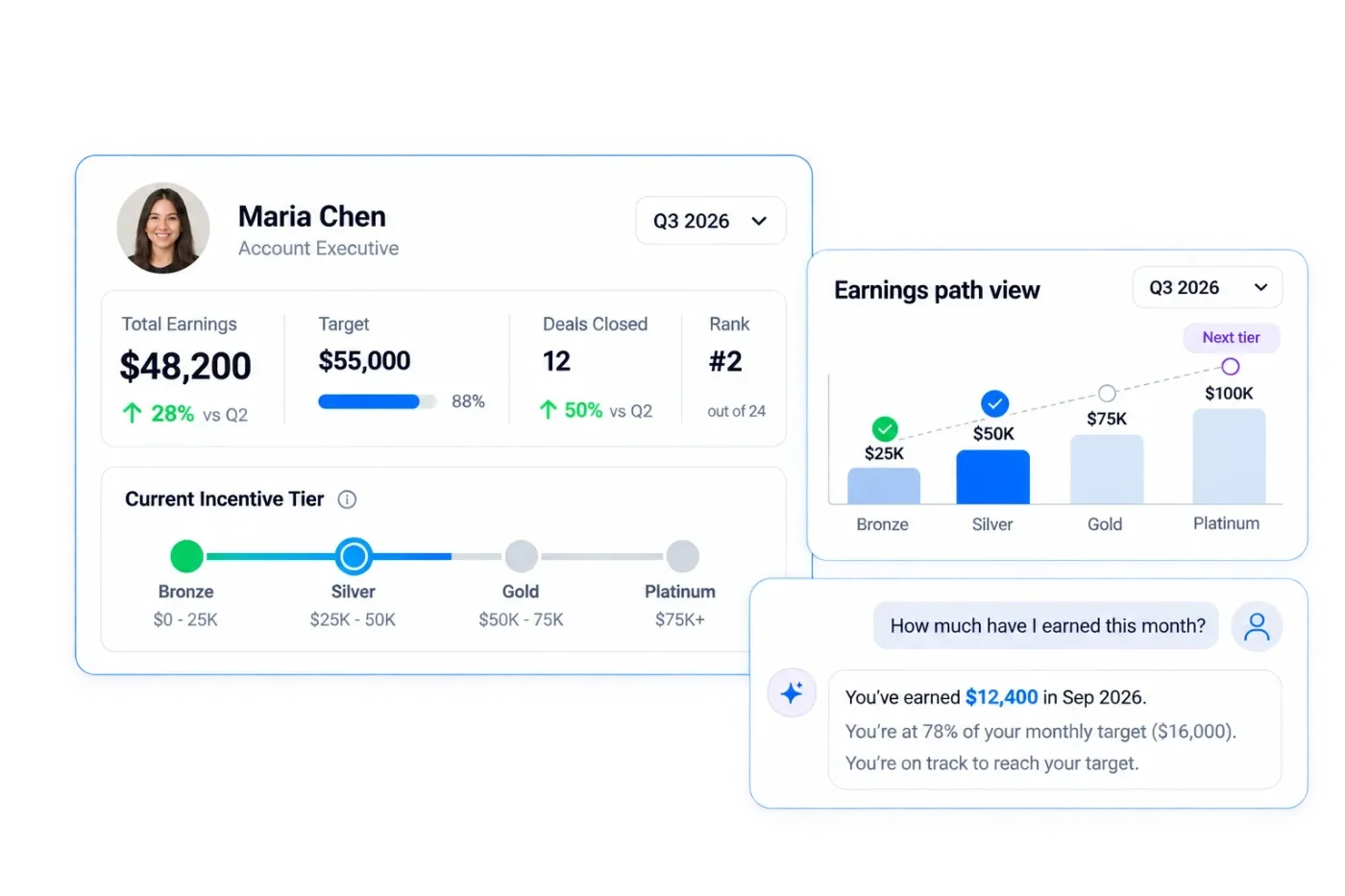
- Incentive plan recommendations: AI for sales incentives analyzes performance history to recommend structures by role, and monitors plan KPIs, cost curves and payout skew to suggest adjustments that stay within budget.
- Guardrails before payout: It detects overpayment risk, plan loopholes and gaming behavior before they reach the payout batch, alongside anomaly checks and multi-level approvals.
- Plan simulation: An estimator and simulation in plans and calculations show the payout impact of a plan before it goes live.
- Earnings answers for reps: Sales professionals ask questions such as "How much have I earned this month?" in plain language, get earnings nudges and see their future earning potential.
- Campaigns from a prompt: Admins describe a SPIF or campaign in plain language, or point to a past one, and AI sets it up instead of an admin configuring it by hand.
- Incentive data in your AI assistant: Xoxoday MCP lets admins query campaign insights and performance details from Microsoft Copilot, Claude and ChatGPT.
To size the opportunity before you talk to anyone, try the sales incentive ROI calculator, which estimates what manual calculation, payout errors and reconciliation cost your sales organization today.
Put AI to work on your commissions
AI is changing how businesses manage sales commissions, from catching errors before payday to recommending smarter plans and answering reps' questions in seconds. The teams that get the most from it keep the calculation transparent, connect clean data and let people approve every change that touches pay.
Start with the readiness checklist, fix the gaps it shows and pilot AI on one plan where errors or disputes are highest. Pair it with sales gamification to keep reps motivated between payouts.
Book your Empuls demo
Frequently asked questions
An AI commission system uses artificial intelligence alongside a rule-based commission engine to analyze performance data, recommend plan structures, flag payout errors and answer earnings questions. The commission formula still runs the same way every cycle, so each payout stays traceable, while AI adds forecasting, anomaly detection and plain-language explanations for reps, managers and finance teams.
Yes, but the safest approach keeps the calculation deterministic. Commission software applies your configured rules to CRM and ERP data, and AI works around it by validating inputs, flagging outliers and explaining results. Letting a generative model compute pay directly is risky, because the same input must always produce the same, auditable payout that finance and reps can trace.
AI improves sales commissions by catching data and payout errors before approval, recommending plan structures by role, forecasting attainable targets and giving reps real-time answers about their earnings. It also tracks payout skew and cost of sales over time, so you can refine plans every cycle instead of waiting for an annual review to find out what worked.
AI recommendations and forecasts are only as good as the data behind them. If CRM records, deal dates or crediting rules are wrong, AI will repeat and scale those mistakes. Salesforce research found only 35% of sales professionals completely trust their organization's data, so validating data at the source is the first step before relying on AI.
Yes. AI can project a rep's likely earnings from their current pipeline, attainment trend and plan rules, and show what they need to reach the next tier. For finance, the same models forecast total commission expense for the period. Forecasts are estimates, so treat them as planning guides and pay only on calculated, approved results.
No. AI removes manual work such as data cleanup, error checks and answering routine earnings questions, but people still own plan design, approvals, exceptions and disputes. Compensation teams shift from building spreadsheets to reviewing recommendations, tuning plans and governing how AI is used, which is higher-value work that most teams never had time for.
Look for a no-code plan builder, automated data connections, a traceable audit trail, pre-payout anomaly checks, approval workflows and a rep-facing earnings view. On the AI side, ask for plan recommendations, overpayment detection and plain-language earnings answers, and confirm that AI never changes a payout without human approval. Test it on one of your real plans.
In some regions, yes. The EU Artificial Intelligence Act classifies AI systems used to make decisions about work relationships or to evaluate workers' performance as high-risk, which brings duties such as human oversight and documentation. Other jurisdictions have privacy and employment rules that apply to pay data, so involve legal and HR before deploying AI that influences pay.





































































































































































































































































































































































































































































































































































