
Key Takeaways
Workplace communication styles are the habitual ways people share information, make requests, give feedback and respond to others at work.
The four classic styles are assertive, passive, aggressive and passive-aggressive, and assertive is the one that builds trust and surfaces problems early.
Five common team personalities, the enforcer, enabler, integrator, guardian and socializer, each bring strengths and blind spots to communication.
Adapting your style means matching the other person's pace, detail and preferred channel, then confirming what was agreed.
Shared platforms, town halls, peer feedback and fewer emails give every communication style a place to be heard.
Workplace communication styles are the habitual ways people share information, make requests, give feedback and respond to others at work. Most people lean toward one style, such as direct and fast, warm and supportive, or structured and detailed, and teams work best when people recognize those differences and adapt to them.
Good communication can be just as stimulating as coffee. And just like coffee, there are different brews of workplace communication styles, each with its own flavor and impact. Understanding communication styles in the workplace helps teams collaborate better, resolve conflicts faster and drive business success. It matters because misunderstandings are constant: in Grammarly's 2024 State of Business Communication report, every knowledge worker surveyed said they experience miscommunication at least weekly.
A quick look at well-known leaders, and how they interact with their world, offers a glimpse into different types of communication styles and their real-world impact.
Take Jeff Bezos. Amazon senior meetings famously begin with everyone reading a six-page memo in silence, an intense focus session that can seem unsettling to new hires. Bill Gates has a more animated approach, rocking in his chair during discussions, with the speed of the motion said to signal how engaged he is.
Mark Parker, the former CEO of Nike, is known for balancing structure and creativity by filling his notebooks with both notes and doodles. Oprah Winfrey's communication style, on the other hand, is built on deep personal connection, engaging her audience with warmth and genuine curiosity.
Marissa Mayer, the former CEO of Yahoo, prioritized structured interactions and personally reviewed new hires. Meanwhile, on the football field, Cristiano Ronaldo's celebrations after big goals send a bold, unspoken message about how he sees himself.
These leaders mastered their communication styles in the workplace, using approaches that fit their personalities and leadership philosophies. Whether through structured briefings, energetic interactions or personal engagement, the way we communicate shapes our professional influence.
Understanding the types of communication styles helps individuals and teams find their voice, collaborate better and create a workplace where ideas flow freely. This guide covers the classic four styles, five workplace communication personalities, a cheat sheet for adapting to each one and 12 strategies that improve communication across a team. Communication styles are one part of the bigger picture covered in our complete guide to employee communication.
Leadership communication styles at the workplace
The leaders above offer two lessons about leadership communication styles. The first, being yourself, matters most, because the second, engaging and refining, only works when your style is genuine.
1. Be you. Be communicating.
What each of these people is doing, even when they are not speaking or writing, is communicating through a signature mix of signals, body language and habits.
Each technique works because they are not trying to fit a mold or an industry best practice of communication. They are simply reaching out to the other side spontaneously and genuinely.
They are themselves, unabashedly and unapologetically. Their sincerity comes across in their spontaneity, and their personality leaves a lasting mark.
2. Communicate. Engage. Redo.
Communication is central to engaging minds, at home and at work. So what lessons do these leaders leave for us, and how do we bring their spark into our own working lives?
The answer is logical and simple. If these leaders became legends by refusing to follow trends and daring to be themselves, even when eyebrows were raised, that is what we should do too.
After all, our message is sharpest, clearest and loudest when it is authentic. There are few better ways to stay engaged and engage others, whether teammates, partners or clients, and that holds true whether you lead a virtual team or meet clients in person. Being authentic does not mean being rigid, though: the best communicators know their natural style and adapt it to the people in front of them.
The four classic communication styles at work
Most guides to types of communication styles at work start with four classic styles: assertive, passive, aggressive and passive-aggressive. The assertive style is the one to aim for, because it is the only one that respects both your needs and other people's.
| Style | What it sounds like | Effect on the team | How to respond |
|---|---|---|---|
| Assertive | "I need the report by Friday so I can brief the client. Can you make that work?" | Builds trust and clarity; problems surface early | Match it: be clear, honest and respectful in return |
| Passive | "Whatever works for everyone is fine with me." | Needs and concerns go unspoken, so issues surface late | Ask direct, open questions and give time to answer, in writing if that helps |
| Aggressive | "Just get it done. I don't care how." | Fear, defensiveness and less honest feedback | Stay calm, restate the shared goal and focus on facts, not tone |
| Passive-aggressive | "Fine. I'm sure you know best." followed by missed follow-through | Confusion and low trust; conflict stays hidden | Name the behavior privately and ask what is really bothering them |
These four describe how people handle needs and conflict. The five personalities in the next section describe something different: the role people naturally play in a team. Most people show a mix of both, so use them as a lens, not a label. If your team uses the assertive style well, it also makes transparency in communication much easier.
Give every communication style a place to be heard
Town hall updates, groups, polls and recognition in one social intranet, for desk and frontline teams.
Talk to our ExpertTrusted by 5,000+ companies
Types of communication styles in the workplace
To be yourself, you first need to know who you are. Before you unlock the engaging power of communication at work, it helps to identify your communication personality, so you can map your way forward while staying relaxed and in the moment. There are five common workplace communication personalities, and most teams need a little of each.
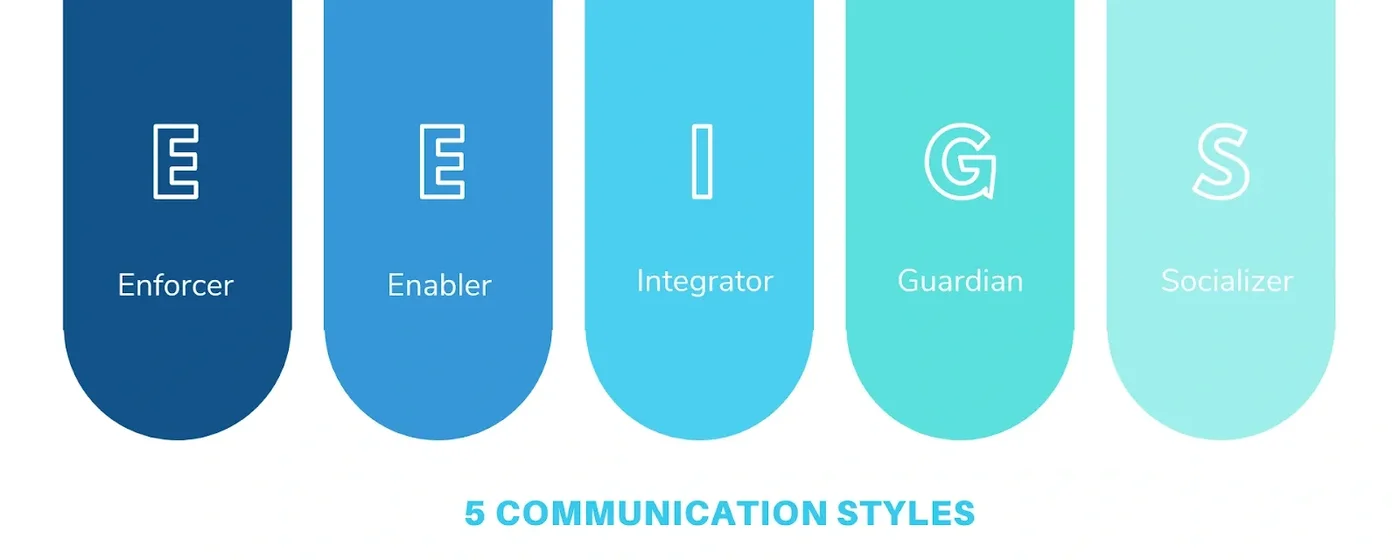
1. The enforcer
Enforcers are proactive personalities who take charge of situations. They set the tone, shape the narrative and control the outcome. Their preferred communication style is free of embellishment, refreshingly direct and deliberately unambiguous. They mean business and do not mince words.
This lead-from-the-front style can be magnetic and often inspires a whole team to act, but it can also trample on others' territory or ruffle a few feathers.
The trick is to put yourself in the other person's shoes. Turning up empathy helps the enforcer see both sides clearly and become a more rounded, mature communicator.
2. The enabler
This is the friendliest tribe in the workplace. Enablers are always championing the underdog, adopting a new idea or cheering on team morale, often without even thinking about it. Expect plenty of thumbs-ups, high-fives and pats on the back from this group.
When it comes to communication, they are sensitive, patient and accommodating, with a presence that grows on you. That is an obvious asset, but it has a flip side.
Left to themselves, enablers can sometimes seem intrusive, and they risk neglecting their own work by spending too much time fixing other people's fires.
As a sensitive type, they can also be hurt when their positivity goes unanswered or ignored. Enablers need to keep drawing boundaries and prioritizing their own goals while keeping their inner glow going.
3. The integrator
Say hello to the natural-born delivery leads of your universe. Integrators make excellent event organizers and project managers, holding the flock together and making sure every piece of the jigsaw works with clockwork precision.
With colleagues, they show a fine grasp of psychology. They know exactly how and when to nudge, steering team morale, and performance with it, like an orchestra conductor.
Their personality can range from reserved to gregarious, but in communication they tend to be measured, keeping a close eye on the workflow and saving their voice for crunch moments.
As a tip, integrators should remember that a ship crewed by talented people can take care of itself, so it is perfectly fine to let go and relax once in a while.
4. The guardian
Shepherd, agony aunt or uncle and philosopher rolled into one, the guardian is the mentor and protector of the team, and nearly every team has one, at least in spirit. Guardians are often on the senior side, with a wealth of experience to draw on when it is time to be a trusted confidant, though there are plenty of exceptions.
Guardians tend to be warm, understanding and mature, and they generally have, or make, time for you. The reverse is also true: some cross over to the dark side and become strict taskmasters.
In their defense, they will say, and probably believe, that they are doing it for the good of the group and to protect their cause.
At their best, guardians have a calming, rejuvenating effect on a team that is truly precious. Their communication, like all great communication, reflects who they are and the moment they are in: comforting, correcting or inspiring, depending on who is in front of them.
5. The socializer
This group is the life of the party, and workplaces, whether in the office or spread across locations, need a little celebration to stay happy and connected. Cordial, generous and outgoing, socializers are often the glue that holds team spirit together, spreading the energy everyone needs to get through the routine.
Their colorful nature shows in how they behave and speak. They will entertain you with their storytelling and fire you up with infectious positivity.
If you were to nitpick, socializers, like enablers, can overstep boundaries and wander into personal space without meaning to, thanks to their naturally extroverted nature.
That said, their energy is priceless for any organization, especially when change, and the confusion that comes with it, seems to be the flavor of every season.
How to adapt your communication style
Knowing your own style is half the job; the other half is adjusting to the people you work with. The cheat sheet below shows how to spot each workplace communication style and what each one needs from you, and the five steps after it turn that into a habit.
| Style | How to spot it | How to communicate with them | Watch out for |
|---|---|---|---|
| Enforcer | Short messages, quick decisions, asks for the bottom line | Lead with the conclusion and the decision needed; keep detail available but optional | Steamrolling quieter voices; invite others in by name |
| Enabler | Encouraging, checks in on people, offers help often | Acknowledge their support, be warm, and make requests clear and specific | Saying yes to everything; help them set boundaries |
| Integrator | Plans, timelines, status updates and follow-ups | Give structure: owners, dates, dependencies and a clear process | Over-managing; agree when they can step back |
| Guardian | Mentors others, raises risks, values fairness and experience | Ask for their view early, explain the reasoning and respect their experience | Resistance to change; involve them in shaping it |
| Socializer | Storytelling, energy in meetings, builds relationships fast | Make space for conversation, use stories and visuals, then confirm next steps in writing | Losing the detail; follow up with a short written summary |
- Know your default: Notice your style when you are rushed or under pressure, because that is when it is strongest.
- Read the other person: Look at how they write, speak and ask questions, and mirror their pace and level of detail.
- Choose the channel: Some people think best in writing, others in conversation. Offer both for important topics.
- Check understanding: End important conversations by agreeing on what was decided and who does what next.
- Ask for feedback: Ask colleagues what helps them most when working with you, and adjust. Practicing active listening makes this much easier.
Share the cheat sheet with your team and ask each person to name their own style. A five-minute conversation about how each person prefers to receive information prevents weeks of friction.
Amplifying workplace communication: 12 strategies that work
Effective workplace communication thrives on structure, rhythm and coordination, like a finely tuned orchestra. These 12 strategies help teams with different communication styles connect; start with the first two, a shared platform and regular town halls, because they give every style a place to be heard. For the principles underneath them, see the pillars of effective communication in the workplace.
1. Powering up with collaborative communication platforms
Modern workspaces buzz with rapid conversations, shared files and endless tasks. The antidote to scattered communication is a collaborative platform that brings chat, video calls, file sharing and project work into one place.
These digital spaces act as the virtual command center for teamwork, keeping everyone on the same page without endless email threads or lost messages. With the right platform in place, bottlenecks shrink and work becomes faster and more transparent.
Try this: Agree which tool is for what, for example chat for quick questions and a shared space for decisions, so information is easy to find later.
2. Holding town hall meetings: where leadership meets the workforce
A thriving workplace is built on transparency and shared purpose. Town hall meetings give leaders and employees a stage for open dialogue: sharing updates, celebrating wins and addressing concerns in real time.
These forums flatten hierarchies, give employees direct access to leadership and make sure company goals resonate at every level. Town halls are not just meetings; they are culture builders that turn corporate communication into a two-way street where voices from every level are heard.
Try this: Collect questions in advance, including anonymous ones, and post a recording and written answers for people who could not attend.
3. Implementing a peer feedback system: elevating growth through recognition
Feedback is not just a performance metric; it is a catalyst for learning, collaboration and growth. A well-structured peer feedback system encourages employees to acknowledge each other's contributions, building a culture of appreciation and improvement.
When employees give and receive feedback from peers, it breaks down silos and creates an environment where constructive insight fuels development. Where recognition and feedback flow naturally, employees do not just perform, they thrive. See how to build it in our guide to a culture of feedback.
4. Digital suggestion boxes: turning ideas into action
The classic suggestion box has evolved. Digital platforms give employee ideas a real-time, interactive space where they are not just submitted but voted on, discussed and refined.
These platforms encourage innovation, boost engagement and create an open culture where employees feel empowered to contribute beyond their roles. A workplace that listens to its employees does not just retain talent; it builds a culture of innovation and growth.
Try this: Reply to every idea, even with a no and a reason, and share which ideas were adopted each quarter.
5. Cross-departmental team building: breaking the silos
Silos are the silent killer of collaboration. When teams stay inside their departments, knowledge stays locked in and company-wide goals get lost in translation.
Cross-departmental activities break down these walls, building relationships across teams. When employees understand how other teams work, collaboration is faster, problem-solving is more creative and company-wide unity grows.
6. Reverse mentorship: flipping the script on learning
Mentorship has traditionally been one-way, with senior employees passing wisdom to junior staff. Reverse mentorship flips that, letting younger employees teach senior leaders about emerging trends, digital tools and changing workplace expectations.
It bridges generational gaps, modernizes leadership perspectives and strengthens communication across experience levels. When knowledge flows both ways, companies future-proof their leadership and build a culture of lifelong learning.
7. Open-plan workspaces with dedicated quiet zones: the best of both worlds
Workplace design is not just about looks; it shapes how employees interact, collaborate and stay productive.
Open-plan spaces encourage spontaneous conversation and teamwork, but they can become distracting without balance. The best offices blend open collaboration areas with quiet zones, so employees can choose how they work best. Quieter communicators, in particular, often do their best thinking away from the buzz.
8. No-email days: cutting through the clutter
Email is efficient, but productivity suffers when inboxes overflow. Microsoft's 2025 Work Trend Index research found the average worker receives 117 emails a day, most skimmed in under a minute. Constant digital chatter leads to overload, miscommunication and missed priorities.
The solution is no-email days or focus periods that encourage teams to talk face-to-face, by phone or on other channels. When email takes a back seat, real conversations take the wheel.
9. Rotation and secondment programs: breaking silos, building connections
Want employees to see the bigger picture? Move them around. Rotation and secondment programs move people between departments, roles or even countries, promoting cross-functional collaboration, knowledge sharing and a deeper understanding of the business.
When people experience different perspectives firsthand, collaboration stops being an afterthought and becomes second nature.
10. Lunch and learn: feeding minds while breaking barriers
Imagine grabbing a bite while learning from colleagues in other departments. Lunch and learn sessions turn casual breaks into knowledge-sharing moments, encouraging cross-team learning and open conversation in an informal setting. Learning does not need a classroom, just the right environment.
11. Walk-and-talk meetings: unleashing ideas on the move
Why sit in a boardroom when you can talk strategy while stretching your legs? Walk-and-talk meetings swap conference rooms for open spaces, encouraging candid conversation, creative thinking and sharper focus. Sometimes the best solutions are found in motion.
12. Digital detox retreats: unplugging to reconnect
In an always-on world, real connection sometimes needs a full disconnect. Digital detox retreats let employees step away from screens, recharge and build stronger in-person relationships through team activities, brainstorming and face-to-face collaboration. Sometimes stepping back is the best way to move forward.
Break down communication barriers with Empuls
Effective workplace communication is not just about exchanging information; it is about building connections, encouraging engagement and creating a culture where every style of communicator feels heard. The Empuls social intranet turns internal communication into one connected experience.
- A central hub for communication: Company news, team updates and key messages live in one feed, with important posts spotlighted, instead of scattered emails and silos.
- Two-way communication: Employees can share opinions, join discussions in groups and engage with leaders in the Townhall, so it is not just top-down.
- Recognition and feedback: Peer-to-peer recognition and pulse surveys make sure people feel valued and heard.
- Engagement for every style: Interactive posts, polls and quizzes and celebrations invite quieter communicators and socializers alike to take part.
- Announcements that reach everyone: Updates go out through the feed, the mobile app, digital signage and Slack, Microsoft Teams or email, so the right people see them at the right time.
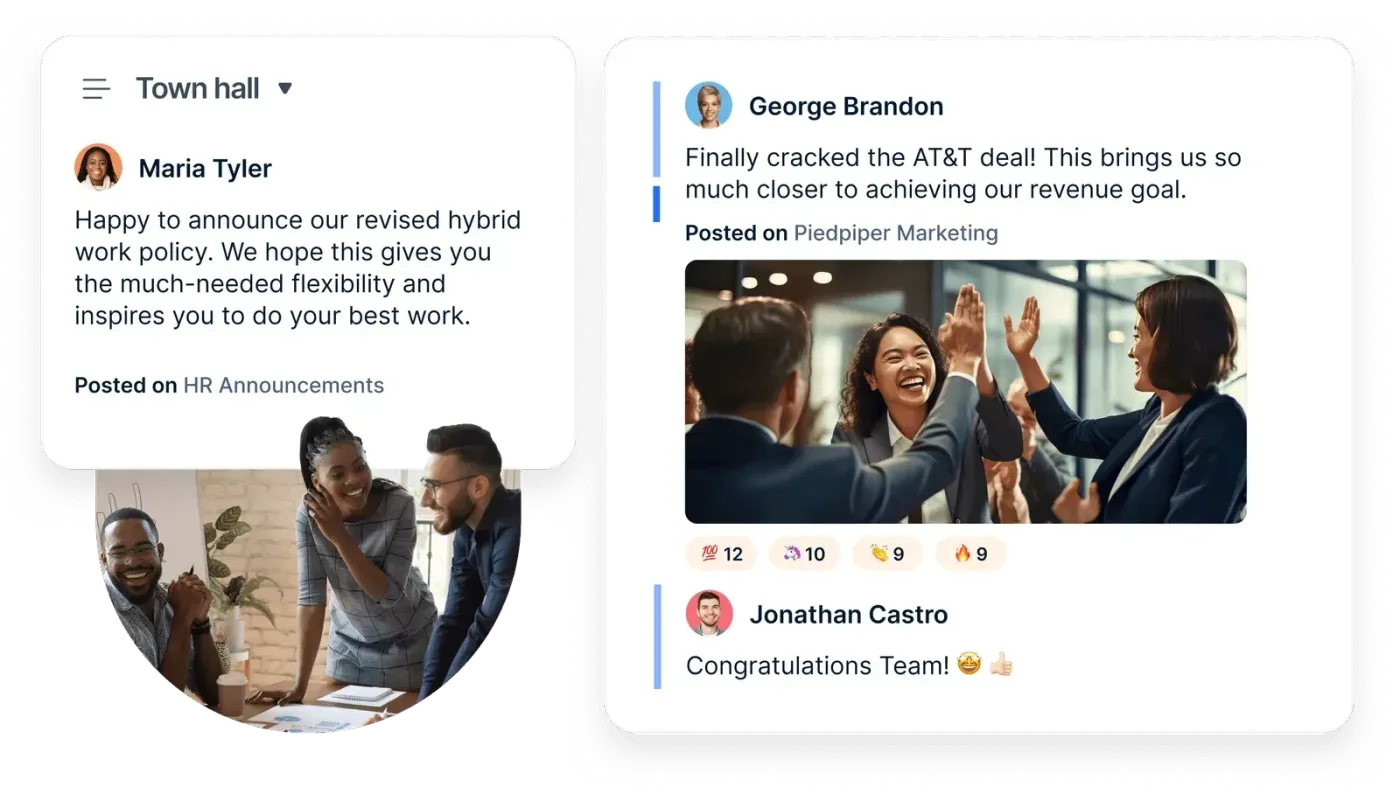
Whatever your communication style, cherish it, nurture it and celebrate it in everyday interactions with colleagues. A cheerful good morning to start the day, a simple hello to someone from another department, a warm thank-you to a colleague who covered for you, a gentle nudge about a looming deadline, a public high-five for a new joiner or an unsung hero, or a friendly team game: there is no better way to say "we are in this together" than keeping your channels of communication open and alive, whether your team sits together or works across locations.
Book your Empuls demo
Frequently asked questions
The four main communication styles are assertive, passive, aggressive and passive-aggressive. Assertive communicators are clear, direct and respectful. Passive communicators avoid conflict and hold back their needs. Aggressive communicators are forceful and dismissive of others. Passive-aggressive communicators seem to agree but resist indirectly, through sarcasm or missed follow-through.
The assertive style is usually the most effective in the workplace. It lets people state their needs, ideas and concerns clearly while respecting others, which builds trust and brings problems to the surface early. Effective communicators also adapt their tone, level of detail and channel to each person and situation.
Notice how you communicate under pressure, how you prefer to receive information and what colleagues say about working with you. Do you lead with the bottom line, check in on people, organize the plan, offer guidance or bring the energy? A quick team discussion or a structured assessment can confirm your default style.
Understanding communication styles reduces misunderstandings and friction, because you can see why a colleague's message feels blunt, vague or overly detailed and respond in a way that works for them. It improves collaboration, feedback and conflict resolution, and helps managers get the best from people with very different personalities.
Start by observing how they speak and write, then mirror their pace and level of detail. Lead with the bottom line for direct communicators, add context for detail-oriented ones and leave room for conversation with relationship-focused colleagues. Confirm decisions and next steps in writing so nothing gets lost between styles.
Yes. Most people have a default style, but it shifts with experience, role, culture and feedback. New managers often become more structured, and people under stress may become more aggressive or more passive. With practice, anyone can strengthen an assertive approach and learn to adapt to different colleagues and situations.
Different styles can make a team stronger when people understand them, combining decisiveness, empathy, organization, wisdom and energy. Without that understanding, the same differences cause friction, such as fast deciders frustrating careful planners. Teams that talk openly about their styles agree on channels and norms and resolve conflict faster.





































































































































































































































































































































































































































































































































































