
Key Takeaways
Healthcare employee recognition is regular, specific appreciation of every care team member, backed by rewards that fit their role and shift.
Only 56.2% of physicians said they feel valued by their organization in 2025, according to the AMA.
Nursing assistants, patient care technicians and environmental services staff turn over far faster than nurses, so recognition must reach every role.
A published points matrix makes healthcare recognition fair and visible across units, shifts and roles.
Recognition works best on top of safe staffing and supportive leadership, not as a substitute for them.
Healthcare employee recognition is the regular, specific appreciation of nurses, doctors and every other care team member for the work they do, backed by rewards that fit their roles and shifts. In a sector where burnout and turnover stay high, a well-run recognition program is one of the few levers that lifts morale quickly, costs little and reaches every role, from the ICU to housekeeping.
When doctors, nurses and other frontline healthcare workers feel the heat of stress and adversity, leaders must step in to help them recover, with genuine recognition, generous appreciation and meaningful rewards. These professionals give their all to care for patients, and healthcare employee recognition programs are the most practical way to give back in a way that matters. From appreciating support staff and recognizing doctors to rewarding nurses, every gesture makes a difference.
Rewards and recognition in the healthcare industry are more than feel-good initiatives. They help boost morale, reduce burnout and strengthen the emotional resilience of the people on the frontline. This guide covers why recognition matters now, best practices for building a healthcare employee rewards program, nurse recognition ideas by role and a points matrix you can adapt.
Why healthcare employee recognition matters now
During the pandemic, doctors, nurses, paramedics, home health aides, housekeeping teams, clerks and many others held the system together, often without enough protection, training or support. The world applauded. But before that crisis, and in many places since, the healthcare community was too easily taken for granted. After all, weren't they just doing their job?
Paradoxically, it is precisely for carrying on their job as if it were just another day, while knowing the risks, that our doctors, nurses and caregivers have proven themselves. As one home health aide put it, many feel like the forgotten heroes. The task for leaders now is to go from a one-time reaction to a year-round program that recognizes and rewards every role, memorably and consistently.
The pressure has not gone away. The AMA's 2025 physician burnout data, based on nearly 19,000 physicians, found 41.9% reported at least one symptom of burnout, and only 56.2% said they feel valued by their organization to a great or moderate extent. The 2026 NSI National Health Care Retention and RN Staffing Report put hospital turnover at 18.5% and RN turnover at 17.6% in 2025, with each bedside RN who leaves costing an average of $60,090.
41.9%
of physicians report burnout
AMA, 2025
56.2%
of physicians feel valued
by their organization (AMA, 2025)
17.6%
hospital RN turnover
NSI, 2025 data
$60,090
average cost of losing
one bedside RN (NSI, 2026)
The case for recognition in healthcare
Demand for care keeps rising too. The Bureau of Labor Statistics projects healthcare occupations to grow much faster than average over the next decade, with about 1.9 million openings each year, and the WHO's State of the World's Nursing 2025 report estimates a global shortage of 5.8 million nurses. Workplaces must be recognition ready for the next generation of healthcare workers, as well as for the people already on the floor.
For the wider picture, see these ways to improve healthcare employee engagement and the full set of healthcare employee retention strategies. This guide stays focused on recognition and rewards.
Recognition must reach every role on the care team
Doctors and nurses get most of the public praise, but the roles with the highest turnover are often the least visible. Housekeeping staff disinfect ventilators, call buttons and bed rails, patient care technicians and nursing assistants handle much of the hands-on care, and many work without anyone noticing what they do.
The NSI report also found that 29.5% of all new hospital hires left within a year. A recognition program that celebrates support staff and new hires as loudly as senior clinicians speaks directly to the groups you are most likely to lose.
Healthcare employee recognition programs really matter
People in every walk of life, doctors and nurses included, are motivated by simple acts of acknowledgment and appreciation. They deserve and want to be recognized and rewarded for their contributions.
"We all want to be recognized for our good work, from frontline staff to nursing leaders," says Anne Jessie, DNP, RN, a nursing leader in the American Academy of Ambulatory Care Nursing. Professional bodies agree: the American Association of Critical-Care Nurses names meaningful recognition as one of its six standards for a healthy work environment, alongside skilled communication, true collaboration, effective decision-making, appropriate staffing and authentic leadership.
Recognition also strengthens engagement across the team. A Gallup and Workhuman study found that employees who receive high-quality recognition were 45% less likely to have left their organization two years later. Teams that are regularly applauded tend to feel a greater sense of belonging and pride, and that positivity carries over to patients.
Recognition does not always need to flow top-down. When colleagues and extended teams recognize each other, it creates solidarity across departments and shifts. This guide to peer-to-peer recognition explains how to set it up.
Recognize every role on the care team
Give nurses, doctors and support staff timely recognition and rewards that work on any shift.
Talk to our ExpertTrusted by 5,000+ companies
Best practices for a healthcare employee rewards program
These nine best practices take you from the foundation to everyday habits. The first two matter most, because recognition only lands on a team that already feels supported, safe and heard.
1. Set the stage and build the culture
Before you can reward performance, give your healthcare teams a working environment that lets them do their best: appropriate staffing, the right tools and leaders who protect their safety. Recognition layered on top of chronic understaffing feels hollow. To tackle the root causes, see these ways to prevent burnout.
2. Build an enabling workplace with free-flowing communication
Ongoing feedback and regular check-ins make recognition specific, because managers learn what people actually did on a shift. Mentoring and light gamification add more ways for everyone to make an impact and be seen for it.
3. Ask what your teams want
Find out what your nurses, doctors and frontline teams expect, what motivates them and how they want to grow. Then match each person's purpose with the organization's purpose to create personalized recognition and rewards that keep them involved and engaged.
4. Stay grateful for the small things
Build a gratitude-driven culture, and remember that not every achievement is a headline milestone. Thanking a colleague in another department who helped with a transfer can go a long way. A meaningful thank-you note, a personalized gift or a coffee catch-up can be as powerful as a formal award for staff who are always stretched.
5. Do not discriminate between roles
If you recognize doctors for a certain achievement, apply the same yardstick, in spirit, to nurses, EMTs, technicians, support staff and administrators. Recognition that is not transparent and fair is not just unfair, it drains morale. Check your data for gaps by role, shift and unit, and read how to prevent bias in recognition programs.
6. Customize recognition
Healthcare professionals are proud of the impact of their profession. Make sure recognition reflects that respect and dignity, and align rewards with the recipient's preferences and the size of the achievement. Some people enjoy public praise, others prefer a quiet word, so find out and follow each person's choice.
7. Blend non-monetary rewards with monetary incentives
Cash will always be valued, but healthcare rewards should also include non-monetary recognition. Non-monetary rewards are often valued more than they cost, they break the monotony of money and, planned well, they touch people more deeply. Show people their impact on patients, remove barriers that slow their work, give autonomy and flexibility where you can, and protect their safety and mental health. For more options, see non-monetary employee recognition.
8. Recognize in the moment
Annual or quarterly awards are a tested way to keep teams engaged, but appreciation should not be saved for the yearly awards evening. Build a culture where small and large moments are recognized on the spot, ideally in public view, so everyday work feels noticed. These on-the-spot recognition ideas are easy to start with.
9. Convert appreciation into points
Add spark to your recognition plan for doctors and nurses with a points workflow, where specific actions earn points in real time. Points add up across the month, winners are honored at a team get-together, and everyone redeems points for rewards they choose. The matrix below shows how it can work.
A recognition points matrix for healthcare teams
A points matrix turns recognition into a clear, fair system that every role can see. Adapt the actions and values to your budget, and keep patient safety and teamwork worth more than speed or volume.
| Action | Suggested points | Who can give it | Why it matters |
|---|---|---|---|
| Helping a colleague during a busy shift (covering a break, grabbing supplies) | 10 | Any colleague | Builds everyday teamwork |
| Named in a positive patient or family comment | 50 | Unit manager | Links recognition to patient experience |
| Speaking up about a safety concern or near miss | 50 | Unit manager or quality team | Reinforces a just, safe culture |
| Covering an extra shift during a staffing crunch | 100 | Unit manager | Acknowledges personal sacrifice |
| Team receives strong patient experience scores for the month | 70 per team member | Department head | Rewards shared results |
| Mentoring a new hire through their first 90 days | 100 | Nurse educator or manager | Protects first-year retention |
| Completing a certification or advanced training | 150 | HR or education team | Encourages growth |
Publish the matrix, set a monthly budget per unit and review the data so night shifts, weekend teams and support roles earn as fairly as day-shift clinicians.
Nurse recognition ideas and rewards for healthcare workers by role
The best recognition fits the role and the shift. The table below groups nurse recognition ideas and rewards for healthcare workers by role, with a rough cost so you can mix low-cost gestures with bigger moments.
| Role | Recognition ideas | Reward ideas | Typical cost |
|---|---|---|---|
| Nurses | Shout-out in shift huddle, patient-nominated awards, Nurses Week celebrations, a seat on a practice council | Points, meal or coffee cards, self-care kits, certification funding, extra paid time off | Low to medium |
| Physicians | Peer nominations, leadership thank-you notes, recognition in grand rounds or newsletters | Conference or CME support, protected time, experiences | Medium |
| Nursing assistants and patient care techs | Public praise from nurses they support, team awards, mentoring roles | Gift cards for groceries or fuel, schedule preference, career ladder support | Low |
| Environmental services and support staff | Recognition for infection control and patient comfort, inclusion in unit celebrations | Points, meal vouchers, family event tickets | Low |
| Administrative and back-office teams | Thanks for coordination under pressure, cross-department kudos | Points, flexible hours, learning budgets | Low |
A few more healthcare employee recognition ideas from the original list still work well:
- Awards and titles: Plaques, certificates, badges, a hall of fame and fun titles that celebrate quirks, such as an award for whoever always volunteers for the hardest jobs.
- Public mentions: Stories on the intranet, newsletter or social channels, with consent, and a short video of the team at work.
- Shared moments: Signed thank-you notes, cross-department potluck lunches, surprise treats mid-week for a stretched team and group photos.
- Family and growth: Family events, scholarships, benefits for family members, promotions and fair appraisals.
- Gifts and experiences: Books, gym or club memberships, gardening kits, gift vouchers, gadgets and getaways for bigger milestones.
For Nurses Week and other dates, see these employee appreciation ideas, and for tenure milestones, this guide to long service awards.
Recognition for frontline healthcare workers on every shift
Recognition for frontline healthcare workers has to work around 12-hour shifts, nights, weekends and multiple sites. Three habits make it reach everyone:
- Make it mobile: Many clinical and support staff do not sit at a computer. Recognition, nominations and rewards should work on a phone in a few taps.
- Recognize across shifts: Night and weekend staff miss daytime ceremonies. Post recognition to a shared feed and repeat key moments at handover.
- Track reach by unit and role: Review monthly who has and has not been recognized, and nudge managers where gaps appear.
These habits are covered in more depth in this guide to engaging frontline workers. To set targets and prove impact, read how to measure employee recognition programs.
How Empuls powers healthcare employee recognition
In a setting where burnout runs high and appreciation often comes too late, Empuls helps healthcare leaders make recognition timely, personal and felt by every role. With Empuls, you can:
- Recognize in real time: Give spot awards in seconds to nurses on night shifts, housekeeping teams maintaining hygiene or admin teams coordinating under pressure, with an AI coach to help write the message.
- Run fair, structured awards: Use nominations and jury workflows for department and hospital-wide awards, so approvals are consistent and transparent.
- Automate milestones: Milestone rewards celebrate work anniversaries, certifications and goals without manual tracking.
- Offer meaningful rewards: Points redeem for gift cards, experiences and merchandise that suit every preference.
- Track participation: Reports and analytics show recognition by unit, role and location, so you can close gaps.
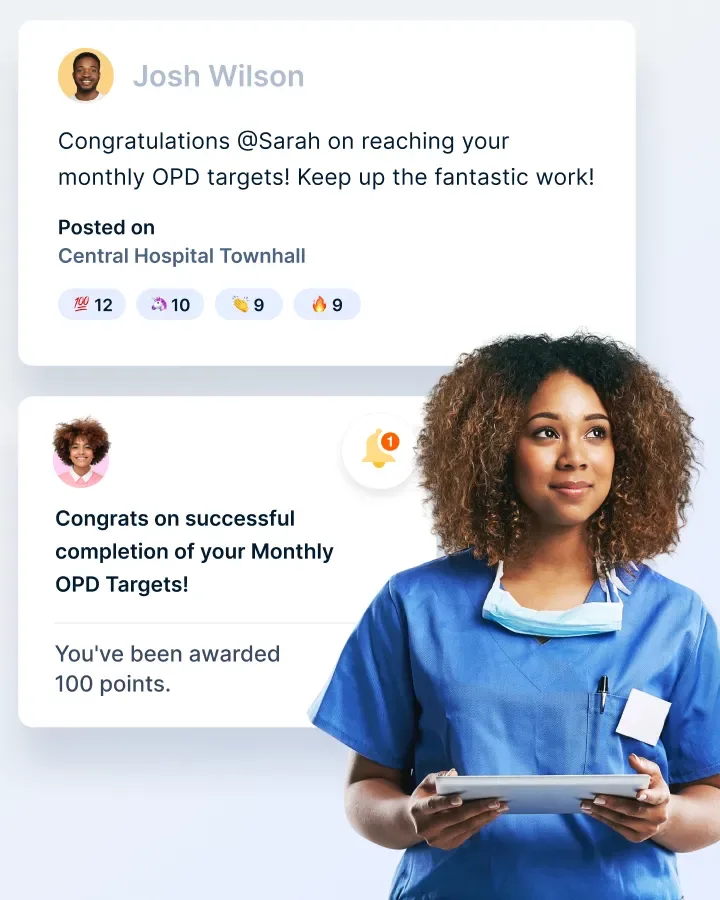
A digital healthcare enterprise with 1,200 to 1,500 employees replaced its manual R&R program with Empuls and saw a 5x rise in award distribution, a 2x increase in engagement and 97% active adoption. Read the healthcare recognition case study.
Healthcare employee recognition is urgent, not optional
The past few years showed what true dedication looks like. Doctors, nurses and healthcare staff did not just do their jobs, they held the system together. Now it is time to build systems that hold them up in return.
Rewards and recognition in healthcare are essential tools to reduce burnout, improve retention and create a workplace where people feel seen, valued and motivated. When appreciation becomes part of the culture, engagement follows, and so does better patient care. Do not wait for another crisis to say thank you. Start now, and use the employee recognition guide to plan the rest of your program.
Book your Empuls demo
Frequently asked questions
Healthcare employee recognition is the practice of regularly acknowledging nurses, doctors, technicians, support staff and administrators for their contributions to patient care and the team. It ranges from a specific thank-you in a shift huddle to formal awards, milestone celebrations and points-based rewards, and it works best when it is timely, fair across roles and tied to patient care.
Start with low-cost, specific recognition: thank-you notes from leaders, shout-outs in huddles, sharing patient comments that name the nurse and peer nominations. Add small rewards such as coffee or meal cards, schedule preferences and protected time for training. Recognizing nurses consistently through the year matters more than spending heavily during Nurses Week.
Good rewards for healthcare workers include points they can redeem for gift cards, groceries or experiences, extra paid time off, schedule preference, certification and education funding, meal vouchers and self-care kits. Letting people choose their own reward works best, because a night-shift nursing assistant and a senior physician rarely value the same thing.
Recognition helps with burnout by making people feel valued and connected to purpose, but it cannot fix the root causes alone. Safe staffing, manageable workloads and supportive leadership come first. The AACN lists meaningful recognition as one of six standards for a healthy work environment, which reflects that recognition works alongside, not instead of, those basics.
Aim for every team member to receive specific recognition at least once a month, with informal thanks happening every shift. Combine that with monthly or quarterly unit awards, annual hospital-wide awards and automatic milestone celebrations. Review recognition data by unit and shift to make sure nights, weekends and support roles are included.
Recognize support staff, such as environmental services, nursing assistants, transport and food service teams, for their specific impact on patient safety and comfort. Include them in unit celebrations, invite nurses and physicians to nominate them, share their stories in internal channels and give them access to the same rewards catalog as clinical staff.
A healthcare employee rewards program should include everyday peer and manager recognition, spot awards for standout moments, structured awards with clear criteria, automatic milestone and anniversary celebrations, a reward catalog employees choose from, a fair budget per unit and reports that show participation by role, unit and shift.





































































































































































































































































































































































































































































































































































