
Key Takeaways
A sales compensation plan defines how a salesperson is paid: base salary, variable pay, quota, measures, and the rules for crediting, timing and adjustments.
Set the commission rate by dividing target variable pay by quota, so a rep with $85,000 of target variable pay and an $850,000 quota needs an average rate of 10%.
The more a rep controls the sale, the more variable the pay mix: about 50:50 for new-business hunters and 70:30 for SDRs and account managers.
Alexander Group found 97% of companies changed their sales compensation plans for 2026, yet only about one in five rated their previous plans very effective.
A written plan document with crediting, clawback and dispute rules prevents most compensation disputes, and some jurisdictions, such as California, require one.
A sales compensation plan is the written agreement that sets how a salesperson is paid: base salary, variable pay, the quota and measures that earn it, and the rules for crediting, timing and adjustments. A good plan states on-target earnings (OTE) and pay mix, pays a rate that delivers target variable pay at quota, and is simple enough for every rep to check. This guide covers the components, the types of sales compensation plans, how to create one in 8 steps and four sales compensation plan examples by role.
Few business functions are as dynamic as sales, and the performance of your reps can decide whether you lead your market or trail it. Finding a top performer is hard, and keeping one is harder. In any sales team, compensation is the primary driver of motivation and of the selling behaviors you want, so the plan behind it deserves as much care as the product you sell.
What a sales compensation plan is
Sales compensation is the total amount a sales representative is paid in a year, including base salary, commission, bonuses and other incentives. A sales compensation plan is the document that defines how that pay is earned: what the rep is measured on, how much they earn at different levels of performance and when they are paid.
It is broader than a commission structure. The sales commission structure is the formula that turns results into variable pay, while the plan wraps that formula with target pay, quotas, crediting rules, payout timing and the policies that prevent disputes. Before you look at examples, you need the seven building blocks every plan uses.
Key components of a sales compensation plan
Seven components appear in almost every plan, and the first three (quota, OTE and pay mix) set the economics of everything else. The table defines each one with an example you can adapt.
| Component | What it is | Example |
|---|---|---|
| Sales quota | The sales target a rep or team is expected to reach in a period, by revenue, units or another measure | $850,000 of annual bookings, or 6 qualified meetings a month |
| On-target earnings (OTE) | Base salary plus the variable pay a rep earns at exactly 100% of quota | $95,000 base + $85,000 target variable = $180,000 OTE |
| Pay mix | The split of OTE between base and variable pay, written base to variable | 53:47, or 70:30 for account management |
| Accelerator | A higher rate paid once a rep passes quota, to reward overperformance | 10% to quota, 15% on bookings above it |
| Decelerator | A lower rate paid below a threshold, so weak performance does not earn full rates | 5% on bookings below half of quota |
| Clawback | Recovery of commission already paid when a deal falls through, such as a cancellation or early churn | Commission repaid if the customer cancels within 90 days |
| SPIFF and sales contest | A short-term bonus or contest on top of the plan to push a specific product or behavior | $250 for each new product attached to a renewal in Q4 |
A quota is a target, not always a threshold. Some plans pay commission only on sales above quota, but most pay from the first dollar and use tiers or accelerators to reward the sales beyond it. Whichever you choose, spell it out, because it changes what a rep takes home. For short-term programs on top of the plan, see these sales SPIFF ideas.
Why sales compensation plans are important
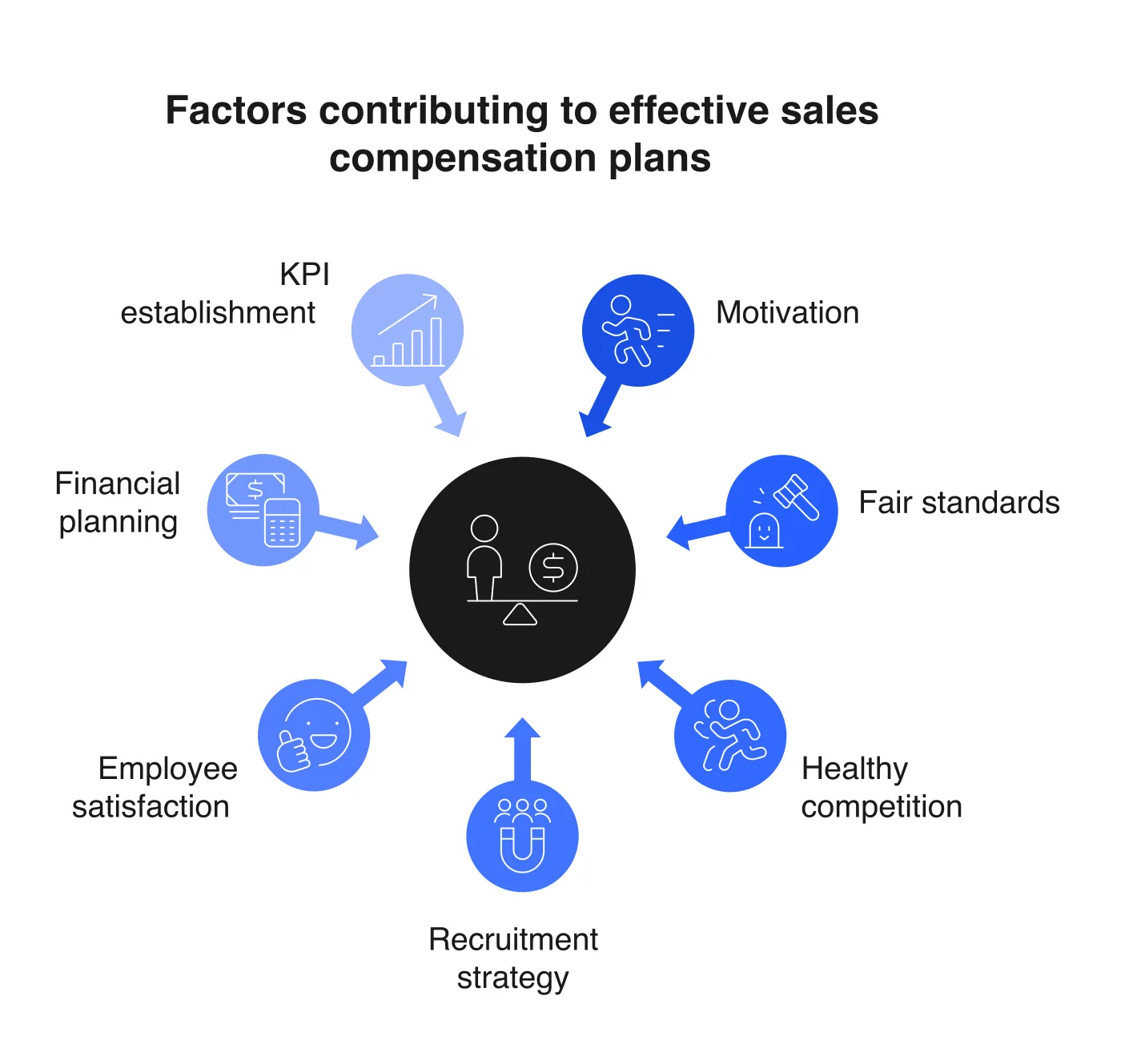
Selling is a demanding job, and sales roles have some of the highest turnover in any company. A robust compensation plan sets fair standards, encourages healthy competition and, most importantly, makes reps feel rewarded fairly for the value they create. It also does work beyond motivation:
- Recruitment: A competitive, clearly explained plan helps you attract experienced sellers.
- Satisfaction and retention: Pay that matches skill and results keeps your best people from looking elsewhere.
- Financial planning: A modeled plan lets finance project the cost of sales and payroll at different attainment levels.
- Performance measurement: The plan's measures become the key performance indicators (KPIs) you use to track whether pay is driving results.
Getting the plan right is still hard for most companies. Alexander Group's 2026 Sales Compensation Trends Survey, based on hundreds of companies across 11 industries, found:
97%
of companies
changed their sales compensation plans for 2026
1 in 5
companies
rated their 2025 plans very effective
57%
of companies
struggle to set accurate quotas
55%
of sellers
expected to reach quota in 2026
Source: Alexander Group, 2026 Sales Compensation Trends Survey
Types of sales compensation plans
Sales professionals can be paid through salary, commission, bonuses or a mix, and most companies combine two or three of the ten types below. Base salary plus commission is the most widely used, so it sits near the top; the formulas and worked numbers for the commission-based types are in the guide to sales commission structures.
| Plan type | How it pays | Example | Best for |
|---|---|---|---|
| Salary only | Fixed annual salary, no variable pay | $70,000 a year regardless of results | Inbound, service-led or highly regulated roles where reps should not push |
| Base salary plus bonus | Salary plus a bonus for hitting set goals | $50,000 base + $2,000 bonus for selling 50 units in a quarter | Roles with team-driven or hard-to-attribute sales |
| Base salary plus commission | Salary plus a percentage of sales | $60,000 base + 5% of closed revenue | Most B2B sales roles |
| Commission only | No base; all pay from commission at a higher rate | 15% of every sale | Independent agents, high-ticket transactional sales |
| Gross margin commission | Commission on profit rather than revenue | 20% of the gross profit on each deal | Dealerships, distributors, teams that can discount |
| Absolute commission | A fixed reward for reaching a specific goal, regardless of quota | $1,000 for each new account opened | Established products where volume goals are clear |
| Relative commission | Variable pay set as a share of target pay, based on quota attainment | 90% of quota earns 90% of target variable pay | Teams with differing territories and quotas |
| Straight-line commission | Pays in direct proportion to attainment, below and above quota | $40,000 target variable at 110% attainment pays $44,000 | Short sales cycles, reps of all performance levels |
| Draw against commission | An advance on future commission, recoverable or not | $5,000 monthly draw repaid from commission earned | New hires, seasonal or long sales cycles |
| Territory volume commission | A team commission on total territory sales, split among reps | 4% of territory sales shared by four reps | Team selling, new market entry |
Salary-only plans make finances simple and protect reps in slow periods, but they remove the incentive that drives peak performance, and top sellers rarely stay long on them. Adding a bonus or commission fixes that. Commission-only plans do the opposite: they cut fixed costs but put all the risk on the rep. If you hire commission-only employees, check minimum wage and overtime rules first, as this guide to commission based sales reps explains.
Turn your comp plan into automatic, accurate payouts
Model OTE, accelerators and clawbacks on real data, then let every payout calculate itself.
Talk to our ExpertTrusted by 5,000+ companies
How to create a sales compensation plan in 8 steps
Creating a sales compensation plan takes eight steps. Steps 2 to 5 set the economics (pay, mix, quota and rate), and they are where most plans go wrong, so model them on real data before you write anything down.
1. Start from the sales strategy and the roles
List what the business needs from sales this year, such as new logos, expansion, margin or a new product, and the roles that deliver it. Each role gets its own plan, because an SDR who books meetings and an account manager who renews contracts influence revenue in different ways.
2. Set target pay from market data
Look at what the market pays for each role and set OTE close to the median for your location and segment. Primary pay data is the safest benchmark. The US Bureau of Labor Statistics reports a May 2025 median wage of $104,920 for sales representatives of technical and scientific products, and The Bridge Group's 2024 SaaS AE report puts median account executive OTE at $190,000.
3. Choose the pay mix for each role
The more a rep controls the outcome of a sale, the more of their pay should be variable. New-business hunters often sit around 50:50, closers in SaaS near 53:47, SDRs nearer 70:30 and account managers 70:30 or higher. For how to set mix and OTE in detail, see this guide to sales commission and incentive plans.
4. Set quotas and targets
Set quotas from territory potential and past results, then sense-check them against capacity: a plan works when most reps can reach quota with solid effort. Assign quotas to teams and individuals before the period starts, so each rep knows what they need to do and how they will be paid for it.
5. Pick the measures, the plan type and the rate
Use no more than three measures, such as bookings, margin and new logos, and weight them by priority. Choose the plan type from the table above, then calculate the rate: Commission rate = Target variable pay ÷ Quota. A rep with $85,000 of target variable pay and an $850,000 quota needs an average rate of 10%.
6. Add accelerators, decelerators, clawbacks and SPIFFs
Decide how the plan rewards overperformance and handles underperformance, and write the rule for every exception: when a deal is credited, how splits work, when commission is clawed back and how leave or territory changes affect quota. Keep SPIFFs short and separate from the core plan.
7. Model the cost, document the plan and communicate it
Run the plan against last year's rep-level results to see the cost of sales at 50%, 100% and 150% of quota. Then write it down using the template below, walk each rep through a worked example and get a signed acknowledgment.
8. Measure and review the plan
Track a small set of KPIs every quarter: share of reps at quota, cost of sales as a percentage of revenue, payout accuracy, disputes, voluntary turnover among top performers and whether the measures you pay for are moving. Change the plan at the start of a period, not in the middle of one.
Sales comp plan template: what to put in the plan document
Disputes usually start where the plan document is silent. Use this sales comp plan template as a checklist: every section should exist in your plan, even if the answer is a single sentence.
| Section | What to include | Example wording |
|---|---|---|
| Purpose and term | Plan goal, effective dates, plan year | This plan rewards new bookings from January 1 to December 31 |
| Eligibility | Roles covered, start date rules, proration for new hires | New hires join on the first day of the month after their start date |
| Target pay | Base salary, target variable pay, OTE and pay mix | Base $95,000, target variable $85,000, OTE $180,000 (53:47) |
| Quota and measures | Quota by period, measures and weights | Annual quota $850,000 of new annual contract value, measured quarterly |
| Rates and tiers | Rate table, accelerators, decelerators, caps if any | 5% below 50% of quota, 15% from 50% to 100%, 20% above 100% |
| Crediting rules | When a deal counts, splits, house accounts | Credited on signed contract; splits recorded in the CRM before close |
| Payment timing | When commission is earned and paid | Paid monthly, one month in arrears |
| Clawbacks and adjustments | Cancellations, nonpayment, returns, recovery method | Commission recovered from future payouts if the customer cancels within 90 days |
| Draws and guarantees | Amount, duration, recoverable or not | Non-recoverable draw of $5,000 a month for the first three months |
| Changes and exceptions | Leave, territory changes, quota relief, termination | Quota is prorated for approved leave of more than two weeks |
| Disputes and governance | Who decides, response time, plan change rights | Disputes raised within 30 days are resolved by sales ops and finance within 10 business days |
| Acknowledgment | Rep signature and date | Signed by the employee and the company before the plan year starts |
4 sales compensation plan examples by role
Every role on the sales team needs a plan that fits its responsibilities, experience, sales cycle and deal type. These four sales compensation plan examples run from SDR to VP of Sales, and the account executive plan comes first because it is the one most companies build around.
1. Account executive compensation plan
What it is: a base salary plus commission on closed revenue, with a decelerator below half of quota and an accelerator above it. When to use it: for reps who own and close deals. Why it works: it balances income stability with a strong pull toward quota and beyond.
How to calculate: base $95,000, target variable $85,000, OTE $180,000 and an annual quota of $850,000. The rate is 5% on bookings up to $425,000, 15% from $425,000 to $850,000 and 20% above quota, which pays exactly $85,000 at 100% ($21,250 + $63,750).
| Attainment | Bookings | Variable pay calculation | Variable pay | Total pay |
|---|---|---|---|---|
| 40% | $340,000 | $340,000 × 5% | $17,000 | $112,000 |
| 80% | $680,000 | $21,250 + ($255,000 × 15%) | $59,500 | $154,500 |
| 100% | $850,000 | $21,250 + $63,750 | $85,000 | $180,000 |
| 120% | $1,020,000 | $85,000 + ($170,000 × 20%) | $119,000 | $214,000 |
2. Sales development representative (SDR) compensation plan
What it is: a higher share of base salary with variable pay tied to qualified pipeline rather than closed revenue. When to use it: for roles that generate and qualify leads instead of closing deals. Why it works: it rewards quality meetings over raw activity. The Bridge Group's 2025 SDR Models and Metrics report, covering 351 B2B companies, puts median SDR OTE at $80,000 with a 68:32 mix ($55,000 base and $25,000 variable) and a median quota of 6 converted meetings a month.
How to calculate: pay $350 for each meeting an account executive accepts as qualified, against a monthly quota of 6. At quota, that is 6 × $350 = $2,100 a month, or $25,200 a year, close to the median variable pay. Many plans add a small bonus when a sourced deal closes, to keep SDRs focused on fit.
3. Sales manager compensation plan
What it is: a base salary plus variable pay on the team's results. When to use it: for front-line managers who lead and develop a team. Why it works: it ties the manager's pay to coaching every rep, not to closing deals personally.
How to calculate: OTE $150,000 at 60:40, so base is $90,000 and target variable pay is $60,000, paid in line with team attainment and at 1.5 times the rate above 100%. If the team reaches 110% of its quota, the manager earns $60,000 + ($60,000 × 10% × 1.5) = $69,000 in variable pay, for $159,000 in total.
4. VP of Sales compensation plan
What it is: a high base salary with a bonus tied to company-wide results, often with equity or profit sharing. When to use it: for senior leaders responsible for the overall revenue number. Why it works: it rewards the long-term health of revenue, not only the current quarter.
How to calculate: base $200,000 and a $100,000 target bonus, weighted 70% on the company revenue plan and 30% on net revenue retention, each paid in line with attainment. At 95% of the revenue plan and 105% of the retention target, the bonus is ($70,000 × 95%) + ($30,000 × 105%) = $66,500 + $31,500 = $98,000, for $298,000 in total.
Industry changes these examples. For subscription businesses, see the SaaS sales commission plan guide, and for store teams, the guide to retail commission percentage models. Compensation also sits alongside non-cash incentives, which the sales incentives guide covers.
How Empuls helps you run your sales compensation plan
A plan is only as good as its execution. Empuls includes sales incentive and commission software that turns the plan document into rules, calculates every payout from your CRM, ERP and HRMS data, and routes results through approval to payroll. Four capabilities matter most for compensation plans:
- Plans for every role: Build commission, target and milestone plans by role, region or department in a no-code builder, with tiers, accelerators and conditional multipliers, and test them with an estimator and simulation before launch.
- The rules that cause disputes: Split credits, roll-ups and override commissions for managers, quota relief for leave or transfers, draws and recoveries, and clawbacks all run in the same engine.
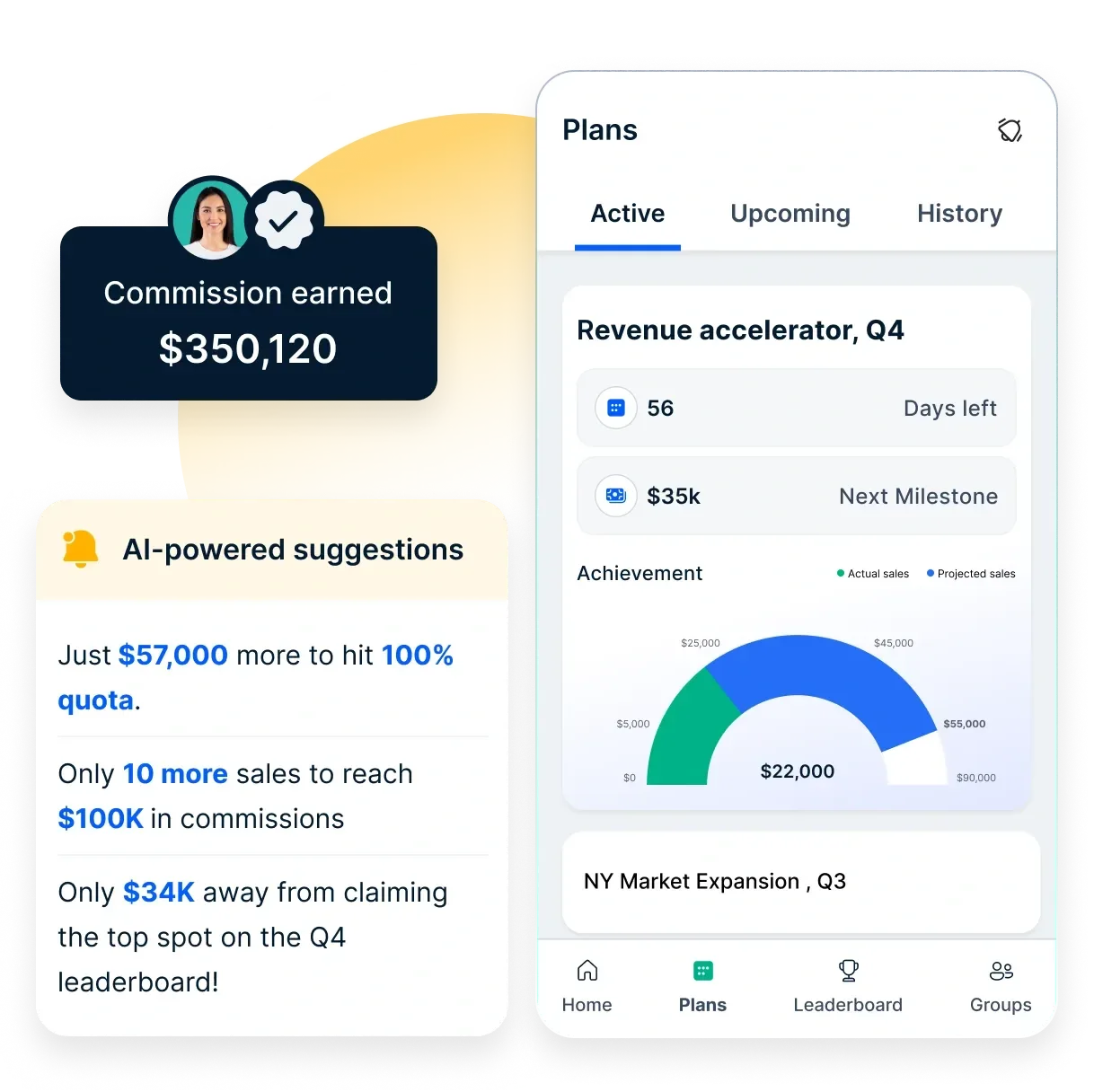
- Transparency for reps: Sales professionals see attainment and earnings in real time on web and mobile, with AI nudges showing how far they are from the next milestone.
- Accurate, traceable payouts: Every calculation is logged, and approved incentives flow to payroll with payouts in 50+ currencies.
Mercedes-Benz India runs quarterly base incentives, performance multipliers and achievement bonuses for 33 franchises on the platform, with 99.9% calculation accuracy and 40% fewer payment disputes, according to the Mercedes-Benz India case study. To see what manual compensation management costs your team, try the sales incentive ROI calculator.
Book your Empuls demo
Frequently asked questions
A sales compensation plan is a document that sets out how sales representatives are paid for their performance. It defines base salary, variable pay such as commission and bonuses, quotas, the measures that earn variable pay, accelerators and the rules for crediting deals, payment timing, clawbacks and disputes. Each sales role usually has its own plan.
A good sales compensation plan supports the sales strategy, pays competitively at quota and is simple enough that every rep can calculate their own payout. It uses no more than three measures, sets quotas most reps can reach with solid effort, rewards overperformance with accelerators and documents the rules for crediting, clawbacks and disputes before the period starts.
A 70/30 compensation plan pays 70% of a salesperson's on-target earnings as base salary and 30% as variable pay, such as commission or bonus. For a $100,000 OTE, that is a $70,000 base and $30,000 of target variable pay. It suits roles where the rep influences but does not fully control the sale, such as SDRs and account managers.
Base salary is the fixed pay a rep receives regardless of results. On-target earnings (OTE) is base salary plus the variable pay the rep earns at exactly 100% of quota. A rep with a $95,000 base and $85,000 of target commission has an OTE of $180,000, and can earn more or less depending on attainment.
A common example is base salary plus commission with an accelerator: a $95,000 base and $85,000 of target variable pay on an $850,000 quota, paying 5% below half of quota, 15% up to quota and 20% above it. At 100% of quota the rep earns $180,000, and at 120% they earn $214,000.
Redesign the plan once a year, in line with the annual sales strategy, and review results every quarter. Alexander Group's 2026 survey found 97% of companies changed their plans for the year. Avoid changing rates or quotas mid-period, and when a change is unavoidable, document the effective date and give reps written notice.
Sales leadership and sales operations usually own the design, with finance modeling the cost and HR checking pay equity, legal requirements and market benchmarks. Involve a few experienced reps to test the plan for clarity before launch. Larger companies often set up a compensation committee to approve exceptions and resolve disputes.
There is no universal benchmark, because the right cost of sales depends on deal size, margins, sales cycle and how much of the sale the rep controls. Calculate your own by modeling total base and variable pay at expected attainment and dividing by expected revenue, then compare it with your gross margin and growth goals.





































































































































































































































































































































































































































































































































































