
Key Takeaways
Organizational change management is the structured way a company moves its people, processes and systems from the current state to a desired future state.
The five components of organizational change are clear objectives, a clear purpose, clear benefits, a clear approach and clear roles and responsibilities.
Perceptyx found that change being handled effectively became the top driver of employee engagement in 2025, yet only 55% of employees rate their organization's change management favorably.
The most common organizational change challenges are resistance, an unclear vision, poor communication, weak manager buy-in, unclear roles, cultural friction and change fatigue.
A one-page plan covering objective, purpose, benefits, impact, roles, communication, training, feedback, measures and reinforcement prevents most change failures.
Organizational change management is the structured way a company moves its people, processes and systems from how things work today to how they need to work tomorrow. It succeeds when five components are clear to everyone: the objective, the purpose, the benefits, the approach and each person's role. Most change efforts that struggle fail on people, not strategy.
Change is inevitable, but managing it well is a choice. Whether you are adopting new technology, restructuring teams or redefining strategy, organizational change touches every corner of a business. The goals are strategic, yet the process is deeply human: fear, confusion and resistance can derail even a well-planned initiative.
This guide explains what organizational change involves, the key areas it affects, the components of organizational change that make it work, proven change management strategies and models, the most common organizational change challenges and a change management plan template you can copy.
What is organizational change
Organizational change is any significant shift in a company's structure, operations, culture, technology or strategy, made to improve performance, respond to the market or realign how people work. It can be a small adjustment, such as a new approval process, or a large transformation, such as a merger or a move to AI-assisted work.
Change is usually one of three types:
- Developmental change: Improves what already exists, such as a better onboarding process.
- Transitional change: Moves from one known state to another, such as moving to a new HR system or office model.
- Transformational change: Reinvents how the organization works, such as a new business model or culture.
Whatever the type, it affects people, and that is where it gets tricky. Engagement drops fast when people do not understand what is changing, why it matters or what is expected of them.
Key areas of organizational change
Change does not happen in a vacuum. Six areas of the business usually need to shift together, and people come first because every other change depends on how employees experience it.
| Area | What changes | Examples |
|---|---|---|
| People | Roles, skills, leadership and team membership | New leaders, redefined roles, reskilling programs |
| Processes | How work gets done | Automated workflows, new approval steps, agile ways of working |
| Technology | The systems people use | A new HRIS, CRM or AI tools, with training to drive adoption |
| Culture | Shared values and behaviors | Moving from hierarchy to collaboration, embedding core values |
| Strategy | The direction of the business | New markets, new goals, a new customer experience |
| Structure | Reporting lines and team setup | Flattening layers, centralizing functions, new business units |
Culture is often invisible but hugely influential, and it takes the longest to shift. Structural changes, by contrast, can happen overnight on an org chart but affect accountability and collaboration for years, so they must be explained clearly. Our guide to cultural alignment covers the culture side in depth.
Why organizational change management matters
Change management is the discipline that helps people, processes and systems move smoothly from the current state to the desired future state. It is not just launching a new tool or policy; it is helping people adopt the change in a way that sticks.
Employees now judge their employer heavily on how it handles change. In Perceptyx's analysis of more than 20 million survey responses, published in December 2025, "change is handled effectively in my company" became the number one driver of employee engagement for the first time, ahead of belonging and feeling valued.
#1
driver of engagement in 2025: change is handled effectively
Perceptyx, 2025
55%
of employees rate their organization's change management favorably
Perceptyx, 2026
5x
as likely to say change is handled well when employees feel supported to adapt
Perceptyx, 2026
How employees experience organizational change
The same research, in Perceptyx's 2026 benchmark of 23 million responses, found that only 55% of employees view their organization's change management favorably. Here is what typically happens with and without it:
| Without change management | With change management |
|---|---|
| Teams feel left out or confused | People understand the why behind the change |
| Leaders struggle to gain buy-in | Objectives are clear, measurable and meaningful |
| Communication breaks down | Teams feel involved, not blindsided |
| The change loses momentum halfway | There is a plan for training, support and feedback |
The five components of organizational change
Behind every successful change initiative lies a simple foundation. These five components of organizational change decide whether a change gains traction or falls flat, and the first, a clear objective, is the one most often skipped.
1. Clear objectives
If people do not know what the change is trying to achieve, they cannot support it. Surprisingly, many change programs launch without well-defined outcomes. When even a senior leader cannot explain what a major initiative is for, employees disengage and the program stalls.
A clear objective works like a compass. It answers two questions: what are we changing, and what does success look like? When people can picture the outcome, they are more likely to contribute ideas and commit.
2. Clear purpose
A strong why fuels commitment. People do not support change because it is happening; they engage when they understand why it matters. The purpose often gets lost in corporate jargon, but told with heart it inspires action. A logistics team that reframes "improving delivery KPIs" as "making sure children get their holiday gifts on time" gives people a reason to care.
3. Clear benefits
What is in it for the people driving the change? If employees see change as a threat to their role or security, they will resist it. When they can connect it to growth, new skills, simpler work or meaningful impact, their mindset shifts. Make the benefits tangible for employees, not only for the bottom line.
4. Clear approach
Even motivated teams need a roadmap. Break the change into clear, manageable steps, celebrate early wins and track progress visibly so people can see how their actions contribute to the bigger picture. Structure reduces fear and builds momentum.
5. Clear roles and responsibilities
Change fails when people do not know what is expected of them. Define who does what, by when and with what support. Whether HR leads the rollout or line managers guide their teams, everyone should have a role that feels intentional and supported.
These five components may seem simple, but they are often the first things overlooked. Get them right and you create teams who do not just accept change but drive it forward.
Keep people informed and heard through every change
See how Empuls combines a social intranet, pulse surveys and recognition to support change.
Talk to our ExpertTrusted by 5,000+ companies
Popular change management models
Change management models give you a proven structure instead of starting from a blank page. Five are widely used, and most organizations combine one process model, such as Kotter's, with one people model, such as ADKAR.
| Model | Core idea | Best for |
|---|---|---|
| Lewin's three-stage model | Unfreeze the current state, make the change, refreeze the new way of working | Simple, one-off changes |
| Kotter's 8-step model | Create urgency, build a coalition, share a vision, remove barriers, win early, sustain and anchor | Large organization-wide transformations |
| ADKAR model | Awareness, Desire, Knowledge, Ability and Reinforcement, one person at a time | Planning the people side and training |
| McKinsey 7-S framework | Align strategy, structure, systems, shared values, style, staff and skills | Diagnosing what else must change |
| Bridges' transition model | Guide people through endings, a neutral zone and new beginnings | Emotional transitions such as restructures |
Organizational change management strategies
Strategy turns the five components into action. Five change management strategies bring structure and clarity to any initiative, and leadership alignment comes first because mixed signals from the top undo everything else.
Leadership alignment
Every successful change begins at the top. Leaders must agree on purpose, messages and expectations. Perceptyx's 2026 benchmark found that only 61% of employees rate their leaders favorably on leading change well. Strong leadership alignment brings:
- Consistent messages: Every team hears the same story.
- Faster decisions: Leaders are not reopening settled questions.
- A united front: People see confidence during uncertainty.
Communication strategy
Change thrives on communication, not only how often but how clear and honest it is. People need to know what is changing, why it matters, how it affects them and where to go for help. Town halls, manager briefings and an internal social platform all play a part. Our guides to employee communication and transparency in communication go deeper.
Stakeholder engagement
Stakeholders, from employees and managers to customers and partners, must be involved throughout. Bring them into early discussions, listen to their feedback and give them ownership where possible. In Perceptyx's data, 69% of employees said they understood the reasons behind change and 68% felt involved in decisions affecting their work, both strongly linked to how well change is handled.
Training and support
Even the best-planned changes fail if people are not equipped to adapt. Offer onboarding for new systems or processes, ongoing support through help desks or peer mentors and a resource hub with FAQs and short tutorials.
Feedback loops and continuous improvement
Change is a journey, not a one-time event. Collect feedback, measure adoption and refine your plan as you go. Short pulse surveys and sentiment analysis show what is working and where people need more support, while there is still time to fix it.
How to manage organizational change step by step
If you are wondering how to manage organizational change in practice, follow these seven steps in order. Skipping the readiness check in step two is the most common reason plans meet resistance later.
- Define the change: Write down the objective, purpose, scope and success measures on one page.
- Assess readiness and impact: Identify which teams are affected, how much and what concerns they are likely to have.
- Align leaders and managers: Agree the message and equip managers to answer questions before the announcement.
- Communicate the why first: Announce the change with its purpose and benefits, then share the plan and timeline.
- Train and support: Give people the skills, tools and help they need to work in the new way.
- Listen and adjust: Run pulse checks during the rollout and fix problems quickly and visibly.
- Reinforce and recognize: Celebrate early wins, recognize people who model the change and update processes so the new way sticks.
Common organizational change challenges
Even with a solid strategy, change is rarely smooth. Seven organizational change challenges come up again and again, and resistance is the most predictable, but change fatigue is the one many leaders now underestimate.
Resistance to change
People fear the unknown, especially when it disrupts routines or job security. Resistance is not always defiance; it often comes from missing information, unclear benefits or bad experiences with past changes. The answer is early, honest communication, empathy and involvement from the start.
Lack of a clear vision
If employees do not know what the change is trying to achieve, they cannot support it. A clear, compelling vision gives teams something to rally around.
Poor communication
Silence or vague updates create uncertainty, and people fill the gaps with assumptions that usually lean negative. Communicate consistently and honestly at every stage, and create two-way channels so employees feel part of the journey.
No buy-in from middle managers
Change loses traction when key stakeholders, especially middle managers, are not on board. They cascade information and drive daily engagement, so win their support early and involve them in decisions.
Unclear roles and responsibilities
When people do not know what is expected, work stalls, or teams duplicate effort. Define who is doing what and how success will be measured.
Underestimating cultural impact
You can change a tool overnight, but culture takes time. A culture that resists collaboration, transparency or agility can quietly sabotage the best change strategy. Name the behaviors the change needs and reinforce them over time.
Change fatigue
When one initiative follows another, people run out of energy to adapt, and even good changes meet apathy. Limit how many changes land on the same team at once, explain how initiatives connect and pause low-value projects so the important ones get attention.
Organizational change management plan template
Use this template to plan any change, large or small. Fill in each row before you announce anything, share it with your leadership team and revisit it at every milestone.
| Plan element | Questions to answer | Owner | Example |
|---|---|---|---|
| Objective | What are we changing and what does success look like? | Executive sponsor | Move all teams to the new HR system by Q2 with 90% active use |
| Purpose | Why now, and why does it matter to employees? | Executive sponsor | Employees get one place for pay, leave and benefits |
| Benefits | What is in it for each affected group? | Change lead | Managers approve leave in one click; HR saves admin time |
| Impact | Who is affected, how much and what will worry them? | HR business partner | All employees; payroll team most affected |
| Roles | Who leads, who supports and who decides? | Change lead | IT runs setup, HR trains, managers champion |
| Communication | What will we say, through which channels and when? | Internal communications | Town hall, manager briefing kit, weekly updates |
| Training | What skills and support do people need? | Learning team | Short videos, help desk and floor walkers in week one |
| Feedback | How will we listen and how often? | HR | Two-question pulse in weeks 2, 6 and 12 |
| Measures | Which metrics will show progress? | Change lead | Adoption rate, support tickets, pulse sentiment |
| Reinforcement | How will we recognize and sustain the change? | Managers | Recognize early adopters, retire the old system |
How Empuls supports organizational change
Organizational change is as much about people as processes. Empuls helps you manage the human side by keeping employees informed, heard and recognized throughout the change.
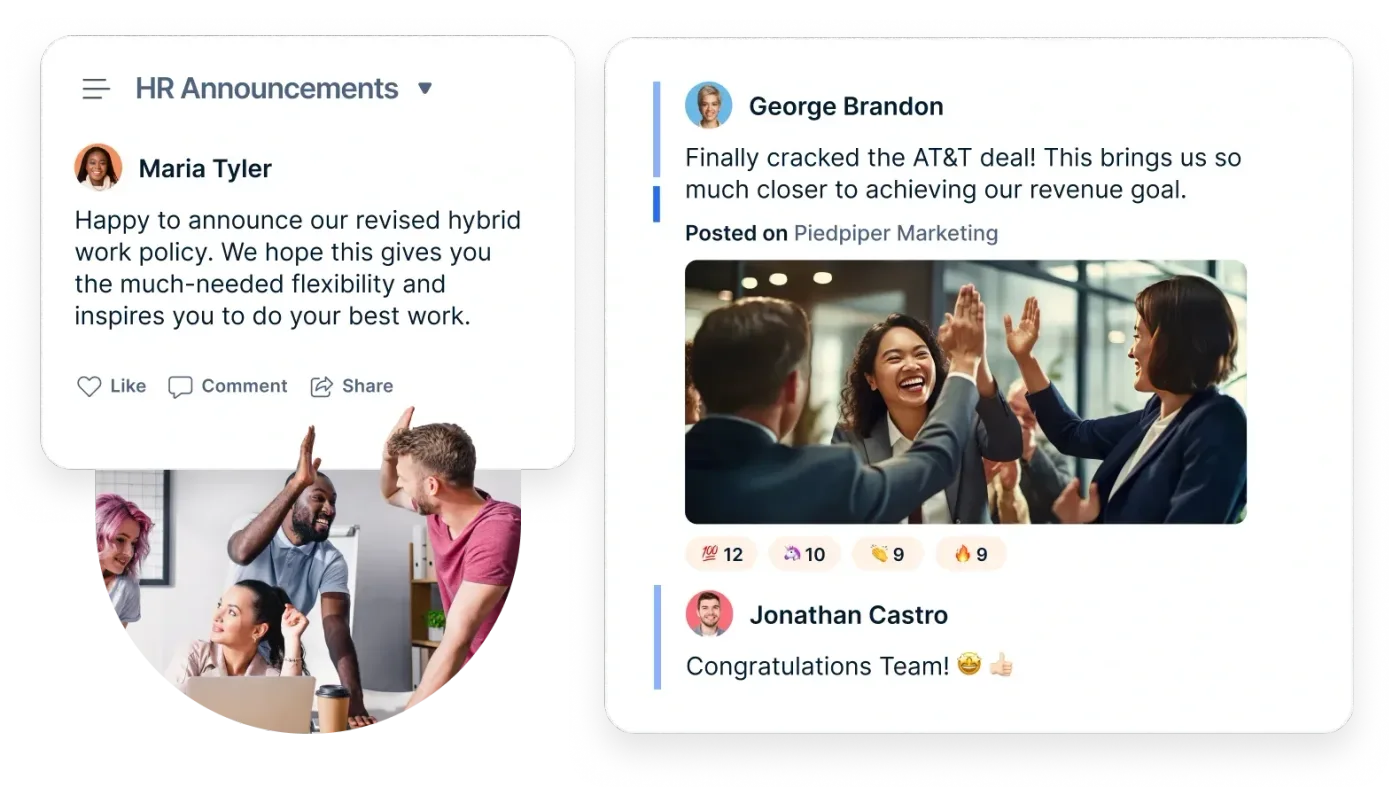
- Transparent communication: The social intranet shares announcements, updates and milestones in one feed with comments and reactions, so communication runs both ways.
- Listening at every stage: Pulse surveys, eNPS and lifecycle surveys, with AI sentiment analysis, show how people feel about the change while you can still adjust.
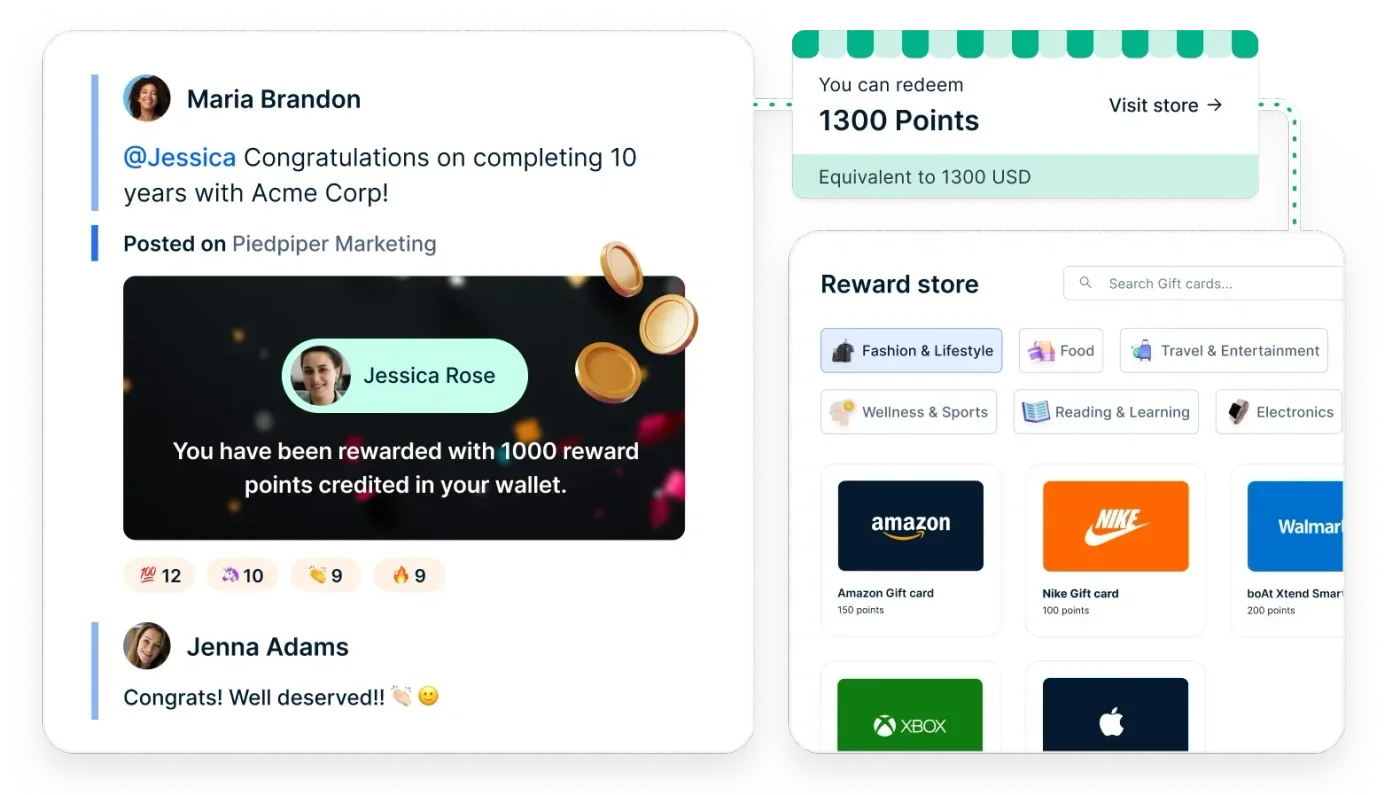
- Recognition that builds momentum: Peer recognition, spot awards and automated milestone celebrations through Empuls recognition keep people motivated through a demanding transition.
Whether you are introducing new tools, shifting culture or leading a large transformation, lead with purpose, stay transparent and involve your people at every step. That is how change becomes progress.
Book your Empuls demo
Frequently asked questions
The five components of organizational change are clear objectives, a clear purpose, clear benefits, a clear approach and clear roles and responsibilities. Together they tell people what is changing, why it matters, what is in it for them, how it will happen and what is expected of each person. When any one is missing, resistance usually grows.
The main goal of organizational change management is to help people adopt a change so the organization gets the results it planned. It does this by preparing, equipping and supporting employees through communication, training, feedback and reinforcement, which reduces resistance, protects productivity during the transition and makes the new way of working stick.
Organizational changes usually fail because of people issues rather than poor strategy. Common causes include an unclear objective or purpose, leaders sending mixed messages, poor communication, weak buy-in from middle managers, too little training, ignoring culture and too many changes at once. Listening to employees throughout the change helps catch these problems early.
A common way to group organizational change is into four types: strategic change to direction or goals, structural change to reporting lines and teams, technological change to systems and tools, and people or cultural change to skills, behaviors and values. Most real initiatives combine several types, which is why they need coordinated planning.
HR plans the people side of change. It assesses impact on roles and skills, advises leaders on communication, prepares managers to support their teams, designs training, updates policies and measures how employees are responding through surveys. HR also helps reinforce the change through recognition, performance goals and rewards that match the new way of working.
Reduce resistance by explaining the why before the what, involving employees early, showing the benefits for them personally and giving managers the information to answer questions. Offer training and support, listen through pulse surveys and act on concerns visibly. Recognizing early adopters also shows others that the change is valued and achievable.
Measure change success with a mix of adoption and outcome metrics: how many people use the new process or system, how well they use it, support tickets, productivity and the business result you set as the objective. Add sentiment data from short pulse surveys to see whether people understand and support the change over time.





































































































































































































































































































































































































































































































































































