
Key Takeaways
Real estate agent commissions in the USA are negotiable fees, usually a percentage of the sale price, and no law sets a standard rate.
Since August 17, 2024, buyer's agent pay cannot be offered on the MLS and must be stated as a specific amount in a written buyer agreement signed before touring.
Redfin data shows the average buyer's agent commission was 2.42% in Q3 2025, higher on homes under $500,000 and lower on homes over $1 million.
What an agent takes home depends on the brokerage split model, such as traditional, graduated, capped, 100% commission or team splits, plus referral and transaction fees.
Brokerages that calculate splits, caps and team overrides in commission software pay agents accurately and keep an audit trail behind every statement.
Real estate agent commissions in the USA are negotiable fees, usually a percentage of the sale price, that pay the listing agent and the buyer's agent for a home sale. Since the NAR settlement rules took effect on August 17, 2024, buyer's agent pay is agreed in writing with the buyer before touring and can no longer be advertised on the MLS, yet Redfin data shows the average buyer's agent commission still sat at 2.42% in late 2025.
For brokerages, the commission question has two sides: what clients pay, and how that money is split between the brokerage, teams and agents. Getting both right shapes profitability, agent retention and trust. This guide covers the rules after the settlement, current commission rates, the main real estate agent commission structures and splits, what agents actually take home per sale, the tax deductions agents use, and how brokerages can run agent commissions without spreadsheets.
What real estate agent commissions are
A real estate agent commission is the fee paid to a licensed real estate professional for helping a client buy or sell a property. It is usually calculated as a percentage of the final sale price and agreed in a contract: a listing agreement with the seller, or a written buyer agreement with the buyer. Commission is not set by law. Every rate, flat fee or split is negotiable.
The commission compensates the agent for their time and effort in pricing and marketing the property, managing paperwork, negotiating the deal and guiding clients through what is often the largest purchase of their lives. Agents do not keep the full amount. The commission is paid to the agent's brokerage at closing, and the brokerage then pays the agent their share under the agent's own commission split.
When one agent represents both buyer and seller (dual agency, where state law allows it), that agent's brokerage can earn both sides of the commission. Many states restrict or require written consent for dual agency, so check your state's rules.
How the 2024 NAR settlement changed real estate commissions
The biggest change to US real estate commissions in decades came from a class action settlement, not from a new law. The National Association of Realtors (NAR) agreed to pay $418 million over about four years and to change its practice rules, and the US District Court for the Western District of Missouri granted final approval on November 26, 2024. The practice changes took effect nationally on August 17, 2024.
Two rules changed how commissions are negotiated and paid:
- No offers of compensation on the MLS: Listing brokers can no longer publish an offer to pay the buyer's agent on a multiple listing service. As NAR's settlement guide for buyers and sellers explains, sellers can still choose to pay a buyer's agent, but that offer is made off the MLS, and sellers can still offer buyer concessions such as help with closing costs.
- Written buyer agreements before touring: Agents working with a buyer must sign a written agreement with that buyer before the buyer tours a home. Per NAR's consumer guide to written buyer agreements, the agreement must state the agent's compensation as a specific amount, such as a flat fee, a percentage, an hourly rate or $0, not an open-ended figure or a range, and describe the services the agent will provide. The agent cannot be paid more than the agreed amount from any source.
| Question | Before August 17, 2024 | After August 17, 2024 |
|---|---|---|
| Who sets the buyer's agent fee? | Usually the seller, through the listing agreement, with an offer to the buyer's broker shown on the MLS | The buyer and their agent, in a written buyer agreement signed before touring |
| Where is buyer's agent pay advertised? | On the MLS listing | Not on the MLS; sellers can still offer it off the MLS or through concessions |
| Who pays the buyer's agent? | Almost always the seller, out of the total commission | The seller, the buyer or a mix, as negotiated in each deal |
| Can the buyer's agent earn more than agreed? | Pay depended on the seller's offer | No. Pay is capped at the amount in the buyer agreement |
| Is commission negotiable? | Yes, though rates were often treated as standard | Yes, and the agreements must say so |
Real estate commission rates today
Historically, total real estate commissions have commonly been quoted at 5% to 6% of the sale price, split between the listing and buyer's agents. The settlement was expected to push buyer's agent fees down, but closed-sale data so far shows only small moves.
According to Redfin's analysis of buyer's agent commissions published in December 2025, the average buyer's agent commission was 2.42% in the third quarter of 2025, up from 2.36% a year earlier and flat from 2.43% in the second quarter. Rates differ by price: buyer's agents earned more on affordable homes and less on expensive ones.
Two cautions apply. Redfin's figures come from closed sales in its own data, not a national census, and there is no official government series for commission rates. Local markets also vary widely, so the right rate for a listing depends on the property, the market and the services included.
Buyer's agent vs listing agent commissions
When a house comes on the market, two sides get involved. The seller is represented by a listing agent and the brokerage that backs that agent. The buyer is represented by a buyer's agent and their brokerage. Each side's commission pays for different work:
- Listing agent: Prices the home, markets it, handles showings and offers, negotiates for the best price and terms and manages the sale through closing. The listing agent's commission is set in the listing agreement with the seller.
- Buyer's agent: Helps the buyer find the right home, assess its value, write and negotiate offers, coordinate inspections and financing and complete the documentation. The buyer's agent's pay is now set in the written buyer agreement.
Before the settlement, the listing agreement usually covered both sides and the listing broker shared part of the fee with the buyer's broker, often close to 50/50. Today the two fees are negotiated separately. A seller may still agree to pay some or all of the buyer's agent fee to attract offers, but if the seller pays less than the buyer agreement states, the buyer owes the difference or the parties renegotiate.
Stop calculating agent splits in spreadsheets
Run graduated splits, team overrides and payouts in one system agents can see in real time.
Talk to our ExpertTrusted by 5,000+ companies
Real estate agent commission structures clients pay
There are three common commission structures between agents and their clients in the USA. Percentage-based commissions are still the most common, and fixed and hybrid fees are growing as buyers and sellers negotiate more actively after the settlement.
1. Percentage-based commissions
- This is the most common structure in US residential real estate.
- The agent earns a percentage of the property's final sale price, for example 2.5% for one side of the deal.
- The rate is set in the listing agreement or buyer agreement and can be negotiated, including tiered rates that fall as the price rises.
2. Fixed-fee commissions
- The agent receives a fixed fee for their services instead of a percentage of the sale price.
- The fee stays the same regardless of the final price, which gives the client more cost predictability and transparency.
- Flat fees are common for limited-service listings and are now allowed in buyer agreements, which must state the amount.
3. Hybrid commission structures
Hybrid structures combine a fixed fee with a percentage. Suppose an agent offers a hybrid plan of 2% of the sale price with a $7,000 minimum:
- If the property sells for $400,000, 2% is $8,000. That is higher than the $7,000 minimum, so the agent earns $8,000.
- If the property sells for $300,000, 2% is $6,000. That is below the minimum, so the agent earns $7,000.
Clients who want a lower rate on a higher-priced home, while making sure the agent is paid fairly for the work on a lower-priced one, often find this structure useful.
Real estate commission split between agents and brokerages
The real estate commission split is how the commission an agent's side earns, called gross commission income (GCI), is divided between the agent and their brokerage. There are six common split models, and most brokerages combine two or three of them, which is exactly where commission administration gets complicated.
| Split model | How it works | Agent take-home on a $12,500 side |
|---|---|---|
| Traditional split | A fixed ratio such as 70/30 between agent and brokerage on every deal | $8,750 (70%) |
| Graduated split | The agent's share rises as annual GCI crosses thresholds, for example 60/40, then 70/30, then 80/20 | $7,500 to $10,000, depending on the agent's tier |
| Capped split | An 80/20 split until the agent has paid the brokerage a set annual cap, then close to 100% minus a transaction fee | $10,000 before the cap; $12,150 after it (with a $350 transaction fee) |
| 100% commission | The agent keeps the full GCI and pays the brokerage a monthly desk fee and per-transaction fees | $12,100 (with a $400 transaction fee), before monthly desk fees |
| Team split | The brokerage split runs first, then the team lead takes a share of the agent's portion, often more on team-generated leads | $4,375 (70/30 brokerage, then 50/50 team split) |
| Referral fee | A share of GCI goes to the referring agent or company off the top, before the split | $6,563 (25% referral fee, then 70/30) |
Franchise brokerages may also deduct a franchise or royalty fee from GCI, and many brokerages charge technology, errors and omissions insurance or transaction fees. Each of these changes what the agent finally receives, so the split model in the agent's independent contractor agreement should spell them out.
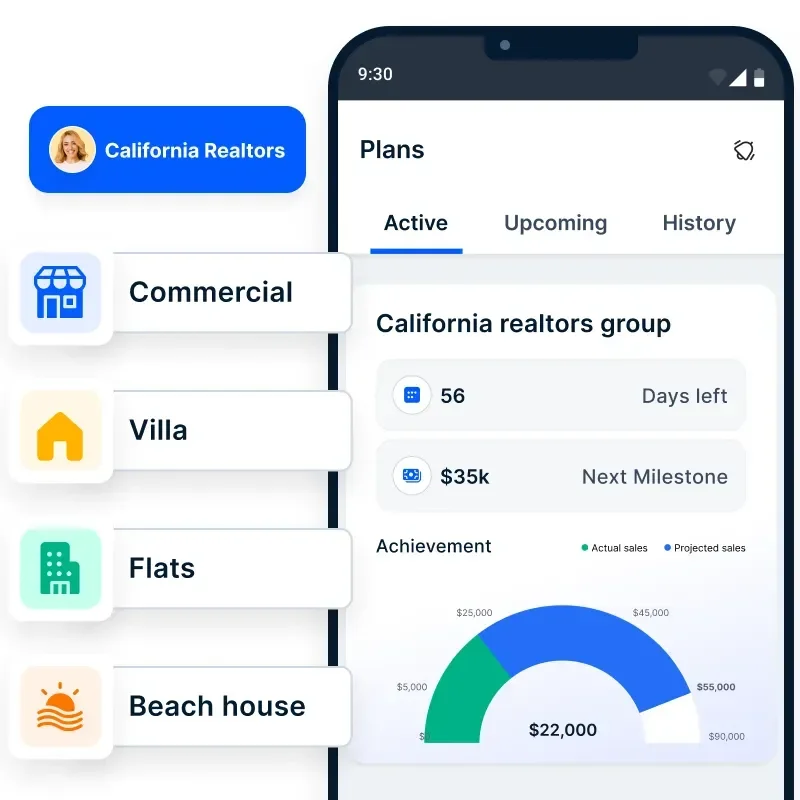
The admin load grows fast. A brokerage with graduated splits, annual caps, team overrides and referral fees has to track every agent's year-to-date GCI, apply the right tier on every closing, and explain each statement when an agent asks. This is where commission software earns its keep: the Empuls plans and calculations engine handles slabs, tiers, split credits and override commissions in a no-code builder, and calculates them the same way every cycle.
How much real estate agents make per sale
How much a real estate agent makes per sale depends on four numbers: the sale price, the side's commission rate, any referral fee and the agent's split. The formula is simple:
| Sale price | Side rate | GCI | Agent at 70/30 | Agent at 80/20 |
|---|---|---|---|---|
| $300,000 | 2.5% | $7,500 | $5,250 | $6,000 |
| $400,000 | 2.5% | $10,000 | $7,000 | $8,000 |
| $600,000 | 2.3% | $13,800 | $9,660 | $11,040 |
| $1,000,000 | 2.2% | $22,000 | $15,400 | $17,600 |
Per-sale pay looks generous, but annual income is lower than many people expect because agents close relatively few deals and pay their own expenses. The 2026 NAR Member Profile reports a median gross income of $59,200 for Realtors in 2025 and a median of nine transaction sides per agent. The US Bureau of Labor Statistics puts the May 2025 median annual wage at $52,830 for real estate sales agents and $73,220 for brokers, and notes that more than half of both groups are self-employed.
2.42%
average buyer's agent commission
Q3 2025 (Redfin)
9
median transaction sides per agent
2025 (NAR Member Profile)
$59,200
median Realtor gross income
2025 (NAR Member Profile)
$52,830
median sales agent wage
May 2025 (BLS)
Real estate agent commissions and income at a glance
For a step-by-step method that applies to any commission plan, see this guide on how to calculate sales commissions. For the trade-offs of commission-only pay, read about commission-based sales reps.
Factors that influence real estate commission rates
Four factors decide most real estate commission rates in the USA. Property value has the clearest measurable effect, so it comes first, followed by market conditions, the agent's experience and plain negotiation.
1. Property value and location
- The location and worth of the property drive the dollar commission. Higher-priced homes usually carry a lower percentage but a larger fee, which Redfin's 2025 data by price tier confirms.
- Within a state, values differ sharply between cities and neighborhoods. Inventory, foreclosure rates and demographics all affect a property's value and how much work a sale takes.
2. Market conditions and demand
- Housing demand, mortgage rates and the wider economy affect commission rates across the country.
- In a seller's market with limited inventory, homes sell faster, which gives sellers more room to negotiate the listing fee and to decline paying the buyer's agent.
- When demand is weaker and more homes are available, sellers are more likely to offer buyer's agent compensation or concessions to attract offers.
3. Agent experience and expertise
- Agents with a solid track record and strong local reputation tend to command higher rates.
- Experienced agents are often brokers with their own firms or top producers on favorable splits. Their market knowledge, negotiating ability and sales history justify a higher fee for many clients.
4. Negotiation and competition
- Commission is fully negotiable between the agent and the client, and the settlement made that negotiation explicit on both sides of the deal.
- Clients can negotiate based on the services they need, the agent's offering and local pricing. Discount and flat-fee brokerages add competitive pressure in many markets.
Tax deductions real estate agents can claim
Most agents are independent contractors, so commission income is self-employment income and business expenses reduce the tax owed. The table below covers the seven deductions that matter most for agents, with current IRS figures; confirm your own situation with a tax professional.
| Deduction | What qualifies | Current rule or figure |
|---|---|---|
| Self-employment tax | Social Security and Medicare tax on net self-employment earnings of $400 or more | 15.3% rate; half is deductible as an adjustment to income |
| Car and mileage | Driving to showings, listings, client meetings and closings | IRS business rate for 2026: 72.5 cents per mile through June 30, then 76 cents from July 1; or actual expenses (Schedule C line 9) |
| Home office | Part of the home used regularly and exclusively for the business | Simplified method: $5 per square foot, up to 300 square feet, or actual expenses (line 30) |
| Commissions paid to others | Referral fees and commissions paid to assistants or other agents | Deductible as commissions and fees (line 10) |
| Marketing and advertising | Listing photos, signage, brochures, online and social ads | Deductible as advertising (line 8) |
| Office supplies, dues and licenses | Supplies, postage, software, MLS and association dues, license renewals | Office expense (line 18); dues and licenses as other expenses |
| Business meals | Meals with clients or colleagues with a clear business purpose | Generally 50% deductible (line 24b) |
Self-employed agents who are not eligible for an employer-subsidized health plan can usually deduct health insurance premiums for themselves, their spouse and dependents. Line references follow the IRS Instructions for Schedule C. Keep receipts and a mileage log, because the IRS allows these deductions only when the criteria are met and documented.
Technology in real estate commission management
Real estate runs on software for the client-facing work: lead tracking, listings and MLS feeds, ad management, transaction checklists, e-signatures and referral networks. The back office often lags behind. Many brokerages still calculate agent splits, caps and team payouts in spreadsheets, then answer agent questions by email.
That gap matters more after the settlement. Buyer's agent fees now vary deal by deal, sometimes paid partly by the seller and partly by the buyer, and every amount must match the written agreement. Brokerages that manage commissions in software can apply the right plan to every closing, show agents what they have earned, and keep an audit trail behind every statement. For the full case, see why teams are replacing Excel for commissions, and compare options in this list of the best sales commission software.
How Empuls helps brokerages manage agent commissions
Empuls sales incentive and commission management automates how commissions and incentives are calculated, approved and paid, with real-time visibility for agents, managers and finance. It is built for enterprise sales organizations, so it suits brokerages, developers and property firms with larger agent networks and complex plans more than a solo agent. Here is how its live features map to brokerage commission work:
01 · Plans
Splits, tiers and team overrides without spreadsheets
Model graduated splits with slabs, tiers and lookups, share deal credit between co-listing agents with split credits, and pay team leads an override layer by role or territory, all in a no-code plan builder.
02 · Accuracy
Calculated the same way every cycle
Sales data from your CRM, ERP and HRMS is validated on the way in, and on-demand recalculation updates every dependent plan when a deal or rule changes. Draws and recoveries handle advances for new agents.
03 · Payouts
Approvals, payouts and an audit trail
Multi-level approvals, pre-payout anomaly checks and clawbacks run before money moves. Pay through payroll or by bank transfer, including agents and other non-employee payees, with every payout logged against its calculation.
04 · Motivation
Real-time earnings and contests
Agents see earnings, target and what the next deal adds on web and mobile, while live leaderboards, SPIFs and contests reward listing or closing pushes on top of the base plan.
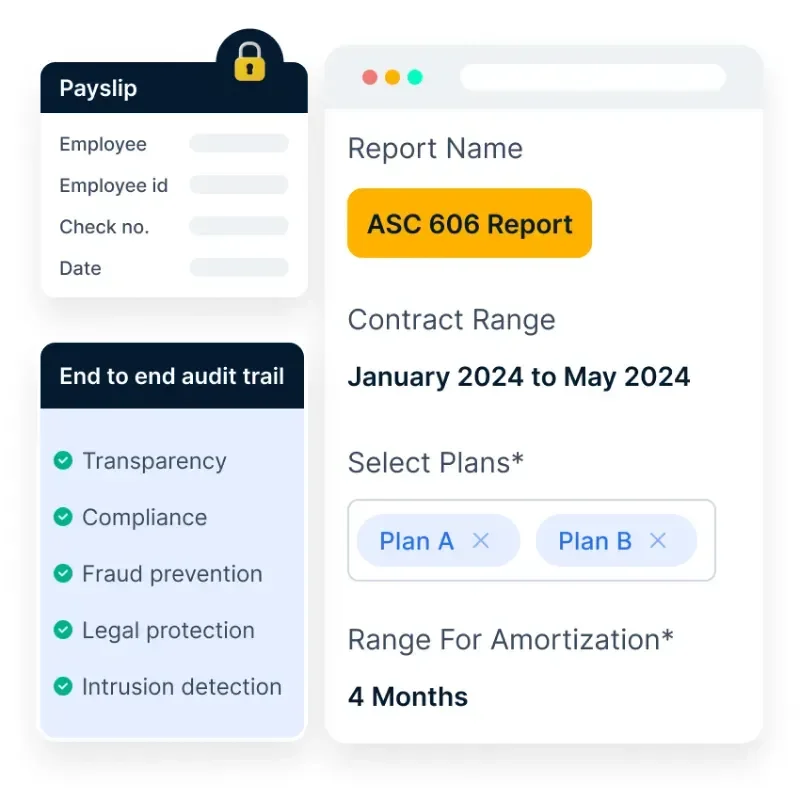
Empuls is SOC 2 Type II and ISO 27001:2022 certified, with role-based access, which matters when commission statements contain personal and financial data. Results from other commission-heavy sales teams show the impact: CarDekho replaced 15 years of manual commission calculations with real-time incentive visibility in under 100 days.
To size the cost of running commissions by hand, try the sales incentive ROI calculator, or see how commission payouts and disbursal work from approval to payment.
Getting real estate agent commissions right
Real estate agent commissions are now negotiated more openly than at any point in recent memory. Buyers sign agreements that state their agent's pay, sellers decide whether to contribute, and rates still cluster around their old levels while the market finds a new normal.
For brokerages, the opportunity is to be clear on both sides: transparent fees and services for clients, and splits agents understand and trust. A fair plan, calculated accurately and paid on time, is one of the strongest reasons a productive agent stays.
Book your Empuls demo
Frequently asked questions
There is no standard rate, because commissions are negotiable. Total commissions have historically been quoted at around 5% to 6% of the sale price across both sides. Redfin's closed-sale data put the average buyer's agent commission at 2.42% in the third quarter of 2025, with lower rates on more expensive homes.
It depends on the deal. The buyer agrees their agent's pay in a written buyer agreement before touring. The seller can still offer to cover some or all of it off the MLS or through concessions, and the buyer pays any remaining amount. The agent cannot receive more than the amount stated in the agreement.
Yes. Real estate commissions are not set by law and are fully negotiable, and under the NAR practice changes both listing agreements and buyer agreements must make that clear. Sellers can negotiate the listing fee and whether to contribute to the buyer's agent, and buyers can negotiate their own agent's fee and services.
There is no single typical split. Traditional brokerages often use fixed ratios such as 50/50, 60/40 or 70/30 in the agent's favor, with better terms as production grows under graduated plans. Capped models switch to near 100% after an annual cap, and 100% commission brokerages charge desk and transaction fees instead. Read the independent contractor agreement closely.
At a 2.5% side rate, one side earns $12,500 in gross commission income. On a 70/30 split the agent keeps $8,750 before transaction fees, marketing costs and taxes, while the brokerage keeps $3,750. A referral fee or team split reduces the agent's share further, and a capped or 100% plan raises it.
The 80/20 rule describes the pattern where a small share of agents, roughly 20%, closes most of the transactions, roughly 80%. It is a rule of thumb, not a measured law. It explains why brokerages design graduated and capped splits: to keep high producers, who generate most of the company's commission income, from leaving for better terms.
Commissions are usually paid at closing. The title or escrow company disburses the commission to each agent's brokerage, and the brokerage pays the agent their share under the split agreement, often within a few days. If a deal falls through before closing, the agent usually earns nothing for that transaction.
Yes. Most agents are independent contractors, so commission income is self-employment income subject to income tax and 15.3% self-employment tax on net earnings of $400 or more. Agents usually make quarterly estimated payments and reduce taxable income with business deductions such as mileage, marketing, home office and commissions paid to others.





































































































































































































































































































































































































































































































































































