
Key Takeaways
The eight common sales commission structures are base plus commission, commission only, tiered, draw against commission, territory volume, residual, gross margin and multiplier.
Calibrate every structure you are considering to pay the same at quota, then compare how much pay moves when reps fall short or overachieve.
In the worked example, pay swings by $12,300 between 75% and 125% of quota under commission only, but by just $1,200 under an equally split territory pool.
A tiered commission structure must state whether it is marginal or retroactive, because the same sales can pay very different amounts.
Gross margin commission protects profit: a rep who discounts to hit a number earns less than one who holds price on the same revenue.
Sales commission structures are the rules that turn a salesperson's results into pay. The eight common types are base salary plus commission, commission only, tiered, draw against commission, territory volume, residual, gross margin and multiplier commission, and each pays a different amount for the same sales. This guide gives the sales commission formula and a worked example for every structure, then shows how to pick and build the right one.
A well-designed commission structure can be the key to driving success in your sales team. When you have the right structure in place, you attract sellers who are motivated to close deals and perform consistently. A poorly structured plan does the opposite: your best sellers notice first, and they are the first to look for better opportunities elsewhere.
What is a sales commission structure
A sales commission structure is the part of a sales compensation plan that defines how a company pays its salespeople for each sale: what the commission is calculated on, at what rate, when it is earned and when it is paid. It is shaped by the company's budget for commissions, base salaries, the performance levels it wants to reward, the products it sells and the norms of its industry.
Commission structures play a key role in motivating salespeople to achieve the objectives that directly affect an organization's success. The structure is only one piece of pay, though. Base salary, on-target earnings (OTE) and the pay mix sit around it, and this guide to building a sales compensation plan covers how those pieces fit together.
Why commission structures are crucial for your sales team
A well-designed commission structure has a significant impact on performance. It drives motivation, sets clear expectations and aligns what reps chase with what the business needs, whether that is new logos, margin or renewals. A thoughtfully crafted structure also helps you attract top talent and keep your high performers.
Structures do not stay right for long, which is why the choice matters so much. CaptivateIQ's 2026 State of Incentive Compensation Management Report, a survey of 200 incentive compensation leaders, shows how often plans now change:
91%
of companies
changed their incentive strategy in the past year
46%
of companies
review and revise compensation plans every quarter
38%
of companies
do not analyze how their comp program performs
Source: CaptivateIQ, 2026 State of Incentive Compensation Management Report
Selecting the best sales commission structure is complex because so many factors interact: sales cycle length, deal size, margins, team selling and how predictable revenue is. The comparison below makes those trade-offs visible by running one rep's quarter through all eight structures.
8 types of sales commission structures with formulas and examples
Most commission structure examples online use different numbers for every type, which makes them impossible to compare. Here every structure is calibrated to pay the same amount at quota, so you can see how each one behaves when a rep falls short or overachieves, and the sections after the table give each sales commission formula and worked example in detail.
The scenario: a rep has a quarterly quota of $120,000 and target variable pay of $9,600 a quarter, on top of a $15,000 quarterly base salary (where the structure has one). Every structure pays $24,600 in total at 100% of quota. Sales carry a 40% gross margin, the rep's customers already pay $120,000 a quarter in recurring revenue, and the three other reps in the territory sell $360,000 a quarter between them.
| Structure | Formula used | Pay at 75% ($90,000) | Pay at 100% ($120,000) | Pay at 125% ($150,000) |
|---|---|---|---|---|
| Base salary + commission | $15,000 + Sales × 8% | $22,200 | $24,600 | $27,000 |
| Commission only | Sales × 20.5% | $18,450 | $24,600 | $30,750 |
| Tiered (marginal) | $15,000 + 6% to $60,000, 10% to $120,000, 14% above | $21,600 | $24,600 | $28,800 |
| Draw against commission | Higher of Sales × 20.5% or the $21,000 draw | $21,000 paid, $2,550 owed | $24,600 | $30,750 |
| Territory volume | $15,000 + (Territory sales × 8%) ÷ 4 reps | $24,000 | $24,600 | $25,200 |
| Residual | $15,000 + New sales × 5% + Recurring revenue × 3% | $23,100 | $24,600 | $26,100 |
| Gross margin | $15,000 + (Sales × 40% margin) × 20% | $22,200 | $24,600 | $27,000 |
| Multiplier | $15,000 + Sales × 8% × Attainment multiplier | $20,400 | $24,600 | $30,000 |
The pay at quota is identical, but the spread around it is not. The chart shows how much total pay moves between 75% and 125% of quota under each structure, which is the clearest measure of how much risk and upside a structure hands to the rep.
1. Base salary plus commission
This structure combines a fixed salary with a variable commission based on sales performance. It gives reps financial stability while still rewarding them for closing deals, and it is the most common starting point for B2B teams.
Formula: Total pay = Base salary + (Sales × Commission rate). Example: at 125% of quota, the rep earns $15,000 + ($150,000 × 8%) = $15,000 + $12,000 = $27,000. Benefits: steady income, an incentive to earn more and better retention of top talent. Watch out for: a base that is too high relative to variable pay can reduce urgency.
2. Commission only
Under this model, reps earn income solely from commission, with no base salary. It is common for high-ticket items, independent agents and entrepreneurial sales roles, and the rate has to be high enough to cover what a salary would have paid.
Formula: Total pay = Sales × Commission rate. Example: to match $24,600 at quota, the rate is $24,600 ÷ $120,000 = 20.5%, so at 125% the rep earns $150,000 × 20.5% = $30,750, and at 75% only $18,450. Benefits: highly performance-driven, lower fixed costs and maximum upside for strong sellers. Watch out for: income swings, and minimum wage and overtime rules for employees, which this guide to commission based sales reps explains.
3. Tiered commission
A tiered commission structure rewards reps with higher rates as they reach specific sales thresholds, giving them a clear path to higher earnings. Tiers that start below quota keep reps earning on the way up, and a higher rate above quota acts as an accelerator.
Formula: Commission = Σ (Sales within each tier × That tier's rate). Example: at $150,000, the rep earns $60,000 × 6% = $3,600, plus $60,000 × 10% = $6,000, plus $30,000 × 14% = $4,200, for $13,800 in commission and $28,800 in total pay. Benefits: encourages higher volume and rewards top performers. Watch out for: a marginal plan applies each rate only to sales inside its tier. A retroactive plan applies the top rate to every dollar, which would pay $150,000 × 14% = $21,000 here, so the plan document must say which one you use.
4. Draw against commission
This structure pays an advance (the draw) on future commission, which is reconciled against what the rep actually earns. It supports new hires during ramp and reps in businesses with long or seasonal sales cycles.
Formula: Payout = Draw, plus (Commission earned − Draw − Any balance owed) when that figure is positive. Example: with a $7,000 monthly draw ($21,000 a quarter) and a 20.5% rate, a 125% quarter earns $30,750, so the rep receives $21,000 in draws and a $9,750 true-up. In a 75% quarter, the rep earns $18,450 but still receives the $21,000 draw. In a recoverable draw, the $2,550 shortfall is carried forward and repaid from future commission. In a non-recoverable draw, it is written off. Benefits: income security during slow periods and lower early turnover. Watch out for: a recoverable balance that keeps growing demotivates reps, so cap how long a deficit can carry.
5. Territory volume commission
Reps earn commission based on the total sales of a territory rather than individual deals. A pool is calculated on territory sales and shared among the team, which suits markets where several people touch each account.
Formula: Rep commission = (Territory sales × Pool rate) ÷ Number of reps, or × the rep's agreed share. Example: at 125%, the rep sells $150,000 and the territory reaches $510,000. The pool is $510,000 × 8% = $40,800, and an equal four-way split pays $10,200, for $25,200 in total. Benefits: encourages teamwork, prevents reps in one region from competing for the same accounts and helps a team break into a new market. Watch out for: the spread is only $1,200 between a weak and a strong quarter, so top performers may feel under-rewarded. If you split the pool by each rep's share of sales instead, the math becomes identical to a flat 8% individual commission.
6. Residual commission
Reps keep earning commission on recurring revenue from customers they sold to before, for as long as those customers keep paying. It is ideal for subscription and service businesses where retention drives revenue.
Formula: Commission = (New sales × Upfront rate) + (Recurring revenue × Residual rate). Example: at 125%, the rep earns $150,000 × 5% = $7,500 on new sales, plus $120,000 × 3% = $3,600 on the existing book, for $11,100 in commission and $26,100 in total. Benefits: long-term earning potential and a reason to look after customers after the sale. Watch out for: large books can make senior reps comfortable, so many plans cap the residual period or step the rate down over time. The SaaS sales commission plan guide covers renewals and multi-year deals in depth.
7. Gross margin commission
Commission is calculated on gross profit instead of total revenue, which aligns sales incentives with profitability and gives reps a reason to protect price.
Formula: Commission = (Revenue − Cost of goods sold) × Commission rate. Example: at 125%, gross margin is $150,000 × 40% = $60,000, and $60,000 × 20% = $12,000, for $27,000 in total. Now suppose the rep reached $150,000 by discounting, and margin fell to 35%: commission drops to $52,500 × 20% = $10,500. A revenue plan would have paid the full $12,000 for the same discounted deals. Benefits: encourages selling higher-margin products and controls discounting. Watch out for: reps need trusted visibility into costs, or they will dispute every payout.
8. Multiplier commission
A multiplier structure adjusts commission up or down based on a performance metric, most often quota attainment, but sometimes a second goal such as margin, product mix or customer satisfaction.
Formula: Commission = Sales × Base rate × Multiplier. Example: with a multiplier of 0.75 below 80% of quota, 1.0 from 80% to 100% and 1.25 above 100%, a 125% quarter pays $150,000 × 8% × 1.25 = $15,000, for $30,000 in total. A 75% quarter pays $90,000 × 8% × 0.75 = $5,400, for $20,400. Benefits: rewards overperformance and ties pay to the KPIs you care about most. Watch out for: multipliers applied to every dollar create cliffs. Here, a rep at 100% earns $9,600, but one more sale that takes them just past 100% lifts the whole quarter's commission by 25%, which invites deal timing games.
Model a new commission structure before it goes live
Run tiers, draws, multipliers and margin plans on your own sales data and see every rep's payout first.
Talk to our ExpertTrusted by 5,000+ companies
Which sales commission structure fits your team
No single structure is best. Most companies combine two, such as base plus tiered commission, or a residual element on top of new-business commission. Use the table to match the structure to your situation:
| Your situation | Structures that fit | Why |
|---|---|---|
| Long or complex B2B sales cycles | Base + commission, tiered | Stable income keeps reps on long deals; tiers still reward the strongest sellers |
| High-ticket, transactional or agent sales | Commission only, draw against commission | Pay tracks results closely; a draw softens the start |
| Discounting is eroding profit | Gross margin, or a margin multiplier | Reps keep more when they protect price |
| Subscription or recurring revenue | Residual, plus upfront commission on new ARR | Rewards both the sale and the retention behind it |
| Team selling in shared territories | Territory volume | Removes competition for the same accounts |
| Strategic goal beyond revenue | Multiplier | Lets you weight pay toward a second KPI |
| New hires ramping up | Draw against commission, or a temporary guarantee | Protects income until the pipeline matures |
Average sales commission rates and pay benchmarks
Determining the right commission rate means weighing the base salary, the nature of your products and services, and the research and technical knowledge the sale requires. Published industry commission percentages vary widely and are rarely traceable, so pay benchmarks from primary sources are a safer starting point. Divide the target variable pay by quota to get the rate your structure needs.
$190K
median OTE
B2B SaaS account executives, 53:47 base to variable (Bridge Group, 2024)
$104,920
median annual wage
sales reps, technical and scientific products (BLS, May 2025)
$72,080
median annual wage
sales reps, other wholesale and manufacturing (BLS, May 2025)
Sources: US Bureau of Labor Statistics; The Bridge Group 2024 SaaS AE Metrics and Compensation report
According to the US Bureau of Labor Statistics, most employers of wholesale and manufacturing sales representatives pay a combination of salary and commission, or salary plus bonus, rather than commission alone. In software, The Bridge Group's 2024 SaaS AE report puts the median annual quota at $800,000 of annual contract value, so a rep with $89,300 of target variable pay (47% of a $190,000 OTE) would need a rate of about 11.2% to earn it at quota. For how to set OTE and pay mix, see this guide to sales commission and incentive plans.
How to structure sales commission in 6 steps
Creating a commission structure takes six steps, and the first two matter most: if the goal and the target pay are wrong, no formula will fix the plan. The process draws on your company's objectives, your team's past performance and the way you will calculate and pay commission.
1. Determine the goal of your commission structure
The primary aim of a commission structure is to help you achieve your business objectives. Whether you want to grow revenue, raise average deal size, protect margin or increase repeat customers, put that goal at the heart of the plan, because it decides which of the eight structures fits.
2. Determine your compensation targets
The compensation target is the total amount you expect to pay a salesperson at quota, as a combination of salary and commission. It varies with responsibilities, seniority and market rates, and it should relate directly to the revenue the role is expected to generate. Setting it first gives you the number every structure is calibrated to.
3. Evaluate the past performance of your sales team
Look at how well your existing structure motivated the team and met your goals. Keep the elements that worked and remove the ones that did not. Model the new structure on last year's actual results at the rep level, as in the comparison table above, to see who would earn more or less and why.
4. Pick your sales commission structure
Based on your goals, compensation targets and past performance, choose one structure or a combination, and tailor it to your business. Also decide when commission is earned and paid: at contract signature, at invoice or when the customer pays. Your reps need to know exactly when they will be paid.
5. Share your sales commission structure
Write the structure down in detail and make it easy to understand. Explain the thinking behind it, show worked examples at different attainment levels and set clear expectations. A rep should be able to check their own payout with a calculator, and this walkthrough on how to calculate sales commissions shows the order of operations to document.
6. Evaluate and maintain your commission structure
A commission structure is a living document. As your business grows, your team evolves or your strategy changes, review it and adjust it so reps stay motivated and objectives are met. Track attainment distribution, cost of sales and plan disputes every quarter, and make structural changes at the start of a period rather than in the middle of one.
Top tips for creating a solid sales commission structure
These five rules apply whichever structure you choose, and the first one prevents most disputes. Use them as a final check before the plan goes live:
- Keep it simple: Salespeople should be able to look at the structure and see that if they do A, they earn B. More than three measures in one plan usually dilutes focus.
- Get it right the first time: Rebuilding a structure mid-year confuses the team and hurts performance, so model it on real data before launch.
- Set achievable targets: Unreachable quotas demotivate rather than stretch. Most reps should be able to reach quota with solid effort.
- Think twice before capping commission: Caps limit earning potential and can make your best performers hold deals for the next period. If you need cost control, use decelerated rates on windfall deals instead of a hard cap.
- Pay accurately and on time: A great structure loses credibility after one wrong payout. Automate calculations once plans include tiers, splits or clawbacks.
For more on what goes wrong when these rules are ignored, see this breakdown of a bad sales incentive plan, and for how commission fits with bonuses, SPIFFs and contests, read the sales incentives guide.
Automate any sales commission structure with Empuls
Empuls includes sales incentive and commission software that runs every structure in this guide from one calculation engine. It reads sales data from your CRM, ERP and HRMS, applies each plan's rules and sends approved payouts to payroll, so a change in structure is a configuration change, not a spreadsheet rebuild.
- Any structure, no code: Build commission, target and milestone plans with flat, tiered, milestone-based or product-mix weighted rates, on revenue or any other KPI, with accelerators and conditional multipliers.
- The hard parts handled: Split credits, roll-ups, override commissions, draws and recoveries, and clawbacks run in the same engine, and cascading plans let one plan's output feed the next.
- Model before launch: An estimator and simulation show payout impact before a plan goes live, which is the calibration step described above.
- Visible and traceable: Reps see attainment and earnings in real time, and approved results flow to payouts in 50+ currencies.
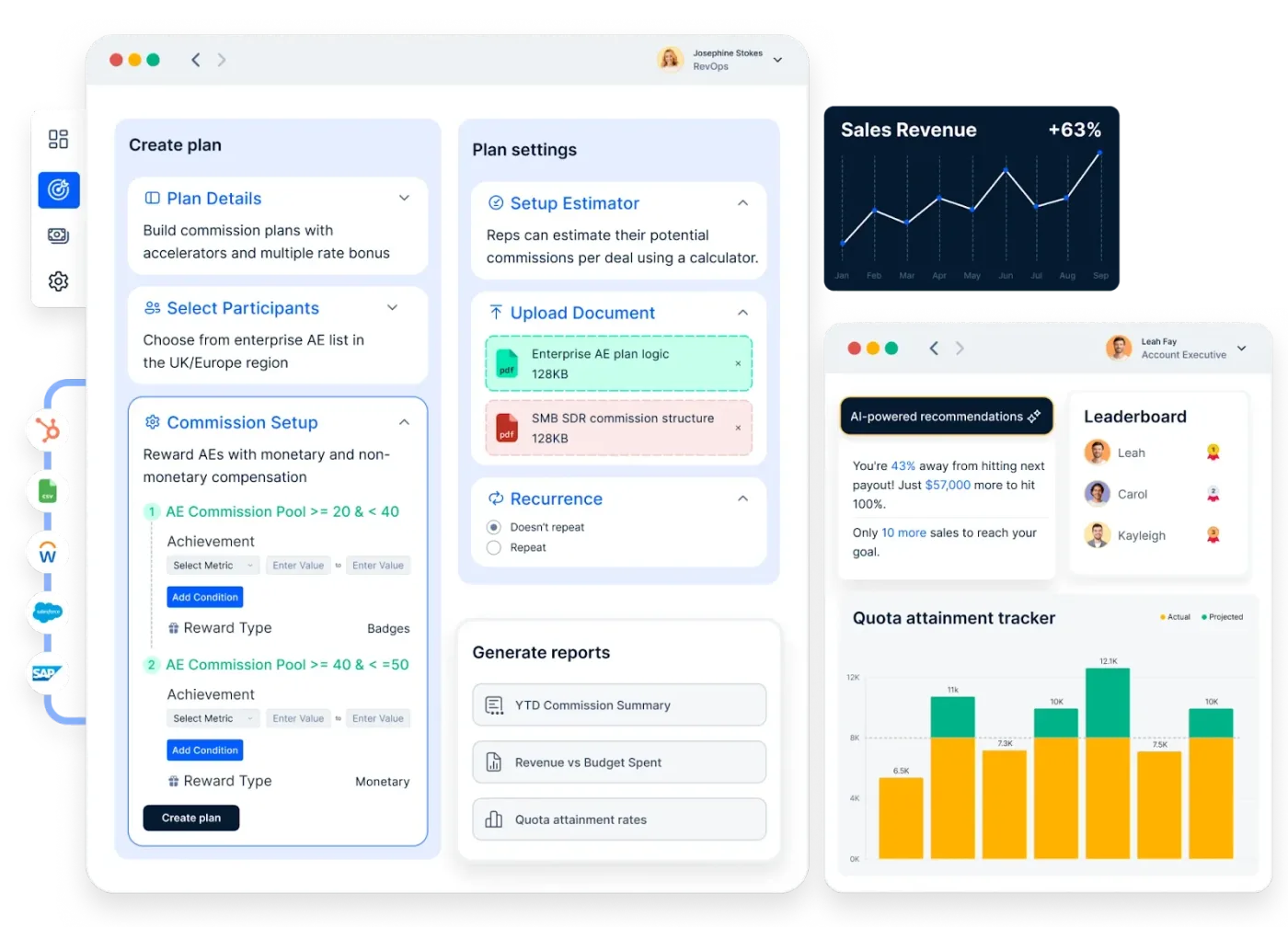
When Mercedes-Benz India moved incentives for its 33 franchises onto the platform, it reached 99.9% calculation accuracy and saw payment disputes fall by 40%, as the Mercedes-Benz India case study describes. To estimate what manual calculation costs your own team, try the sales incentive ROI calculator.
Book your Empuls demo
Frequently asked questions
The best way is to start from the behavior you want and the pay a rep should earn at quota, then choose the structure that rewards that behavior. Base salary plus tiered commission suits most B2B teams because it offers stability and rewards top performers. Calibrate the rates so the plan pays the target amount at 100% of quota, and test it on last year's results.
A fair rate is one that pays a rep their target variable pay when they reach a realistic quota. Calculate it by dividing target variable pay by quota: $60,000 of variable pay on a $750,000 quota needs an 8% rate. Rates vary widely by industry, deal size and pay mix, so a rate copied from another company rarely fits your plan.
Base salary plus commission is the most common structure, often with tiers or accelerators above quota. The US Bureau of Labor Statistics notes that most employers of wholesale and manufacturing sales representatives use a combination of salary and commission, or salary plus bonuses. Commission-only plans are more common for independent agents and high-ticket transactional sales.
In a marginal tiered commission, each rate applies only to the sales inside its tier, so moving up a tier raises the rate on new sales only. In a retroactive plan, reaching a higher tier applies that rate to all sales in the period. On $150,000 of sales with a 14% top tier, a marginal plan might pay $13,800 while a retroactive plan pays $21,000.
In sales compensation, 70/30 usually describes the pay mix: 70% of on-target earnings paid as base salary and 30% as variable pay. It suits roles where the rep influences the sale but shares it with others, such as account management. Roles where the rep drives most of the outcome, like new business, often use 50/50 or 60/40 instead.
Most sales leaders avoid hard caps, because limiting earnings can cause top performers to delay deals or leave. If the concern is a windfall from one unusually large deal, use a decelerated rate above a set deal size or a review step for exceptional deals instead. Make any such rule clear in the plan document before the period starts.
Choose revenue-based commission when prices are fixed and reps have little control over discounting, because it is simpler to calculate and explain. Choose gross margin commission when reps can negotiate price or influence product mix, because it rewards protecting profit. Some companies combine the two by paying on revenue with a multiplier that rises with deal margin.
Review the structure every quarter and change it at most once a year unless the business changes significantly. CaptivateIQ's 2026 report found that 46% of companies now review and revise plans quarterly. Make changes at the start of a period, give reps written notice and model the effect on their earnings before the new structure takes effect.





































































































































































































































































































































































































































































































































































