
Key Takeaways
An employee pulse survey is a short, frequent survey of 5 to 15 questions that tracks a few focused topics so problems surface before people leave.
As of August 2026, 53% of US employees were watching for or seeking a new job, according to Gallup, which makes frequent listening a retention tool.
Pulse surveys complement the annual engagement survey: the engagement survey diagnoses, and pulses track whether actions are working.
Most organizations run pulses monthly or quarterly, and the right cadence is the one managers can act on before the next pulse.
Segment results, fix high-impact issues first and tell employees what changed after every pulse to keep participation high.
An employee pulse survey is a short, frequent survey of 5 to 15 questions that tracks how employees feel about a few focused topics, such as workload, recognition or their manager, so you can spot problems early and act before people leave. Most teams run one monthly or quarterly, keep it under five minutes and share results within days.
Attracting great people is only half the battle. Keeping them is what drives long-term success, and the risk is high: Gallup's employee retention indicator shows that as of August 2026, 53% of US employees were watching for or actively seeking a new job, and Gallup estimates voluntary turnover costs US businesses about $1 trillion every year. An annual survey cannot keep up with sentiment that shifts that fast. A pulse survey can.
This guide covers what an employee pulse survey is, how often to run pulse surveys, 20 pulse survey questions you can use today, the manager's role and the employee pulse survey best practices that turn quick feedback into retention.
What an employee pulse survey is
An employee pulse survey checks the "pulse" of your workforce, and its results show whether the organization is in a healthy or unhealthy state. Pulse surveys help HR leaders regularly assess how employees feel about their jobs and the company, especially on operational or strategic issues, and they measure satisfaction, loyalty and engagement so leaders can make informed, proactive decisions.
Most HR teams traditionally relied on large annual surveys. These are far from extinct, but on their own they are too long, produce data that is out of date by the time it is analyzed and tend to trigger reactive action. Those limits are why pulse surveys have become a standard part of modern listening programs. For a full overview of survey formats, see the pillar guide to the types of employee surveys.
Pulse survey vs engagement survey
A pulse survey does not replace an engagement survey. The engagement survey diagnoses every driver in depth once or twice a year, while pulse surveys track a few priorities in between and show whether your actions are working.
| Pulse survey | Engagement survey | |
|---|---|---|
| Length | 5 to 15 questions, under 5 minutes | 30 to 60 questions, 15 to 25 minutes |
| Frequency | Weekly, monthly or quarterly | Once or twice a year |
| Scope | A few focused topics, often rotated | Every engagement driver |
| Speed to insight | Days | Weeks |
| Main job | Track trends and check progress on actions | Diagnose root causes and set priorities |
| Who acts | Mostly team managers | Leadership, HR and managers together |
If you are planning the larger survey, read the guide to running an employee engagement survey.
Why employee pulse surveys matter for retention
You should not wait a whole year to learn whether morale has gone up or down. Pulse surveys earn their place for three reasons, and real-time insight comes first because it is what gives you time to act before someone resigns.
- They provide real-time insight: Engagement can move sharply within weeks after a reorganization, a new leader or a change in policy. Frequent pulses let you notice those shifts, detect warning signs and take proactive steps instead of reading about the damage in next year's report.
- They earn higher response rates: Pulse questions are short and easy to complete, which lifts participation. More answers mean more reliable data to identify issues and themes.
- They give HR analytics that leaders use: HR leaders who bring trend data on engagement, workload and attrition risk into planning conversations earn a stronger seat at the table, because they can anticipate problems before they surface in turnover numbers.
53%
of US employees
watching for or seeking a new job (Gallup, August 2026)
$1 trillion
a year
estimated cost of US voluntary turnover (Gallup)
26% to 82%
pulse response rate
in an Empuls continuous listening case study
Why frequent listening pays off
The last figure comes from an Empuls continuous listening case study in which a global enterprise of more than 10,000 employees tripled its pulse survey response rate after moving pulses into the channels employees already use and acting visibly on the results.
How often to run pulse surveys
There is no single right cadence. Choose it based on how fast things change in your organization and how quickly managers can act, because surveying faster than you can respond is the main cause of survey fatigue.
| Situation | Suggested cadence | Why |
|---|---|---|
| High turnover or frontline teams | Monthly | Sentiment shifts quickly and early warning matters most |
| During a merger, restructuring or leadership change | Every 2 to 4 weeks for the change period | Track reaction and address concerns while they are fresh |
| Stable teams with an annual engagement survey | Quarterly | Enough to track action plans without fatigue |
| After launching a new policy or program | One pulse 4 to 6 weeks after launch | Measures real reaction once people have tried it |
| Daily mood check-ins | Daily, one optional question | Lightweight signal on wellbeing, not a full survey |
Whatever cadence you choose, keep a few core questions constant so you can trend them, and rotate the rest so people do not answer the same survey every time.
Catch disengagement before it turns into resignations
Automated pulses in Slack, Teams or email with AI comment themes and team-level trends.
Talk to our ExpertTrusted by 5,000+ companies
7 factors to consider before launching pulse surveys
Seven factors decide whether a pulse program succeeds, and the first two, leadership support and clear communication, matter most because they drive participation. Work through them in order before your first launch.
- Leadership support: You will need executive backing. Show leaders what data they can expect, how often and how it will help the business, such as earlier warning on attrition in key teams.
- Communication: Once leaders endorse the program, they should encourage employees to take part. Answer "What's in it for me?" up front, and half the battle for a high response rate is won.
- Transparency: Employees will trust the process only if they see the results and the improvement plans. Be ready to share results after every pulse and involve employees in planning next steps.
- Frequency: Decide the cadence in advance using the guide above, and protect employees from survey fatigue, which happens when people stop responding because they think their feedback is not used.
- Length: Keep each pulse to 5 to 15 questions and under five minutes. State the expected time honestly.
- Question structure: Ask about specific topics, such as culture, inclusion, recognition or work-life balance, so you can track changes over time. Use one consistent rating scale and add a single open-ended question.
- The right platform: There is no one-size-fits-all pulse survey tool. What worked for another company may not work for yours.
When you evaluate pulse survey platforms, ask these questions:
- Is it cost-effective at your headcount?
- Is it easy to use and mobile friendly, including for employees without a corporate email?
- Can it deliver surveys in tools people already use, such as Slack or Microsoft Teams?
- Does it guarantee anonymity, with a minimum group size before results are shown?
- Can you customize questions, audiences and cadence?
- Does it meet your data security and backup requirements?
- How quickly can managers see and act on their own team's results?
For a deeper selection process, see how to choose an employee engagement survey vendor.
20 pulse survey questions to start with
These 20 pulse survey questions cover five themes, four questions each. Use a 5-point scale (1 = strongly disagree, 5 = strongly agree) for the statements, pick 5 to 10 per pulse and keep the first theme in every pulse, because overall engagement is the trend line everything else explains.
| Theme | Questions |
|---|---|
| Overall engagement (keep in every pulse) | I am proud to work here. / I would recommend this company as a great place to work. / I see myself working here a year from now. / I feel motivated to do my best work. |
| Manager support | I receive enough feedback from my manager. / My manager supports my wellbeing. / My manager keeps me informed about changes that affect me. / I can raise concerns with my manager without fear. |
| Recognition and growth | I feel my work is recognized and valued. / I have been recognized for good work in the last month. / I see opportunities to grow my career here. / I am learning new skills in my role. |
| Workload and wellbeing | My workload is manageable. / I can switch off from work outside working hours. / I have the resources I need to do my job. / I rarely feel burned out. |
| Change and communication | I understand the reasons behind recent changes. / I am confident in the direction of the company. / I have the support I need to adapt to the new way of working. / Leadership communicates openly with employees. |
End every pulse with one open question, such as "What is one thing that would make your work better this month?" For more phrasing ideas on asking for and giving feedback, see these employee feedback examples.
How to run an employee pulse survey in 6 steps
Once you have worked through the factors above, running each pulse follows six steps. The fifth, planning post-survey actions, is the crux of the process and decides your response rate next time.
- Announce the survey: Share why you are running it, how long it takes and how results will be used. An announcement from the CEO or a senior leader has more effect.
- Launch the survey: Send it through the channels employees actually use, such as email, Slack, Microsoft Teams or text, so everyone can respond from any device.
- Send reminders: Use automatic nudges that stop once someone has responded, and ask managers to mention the pulse in team meetings.
- Share and analyze the results: Share headline results with employees soon after the pulse closes, then dig into the findings. Focus groups can help explore themes and brainstorm solutions.
- Plan post-survey actions: Agree on next steps, a realistic timeline and who is involved, and tell employees. This step determines whether people respond next time.
- Repeat: Run the next pulse on your chosen cadence. Employees need to see improvements before they willingly take part again, so do not repeat faster than you can act.
The manager's role in the pulse survey process
Managers bridge leadership and employees, and they decide whether pulse insights lead to action. Their role spans six stages, with taking action on insights as the one that matters most.
- Encouraging participation: When managers explain why pulses matter and reassure people that feedback is valued, participation rises and answers get more honest.
- Framing the right questions: HR designs the survey, but managers know daily workplace concerns and can suggest questions that will produce actionable insights.
- Analyzing feedback: Managers should work with HR to read their team's trends, recognize successes and pinpoint issues.
- Taking action: Managers implement team-specific changes, whether that is improving communication, rebalancing workload or making the team more inclusive.
- Communicating results: Managers share key findings with their teams, acknowledge what needs to improve and outline concrete next steps.
- Monitoring progress: Managers compare new results with past pulses and adjust. A constant feedback loop keeps engagement efforts relevant.
When managers play this role, pulse surveys become part of how the team works rather than another HR initiative. Managers need support to do it, though: Gallup's State of the Global Workplace 2026 report found that manager engagement fell from 27% to 22% in 2025, so give them simple team reports and a clear action template rather than raw data.
Employee pulse survey best practices
A well-run pulse survey should surface real engagement challenges and lead to measurable improvement. These five employee pulse survey best practices make that happen.
- Ask targeted questions about real issues: Generic questions like "Do you feel engaged?" add little. Ask about specific drivers instead. Rather than "Are you happy with your job?", ask "Do you feel your work is recognized and valued by leadership?"
- Match cadence to business needs: Not every company needs weekly pulses. High-turnover environments benefit from monthly surveys, while stable teams may do better quarterly.
- Use AI and real-time analytics: Traditional reports can take weeks, so insights are stale by the time anyone acts. Real-time dashboards and AI comment analysis help managers spot dips and respond quickly.
- Close the feedback loop every time: After each pulse, share three key takeaways, acknowledge concerns and name the actions you are taking. If results point to burnout, talk about workload changes or wellbeing support.
- Tie insights to business decisions: If pulses show falling trust in leadership, use them to shape manager training. If remote employees feel disconnected, adjust how you run team rituals and communication.
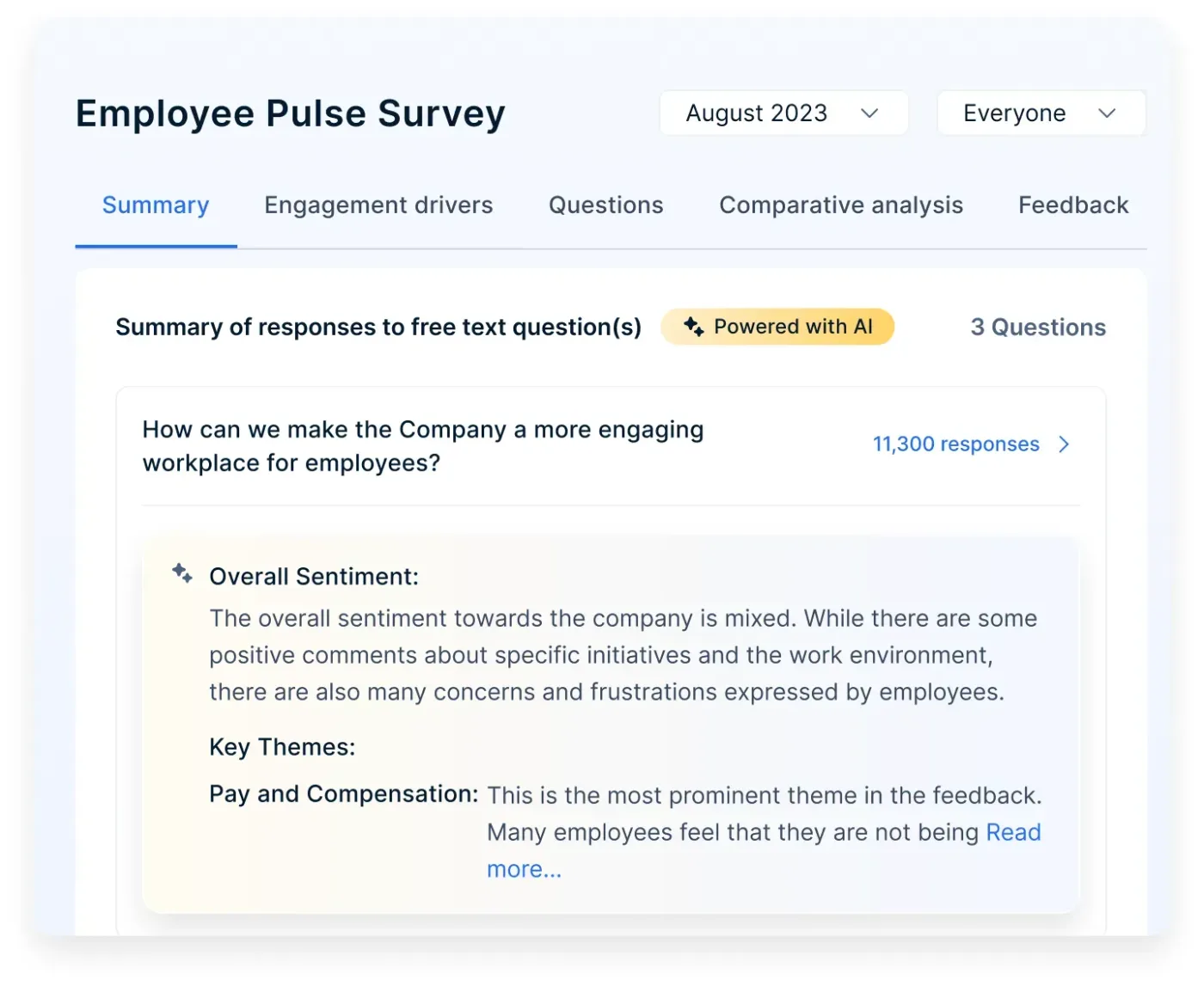
AI summaries like the one above read thousands of open comments and return the overall sentiment and the main themes, so managers know what is behind a score without reading every response. Learn more about AI employee engagement surveys.
Turning employee pulse survey results into action
A pulse survey is only as effective as the action it drives, and employees notice quickly when their input changes nothing. These five steps help you analyze, communicate and act on results, starting with root causes because acting on a symptom wastes the next cycle.
- Look beyond scores to root causes: A low score on "I feel valued at work" is a signal, not a diagnosis. It may point to weak recognition, limited growth or poor manager support. Read the open comments and compare with earlier pulses to find the cause.
- Segment the data: Company-wide averages hide gaps. Break results down by department, seniority, tenure and location. A healthy overall score can hide a new-hire group in one division scoring far lower, which points to onboarding or leadership in that team rather than engagement overall.
- Prioritize high-impact issues: Not every concern carries equal weight. Unmanageable workloads that drive burnout affect retention far more than minor communication gaps, so tackle the issues tied to turnover risk and productivity first.
- Communicate with specifics and accountability: Replace "We appreciate your input" with clear statements, such as "Many of you told us career paths are unclear, so we are launching a mentorship program next quarter" or "Only a minority of you feel leadership is accessible, so we are starting monthly open Q&A sessions."
- Act fast, then track over time: Quick, visible changes lift future participation. If a pulse shows a recognition gap, start with simple steps such as peer employee recognition and refine later. If a weak area does not improve across several pulses, the root cause probably has not been addressed.
For a structured way to plan and track those actions, use this employee engagement action plan, and to understand what drives people to leave, read about employee attrition.
How Empuls helps you run employee pulse surveys
Empuls pulse surveys are built to keep the loop short, from question to action, without adding admin for HR.
- Automated cadence: Schedule weekly, monthly or quarterly pulses delivered through Slack, Microsoft Teams or email, with nudges that stop once someone responds.
- Anonymity employees trust: Individual responses stay hidden, and team breakdowns appear only above a minimum group size.
- AI insight: AI sentiment analysis groups open comments into themes and flags concerns with manager-ready summaries.
- Action that sticks: Turn results into action plans with owners and deadlines, and pair pulses with lifecycle surveys at onboarding and exit.
Pulses work best as part of a broader continuous listening program, where engagement surveys, pulses and lifecycle feedback feed one view of how employees feel.
Small surveys, big retention gains
A well-designed employee pulse survey is a proactive way to understand sentiment, catch concerns early and build a culture of continuous improvement. Its real value lies in what you do next: analyze the trends, act quickly and tell employees what changed.
Keep pulses short, keep the cadence realistic and close the loop every time. When employees see their feedback lead to real improvements, trust rises, and engagement and retention follow. To see why the once-a-year model struggles on its own, read why annual employee surveys fail.
Book your Empuls demo
Frequently asked questions
The purpose of a pulse survey is to check employee sentiment quickly and often on a few focused topics, such as workload, recognition or manager support. It shows trends between larger surveys, gives early warning of disengagement and attrition risk, and lets you check whether actions from your last engagement survey are working.
A pulse survey should have 5 to 15 questions and take no more than five minutes. Keep two or three core questions the same every time so you can track trends, rotate the rest across themes, and include one open-ended question so employees can explain their ratings in their own words.
Most organizations run employee pulse surveys monthly or quarterly. Monthly suits fast-changing or high-turnover teams, while quarterly suits stable teams that also run an annual engagement survey. During a major change, a pulse every two to four weeks can help. Never survey faster than managers can act on the results.
Pulse surveys should be anonymous, because employees give honest feedback only when they feel safe. Use a tool that hides individual answers and shows team results only above a minimum group size, typically five respondents. Tell employees clearly who sees the data, in what form and how it will be used.
Avoid pulse survey fatigue by keeping surveys short, rotating questions, matching the cadence to your ability to act and sharing results after every pulse. Fatigue usually comes from feeling unheard rather than from survey length, so the strongest remedy is showing employees what changed because of their last answers.
A good pulse survey response rate is one that holds steady or rises over time, because the best benchmark is your own trend. Response rates usually climb when surveys reach people in tools they already use, take a few minutes and lead to visible action, and they fall when feedback seems to go nowhere.
Pulse surveys can measure overall engagement, morale, workload and burnout risk, manager support, recognition, career growth, trust in leadership, team collaboration and reactions to specific changes such as a new policy or reorganization. Pick the few topics that matter most right now and keep one engagement question as a constant trend line.





































































































































































































































































































































































































































































































































































