
Key Takeaways
Sales performance is how well a team turns time, pipeline and effort into revenue against target, driven by win rate, deal size, cycle length and pipeline.
Diagnose before you fix: match the symptom in your numbers to its cause, then start with the two or three levers that address it.
Small gains compound: lifting win rate from 20% to 25%, deal size by 10% and cutting the cycle from 90 to 75 days raises revenue per day by about 65%.
Coaching on real calls, more selling time and clear goals lift the middle of the team, where most of the upside sits.
Incentives and recognition work best when they reward the specific behaviors that win deals and are reviewed every cycle.
Here is how to improve sales performance: diagnose where deals are actually stalling, set goals reps believe in, coach on real conversations, give sellers more time with buyers, and tie incentives and recognition to the behaviors that win. The 15 proven ways below cover each lever, with a diagnostic table, a worked sales velocity example and a 30-60-90 day improvement plan you can copy.
Sales performance is how well a sales team or an individual seller turns time, pipeline and effort into revenue against a target, measured by outcomes such as quota attainment and revenue, and by drivers such as win rate, deal size and sales cycle length. Improving it rarely comes from one big change. It comes from small, measured fixes to the process, the people and the way they are rewarded.
Why sales performance stalls
Most sales teams are working harder for thinner results. The Ebsta and Pavilion 2025 GTM benchmark report found that the share of sellers missing quota climbed to 78% from 69%, that just 14% of sellers drive 80% of revenue, and that the average seller spends only 21% of the day engaging with customers. That gap between the top and the rest is where most of the upside sits.
Coaching and skills are part of the story. In Salesforce's 2026 State of Sales research, sellers spent only 40% of their time selling, 46% said they rarely get feedback on their sales conversations and 47% said they do not get enough roleplay before customer calls. Buyers are also changing: a Gartner survey published in March 2026 found 67% of B2B buyers prefer a rep-free experience, so the conversations reps do get have to count.
78%
of sellers missed quota
Ebsta and Pavilion, 2025
14%
of sellers drive 80% of revenue
Ebsta and Pavilion, 2025
40%
of a seller's time is spent selling
Salesforce, 2026
46%
rarely get feedback on sales conversations
Salesforce, 2026
Where sales performance is leaking today
The good news is that each of these numbers points to a fix. Less admin means more selling time, regular coaching closes the skills gap, and clear goals with fair rewards lift the middle of the team toward the top performers.
Diagnose the problem before you pick a fix
Not every team needs all 15 fixes at once. Use the table below to match the symptom you see in your numbers to its likely cause, the metric that confirms it and the ways in this guide to start with.
| Symptom you see | Likely cause | Metric to check | Start with |
|---|---|---|---|
| Plenty of pipeline, few wins | Weak discovery or qualification, no coaching on calls | Win rate by stage, stage conversion | Ways 2, 6 and 8 |
| Deals stall late in the cycle | Single-threaded deals, no urgency or clear value | Sales cycle length, slipped deals | Ways 9, 11 and 12 |
| Thin pipeline | Poor sales and marketing handoff, low prospecting time | Pipeline coverage, lead to opportunity rate | Ways 13 and 14 |
| A few stars carry the team | Unclear goals, flat pay, little recognition for the middle | Quota attainment distribution | Ways 1, 4 and 5 |
| Reps busy but not selling | Manual admin, data entry, scattered tools | Share of time spent selling | Ways 3, 10 and 14 |
| Revenue churns after the sale | No account plan for retention and expansion | Net revenue retention, expansion revenue | Way 7 |
Spot reps falling behind while there is time to coach
See quota attainment, earnings and leaderboard rank update as deals close.
Talk to our ExpertTrusted by 5,000+ companies
How to improve sales performance: 15 proven ways
These 15 ways to improve sales performance run from foundations to market awareness. Start with the first five, because clear goals, skills, data, incentives and engagement set the conditions in which every other tactic works.
1. Set clear and attainable goals
Establishing clear and achievable sales goals is the foundation for improving sales performance. Goals provide direction, motivation and a sense of purpose for sales teams. When setting goals, make them specific, measurable, attainable, relevant and time-bound (SMART). For example, a SMART goal could be to increase monthly sales by 20% in the next quarter.
Quota setting is hard even for large firms: in the Alexander Group 2025 Sales Compensation Trends Survey, 44% of firms named setting accurate quotas as a top sales compensation challenge. Base targets on territory potential and past results, then break them into weekly milestones so salespeople can track progress and correct course early.
2. Invest in sales training and coaching
Well-trained and skilled sales professionals can significantly impact sales performance. Training should focus on communication skills, negotiation tactics, objection handling and understanding customer needs, and it should keep the team current on products and industry trends.
Training sticks only when it is practiced. Regular roleplay, call reviews and one-on-one coaching help salespeople apply what they learn, and they close the feedback gap most sellers report. A useful rhythm is one recorded call reviewed per rep per week, with one specific behavior to try on the next call.
3. Use a CRM system and keep its data clean
A CRM system enables sales teams to manage customer data, track leads and monitor sales interactions in one place. It streamlines workflows and gives reps insight into customer behavior, preferences and past interactions, so they can personalize their approach and prioritize the best opportunities.
The CRM is only as useful as its data. Agree on required fields per deal stage, automate activity capture where you can and review data quality in pipeline meetings, because forecasts, coaching and incentive payouts all depend on it.
4. Incentivize and recognize performance
Providing appropriate incentives and recognition for sales achievements is a powerful motivator. Incentives could include commissions, bonuses, accelerators above quota or SPIFs tied to specific products. Recognizing top performers publicly boosts morale and encourages healthy competition, and Gallup research with Workhuman found well-recognized employees were 45% less likely to have left after two years.
Design the incentive structure to align with both individual and team goals, so it encourages collaboration while still rewarding outstanding individual contributions. For plan types and design choices, start with this guide to sales incentives, then see how to incentivize a sales team for 12 incentive strategies.
5. Implement sales gamification
Sales gamification introduces game-like elements into the sales process to motivate and engage the team: leaderboards, badges, points and rewards for specific milestones. Healthy competition pushes reps to perform better, and team challenges build camaraderie and knowledge sharing.
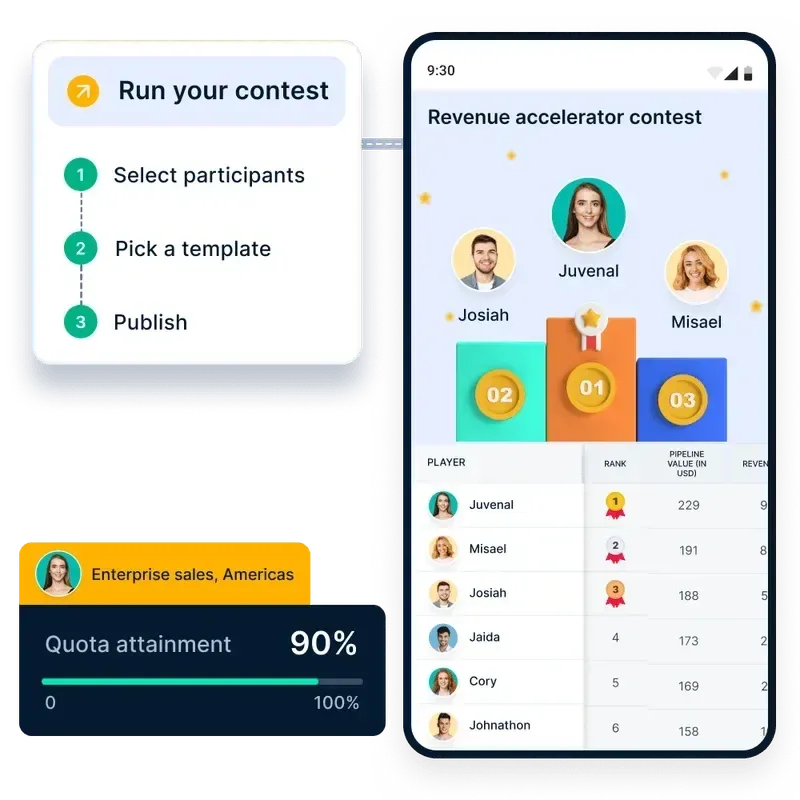
Keep contests short, scoped to similar peers and based on CRM data so the results feel fair. For formats and a contest planner, see this guide to sales gamification.
6. Analyze and learn from sales data
Data-driven decisions are vital to sales performance improvement. Analyze sales data to find trends, bottlenecks and what your best reps do differently. Track key performance indicators such as win rate, stage conversion, sales cycle length, average deal size, customer acquisition cost and customer lifetime value.
A simple way to see which lever matters most is the sales velocity formula: revenue per day equals the number of opportunities, times the win rate, times the average deal size, divided by the sales cycle length in days. The worked example below shows how small gains on each lever compound.
| Scenario | Opportunities | Win rate | Average deal | Cycle (days) | Revenue per day | Change |
|---|---|---|---|---|---|---|
| Baseline | 50 | 20% | $20,000 | 90 | $2,222 | None |
| Better discovery and coaching | 50 | 25% | $20,000 | 90 | $2,778 | +25% |
| Faster cycle | 50 | 20% | $20,000 | 75 | $2,667 | +20% |
| Larger deals | 50 | 20% | $22,000 | 90 | $2,444 | +10% |
| All three together | 50 | 25% | $22,000 | 75 | $3,667 | +65% |
7. Focus on customer retention and upselling
While acquiring new customers is essential, focusing on retention and upselling to existing customers is equally crucial. The Ebsta and Pavilion report found that 52% of new revenue in 2024 came from existing accounts. Loyal customers tend to be more profitable in the long run and become advocates who refer others.
To improve retention, prioritize excellent service, address issues promptly and keep in regular contact with clients. For upselling, identify products or services that complement what the customer already uses and offer recommendations based on their needs, not your quota.
8. Encourage continuous feedback and communication
Open and transparent communication within the sales team is vital for improvement. Encourage regular feedback from reps about their experiences, challenges and ideas, and give constructive feedback and coaching in return.
Regular team meetings and one-on-ones help address concerns, celebrate successes and create a supportive environment. Keep pipeline reviews and coaching sessions separate, so one-on-ones are about developing the seller, not only inspecting the forecast.
9. Use social proof and testimonials
Social proof is the tendency to follow the actions of others when uncertain. Incorporate it into your sales strategy by sharing reviews, testimonials and case studies from satisfied customers in the same industry and size as the prospect.
Success stories build trust and credibility and reduce the perceived risk of buying. They matter more as buyers research on their own, so give reps a short, searchable library of proof points by industry and use case.
10. Adopt technology, automation and AI
Use sales automation and AI tools to streamline processes, save time and improve efficiency. Automation helps with lead routing, follow-up sequences, meeting notes and CRM updates, so reps spend more time building relationships and closing deals.
Adopt tools with care, though. A Gartner survey of 1,026 B2B sellers found that sellers who effectively partner with AI tools were 3.7 times more likely to meet quota, but also that sellers overwhelmed by the number of skills and technologies their job requires were 45% less likely to attain quota. Add fewer tools, train well and retire what nobody uses. For more ways to free up selling time, see these ways to improve sales productivity.
11. Personalize and segment your outreach
Tailoring your sales approach to individual customers can significantly enhance sales performance. Use customer data to segment your audience by industry, size, needs, past purchases and behavior, then create messages and pitches that speak to each segment's real problems.
Personalization makes customers feel understood and increases conversion. In complex deals, it also means engaging more than one stakeholder: the Ebsta and Pavilion report found that when decision makers are involved in the first two stages of the sales process, win rates rose by 55%.
12. Offer limited-time promotions and incentives
Create a sense of urgency by offering time-limited promotions, discounts or exclusive incentives. Limited-time offers prompt customers to make a decision sooner and can help close deals stuck at the end of a quarter.
Use them sparingly and make sure they align with your business goals and do not erode the value of your products or services. Constant discounting trains buyers to wait for the next offer and lowers average deal size.
13. Align sales and marketing
Sales and marketing teams must work in sync to optimize sales performance. Alignment ensures a smooth handover of leads, consistent messaging and a shared understanding of the target audience.
Agree on a shared definition of a qualified lead, review lead quality together every month and feed win and loss reasons back to marketing. When both teams are aligned, marketing generates better leads and sales converts more of them. For pipeline-side tactics, see these strategies on how to increase B2B sales.
14. Improve time and territory management
Sales reps have limited time to engage with potential customers. Effective time and territory management helps them focus on the most promising opportunities: block time for prospecting, plan travel routes and allocate territories by potential, not just geography.
Ebsta and Pavilion found that top performers spend nearly 50% of their time with customers, against 21% for the average seller. Help reps get closer to that by cutting internal meetings and administrative tasks that do not move a deal forward.
15. Monitor competitor activity
Keep a close eye on your competitors' strategies, pricing and offerings. Understanding their strengths and weaknesses lets you position your products more effectively and highlight your unique selling points.
Regular competitor analysis can reveal gaps you can capitalize on and threats to your market share. Turn it into short battle cards that reps can use on calls, and update them with what you hear in won and lost deals.
Build a sales performance improvement plan
A sales performance improvement plan turns the ways above into a sequence with owners and measures. The 30-60-90 day template below works for a whole team; adapt the targets to your baseline from the diagnostic table.
| Phase | Focus | Actions | Measure of success |
|---|---|---|---|
| Days 1 to 30 | Diagnose and set goals | Pull win rate, cycle length, deal size and time spent selling by rep; agree on SMART goals and one coaching focus per rep | Baseline set, goals signed off |
| Days 31 to 60 | Coach and remove friction | Weekly call reviews and roleplay, automate one manual task, launch a short contest on a lagging metric | Stage conversion and activity on target behaviors improve |
| Days 61 to 90 | Reward and review | Recognize progress publicly, check incentive payouts against results, compare metrics with the baseline | Win rate, attainment or velocity up against baseline |
At the individual level, a performance improvement plan for one rep should follow the same logic: a clear gap, specific behaviors to change, the support you will provide and a fair timeline. Use it after coaching has been tried, not as a first step, and see this guide to employee performance management for the wider process.
Sales performance tips for individual reps
Managers set the system, but each seller can increase sales team performance from the inside. These five sales performance tips work for any rep, whatever the plan or industry.
- Protect selling time: Block prospecting and customer time on your calendar before internal meetings fill it.
- Prepare every call: Know the account, the stakeholders and the one next step you want before you dial.
- Multi-thread deals: Build relationships with several people in the buying group, including the decision maker.
- Ask for feedback: Request a call review from your manager or a top peer every week.
- Track your own numbers: Know your win rate, cycle length and where you are against target at all times.
For ways to keep reps motivated through a long quarter, see these strategies to motivate a sales team.
How Empuls helps improve sales performance
Empuls brings sales incentives, gamification and sales performance analytics onto one platform, so goals, rewards and results are visible on the same data. Admins build commission, target and milestone plans in a no-code builder, and calculations run automatically from CRM, ERP and HRMS data.
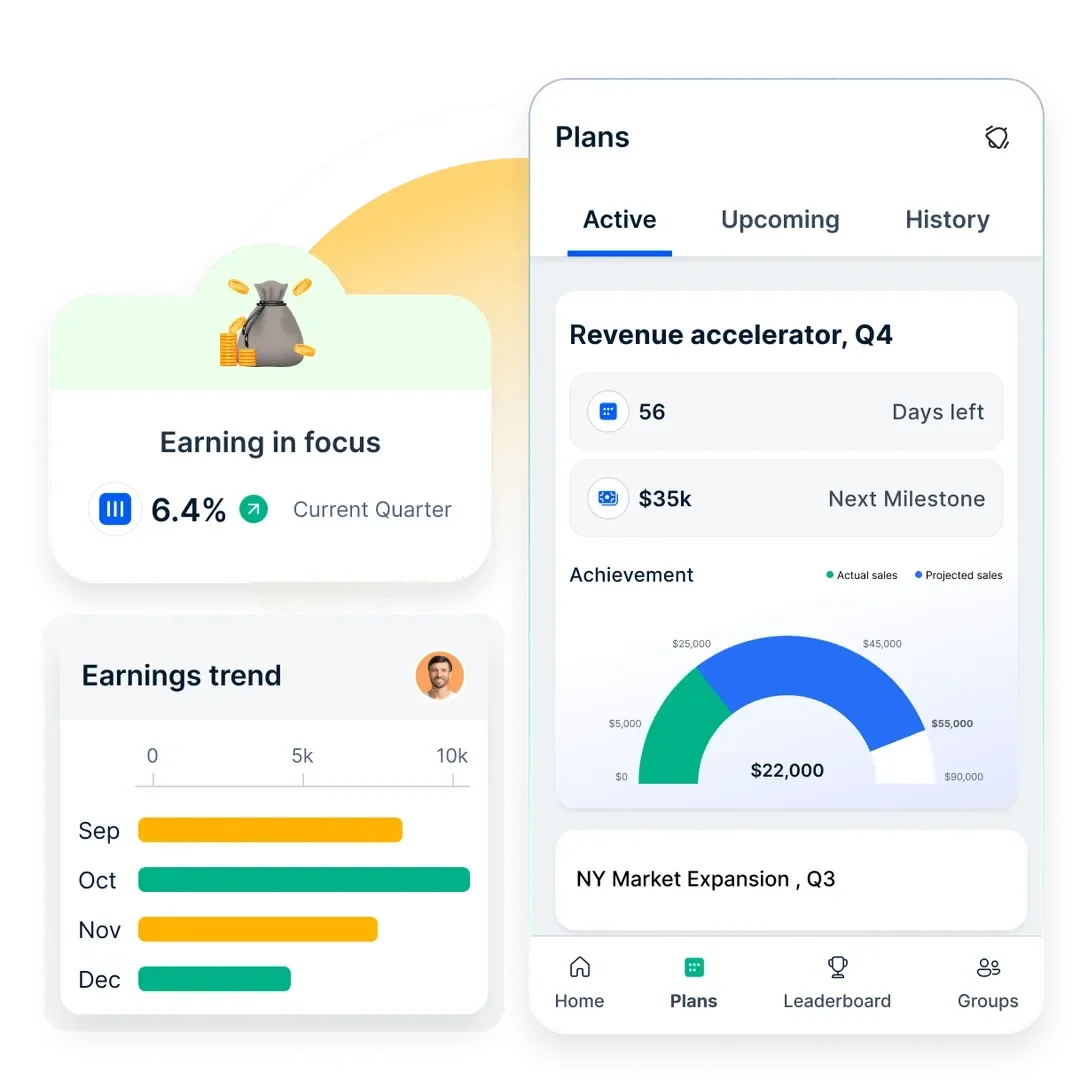
Sales professionals see their KPI scorecard, earnings, leaderboard rank and distance to the next milestone, while managers get quota attainment analytics that surface sellers falling behind mid-cycle, while there is still time to coach. Plan-by-plan comparisons show which incentive plans actually paid off, and live leaderboards, contests and badges keep energy up between payouts.
Explore Empuls sales incentives, sales intelligence and performance analytics and sales gamification.
Make sales performance improvement a habit
Improving sales performance is an ongoing process that takes strategy, discipline and adaptability. Diagnose where deals stall, fix one or two levers at a time, coach on real conversations and reward the behaviors that win.
Then review results every cycle against your baseline, keep what works and drop what does not. Small gains in win rate, cycle length and deal size compound into large gains in revenue.
Book your Empuls demo
Frequently asked questions
Improving sales performance means raising how much revenue a sales team or seller produces against target, by lifting the drivers behind it: win rate, deal size, sales cycle length, pipeline and time spent selling. It usually combines better goals and coaching, cleaner processes and data, and incentives that reward the behaviors that win deals.
The main factors are the quality and fit of the product, the sales process, the skills and coaching of the team, the quality of leads and pipeline, the time reps spend selling, the incentive plan, and market and buyer conditions. Team performance also depends on management: clear goals, fair territories and regular feedback make a measurable difference.
Start with the biggest leak your data shows. Most teams see the fastest gains from weekly call coaching, removing one manual task that eats selling time, and a short contest on a lagging behavior such as booked next steps. Pair these with clear weekly goals and public recognition of progress, then measure against your baseline after 30 days.
Sales performance is measured with outcome metrics such as revenue, quota attainment and growth, and with driver metrics such as win rate, average deal size, sales cycle length, pipeline coverage and stage conversion. Sales velocity combines the drivers into revenue per day: opportunities times win rate times deal size, divided by cycle length.
A sales performance improvement plan is a structured, time-bound plan to close a gap in results. For a team, it sets a baseline, goals, actions and owners over 30, 60 and 90 days. For an individual rep, it defines the gap, the behaviors to change, the coaching and support provided, and how progress will be judged.
A sales manager sets realistic goals, coaches on real calls, removes obstacles, reviews pipeline and data, and recognizes progress. The manager's coaching is often the biggest lever, because most sellers report rarely getting feedback on their conversations. Good managers also keep pipeline inspection separate from development so one-on-ones actually build skills.
Sales incentives boost performance by rewarding the results and behaviors the business needs, such as exceeding quota, selling a priority product or booking meetings. Accelerators above target, short SPIFs, contests and recognition all help. They work best when targets are achievable, payouts are accurate and timely, and reps can see what they are earning in real time.
Technology improves sales performance by automating admin, keeping customer data in one place, surfacing insights from pipeline data and giving reps live visibility of goals and earnings. CRM, conversation intelligence, AI assistants and incentive platforms are the most common tools. Add them carefully, because too many tools overwhelm sellers and reduce their time with customers.





































































































































































































































































































































































































































































































































































