
Key Takeaways
An external recognition program lets customers, patients, clients, partners and vendors thank employees directly, then celebrates that praise inside the company.
External praise carries unique weight because it comes from the people the work actually affects, which deepens purpose and pride.
Most programs succeed or stall on placement: put a simple, no-login link or QR code at the touchpoints customers already use.
Set moderation rules and ask employees for consent before sharing their name or praise publicly.
Gallup and Workhuman found well-recognized employees were 45% less likely to leave within two years, so recognition that reaches frontline staff pays off.
An external recognition program lets customers, clients, patients, partners and vendors thank your employees directly, then routes that praise to the employee, their manager and the wider company. It turns great service into visible, credible appreciation from the people the work actually affects. This guide explains how an external recognition program works, the types of external employee recognition, the benefits and a step-by-step way to run one, with a touchpoint planner you can copy.
An external recognition program is a structured way for people outside your organization to recognize and appreciate your employees for the value they deliver, usually through a simple link, form or QR code, with the praise then celebrated inside the company and, with consent, in public.
Think recognition only comes from within your company? Think again. Your customers, partners, vendors and even patients often see your employees at their best, yet most of their appreciation never reaches the person who earned it. An external recognition program closes that gap, and when the praise is visible across your organization, or even on LinkedIn, it creates a ripple effect of motivation, loyalty and advocacy.
What an external recognition program is
Internal recognition usually flows from peers or managers. External recognition captures moments that go unnoticed inside your systems but leave a lasting impression on the people you serve. A typical program has four parts:
- Public recognition portals: Shareable links or QR codes placed in emails, websites, apps or physical locations such as reception desks, counters and name badges.
- Recognition forms: Short forms where customers or partners leave a message for the employee they dealt with, with no login required.
- Published shout-outs: Approved messages are shared to internal channels such as a recognition feed, a Wall of Fame or digital signage.
- Social sharing: Recognized employees can share their kudos on LinkedIn to build their personal profile and your employer brand.
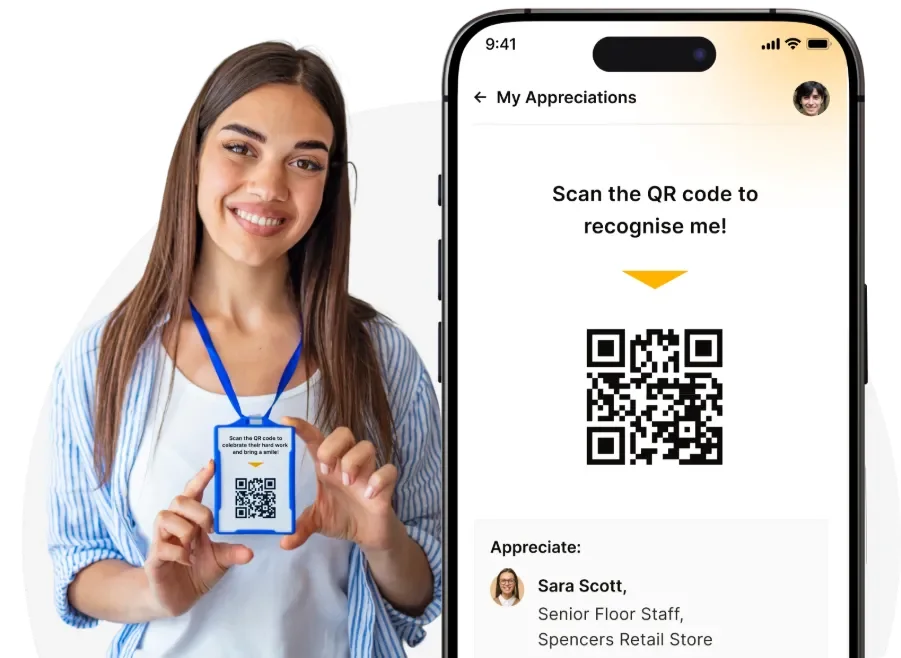
Popular use cases include a patient recognizing a nurse for exceptional care, a client thanking the project lead after a successful delivery, a vendor commending the procurement team for smooth coordination and a customer thanking a support rep for fast issue resolution. Each brings customer feedback closer to the people who make it happen and turns recognition into a two-way street.
Types of external employee recognition
Some of the most meaningful appreciation comes from the people your employees serve directly. There are seven common types of external recognition, and the table shows who gives each, a typical example and the best channels to collect it.
| Type | Who gives it | Example | Best channels |
|---|---|---|---|
| Customer recognition | End customers and buyers | A customer thanks a support agent who resolved a critical issue | Post-interaction surveys, email links, QR codes on receipts or packaging |
| Partner or vendor recognition | Channel partners, suppliers, service providers | A vendor thanks the finance team for on-time payments and clear communication | Partner portals, post-meeting follow-ups, partner newsletters |
| Patient or client recognition | Patients, families and service clients | A patient commends a nurse for compassionate care during recovery | Discharge kits, follow-up emails, client portals |
| Client project recognition | Project sponsors and account stakeholders | A sponsor commends the implementation team for hitting a tight deadline | End-of-project feedback forms, quarterly business reviews, CSAT and NPS surveys |
| Community recognition | Nonprofits, event attendees, local groups | A nonprofit praises employee volunteers after a community clean-up | QR codes at events, thank-you campaigns, community forums |
| Training and onboarding recognition | External facilitators, mentors, training partners | A guest speaker recognizes the L&D team for a flawless virtual session | Post-session forms, partner portals, follow-up emails |
| Industry and public recognition | Award bodies, media, professional associations | An engineer is named in an industry award or invited to speak at a conference | Award nominations, press, LinkedIn and company website features |
Healthcare offers a well-known model. With The DAISY Award, nurses can be nominated by anyone, including patients, family members and colleagues, and thousands of facilities and nursing schools worldwide take part. The same principle works in retail, hospitality, field service and B2B account teams: make it easy for the person who was helped to say so.
Each of these types can be captured, moderated and celebrated in one place, so your people get the appreciation they deserve no matter where it comes from.
Why external recognition matters
Recognition has always been a powerful motivator, but when it comes from outside the organization it carries a unique weight. It validates an employee's work through the eyes of the people it affects most, and it does five things internal recognition alone cannot:
- It deepens employee purpose: When an employee is thanked by a customer or partner, it creates an emotional connection to their role. They are no longer just doing a job; they can see the difference they make.
- It boosts morale and pride: Public recognition from external sources validates performance in a way that is hard to replicate internally. It says: you are doing great, and the people you serve noticed.
- It drives service excellence: Knowing their efforts could be appreciated by customers encourages employees to go the extra mile and keep that standard consistently.
- It amplifies your employer brand: When employees share external appreciation on social platforms or internal feeds, it shows your culture of recognition and customer focus to candidates and clients.
- It creates a feedback loop of trust: Customers and partners feel heard when their compliments are celebrated, and employees feel trusted when those voices are amplified.
Recognition is also one of the clearest levers you have on retention. Gallup and Workhuman found that well-recognized employees were 45% less likely to have left their organization two years later, and the same research estimates that replacing a frontline worker costs about 40% of their salary. For customer-facing teams, external praise is often the most meaningful recognition they get.
Let customers thank your team in seconds
Collect praise from customers, patients and partners with a QR code or link, then celebrate it on your feed and screens.
Talk to our ExpertTrusted by 5,000+ companies
Benefits of an external recognition program
External recognition programs go beyond feel-good moments and deliver tangible business value. These six benefits fall into two groups: what your people gain and what your business gains.
01 · People
Higher engagement and motivation
When employees see their work appreciated by people outside the company, it reinforces their impact and increases intrinsic motivation.
02 · People
Stronger retention and loyalty
Employees who feel seen and valued, especially by customers, build a stronger emotional connection with the company and are more likely to stay.
03 · People
A culture of transparency
Letting the outside world take part in recognition promotes openness, accountability and alignment across teams.
04 · Business
Real-time service quality feedback
Support, sales and field teams learn what is working from the appreciation itself, which doubles as qualitative feedback.
05 · Business
Better customer relationships
Giving customers a way to thank individuals humanizes your brand and deepens the bond between both sides.
06 · Business
A stronger employer brand
Recognition employees share on LinkedIn builds your employer brand organically and helps attract talent.
With engagement at just 20% globally in Gallup's State of the Global Workplace 2026 report, any recognition source that reaches frontline and customer-facing employees is worth building.
How to run an external recognition program
Running an external recognition program takes a few decisions up front about where praise is collected, who reviews it and how it is celebrated. Follow these seven steps in order, because the first two decide how much praise you receive and the third keeps it safe to publish.
- Pick your first audiences and teams: Start where employees meet customers most, such as stores, clinics, support, field service or account teams, and run a pilot with one or two of them.
- Place invitations at real touchpoints: Put links and QR codes where customers already are: receipts, email signatures, chat sign-offs, discharge kits and project wrap-up emails. Keep the form to a name and a short message.
- Set moderation rules: Decide what is auto-approved, what a moderator reviews and what needs manager review, especially if praise carries points. Filter out spam, abuse and complaints disguised as praise.
- Route praise to the right person: Match each message to the named employee, notify them and their manager and post approved praise to the recognition feed.
- Celebrate it visibly: Share praise in team huddles, on a Wall of Fame and on screens in break rooms or shop floors, and let employees choose whether to share it on LinkedIn.
- Add a reward where it fits: Consider converting external praise into points or a small award, so customer praise and internal recognition carry equal weight.
- Measure and expand: Track praise volume by team, the share of employees recognized externally and the themes customers mention, then extend the program to more teams.
External recognition touchpoint planner
The most common reason external recognition programs stall is that customers never see the invitation. Use this planner to choose where to ask for praise and what to say, starting with the two or three touchpoints your customers use most.
| Touchpoint | Where to place the invitation | Example wording |
|---|---|---|
| In-store or on-site | QR code on name badges, counters and receipts | "Did Sara help you today? Scan to say thanks." |
| Customer support | Link in chat sign-offs and ticket closure emails | "Was Alex helpful? Leave a quick thank-you for them." |
| Healthcare | Card in discharge kits and follow-up emails | "Want to thank someone who cared for you? Tell us here." |
| Field service | Link in job completion texts and invoices | "Happy with today's visit? Send Raj a thank-you." |
| B2B accounts | Quarterly business review follow-ups and project wrap-up emails | "Who on our team made this project work? Recognize them here." |
| Partners and vendors | Partner portal and newsletter | "Know someone on our team who made your job easier? Let them know." |
| Events and CSR | Posters and QR codes at the venue | "Thank a volunteer who made today great." |
| Website and app | A recognition link on your contact or help page | "Got great service? Recognize the person behind it." |
Customer-facing incentive programs and external recognition work well together. For reward ideas for these teams, read about customer service incentive programs, and for recognizing deskless teams, see this guide to frontline workers.
Other ways to recognize employees externally
Customer praise is the core of an external recognition program, but there are four more ways to show employee appreciation externally. Each adds public visibility and works best with the employee's consent:
- LinkedIn and social posts: Post about a team member's work, tag them and explain the impact. Leaders posting about their teams is one of the simplest forms of public recognition for employees.
- Website and blog features: Feature employees, not just executives, in case studies, team pages and customer stories.
- Industry award nominations: Nominate employees and teams for awards run by industry associations, professional bodies and trade media.
- Speaking and publishing opportunities: Put employees forward to speak at conferences, join webinars or write for industry publications, giving them credit for their expertise.
These gestures sit alongside internal formats. For formal awards that run on a schedule, see how to set up an employee of the month program, and for the wider picture, read this guide to employee recognition.
How Empuls enables external recognition
Empuls makes external recognition a core part of the recognition program rather than a separate tool. With Empuls external praise, customers, patients, clients and partners can thank your team without logging in, and every message reaches the person who earned it:
- QR codes and links with no login: Customers scan a QR code or open a custom link, type a short note and submit, which works even in fast frontline interactions.
- Configurable approval: Admins can auto-approve trusted senders, route praise to a moderator or require manager review for praise tied to points, with spam and abuse filters before anything reaches the queue.
- Routed to the right employee: HR system integrations match praise to the named employee, their team and reporting line, so it shows up in analytics.
- Visible where people work: Approved praise posts to the recognition feed and the Wall of Fame, which can be cast to TV screens, kiosks and digital signage on shop floors.
- Rewards that count: External praise can convert into points that employees redeem for rewards they choose, alongside internal Empuls recognition.
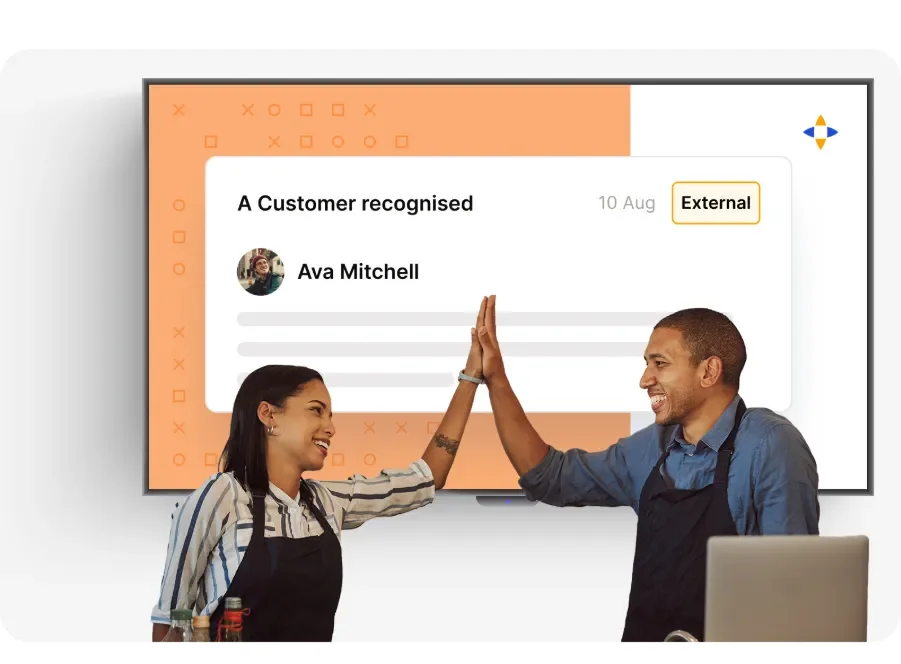
For frontline-heavy industries such as retail, healthcare, hospitality, logistics and manufacturing, external praise pairs well with the wider frontline workforce features.
Recognition that goes beyond the workplace
Recognition should not stop at your org chart. When customers, partners or vendors appreciate your employees, it brings unmatched authenticity to your culture and shows people the real impact of their work.
Start with one team and two touchpoints, set clear moderation and consent rules and celebrate every message visibly. An external recognition program turns service moments into stories worth celebrating, and those stories build pride, trust and performance across the organization.
Book your Empuls demo
Frequently asked questions
External recognition is appreciation for an employee that comes from outside the organization, such as customers, patients, clients, partners, vendors or the community. It can arrive as a thank-you message, a review that names the employee, an industry award or public praise. An external recognition program collects this praise and celebrates it inside the company.
Internal recognition comes from inside the company, from managers, peers or leaders. External recognition comes from the people your employees serve or work with outside the company. Internal recognition reinforces values and teamwork, while external recognition validates the impact of the work on customers. Strong programs combine both in one feed.
Customers usually recognize employees through a short form opened from a QR code, a link in an email or chat, or a feedback survey that asks them to name who helped. The best forms need no login and take under a minute. Approved messages are then routed to the employee and celebrated internally.
It can be, and many programs convert approved external praise into points so it carries the same weight as internal recognition. Keep the reward modest and apply the same rules to everyone. The visibility of the praise, such as sharing it in team meetings and on screens, often matters more to employees than the reward.
Use moderation rules. Auto-approve trusted senders, send other messages to a moderator and require manager review when praise carries points. Spam and abuse filters catch most problems, and reviewers can reject complaints disguised as praise or messages with personal or sensitive details before anything is published.
Frontline and customer-facing industries benefit most, including retail, healthcare, hospitality, automotive service, logistics, field service and financial services. Any business where employees interact directly with customers, patients or clients has a steady flow of praise to capture. B2B account and project teams also benefit from client recognition.
You can share an employee's achievement on LinkedIn, feature them in customer stories or on your website, nominate them for industry awards and put them forward for speaking opportunities. Always ask for consent first, because some employees prefer private recognition and some roles have privacy or safety reasons to avoid public exposure.





































































































































































































































































































































































































































































































































































