
Key Takeaways
Employee engagement in startups depends most on transparency, ownership, a sustainable pace and visible appreciation, all of which founders control directly.
Startup Snapshot found that 50% of startup employees report burnout and only 18% say their founders are fully transparent about company challenges.
The most effective startup employee engagement ideas are low cost: peer recognition, learning allowances, flexible work, mentoring and honest all-hands meetings.
Engagement priorities shift with growth, from shared mission at seed stage to manager training and consistent recognition after Series B.
Well-recognized employees were 45% less likely to have left after two years, which makes recognition one of the strongest levers for employee retention in startups.
Employee engagement in startups is the energy, ownership and commitment people bring to a young company, and it decides whether a small team can outrun bigger competitors. The most effective ways to improve it are cheap: transparent communication, real autonomy, visible recognition, growth opportunities and protection from burnout.
Startups thrive on energy, innovation and bold ambition, but without engaged employees even the most promising venture can stall. Building a product is only half the battle. The other half is building a culture where people are inspired to give their best. That is harder than it sounds: Gallup's State of the Global Workplace 2026 report found that only 20% of employees worldwide were engaged at work in 2025. In a startup, where every role is mission-critical, that kind of disengagement can quietly derail your momentum.
Whether you're running lean or scaling fast, this guide covers why engagement matters so much for startups, how startup culture shapes it and 16 effective, budget-friendly ways to improve employee engagement in startups, from culture-building habits to the tools that make them stick.
Why employee engagement in startups matters
When engaged, startup teams produce better results and build great things. Keeping them engaged also means they are more likely to stay, which saves the startup money and time on hiring and training. Employee retention in startups is especially fragile: when one of ten people leaves, you lose a tenth of your capacity and often a large share of the knowledge in one area.
A team member who isn't invested will do only what's needed to collect a paycheck, and in a small team that attitude spreads quickly. When startup employees are fully engaged, they are driven to meet the company's goals because they feel a shared bond with it. The gap is measurable: Gallup's research on engagement and productivity found that teams in the top quartile of engagement are 23% more profitable and have 78% lower absenteeism than those in the bottom quartile.
How startup culture and engagement are connected
Startup culture and engagement are tightly linked because a startup's culture is set by a handful of people and felt by everyone every day. The traits that make startups exciting, such as speed, ambiguity and big stakes, can also drain people when they go unmanaged.
The pressure is real. In Startup Snapshot's research on startup employee wellbeing, 50% of startup employees reported burnout and 52% reported anxiety. Only 18% said their founders were completely transparent about the company's challenges, and lack of transparency ranked as a bigger stressor than pay or workload. That points to four levers founders control directly:
- Transparency: Share runway, priorities and setbacks honestly. Uncertainty hurts more than bad news.
- Ownership: Give people real decisions, not just tasks, so they feel the company's success is partly theirs.
- Pace: Treat sprints as sprints, not as the default. Sustained overwork is the fastest route to burnout and exits.
- Appreciation: In a small team, every contribution is visible. Recognizing it costs little and builds loyalty.
Build an engaged startup team from day one
Recognize wins, run pulse surveys and celebrate milestones in one platform that grows with you.
Talk to our ExpertTrusted by 5,000+ companies
16 effective ways to improve employee engagement in startups
The 16 startup employee engagement ideas below are grouped loosely from growth and connection to autonomy, tools and recognition. Transparent communication (idea 11) and rewards and recognition (idea 16) carry the most weight, because they shape how people feel about every other initiative on this list.
1. Provide professional development opportunities
Investing in your team's growth builds their skills and shows that the startup values their progression. The investment can take many forms, from workshops and online courses to tickets for industry conferences and events.
On a tight budget, give each person a small learning allowance, set aside a few hours a month for learning and ask people to share one takeaway with the team. Learning in public multiplies the value of every course.
2. Encourage employees to volunteer
Motivating your team to take part in volunteer activities is another way to boost engagement. Giving to others brings a sense of joy and calm, and it gives people a break from their busy schedules.
Encourage your team to join local community service, such as neighborhood clean-ups or helping at a senior citizens' home. Salesforce has built volunteering into its culture from its earliest days with paid volunteer time off for employees, and startups can borrow the idea at small scale with one paid volunteer day a quarter. Initiatives like these create a sense of purpose that goes beyond work achievements, and giving back together boosts morale, team unity and pride in the company.
3. Promote camaraderie
Potlucks are a simple way to bring everyone together. Each person brings a home-cooked dish to share, and the conversation flows around the food. Hosting a potluck is also far cheaper than dining out.
When team members share a meal, they exchange ideas and learn about each other's work in a relaxed setting, which makes everyday collaboration smoother. For remote teams, a virtual coffee roulette or a shared channel for weekend photos does a similar job.
4. Introduce games and challenges
Too much of the same work can make anyone lose their spark. Sprinkle fun into everyday tasks through friendly challenges, quick games or a team leaderboard.
Atlassian runs ShipIt, a quarterly 24-hour internal hackathon where employees work on projects of their choice outside their regular duties. The approach has three clear benefits:
- Creativity and innovation: Letting people pick their own projects taps into diverse talents and interests, and surfaces ideas that would never come through regular channels.
- Higher engagement: A change of pace is a real morale booster. People feel more motivated when they work on something they genuinely want to build.
- Cross-team collaboration: Hackathons bring together people from different teams who rarely work together, which builds community and leads to unexpected solutions.
5. Let employees mentor each other
Every team member brings unique skills, sometimes in areas unrelated to their role. That is a ready-made development program.
Invite employees to mentor colleagues in what they know best, from design and data analysis to public speaking or competitive coding. Mentees learn new skills, and mentors deepen their expertise and confidence by teaching it.
6. Run financial education sessions
Money worries distract people and hurt their focus at work, and in a startup where every role matters, that cost adds up quickly. Equity can also be confusing: many employees don't understand how their stock options work or what they might be worth.
Workshops, seminars or access to financial planning tools help employees manage money, plan investments and build long-term stability. Start with a session on how your equity plan works, then add budgeting and tax planning. Financial wellness benefits can extend the support beyond a single session.
7. Celebrate milestones and birthdays
Recognizing birthdays, work anniversaries and personal milestones lifts spirits and shows people they are seen as individuals. In the rush of daily work these moments are easy to miss, and a missed one can quietly weaken an employee's emotional connection with the company.
Put a simple system in place so nothing slips: automated reminders, a team shoutout and a small gift. Celebrations features can handle birthdays, work anniversaries, onboarding and life events automatically.
8. Allow remote and flexible work
Many workers, especially younger ones, value the chance to work from home or choose their hours. People do their best work when they can balance their job and personal life, and juggling the two without flexibility creates stress that affects work quality.
Spotify's Work From Anywhere policy, introduced in 2021, lets employees choose between working from home, the office or a mix, and the company's HR leadership publicly reaffirmed it in 2025. Startups can offer the same trust at almost no cost, as long as expectations for availability and outcomes are clear.
9. Promote wellbeing and balance
Wellbeing is crucial in startups, where the pace is fast and the demands are high. Build a culture that prioritizes mental and physical health, encourages regular breaks and protects time off.
Lead by example: founders who send messages at midnight set an expectation, whatever they say. Simple wellness programs, such as team fitness challenges or access to counseling, show people that the company cares about them as well as their output.
10. Create a pet-friendly workplace
A pet-friendly office can reduce stress and lift the mood, especially in an intense startup environment. Pet insurer Trupanion is well known for welcoming dogs at its offices, and even a monthly pet day can bring a lot of joy. It helps with:
- Stress reduction: Pets have a calming effect on people, which creates a more relaxed atmosphere in fast-paced, high-stakes teams.
- Job satisfaction: A pet-friendly policy is a visible perk that signals a flexible, accommodating culture and can help attract talent.
- Work-life balance: Pet owners don't have to worry about leaving pets alone at home, which removes guilt and helps them focus.
11. Communicate transparently
Transparent communication builds trust and keeps everyone on the same page, which is crucial in a startup where roles are diverse and interdependent. Given how strongly transparency is linked to startup employee wellbeing, this is the single most important habit on this list.
Share the numbers that matter, such as runway, revenue and key metrics, in a monthly all-hands. Explain the reasons behind big decisions, admit what you don't know yet and give people a channel to ask anything. Regular updates and feedback loops turn employees from recipients of information into active participants in the company's growth.
12. Give employees autonomy over projects
Giving employees ownership of projects boosts their confidence and their sense of accountability. Google's well-known "20% time" encouraged engineers to spend part of their week on self-directed projects, and products such as Gmail grew out of that freedom.
Autonomy in choosing and running projects encourages people to explore new ideas and approaches, which keeps a startup's culture dynamic and innovative. Pair it with clear goals so freedom doesn't turn into drift.
13. Run intrapreneurship programs
Intrapreneurship programs encourage employees to act like entrepreneurs inside the company, which is exactly the mindset a startup needs to stay innovative and competitive. 3M has long encouraged employees to spend part of their time exploring their own ideas, a practice credited with products like the Post-it Note.
In a startup, this can be as simple as a quarterly pitch day where anyone can propose a new feature, process or market, with a small budget and time to test the winning idea. The freedom to innovate motivates people and keeps the company at the front of its market.
14. Set up employee-driven committees
Employee-driven committees give team members a say in parts of the company, from event planning to workplace improvements and values. In a startup, they make sure every voice is heard as the team grows beyond the founders' direct reach.
Committees also give management valuable insight and ideas, and they spread ownership of culture across the team instead of leaving it with the founders or a single HR person.
15. Use technology for efficiency
Technology that streamlines processes is essential in a startup where resources are limited and productivity is key. Automate repetitive admin so people spend their time on work that matters.
Performance management is a good example. Deloitte redesigned its performance management around frequent check-ins instead of annual reviews, dropping cascading objectives and 360-degree feedback tools. The new approach focused on three things:
- Acknowledging contributions: Recognizing each employee's unique input within their team.
- Objective performance assessment: Keeping evaluations fair and unbiased.
- Developing potential: Giving people the support and resources to reach their full capability.
Startups can start with lightweight tools: regular one-to-ones, short pulse surveys and a shared place for goals and feedback.
16. Reward and recognize good work
Recognizing and rewarding employees for their hard work is crucial for morale and motivation, especially in a startup where the work is demanding. It also pays off in retention: a Gallup and Workhuman study found that well-recognized employees were 45% less likely to have turned over after two years.
Speed matters as much as size. One global business analytics company with 13,000 employees used Empuls spot awards to replace a slow voucher and approval process, cutting the time to give an award from days to under five minutes and tying every award to its company values. For a small team, start with peer shoutouts and a modest monthly reward budget, and see how recognition software for startups differs from enterprise tools before you buy.
Startup employee engagement ideas by growth stage
How to engage startup employees changes as the team grows. What works for ten people in one room breaks at fifty across two cities, so match your efforts to your stage:
| Stage | Team size | Engagement focus | Ideas to start with |
|---|---|---|---|
| Pre-seed and seed | Under 15 | Shared mission and trust | Weekly all-hands, founder one-to-ones, peer shoutouts, potlucks |
| Series A | 15 to 50 | Clarity as roles specialize | Career conversations, learning allowance, pulse surveys, celebrations |
| Series B and beyond | 50 to 200 | Consistency across teams and locations | Manager training, recognition platform, employee committees, action plans |
| Scale-up | 200 plus | Keeping startup culture at scale | Intrapreneurship programs, engagement analytics, structured rewards and benefits |
Whatever your stage, turn survey results into a short employee engagement action plan so people can see their feedback leads to change, and watch for early signs of employee disengagement when the pace picks up.
Make work better with Empuls
Startups thrive on passion, purpose and people. When the spark starts to fade, the right tools help you reignite it. Empuls is Xoxoday's AI-powered employee engagement platform, and it makes it easy to build a connected, motivated and appreciated team without breaking the bank. Empuls helps startups:
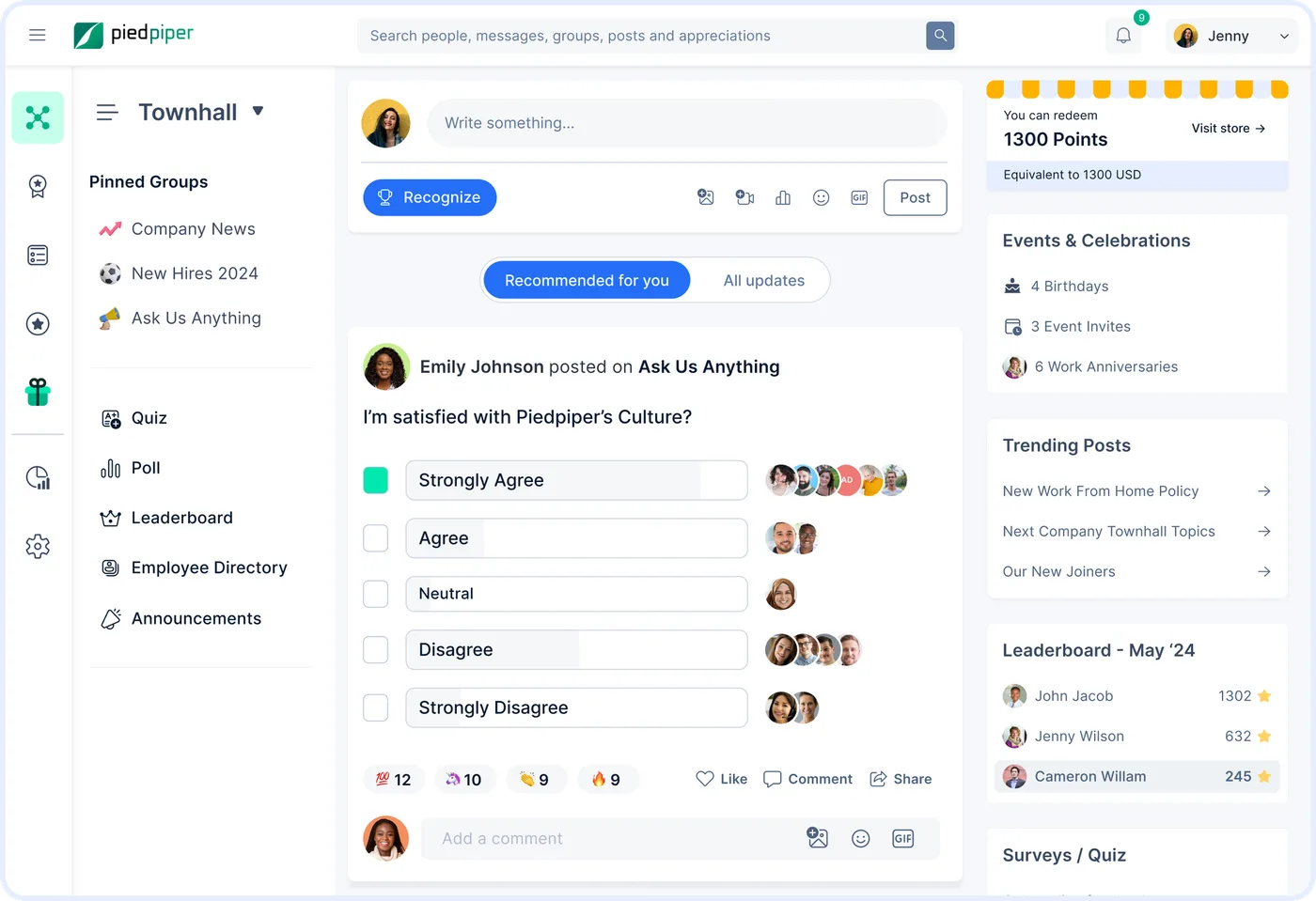
- Recognize and reward instantly: Celebrate every win and milestone with peer-to-peer recognition, spot awards and milestone rewards.
- Create a culture of belonging: Use the social intranet to drive open communication, celebrate life events and bring watercooler chats online.
- Listen and act: Run eNPS and pulse surveys to understand your team and respond with data-backed action plans.
- Offer meaningful perks and benefits: Give your team access to a global catalog of gift cards, experiences and merchandise, plus benefits such as discounts, wellness budgets and tax-saving options.
- Use AI to keep recognition flowing: Recognition Coach helps managers write meaningful appreciation, and Empuls AI turns engagement data into plain-English insights, so good work doesn't go unnoticed.
Whether you're 10 or 100 people strong, Empuls grows with you, so you can focus on building your startup while it takes care of the everyday work of culture.
Final thoughts on startup engagement
Employee engagement is the heartbeat of every thriving startup. When your team feels valued, heard and connected, they become your biggest champions. From simple potlucks to a full engagement platform, small actions add up to a big impact, and the 16 ideas above are culture builders that create lasting motivation and loyalty.
Whether you're at the seed stage or scaling up, invest in your people early. For the wider picture, read our guides to employee engagement and employee engagement strategies. When your team wins, your startup wins.
Book your Empuls demo
Frequently asked questions
Employee engagement is important in startups because every person carries a large share of the workload and knowledge. Engaged employees take ownership, solve problems without being asked and stay longer, which protects the company from costly turnover. Disengagement spreads quickly in small teams, so one unhappy person can affect morale and output far more than in a large company.
Startups can improve employee engagement on a tight budget by focusing on habits rather than spending. Share company numbers openly, give people ownership of projects, recognize good work publicly, offer flexible hours, run peer mentoring and hold regular one-to-ones. Small learning allowances, potlucks and volunteer days add connection and growth at very little cost.
Low engagement in startups usually comes from uncertainty about the company's direction, poor communication from founders, sustained overwork, unclear roles and a lack of recognition. Research on startup employee wellbeing shows that lack of transparency is a bigger stressor than pay or workload, so honest, regular updates about runway and priorities make a large difference.
To improve employee retention in startups, combine fair pay and clear equity with growth, recognition and a sustainable pace. Hold regular career conversations, recognize contributions quickly, explain how stock options work and watch for signs of burnout. Engagement surveys and stay interviews help you spot problems early, while there is still time to fix them.
Most startups benefit from an employee engagement platform once they pass about 30 to 50 people, work across locations or add a layer of managers. At that point, founders can no longer see every contribution personally, and a platform keeps recognition, surveys, celebrations and rewards consistent across teams without adding HR headcount.





































































































































































































































































































































































































































































































































































