
Key Takeaways
Employee engagement in the pharma industry depends on keeping purpose visible, because compliance pressure and long development cycles hide the link between daily work and patients.
A Q4 2025 survey found 27% of bio/pharma professionals had an involuntary job change in two years, so honest communication about change is now central to retention.
The FDA counts Employee Engagement and Empowerment as one of five practice areas in its Quality Management Maturity program, linking engagement directly to quality.
Recognition must reach every function, including QA, plant and regulatory teams whose work is critical but rarely visible.
Measure pharma engagement ROI against compliance quality, retention in critical roles, innovation and commercial outcomes.
Employee engagement in the pharma industry is how connected researchers, plant and quality teams, field reps and corporate staff feel to their work and to the mission of improving patients' lives. It needs deliberate attention because compliance pressure, long development cycles, siloed functions and recent restructuring can disconnect even mission-driven people from that purpose. The strongest programs make purpose visible, recognize every function and turn feedback into action.
The pharmaceutical industry is fueled by purpose. Every molecule discovered, every clinical trial run and every prescription filled is a step toward better health. Behind these breakthroughs are people, from researchers and sales reps to plant workers and compliance teams, working in high-pressure, highly regulated environments.
In such a mission-driven industry, you would expect engagement to be naturally high. Reality often looks different. That is why employee engagement in the pharma industry needs continuous focus, not a one-time initiative. When employees feel heard, appreciated and aligned with the mission, they are more productive, resilient and innovative. This guide covers the challenges unique to pharma, the drivers and activities that work, how to measure ROI and how a platform can help. For engagement in hospitals and clinics, read our companion guide to healthcare employee engagement.
Why employee engagement in the pharma industry needs attention now
Pharma and biotech employees have lived through two years of restructuring, pipeline cuts and reorganizations, and the latest survey data shows it in how secure and committed they feel. Three figures from a Q4 2025 survey of bio/pharma professionals frame the problem.
27%
had an involuntary job change
in the past two years, up from 14.5% (Q4 2025)
25%
feel much less secure in their role
up from 11% a year earlier
46%
strongly reject leaving the industry
down from 59% a year earlier
Job security and commitment signals among bio/pharma professionals
These figures come from the BioPharm International, Pharmaceutical Technology and Pharmaceutical Executive employment and trends survey published in January 2026. The same survey found a bright spot: 30% of respondents were fully satisfied with their job, up from under 15%, with intellectual stimulation (50%) and work-life balance (43%) as the top drivers of satisfaction. That is a strong signal that purpose and the work itself still matter most.
Leadership is the other pressure point. BioSpace's 2026 US Life Sciences Employment Outlook found that 15% of professionals looking to leave cited unhappiness with company leadership, compared with 9.1% who cited their manager. Pharma industry employee retention therefore depends on how leaders communicate change, not only on how managers run teams.
Challenges of employee engagement in pharma
Pharma companies face six recurring engagement challenges, and regulatory intensity carries the most weight because it shapes the daily experience of quality, manufacturing and clinical teams. The list moves from pressures built into the work itself to structural ones, such as silos and restructuring, that leaders can change more directly.
1. Regulatory intensity and compliance pressure
Pharma employees, especially in quality assurance, manufacturing and clinical trials, must meet rigorous regulatory standards. This high-stakes environment can create a compliance-first culture that leaves little room for creativity or emotional connection to the work.
2. Long product development cycles
Drug discovery and development often span years, sometimes decades. For R&D and regulatory teams, the delay before outcomes are visible can sap motivation. Without consistent recognition or visible milestones, engagement naturally dips over time.
3. Functional silos
From scientists in labs to sales reps meeting healthcare professionals (HCPs), pharma roles often operate in isolation. This limits collaboration and knowledge sharing and creates a fragmented culture.
4. Field force disconnection
Medical representatives, medical science liaisons (MSLs) and sales teams are constantly on the move. Without the right digital touchpoints and feedback channels, they feel disconnected from internal culture and decisions, especially as their roles shift toward hybrid, omnichannel HCP engagement.
5. Limited visibility for non-corporate roles
Plant workers, lab technicians and compliance officers often get less recognition than commercial or corporate teams. Their contributions are critical yet frequently overlooked, which leads to disengagement.
6. Restructuring and job insecurity
Layoffs, site consolidations and portfolio reprioritization leave remaining employees uncertain about their future. When decisions are made quickly without explaining the reasoning, trust erodes, and the strongest performers are often the first to explore other options.
Addressing these challenges requires more than surveys and spot bonuses. It needs an inclusive, tech-enabled approach that reaches every corner of the organization.
Recognize every function, from lab to field
Run values-based recognition, pulse surveys and field incentives for distributed pharma teams on one platform.
Talk to our ExpertTrusted by 5,000+ companies
Why employee engagement matters in the pharma industry
In a high-impact industry like pharma, engagement does more than lift morale. It influences compliance, innovation and patient outcomes. The US FDA's Center for Drug Evaluation and Research includes Employee Engagement and Empowerment as one of five practice areas in its Quality Management Maturity program (April 2026 update), a clear sign that regulators see engaged people as part of quality, not separate from it.
- Compliance and quality assurance: Engaged employees take ownership of processes, follow protocols meticulously and flag gaps early, which reduces errors, deviations and compliance risk. Gallup's Q12 meta-analysis (2024) found top-quartile engagement units see 32% fewer quality defects than bottom-quartile units.
- Innovation and speed to market: R&D needs passion and persistence as well as expertise. Scientists and project teams who feel recognized and supported push boundaries and collaborate across functions.
- Patient-centricity: Every pharma employee, from manufacturing to marketing, has a hand in patient outcomes. Connecting individuals to that purpose builds empathy, accountability and service quality.
- Talent retention: Demand for data scientists, regulatory experts and skilled field reps stays competitive. Engaged employees are more loyal and become advocates for the company.
- Global cultural alignment: Pharma companies operate across borders and time zones. A consistent engagement strategy unifies diverse teams around shared values.
In short, investing in pharma employee engagement strategies means investing in safer products, faster innovation and a more resilient organization.
Key drivers of employee engagement pharma companies must prioritize
Engaging pharmaceutical employees takes five drivers, and a purpose-led culture comes first because it is the reason most people chose pharma in the first place. The other four, communication, recognition, feedback and growth, are how you keep that purpose visible in day-to-day work.
1. Purpose-led culture
Purpose driven engagement in pharma means reinforcing the why behind the work on a regular schedule. Pharma employees are deeply mission-driven, but they need to feel that connection often, not only at launch events. Ways to do it:
- Share real stories, with consent, of how your products have changed patients' lives.
- Feature employee contributions in internal newsletters and social channels.
- Celebrate the science and the humanity behind each milestone, from first-in-human dosing to approval.
This helps teams in R&D, manufacturing and compliance see the bigger picture, even when their own work is years from a patient.
2. Transparent communication
With so many moving parts across functions, timely and honest communication is essential, especially during restructuring. Use a central social intranet for company updates, trial news and regulatory wins, hold town halls where leaders address progress, vision and hard questions, and explain the reasoning behind fast decisions. This reduces silos and builds trust.
3. Recognition across functions
Behind-the-scenes roles are often missing from traditional reward programs. Build a culture that celebrates every function: recognize lab scientists for discoveries, plant teams for clean audits and right-first-time batches, and field reps for meaningful HCP engagement. Tying recognition to company values keeps it fair. Our guide to a values-based recognition program shows how.
4. Feedback-driven engagement
When regulations change, pipelines shift or sites restructure, employees need to be heard. Use lifecycle and pulse surveys to capture sentiment during audits, rollouts and reorganizations, collect feedback from field reps after launches, and measure psychological safety and team alignment across sites. AI can now summarize open comments into themes and action plans. Our guide to AI employee engagement surveys covers how.
5. Learning, growth and skill mapping
Pharma professionals are knowledge-driven by nature. Reward completed certifications, compliance modules and clinical training, use skill mapping to find learning gaps and internal mobility options, and connect career paths to performance reviews. The Q4 2025 survey above found only 7% of respondents saw their company as a leader in closing the digital skills gap, so growth in data and digital skills is a real differentiator.
How engagement needs differ across pharma functions
A single engagement program rarely fits a lab scientist, a GMP operator and a field rep equally well. Use this comparison to tailor recognition, communication and feedback by function:
| Function | What engages them | Recognition moments | Main risk |
|---|---|---|---|
| R&D and clinical | Scientific purpose, autonomy, learning, credit for ideas | Study milestones, publications, patent filings, protocol approvals | Long cycles with few visible wins, program cuts |
| Quality and manufacturing | Safe, well-run sites, respect for precision, clear career steps | Clean audits, right-first-time batches, SOP improvements, safety records | Invisible work, shift fatigue, compliance-first culture |
| Field force and MSLs | Fair incentives, product knowledge, connection to head office | HCP feedback, launch readiness, certifications, peer wins | Isolation on the road, changing access to HCPs |
| Regulatory and corporate | Influence on decisions, cross-team collaboration | Successful submissions, inspection readiness, process wins | Siloed work, uncertainty during restructuring |
Plant teams in pharma share many needs with other manufacturing workforces, so the shop-floor tactics in our guide to employee engagement in manufacturing apply here too.
Top employee engagement activities in pharma companies
Whether employees work in labs, plants, offices or the field, engagement activities must feel relevant, inclusive and rewarding. These six activities have the widest reach across functions:

- Leadership town halls and virtual lab walkthroughs: Monthly town halls on product updates, clinical milestones and strategy, plus virtual lab tours or R&D showcases that build awareness across functions.
- Gamified learning and product challenges: Leaderboards for training modules, quizzes tied to new launches and rewards for accuracy and knowledge retention. This works especially well for field teams who need frequent upskilling.
- Recognition for compliance and quality excellence: Celebrate QA, regulatory affairs and manufacturing teams for successful audits, defect-free batches and contributions to SOP or safety updates, and share wins on a digital wall of fame.
- Wellness initiatives for field and factory teams: Step challenges and ergonomic awareness for plant workers, mental health days or therapy allowances for high-stress teams, and virtual yoga or nutrition sessions accessible anywhere.
- Cross-functional collaboration events: Innovation hackathons on real business problems, science-meets-sales days where reps and researchers learn from each other, and peer-nominated awards for cross-team work.
- Milestone recognition and contribution spotlights: Mark work anniversaries, patent filings, successful inspections and approvals with personalized shout-outs and digital badges, automated through your HRMS and learning systems.
These activities drive engagement while reinforcing a culture of purpose, learning and appreciation.
Measuring the ROI of employee engagement in the pharma industry
Where compliance, efficiency and innovation affect both patients and revenue, engagement has to be tied to business outcomes. Track engagement scores alongside these five areas and look for correlations over time:
| Area | Metrics to track | What good looks like |
|---|---|---|
| Compliance quality | Audit and inspection findings, deviations, CAPA rates, SOP adherence, training completion | Fewer repeat deviations in teams with higher engagement |
| Retention in critical roles | Attrition among regulatory affairs, clinical trial managers, R&D scientists and field reps | Early warning from survey sentiment before resignations |
| Innovation | Process improvement ideas, patent filings, cross-functional projects | More ideas submitted and implemented |
| Commercial outcomes | Field team engagement vs HCP feedback, adoption after training, regional performance after incentives | Engaged territories outperform peers |
| Survey analytics | eNPS trend, participation, sentiment by department and country | Rising participation and fewer hotspots |
This helps HR and leadership make informed decisions and show the board that engagement is part of operational performance.
How Empuls supports employee engagement in pharma
Empuls, Xoxoday's employee engagement platform, is built for complex, distributed and compliance-heavy organizations like pharma companies. Whether you manage research teams, plant workers or a mobile sales force, it brings engagement into one place:
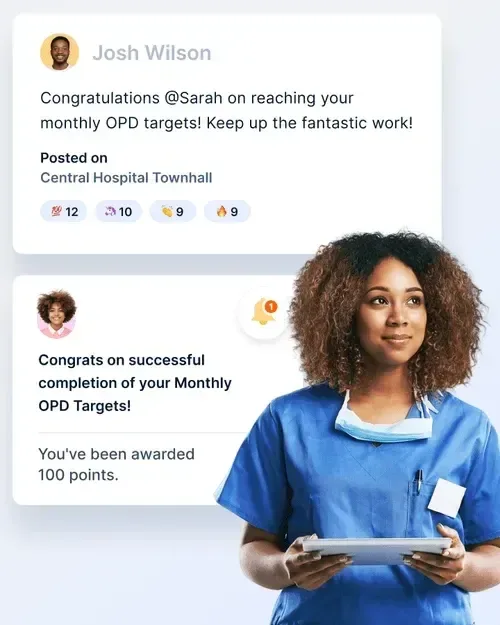
- A social intranet for a dispersed workforce: The social intranet brings lab scientists, field reps, QA teams and leaders onto one feed for announcements, recognition walls, community groups and celebrations, on desktop or mobile.
- Recognition that reaches every function: Recognition and rewards tied to company values, with an AI Recognition Coach that prompts managers to recognize under-recognized roles such as compliance, tech transfer and regulatory affairs.
- Feedback across the employee lifecycle: Pulse, lifecycle and eNPS surveys with AI sentiment analysis and suggested action plans, including quick check-ins for field teams after launches or HCP events.
- Personalized rewards and benefits: A localized rewards catalog, automated milestone rewards for anniversaries and project completions, and flexible benefits and wellness programs.
- Field force incentives: Run transparent sales incentive programs for medical and sales reps alongside recognition.
- Integrations with your stack: Sync with HRMS tools, connect learning platforms for learning-linked rewards and work inside Microsoft Teams and Slack.
Building a purpose-led, engaged pharma workforce
In an industry where the work directly affects human lives, the engagement of every scientist, sales rep, plant worker and compliance officer matters. Pharma thrives on precision, purpose and innovation, but without engaged employees even strong pipelines can fall short of their potential.
That is why employee engagement in the pharma industry has to move from a tactical HR initiative to a core business strategy. Make purpose visible, explain change honestly, recognize every function and close the feedback loop. Done well, it builds a workplace that is as people-focused as it is patient-focused.
Book your Empuls demo
Frequently asked questions
Employee engagement in the pharma industry is how committed and connected researchers, quality and manufacturing teams, field reps and corporate staff feel to their work and to the mission of improving patient health. Engaged pharma employees follow protocols carefully, collaborate across functions, contribute ideas and stay longer, which supports compliance, innovation and commercial results.
Engagement is challenging in pharmaceutical companies because strict regulations create a compliance-first culture, drug development takes many years, and functions such as R&D, manufacturing and sales often work in silos. Field teams are physically remote, plant and quality roles get little recognition, and recent restructuring has made many employees feel less secure in their roles.
The best pharma employee engagement strategies make purpose visible through patient stories, communicate transparently during change, recognize every function including quality and plant teams, run regular pulse and lifecycle surveys, and invest in learning and internal mobility. Tailoring these to R&D, manufacturing, field force and corporate teams makes them far more effective.
Engaged pharma employees take ownership of processes, follow standard operating procedures more carefully and raise issues earlier, which lowers deviations and compliance risk. The FDA includes employee engagement and empowerment as a practice area in its Quality Management Maturity program, and Gallup research links high engagement with fewer quality defects.
Pharma companies improve employee retention by explaining the reasoning behind organizational changes, recognizing contributions in every function, offering clear learning and career paths, and acting visibly on survey feedback. Monitoring engagement and sentiment in critical roles such as regulatory affairs, clinical operations, R&D and field teams helps leaders spot attrition risk early.





































































































































































































































































































































































































































































































































































