
Key Takeaways
Insurance agent commission is usually a percentage of premium, or a flat amount per policy or member, paid by the insurer for selling and keeping a policy in force.
Life insurance pays the most front-loaded commission, property and casualty pays a similar rate on every renewal, and health often pays a flat amount per member.
For 2027, CMS caps Medicare Advantage agent pay at $725 per initial enrollment and $363 per renewal year nationally.
The BLS reports a May 2025 median wage of $62,280 for insurance sales agents, with the top 10% earning more than $138,140.
Insurance sales commission automation replaces manual calculation with validated data, a rule engine, real-time statements and automatic clawbacks, which cuts errors and disputes.
Insurance agent commission is the payment an insurer makes to an agent for selling and keeping a policy in force, usually a percentage of the premium and sometimes a flat amount per policy or member. Rates depend on the line of insurance, whether the policy is new or a renewal, the carrier's contract and whether the agent is captive or independent. This guide explains how insurance agents get paid, how commission rates differ by type of insurance, the components of a commission structure, how to calculate commission with worked examples and how insurers automate commission management.
Managing insurance agent commissions goes beyond calculating payouts. With different structures, varying rates by policy type and several sales channels, insurers have to balance competitive pay with profitability while keeping agents motivated to sell the policies that matter most. Whether you are a sales head designing payouts or an agent trying to understand your earnings, the mechanics below are the place to start.
How insurance agents get paid
Commission is the main way insurance agents earn. The US Bureau of Labor Statistics notes that commissions are the most common form of pay, especially for experienced agents, and that the amount depends on the type and amount of insurance sold and on whether the policy is new or a renewal. How the rest of the package looks depends on who the agent works for:
- Independent agents: They sell policies from several carriers and may be paid by commission only. They usually earn higher rates but cover their own business costs, such as rent, office supplies and marketing.
- Captive agents: They sell for a single carrier. Many receive a salary or a training allowance in their early years plus commission, and some carriers provide office support and leads.
- Employees of an agency or carrier: According to the BLS, they are paid salary only, salary plus commission, or salary plus bonus, with bonuses for reaching sales goals or agency profit targets.
- Fee-based advisors: Some agents in financial planning charge a fee for services instead of, or alongside, commission.
Timing matters as much as the rate. Some carriers pay commission as the premium is collected, while others advance most of the first-year commission when the policy is issued, which helps a new agent's cash flow but creates a chargeback if the policy lapses early. Because the first year is often the hardest, many carriers also pay new agents bonuses or allowances to support their income while they build a book of business.
Insurance agent commission rates by type of insurance
Commission patterns differ more by line of insurance than by carrier. Life insurance comes first in the table because it has the most front-loaded pattern, which shapes how life agents plan their income; Medicare is the only line where a regulator publishes maximum amounts.
| Line of insurance | How commission is calculated | First-year pattern | Renewal pattern |
|---|---|---|---|
| Life insurance | Percentage of first-year premium, then a smaller percentage of renewal premiums | Highest of any line; can be a large share of the first year's premium | Much lower, often paid only for a set number of years |
| Property and casualty (auto, home) | Percentage of each premium, new and renewal | Moderate percentage of premium | Same or slightly lower percentage every year the policy renews |
| Commercial insurance | Percentage of premium, sometimes negotiated per account | Varies with policy size and complexity | Continues on renewal; agencies may also earn contingent commissions |
| Individual and group health | Often a flat amount per member or per employee per month, or a percentage of premium | Same as renewal in most flat-fee contracts | Continues while the member stays enrolled |
| Medicare Advantage and Part D (US) | Flat amount per enrollment, capped by CMS | Up to $725 per Medicare Advantage enrollment for 2027 | Up to $363 per year for renewal years |
| Annuities | Percentage of the amount invested | Paid on the deposit, varies by product and term | Some products pay a small trail commission |
The Medicare figures come from the Centers for Medicare and Medicaid Services, which caps what plans may pay independent agents and limits renewal pay to half the initial amount, as its agent and broker compensation page explains. The contract year 2027 memo dated June 1, 2026 sets national maximums of $725 initial and $363 renewal for Medicare Advantage, higher caps of $902 and $451 in California and New Jersey, and $130 and $65 for standalone Part D plans.
Components of an insurance commission structure
An insurance commission structure combines seven components, and most agent contracts use at least four of them. The first two (first-year and renewal commission) make up most of an agent's income, while the rest steer behavior toward volume, quality and retention.
| Component | What it is | What it rewards |
|---|---|---|
| Base or first-year commission | The commission paid when a policy is sold and issued, the agent's primary source of income | New business |
| Renewal commission | Paid each time a client renews or keeps paying premiums on a policy | Long-term client relationships and service |
| Performance bonuses | Extra pay for hitting production goals, sales targets or benchmarks | Volume above expectations |
| Persistency or retention bonuses | Paid when a high share of an agent's policies stays in force for a set period | Selling the right policy to the right client |
| Supplementary commissions | Additional pay for selling specialized products or meeting carrier requirements | Focus on priority products |
| Overrides | A percentage of the commissions earned by agents a manager or agency recruits and supervises | Building and coaching a team |
| Contingent commissions | Profit-sharing paid to agencies by P&C carriers, based on factors such as loss ratio, growth and volume | Profitable, well-underwritten business |
Two rules sit alongside these components. Chargebacks recover commission already paid when a policy lapses, is cancelled or is found to be misrepresented within a set period. Vesting decides whether an agent keeps receiving renewal commission after leaving the carrier. Both should be written into the contract, because unclear rules on either are a common source of disputes.
Pay every agent, broker and partner accurately
Automate first-year, renewal, override and chargeback calculations in one commission engine.
Talk to our ExpertTrusted by 5,000+ companies
Insurance agent commission calculation with examples
The basic formula is simple: Commission = Premium × Commission rate, or the flat amount per policy where the contract uses one. This calculator uses example rates to show the five calculations agents and commission teams run most often; replace them with the rates in your own schedule.
| Calculation | Formula | Example | Commission |
|---|---|---|---|
| Life, first year | Annual premium × first-year rate | $1,200 premium × 70% example rate | $840 |
| Life, renewal | Renewal premium × renewal rate | $1,200 premium × 5% example rate | $60 a year |
| Auto, new and renewal | Premium × rate | $1,800 premium × 12% new, then 10% on renewal | $216, then $180 a year |
| Medicare Advantage | Enrollments × amount per enrollment | 10 initial enrollments × $725 (2027 national maximum) | Up to $7,250 |
| Manager override | Team first-year commission × override rate | $50,000 of team commission × 5% example rate | $2,500 |
Chargebacks change the picture when a policy fails early. Say the carrier advanced the full $840 on the life policy above and recovers unearned commission pro rata over the first 12 months. If the policy lapses after four months, eight months are unearned, so the chargeback is 8 ÷ 12 × $840 = $560 and the agent keeps $280. Some contracts recover 100% in the first months and less later, so check the schedule.
Annual income adds these pieces together. A life agent who writes 20 policies averaging $1,200 a year at the 70% example rate earns 20 × $1,200 × 70% = $16,800 in first-year commission, plus renewals on earlier business: 60 in-force policies at $1,200 and 5% add $3,600. Renewals grow every year the agent keeps clients, which is why retention bonuses and service matter so much in this industry.
Factors that affect how much insurance agents earn
Commission structures set the rate, but four other factors decide what an agent actually takes home. Pay varies widely across the profession, as the latest BLS data for insurance sales agents shows:
$62,280
median annual wage
May 2025
$37,330
lowest 10% earned less than
May 2025
$138,140
highest 10% earned more than
May 2025
572,600
insurance sales agent jobs
in 2025
Source: US Bureau of Labor Statistics, Occupational Outlook Handbook, insurance sales agents
- Type of agent: Independent agents usually earn higher commission rates than captive agents but pay their own business expenses.
- Type of policy: Agents can specialize in one line or several, for example home and auto, or life and health, provided they meet the licensing requirements in their jurisdiction. The mix of lines changes both first-year and renewal income.
- Book of business and experience: Renewal income builds over time, so experienced agents with a large, loyal client base can reach six-figure incomes while new agents depend on first-year commission.
- Location: A large city offers more prospects than a small town, and the cost of living, employment rates and accident or crime rates all shape demand for insurance.
Why insurance commission management is so complex
Insurance commission management is harder than in most industries because three layers of variables multiply each other. Agent ecosystems, product lines and payout layers each add rules, and a manual process has to get every combination right every cycle.
- A diverse agent ecosystem: Employee agents, captive and independent agents, brokers, telemarketers, bancassurance and alliance partners each have their own commission structure.
- Varied product lines: Life, health, property and casualty and investment-linked products each calculate commission differently.
- Layered payouts: New business, renewals, residuals, overrides, bonuses and chargebacks all apply to the same policy over its life.
When this runs on spreadsheets, five problems follow, and each has a clear fix:
| Challenge | What goes wrong | What fixes it |
|---|---|---|
| Data inaccuracy and disputes | Manual tracking causes miscalculations, wrong payouts and inconsistent credit across channels; disputes eat sales leaders' time | One validated data pipeline and rules that calculate the same way every cycle |
| Clawbacks and chargebacks | Recovering commission on cancelled or misrepresented policies by hand leads to overpayments and strained relationships | Automatic clawback calculation from incentives already paid, with admin approval |
| Low visibility for agents | Agents cannot see how commission is calculated and grow skeptical of payouts | Real-time statements showing every policy, rate and adjustment |
| Wrong product mix | Agents favor easy, low-value policies over the ones that drive revenue | Weighted rates, product-mix bonuses and revenue-linked KPIs |
| Disengagement and churn | Agents move to competitors with more attractive incentives and more recognition | Gamification, contests and timely rewards between payouts |
Agent churn is also a culture problem, not only a pay problem. For ways to keep agents and employees engaged beyond commission, see employee engagement in the insurance industry and how insurers build an insurance agent loyalty program.
Insurance sales commission automation: what it is and how to implement it
Insurance sales commission automation is the use of software to calculate, track, approve and pay agent commissions from policy and premium data, based on predefined rules. Done well, it replaces weeks of manual calculation with a repeatable process; this section covers what it includes, what each role needs from it and how to roll it out.
- Automated data ingestion: Policy, premium and carrier statement data flows in from policy administration, CRM and carrier systems, in whatever format each source uses.
- Rule-based calculations: A commission rule engine applies rates by product, agent level, tenure, license, region and channel.
- Real-time dashboards: Agents and managers see commission as it is earned, with a statement behind every number.
- Integration with finance: Approved commission flows to payroll and accounting, with an audit trail for every adjustment.
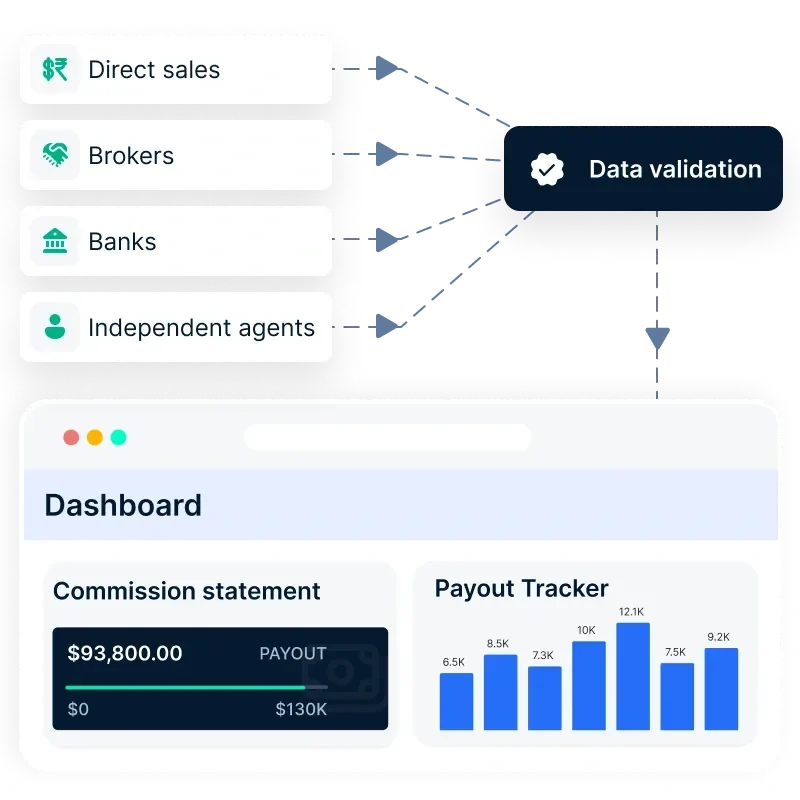
Each role in the distribution chain needs something different from insurance commission software, and the system has to serve all of them at once:
| Role | What they need from commission automation |
|---|---|
| Employee and captive agents | Accurate, timely payouts based on license, policy type and tenure, with visibility into every calculation |
| Independent agents and brokers | Carrier-level commission capture and reconciliation, splits across carriers, overrides and retroactive adjustments |
| Telemarketers | Flat-rate or referral commissions tracked against team goals |
| Alliance and bancassurance partners | Co-sell and referral tracking with automated profit sharing on premiums |
| Managers | Team dashboards, override logic and early warning on agents falling behind |
| Regional heads and VPs | Hierarchical overrides, regional incentive insights and analytics on incentive spend |
Implementation succeeds when business operations, finance and IT own it together. Follow these five steps to automate insurance commissions at scale:
- Consolidate the data: Bring policy, premium, agent hierarchy and carrier statement data into one pipeline, and decide which system is the source of truth for each field.
- Configure the rules: Translate every commission schedule, bonus, override and chargeback rule into the system, and retire rules nobody can explain.
- Set validation and approval workflows: Check data on the way in, flag anomalies before approval and define who signs off each payout.
- Run in parallel: Calculate one or two cycles in both the old process and the new system, and resolve every difference before you switch.
- Train and communicate: Show agents and managers how to read their statements and raise queries, so trust in the new numbers builds quickly.
The payoff is faster payout cycles, fewer errors and disputes, built-in license and policy checks for compliance, and agents who trust their pay. For the general automation case beyond insurance, see how to automate the sales commission process, and for a related regulated industry, sales commission automation in banking.
How Empuls helps insurers automate agent commissions
Empuls includes sales incentive and commission software built for the hierarchies and payout rules insurance distribution depends on. It turns your commission schedules into rules, calculates every payout from CRM, ERP and HRMS data, and pays employees and agents through one process, which makes it a practical route to commission automation for insurers of any size.
- Every commission rule in one engine: Build commission, target and milestone plans in a no-code builder, with slabs, tiers and lookups, product-mix weighting, split credits, override commissions for managers, draws and recoveries, and clawbacks calculated from incentives already paid.
- Payouts for agents and partners: Approved incentives go through multi-level approvals to payroll, bank transfer, UPI or rewards, and channel partners, dealers, distributors and agents can be paid on the same platform as employees, in 50+ currencies.
- Transparency that cuts disputes: Agents see attainment and earnings in real time on web and mobile, and every payout is logged against the calculation that produced it.
- Engagement between payouts: Sales gamification with live leaderboards, SPIFs and contests nudges agents toward the products and behaviors you want.
To estimate what manual commission work costs your team, try the sales incentive ROI calculator.
Book your Empuls demo
Frequently asked questions
Insurance agent commission is usually a percentage of the premium the client pays, or a flat amount per policy or member. The rate depends on the line of insurance, whether the policy is new or a renewal, and the carrier's contract. Life insurance pays the highest first-year commission, while property and casualty pays a similar rate every renewal.
Yes, most do. Renewal commission is paid when a client renews a policy or keeps paying premiums. In property and casualty insurance it is often close to the new-business rate, while life insurance renewal commission is much lower than the first-year rate and may stop after a set number of years. Vesting rules decide whether renewals continue after an agent leaves.
Many do, but income varies widely. The BLS reports a median annual wage of $62,280 for insurance sales agents in May 2025, with the lowest 10% earning less than $37,330 and the highest 10% more than $138,140. Agents with a large book of renewals and high-commission lines, such as life insurance, tend to earn the most.
A chargeback is the recovery of commission already paid when a policy lapses, is cancelled or is found to be misrepresented within a set period. If a carrier advanced $840 of first-year commission and recovers it pro rata over 12 months, a lapse after four months creates a $560 chargeback. Contracts set the period and recovery schedule.
Independent agents usually earn higher commission rates because they sell for several carriers and own their client relationships, but they pay their own rent, staff and marketing. Captive agents sell for one carrier and often receive a salary, training allowance, leads or office support, which lowers both their risk and their commission rates.
Medicare Advantage and Part D agents receive a flat amount per enrollment, capped by CMS. For 2027, independent agents can earn up to $725 for an initial Medicare Advantage enrollment and up to $363 for each renewal year nationally, with higher caps in some states. Standalone Part D plans are capped at $130 initial and $65 renewal.
Insurance commission software calculates, tracks, approves and pays agent and broker commissions automatically from policy, premium and carrier data. It applies rules for first-year, renewal, override and chargeback calculations, shows agents real-time statements and sends approved payouts to payroll, which reduces errors, disputes and the time spent on each commission cycle.
Multiply the premium by the commission rate in the agent's contract, or multiply the number of policies or members by the flat amount. A $1,800 auto policy at a 12% new-business rate pays $216. Then add renewals, bonuses and overrides and subtract any chargebacks for lapsed or cancelled policies to get the agent's total payout.





































































































































































































































































































































































































































































































































































