
Key Takeaways
An employee gift card program rewards employees with gift cards under published rules for eligibility, budget, delivery and tax.
Most employee programs use $25, $50 and $100 cards, so budget by occasion and include platform fees and tax gross-ups in the total cost.
In the US, gift cards are always taxable wages, even small ones, so run them through payroll and decide whether to gross them up.
Choice drives value: multi-brand catalogs and reward links avoid the unused, unwanted single-brand cards many people end up holding.
Measure redemption rate, coverage, budget use and the retention of recognized employees to prove the program works.
An employee gift card program is a structured way to reward employees with gift cards for set occasions, such as milestones, targets and everyday wins, using clear rules for budget, eligibility, delivery and tax. Done well, it gives people choice, keeps recognition timely and costs far less to run than physical gifts.
Gift cards are practical, personal and easy to manage. They let employees choose what they value most, which makes the reward feel more meaningful than a one-size-fits-all prize. This guide covers how to run an employee gift card program from start to finish: goals, budgets, card types, delivery, tax, measurement and the challenges to plan for, followed by 11 employee gift card ideas you can use for any occasion.
If you only need the basics of what employee gift cards are and why they beat cash and merchandise, start with our explainer on employee gift cards. This post is about running the program behind them.
What an employee gift card program is
An employee gift card program is a recognition system in which a company rewards employees with gift cards, prepaid cards or reward points redeemable for gift cards, under published rules for who qualifies, for what, how much and how often. The rules are what separate a program from ad hoc gifting: they keep rewards fair, budgeted and tax compliant.
Most programs cover a mix of moments: birthdays and work anniversaries, spot awards for great work, sales or project targets, holidays and company-wide thank-yous. The same structure works for a 20-person startup and a global enterprise; only the tooling changes. When the same approach is used for clients and partners as well as staff, it is usually called a corporate gift card program, and our guide to corporate gift cards covers that wider use.
Benefits of an employee gift card program
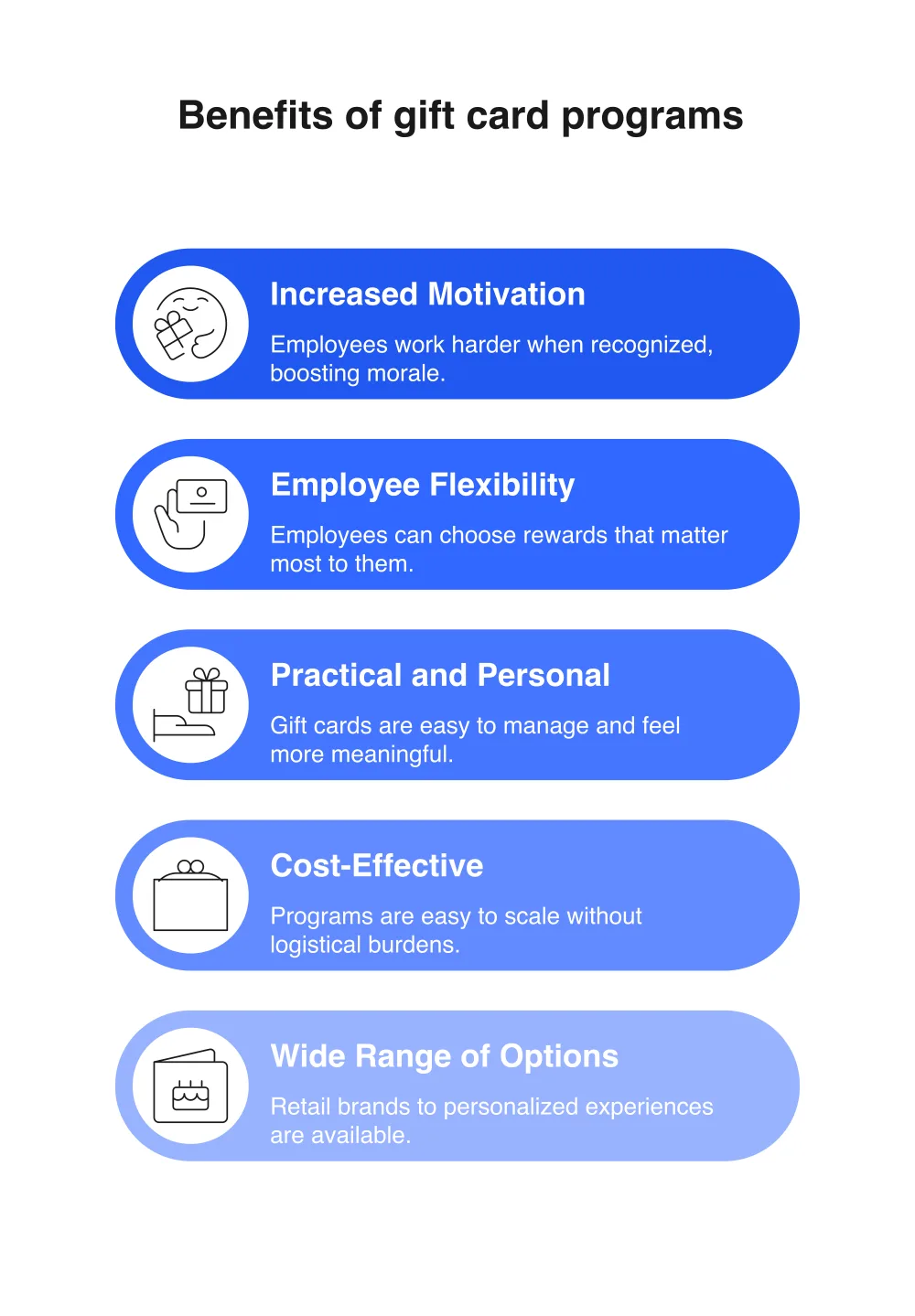
Gift cards for employee rewards work because they combine choice with speed. Here is why employee gift card programs appeal to employers and employees alike:
- Flexibility for employees: Gift cards let employees choose what they want or need. Whether it is a shopping trip at a favorite store or a dining experience, gift cards cater to personal preferences.
- Cost-effective for employers: Programs are budget-friendly and scalable. You set clear spending limits while still offering a gesture that resonates.
- Boosts motivation and retention: Recognizing effort with a tangible reward keeps people focused on company goals. Gallup's research with Workhuman found that well-recognized employees were 45% less likely to have changed organizations two years later.
- Easy implementation: Unlike traditional rewards programs, gift card programs are simple to set up and run, whether you manage a small business or a large, distributed team.
- Versatility: Gift cards suit every type of recognition, from work anniversaries and milestones to daily achievements, which makes them a flexible tool for any reward strategy.
Gift cards are also what most programs already use. According to the Incentive Research Foundation's Industry Outlook for 2025, gift cards account for at least 43% of all incentives in North America and 41% of reward contributions in Europe, and 55% of North American respondents expected gift card use to grow.
How to run an employee gift card program in 7 steps
These seven steps take you from a blank page to a running program, and they are ordered the way decisions depend on each other: goals shape the budget, the budget shapes card choice, and so on. If you only get one step right, make it the budget and eligibility rules in steps 1 and 2, because fairness problems later almost always trace back to vague rules there.
Step 1: Set goals, occasions and eligibility
Define the purpose of your program and the criteria for eligibility. Whether rewards are tied to performance milestones, work anniversaries or special events, employees should understand how and when they will be rewarded. Clear guidelines create transparency and prevent confusion.
Write down three things for every occasion: the trigger (what earns the reward), who can give it (HR, managers, peers) and who can receive it (all staff, contractors, interns). Then publish the rules where everyone can find them.
Step 2: Set a budget per occasion
Budget for the total cost of the program, not just card face values. Include platform fees, any tax gross-up and the hours HR spends administering it. The IRF 2025 outlook found that employee programs in North America mostly distribute $25, $50 and $100 cards, with an average denomination of $142 across all programs. These ranges are a sensible starting point:
| Occasion | Typical value | Frequency | Who gives it |
|---|---|---|---|
| Birthday | $25 to $50 | Once a year | HR, automated |
| Work anniversary | $50 to $100, rising with tenure | Once a year | HR, automated |
| Spot award or peer recognition | $10 to $50 | As earned | Managers and peers |
| Target or project win | $50 to $250 | Per milestone | Managers |
| Holiday or company thank-you | $25 to $100 | Once or twice a year | Company-wide |
| Onboarding welcome | $25 to $75 | Once per hire | HR, automated |
Worked example: A 200-person company giving a $25 birthday card, a $50 anniversary card, a $50 holiday card and two $50 spot awards to a quarter of staff spends $5,000 + $10,000 + $10,000 + $5,000 = $30,000 a year, or $150 per employee before tax. Grossing up for tax (step 5) adds roughly 40% in the US, which takes the total to about $42,000.
Step 3: Choose card types and a catalog
Tailor the options to your employees' preferences. Offering a mix of retail, dining, experiential and charity options ensures each person finds something they value. Choice matters more than the brand you pick: in Bankrate's 2024 gift card survey, 43% of US adults had at least one unused gift card, 24% had received a card for an inconvenient store and 23% one for a store they did not like.
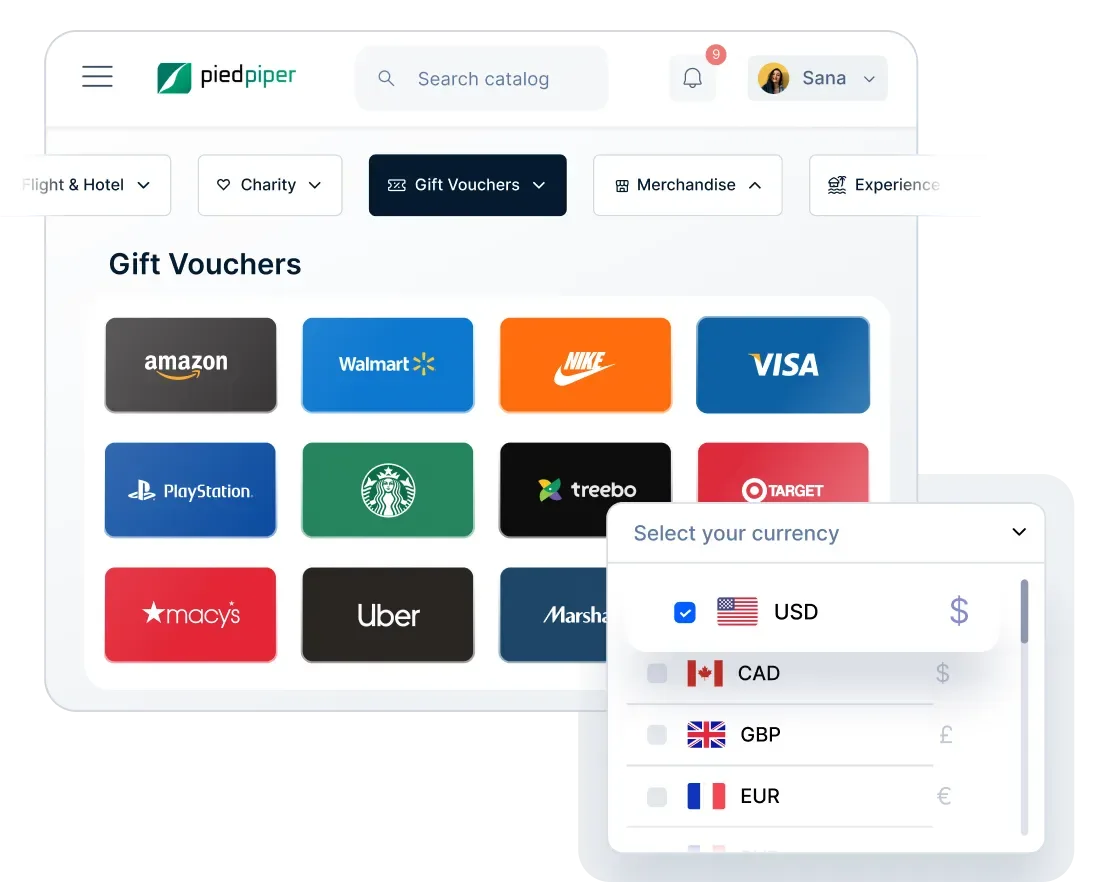
That is why many programs now send a reward link, points or a multi-brand card instead of a single-brand card, so the employee picks the brand after the fact. Our comparison of reward links, gift cards and coupons explains the trade-offs. For distributed teams, make sure the catalog localizes by country and currency.
Step 4: Plan delivery and frequency
Decide when and how often gift cards go out. Regular recognition, such as quarterly or annual milestones, helps maintain motivation, while spontaneous rewards for day-to-day achievements, like exceeding targets, reinforce positive behavior in real time.
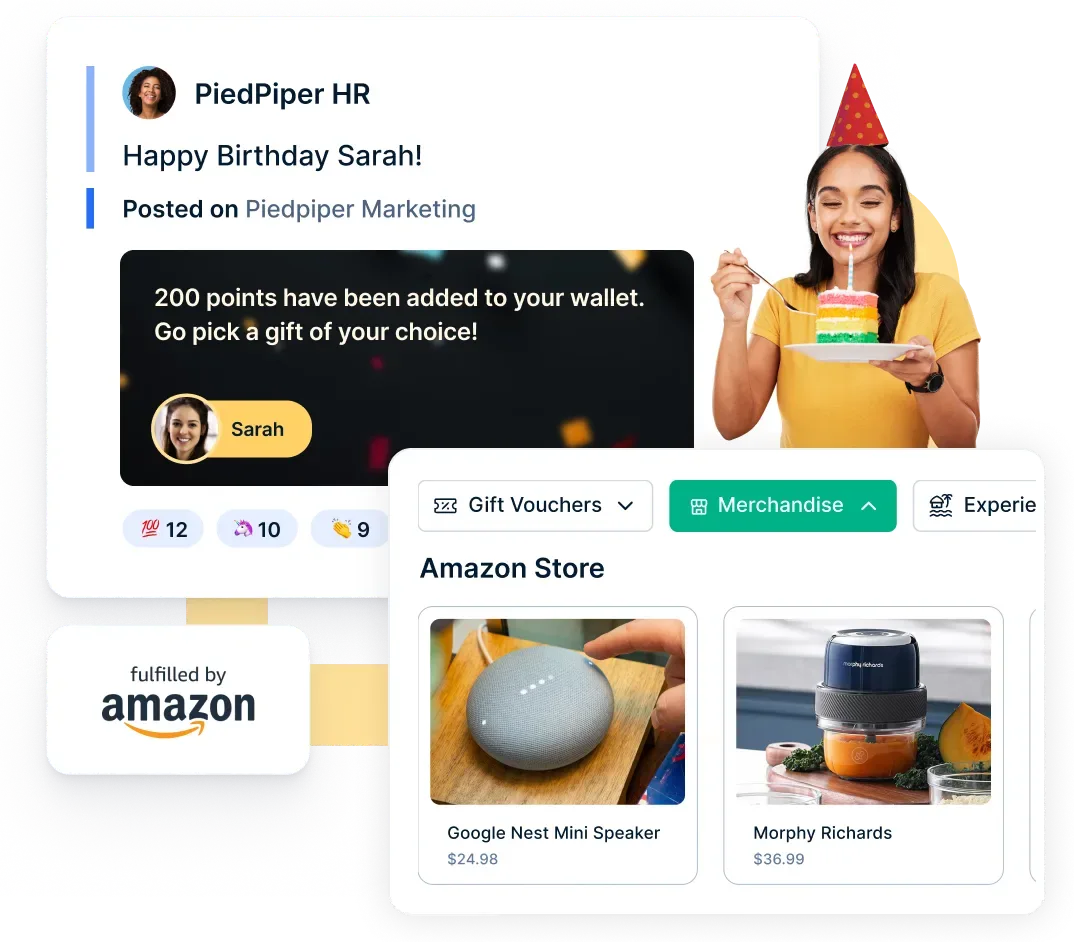
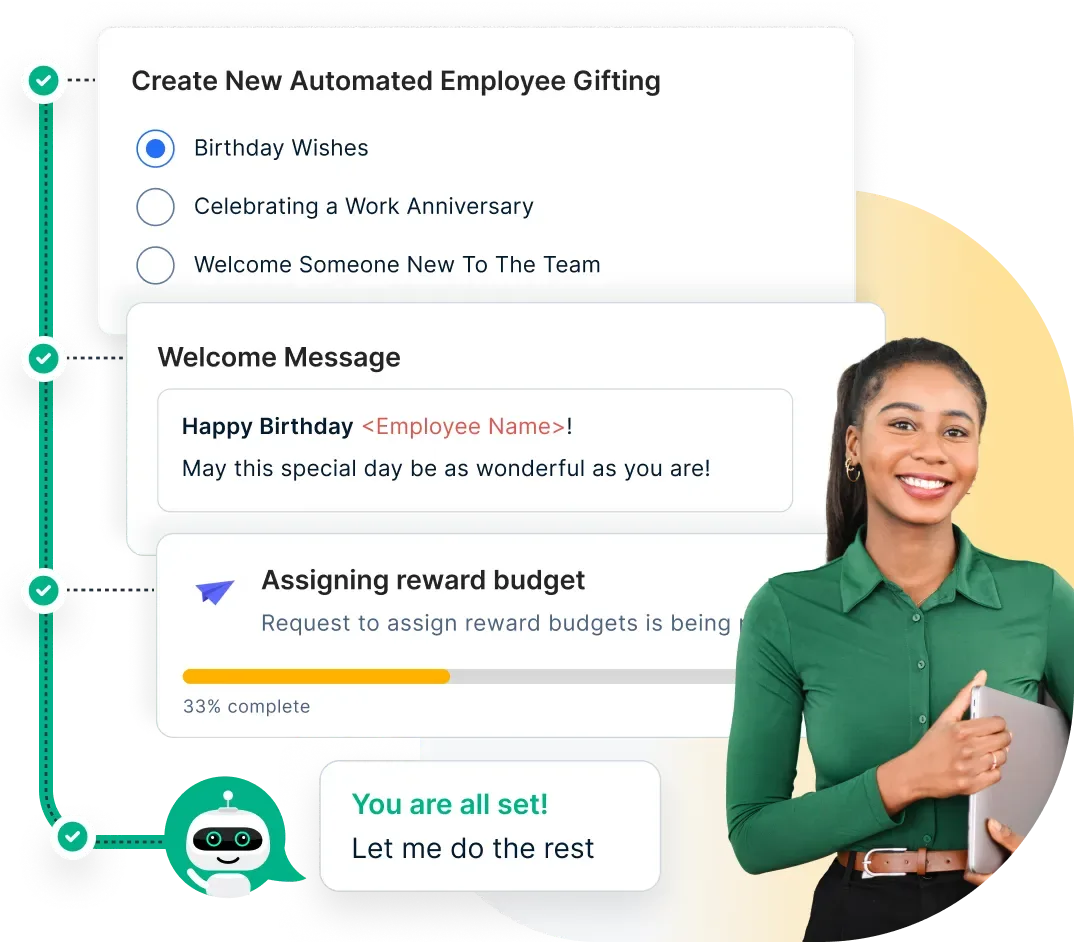
Digital delivery by email, SMS, Slack or Microsoft Teams removes shipping costs and reaches remote and frontline staff on the same day. Automate the predictable moments, such as birthdays and anniversaries, from your HRIS so nobody is missed, and keep a manual option for spot awards.
Step 5: Plan for tax
In most countries, gift cards given to employees are taxable income, so decide up front whether employees absorb the tax or you gross it up. The next section covers the rules in the US and UK and shows how to calculate a gross-up.
Step 6: Communicate and celebrate publicly
Announce the program with some energy and give regular updates so everyone stays engaged. While the gift may be personal, the recognition does not have to be: share achievements in a company-wide channel or team meeting when a gift card goes out, because public recognition adds to the value of the reward. Train managers on the rules so they use their budgets consistently.
Step 7: Measure, ask for feedback and refine
Track who receives gift cards, for what purpose and how often. This data helps you ensure fairness and spot departments or employees who are being overlooked. Ask employees which rewards matter to them and fold their input back into the catalog and the occasions you cover. The metrics in the measurement section below give you a starting scorecard.
Automate gift cards for every employee moment
Send birthday, anniversary and spot-award rewards from one catalog of 10M+ options in 150+ countries.
Talk to our ExpertTrusted by 5,000+ companies
Gift card tax rules for employees
Gift card tax is the part of a program that most often goes wrong, because many employers assume small gifts are exempt. In the US they are not: the IRS Publication 15-B for 2026 says cash and cash-equivalent benefits, including gift cards and gift certificates, are never excludable as de minimis benefits, no matter how small, and that the employee achievement award exclusion does not apply to gift cards.
| Country | Are employee gift cards taxable? | What to do |
|---|---|---|
| United States | Yes, as wages, regardless of amount | Run through payroll; the optional flat federal withholding rate on supplemental wages is 22% under IRS Publication 15 |
| United Kingdom | Usually; a non-cash voucher of £50 or less can be tax-free as a trivial benefit, but not if it rewards work or performance | Use trivial benefits for birthdays and holidays; report performance rewards through payroll |
| Other countries | Rules vary widely | Check local thresholds before launching in a new market |
How a gross-up works: To make sure an employee receives the full face value, divide the card value by one minus the combined tax rate. For a $100 card with 22% federal withholding and 7.65% Social Security and Medicare, that is $100 / (1 - 0.2965) = about $142, before any state income tax. For country-by-country thresholds, see our global guide to employer gift tax laws. This is general information, so confirm your treatment with a tax advisor.
11 employee gift card ideas for any occasion
The variety of gift cards available means every employee can find something that suits them. These 11 employee gift card ideas run from the most universal (retail and open-loop cards) to the most personal (customizable cards), and most programs offer five or six of them through one catalog rather than all 11 as separate choices.
1. Retail gift cards
Retail gift cards remain a top choice because they give employees access to their favorite stores, from electronics and fashion to groceries and home goods. Brands like Amazon, Target and Walmart are popular because of their vast selection, so employees can easily choose something they will use.
2. Experience-based gift cards
Experience-based gift cards suit employees who prefer experiences over material goods. They can be used for restaurants, vacations, concerts, sports events and theater shows. Whether it is a quiet dinner or an adrenaline-pumping adventure, they help employees create memories beyond the workplace. Our guide to experiential rewards has more ideas.
3. Visa or Mastercard prepaid cards
Visa or Mastercard prepaid cards work like a debit card and can be used almost anywhere, which makes them an excellent choice for employees who value freedom in how they spend their reward, whether on daily expenses, online shopping or bills. Check activation fees and expiry terms before you buy in bulk.
4. Fashion and lifestyle gift cards
Fashion and lifestyle vouchers keep corporate gift cards for employees on an elegant plane. Popular picks include H&M and Hollister in the US, and Woodland footwear, Nykaa beauty and Louis Philippe menswear in India. Let employees choose the brand, because style is personal.
5. Digital gift cards
Digital gift cards arrive by email or text and can be used immediately, whether for streaming, e-books or food delivery. Employees love the convenience and instant gratification, and they are the easiest format to send to remote teams. See our guide to digital gift cards for how they work at scale.
6. Restaurant and coffee gift cards
Food is a universal pleasure, and restaurant gift cards treat employees to a meal out, from fine dining to a quick bite. Starbucks and McDonald's work almost everywhere, Romano's Macaroni Grill suits US teams, and Barbeque Nation and Café Coffee Day are favorites in India.
7. Subscription gift cards
Subscriptions provide ongoing value. Gift cards for services like Netflix, Spotify or meal kits let employees enjoy entertainment, music or home-cooked meals for months, so the reward keeps giving long after the moment of recognition.
8. Charity donation gift cards
For employees who are passionate about making a difference, charity gift cards let them donate to a nonprofit of their choice. This option suits socially conscious companies and fits neatly alongside corporate social responsibility and workplace giving programs.
9. Wellness gift cards
Wellness gift cards for gym memberships, yoga classes or retreats show that you care about employees' mental and physical health. Good options include Cult.fit and Decathlon in India, and Ulta Beauty and Bath & Body Works in the US.
10. Local business gift cards
Gift cards for nearby shops, cafes or services reward employees while helping local entrepreneurs thrive. They are a good fit for companies that value community engagement and want something connected to employees' everyday lives.
11. Customizable gift cards
Customizable gift cards take recognition to a more personal level. Some companies brand cards with their logo, and you can personalize them for work anniversaries, birthdays or milestones with a message that names the achievement. That small touch creates a deeper emotional connection between the company and its people.
When a gift card is not the right fit, for example for a 10-year anniversary or a team offsite, look at employee reward ideas beyond gift cards or our employee milestone gift ideas.
Challenges of employee gift card programs
Six challenges come up in almost every program, and each has a practical fix. They are listed roughly in the order employees notice them, starting with preferences and value, which shape how the program feels, and ending with tax and logistics, which shape how it runs.
- Managing diverse preferences: What excites one person may not interest another, and a narrow range of cards leaves some employees feeling overlooked. Offer a broad selection across retail, dining, experiences and charity, or let employees choose through a multi-brand catalog.
- Maintaining program value: Over time, employees may see gift cards as routine. Vary the occasions, add a personal message every time and mix planned rewards with surprise ones to keep the program fresh.
- Tracking and oversight: Without a central record of who is rewarded, for what and how often, some employees get frequent rewards while others are neglected. A single platform with reporting by team and manager prevents this.
- Budget constraints: Gift cards are cost-effective, but spending can drift without limits. Set budgets per occasion and per manager, and review them quarterly.
- Tax implications: Gift cards are taxable income in many countries, which can surprise employees. Decide on gross-ups, run rewards through payroll and tell employees how their rewards are taxed.
- Logistics of distribution: In large or global organizations, getting every card out on time is complex. Digital delivery, HRIS-triggered automation and a catalog that localizes by country remove most of the manual work.
How to measure your employee gift card program
Measure your program with a small set of metrics that cover usage, fairness and outcomes. Review them quarterly alongside your engagement survey results so you can link recognition to retention, not just spend.
| Metric | What it tells you | Healthy signal |
|---|---|---|
| Redemption rate | Whether employees value what you offer | Rising over time; low rates point to the wrong catalog |
| Time to redeem | Whether the reward is convenient | Most rewards redeemed within 30 days |
| Coverage | Share of employees rewarded at least once a quarter | Even across teams, locations and shifts |
| Budget utilization | Whether managers use their budgets | Close to plan, with no team far below |
| Recognition scores | Whether people feel valued | Improving in pulse and engagement surveys |
| Retention of recognized employees | Whether the program supports retention | Lower attrition than the company average |
Companies excelling in employee gift card recognition
These organizations use gift cards inside broader recognition programs rather than as standalone handouts. The common thread is choice: employees earn points or recognition and then pick the reward themselves.
- Southwest Airlines: The SWAG (Southwest Airlines Gratitude) program lets managers and peers award points for outstanding work and milestones. Employees redeem them in the SWAG Shop for dozens of gift cards, merchandise, travel and event tickets, which builds a culture of appreciation at every level.
- FullContact: According to Built In, its peer-to-peer recognition program lets employees praise colleagues and earn points they redeem for gift cards from a broad range of vendors.
- Huntress: The cybersecurity company runs a #kudos Slack channel integrated with a recognition tool, where employees give tokens for accomplishments, work anniversaries and birthdays and redeem them for company merchandise and gift cards. It keeps remote employees connected and appreciated.
- KPIT Technologies: The 5,000+ person mobility tech company replaced physical gifting with a global e-voucher catalog and multi-currency redemption on Empuls, which let it scale recognition across the US, Europe, Japan, Korea and Thailand.
Run your employee gift card program on Empuls
Empuls brings recognition, celebrations and rewards into one platform, so gift cards become part of a recognition moment instead of a separate admin task. Set up birthdays, work anniversaries and onboarding once through celebrations, and Empuls sends the message, e-card and reward automatically. Managers and peers can attach points to recognition for everyday wins and to milestone rewards for targets and project completions.
Employees redeem from a catalog of 10M+ options across gift cards, prepaid cards, merchandise, experiences and charity, localized for 150+ countries and their currency. One global technology company using Empuls across 33 countries reached a 90% redemption rate and more than $1M in rewards redeemed in a single financial year. If you need to send gift cards in bulk outside a recognition program, Xoxoday Plum handles that too.
Make your employee gift card program count
An employee gift card program works when it is fair, personal and simple to run. Set clear rules and budgets, offer real choice, deliver rewards on time, plan for tax and measure what happens. Pair every card with a specific thank-you, and a modest budget will do more for morale and retention than a large one handed out without meaning. For a wider view of when to give what, read our employee gifting guide.
Book your Empuls demo
Frequently asked questions
In the US, yes. The IRS treats gift cards as cash equivalents, so they count as taxable wages at any value and must go through payroll. In the UK, a non-cash voucher of £50 or less can be a tax-free trivial benefit, but not when it rewards work or performance. Other countries set their own thresholds, so check local rules before launching.
Most employee programs use $25, $50 and $100 cards. A common pattern is $25 to $50 for birthdays, $50 to $100 for work anniversaries, $10 to $50 for spot awards and $50 to $250 for major targets. Budget for the full cost, including platform fees and any tax gross-up, which can add about 40% in the US.
Gift cards are a good reward when they come with genuine recognition and real choice. They are fast to deliver, easy to budget and let employees pick what they value. They work less well as a generic, unexplained handout, so pair each card with a specific thank-you and offer a multi-brand catalog instead of a single store.
Send digital gift cards or reward links by email, SMS, Slack or Microsoft Teams so remote employees receive them the same day. Use a catalog that localizes brands and currency by country, so a reward sent to someone in London is as usable as one sent to Chicago. Automate recurring occasions from your HR system.
Yes. Gift card programs scale down well because there is no inventory or shipping. A small business can start with two or three occasions, such as birthdays, work anniversaries and spot awards, set a fixed value for each, and send digital cards manually or through a low-cost platform before adding automation as the team grows.
Combine scheduled and spontaneous rewards. Scheduled cards cover birthdays, anniversaries and holidays once a year, while spot awards for good work can happen any time. Aim for every employee to be recognized at least once a quarter, and watch that rewards do not become so frequent or predictable that they feel routine.
For recognition, gift cards often have more impact than equal cash because they feel like a treat rather than part of pay, and employees remember what they bought with them. Cash still suits large performance bonuses. Both are taxable in the US, so the choice is about how the reward feels, not about saving tax.





































































































































































































































































































































































































































































































































































