
Key Takeaways
An employee benefits survey asks employees how satisfied they are with each benefit, which ones they use and what is missing.
Only 57% of employees fully understand what their benefits cover, so always include awareness and communication questions.
Comparing importance with satisfaction for each benefit shows where to invest first and where you may be overspending.
Run the survey two to three months before benefits renewal or open enrollment, so results can still change what you buy.
Share what will and will not change after every benefits survey, because unanswered feedback lowers trust and future response rates.
Employee benefits survey questions ask your people how satisfied they are with each benefit, which ones they use and value, and what is missing. The answers show where to spend your benefits budget, which perks to cut or explain better, and how to build a package that helps you hire and keep people.
It is worth asking, because many employees do not fully understand what they already have. MetLife's 2025 Employee Benefit Trends research found that only 57% of employees fully understand what their benefits cover, and 72% want benefit communications tailored to their needs. This guide gives you more than 60 ready-to-use questions grouped by benefit area, with answer formats, plus the steps to run the survey and act on the results.
What is an employee benefits survey
An employee benefits survey is a questionnaire companies use to gather employee feedback on their current benefits package. It shows whether benefits match employee expectations and where to improve. These surveys usually cover health insurance, retirement plans, paid time off, parental leave, wellness programs, flexibility, learning, recognition and perks.
By analyzing responses, companies can tailor benefits to different groups of employees and keep their offering competitive and relevant. The payoff is real: in the same MetLife research, employees who understand and are satisfied with their benefits were 1.4 times more likely to feel engaged and 1.2 times more likely to be productive at work. If you are new to the topic, our guide to employee benefits explains the main types first.
Why conduct an employee benefits survey
Benefits are one of your largest people costs, so a survey is the cheapest way to check you are spending in the right places. There are five main reasons to run one, and the last, data-driven decisions, is what usually wins budget approval.
- Identify gaps: Find crucial benefits missing from your package, and areas where your offering falls short of employee expectations or of what competitors offer.
- Prioritize needs: Not all benefits hold equal value. The survey shows which ones employees prioritize, so you can focus resources where they make the most difference.
- Improve communication: Employees are often unaware of benefits you already offer. The survey reveals these communication gaps so you can fix them before adding new costs.
- Boost engagement: When employees feel heard, trust grows. Asking, and then acting, shows a proactive approach to their needs.
- Make data-driven decisions: Benefits are a significant cost. Survey data helps you optimize the package and can lead to savings by removing benefits few people use or value.
57%
of employees fully understand what their benefits cover
MetLife, 2025
72%
want benefit communications tailored to their needs
MetLife, 2025
88%
of employers rate health benefits very or extremely important
SHRM, 2026
Why benefits need regular employee feedback
Employers already agree that core benefits matter: SHRM's 2026 Employee Benefits Survey found 88% of employers rate health-related benefits as very or extremely important. A survey tells you whether employees see the same value, and which extras they would trade for.
How to run a benefits survey
Running a benefits survey well takes six steps, and timing is the one teams most often get wrong. Run it two to three months before your benefits renewal or open enrollment, so the results can still change what you buy.
- Set clear goals: Decide what decisions the survey should inform, such as renewing a health plan, adding a wellbeing benefit or restructuring a flexible benefits allowance.
- Choose your question mix: Combine satisfaction ratings, importance rankings and a few open questions. Use the question bank below and keep the total to 20 to 30 questions.
- Protect anonymity: Make responses anonymous and report only at group level, with a minimum group size, so people can be honest about sensitive topics such as health and finances.
- Explain the purpose: Tell employees why you are asking, when results will be shared and what kinds of changes are possible, so expectations stay realistic.
- Promote participation: Announce the survey through the channels people use, ask managers to mention it and send one or two reminders before the deadline.
- Analyze and act: Look at results by group, decide on changes and share what will and will not change. The section on taking action below walks through this.
Pro tips for a successful employee benefits survey
A benefits survey is not just about gathering data; it is about understanding what truly matters to your team. These five tips raise both response rates and the quality of answers, and anonymity matters most because benefits touch health, family and money.
- Anonymity and confidentiality: Ensure complete anonymity to encourage honest feedback, and say clearly who sees the results.
- Keep it concise: Shorter surveys with well-defined questions are more likely to be completed. Rotate deeper modules year to year rather than asking everything at once.
- Clear communication: Explain the purpose of the survey and how the feedback will be used.
- Promote participation: Build interest through internal communication channels, team meetings and manager reminders.
- Analyze and act: Do not just collect data. Analyze the results and build a clear action plan based on what employees said.
How rewards increase benefits survey participation
Benefits surveys are crucial for understanding your workforce's needs, but a high response rate can be hard to reach. A small reward can help in four ways, as long as it never compromises anonymity or rewards particular answers.
- Boosting response rates: People are more inclined to take part when there is an incentive. A small reward, such as a raffle entry for a desirable prize or a donation to a chosen charity for each response, can increase completion and shows appreciation for people's time.
- Encouraging honesty: Some employees hesitate to share critical opinions even in anonymous surveys. A small, guaranteed reward on completion, regardless of the answers, signals that every response is welcome.
- Uncovering deeper insights: Invite thoughtful comments and suggestions in open questions. If you reward detail, do it through a team-level goal, such as a donation when participation passes a target, so individual answers stay anonymous.
- Building a culture of feedback: Regular surveys with fair rewards create a positive association with giving feedback. Employees see themselves as partners in shaping benefits, which supports a wider culture of feedback.
For reward ideas and wording, see our guide to survey incentive ideas that boost participation.
Ask what your people value, then deliver it
Run benefits surveys and offer flexible benefits from one platform, with usage data to show what works.
Talk to our ExpertTrusted by 5,000+ companies
Crafting effective benefits survey questions
The key to a useful survey lies in insightful questions, and four question types cover almost every need. Ranking questions deserve special attention, because they force trade-offs that satisfaction ratings alone never reveal.
| Question type | Example | Best for |
|---|---|---|
| Multiple choice | How satisfied are you with the health insurance plan? (Very satisfied, somewhat satisfied, neutral, somewhat dissatisfied, very dissatisfied) | Clear, comparable satisfaction scores |
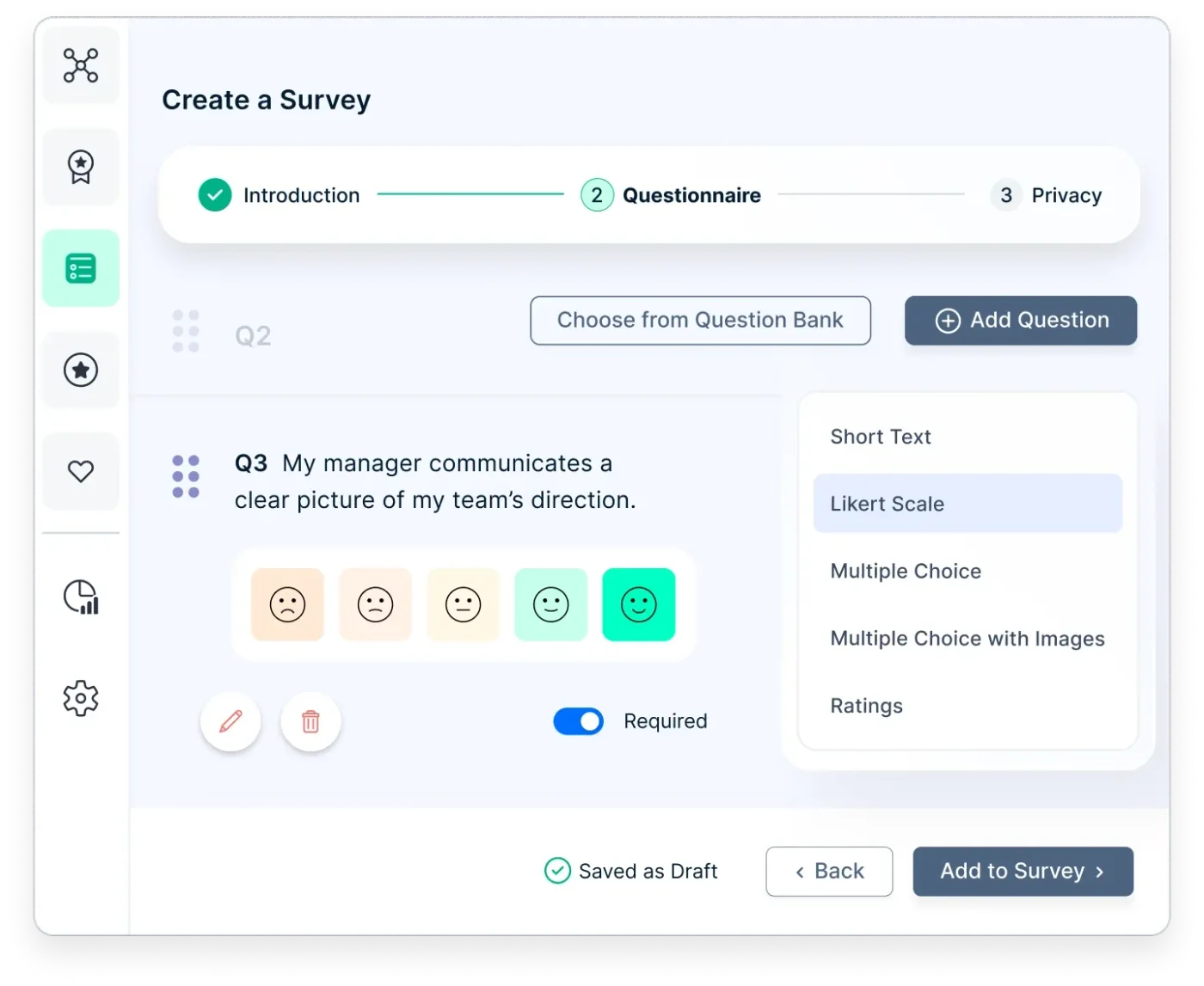
| Likert scale | The current benefits package meets my needs. (Strongly agree to strongly disagree) | Measuring agreement and tracking change over time |
| Ranking | Rank these benefits in order of importance to you: health insurance, paid time off, retirement savings, flexibility, learning budget. | Finding priorities and trade-offs |
| Open-ended | What additional benefits would be most helpful to you? How can we improve communication about our benefits? | Discovering needs you did not think to ask about |
Employee benefits survey questions to ask
The question bank below covers twelve areas, starting with context and awareness and then moving through each benefit type. Use the 1 to 5 satisfaction scale for rated questions (1 very dissatisfied, 5 very satisfied), always include the context and awareness sections, and pick the benefit areas that match your current package.
Context questions
These questions let you compare results by group without identifying anyone. Use broad bands rather than exact ages or dates.
| Question | Answer format |
|---|---|
| Which department or function do you work in? | Single choice |
| How long have you worked here? | Bands: under 1 year, 1 to 3, 3 to 5, over 5 |
| Which work arrangement best describes you? | On-site, hybrid or remote |
| Who do you cover under your benefits? | Self only, self and partner, self and children, family |
| Which life stage best describes you right now? | Single choice, optional |
Awareness and communication questions
These questions show whether low satisfaction comes from the benefit itself or from people not knowing about it. Fixing awareness is usually the cheapest improvement you can make.
| Question | Answer format |
|---|---|
| I understand what my benefits cover. | 1 to 5 agreement |
| Which of these benefits did you know we offer before today? | Multiple choice list |
| Which benefits have you used in the past 12 months? | Multiple choice list |
| How would you prefer to receive information about benefits? | Email, app, manager, HR session, intranet |
| Overall, how satisfied are you with our benefits package? | 1 to 5 satisfaction |
Health insurance survey questions
Health insurance is one of the most valued benefits. These questions assess satisfaction with current coverage and identify areas for improvement.
| Question | Answer format |
|---|---|
| How satisfied are you with the current health insurance plan? | 1 to 5 satisfaction |
| Does the coverage meet your personal and family needs? | Yes, partly or no |
| Are the premium costs reasonable for the benefits offered? | 1 to 5 agreement |
| How easy is it to access healthcare providers in the plan's network? | 1 to 5 ease |
| Have you faced any challenges using your health insurance? | Yes or no, then open text |
| What additional health benefits or coverage options would you like? | Open text |
Retirement benefits survey questions
Retirement benefits play a key role in long-term financial security. These questions gauge satisfaction with the plan and whether employees need more support.
| Question | Answer format |
|---|---|
| How satisfied are you with the retirement plan options? | 1 to 5 satisfaction |
| Do you have enough information to make decisions about your retirement savings? | 1 to 5 agreement |
| Does the company contribute enough to support your long-term goals? | 1 to 5 agreement |
| Would you be interested in financial planning resources or workshops? | Yes, maybe or no |
| Are the investment options diverse and suitable for your needs? | 1 to 5 agreement |
| What retirement benefits or improvements would you find valuable? | Open text |
Paid time off and leave survey questions
Paid time off and leave policies shape work-life balance and job satisfaction. These questions check whether employees feel they have enough time off and can actually take it.
| Question | Answer format |
|---|---|
| How satisfied are you with the paid time off (PTO) policy? | 1 to 5 satisfaction |
| Do you have enough leave days to maintain a healthy work-life balance? | 1 to 5 agreement |
| How easy is it to request and receive time off when needed? | 1 to 5 ease |
| Which leave changes would you value most? | More vacation, flexible sick leave, parental leave, caregiver leave, other |
| Have you hesitated to take leave because of workload or company culture? | Often, sometimes or never |
| What would you change about our leave policy? | Open text |
Wellness and mental health survey questions
Wellbeing is crucial for productivity and engagement. These questions assess awareness and effectiveness of wellness programs and mental health support.
| Question | Answer format |
|---|---|
| Are you aware of the company's wellness and mental health programs? | Yes or no |
| How satisfied are you with mental health support, such as counseling or an employee assistance program? | 1 to 5 satisfaction |
| Do you feel comfortable using mental health resources through the company? | 1 to 5 agreement |
| The company prioritizes employee wellbeing effectively. | 1 to 5 agreement |
| What wellness benefits or initiatives would improve your wellbeing? | Open text |
Financial wellbeing survey questions
Money is a top worry for many employees: in MetLife's 2026 Employee Benefit Trends Study, 83% named rising living and medical costs as their top stressor, and 50% said they often avoid medical care because of out-of-pocket costs. These questions show whether tools such as tax-saving benefits, savings support or earned wage access would help.
| Question | Answer format |
|---|---|
| How often do money worries affect your focus at work? | Often, sometimes, rarely or never |
| How confident are you that you could cover an unexpected expense? | 1 to 5 confidence |
| Which financial support would help you most? | Tax-saving benefits, financial coaching, emergency savings, salary advance, discounts, other |
| Have you delayed medical care because of out-of-pocket costs? | Yes or no |
Flexibility and remote work survey questions
Employees increasingly expect flexibility in how and where they work. These questions show how well current policies support productivity and satisfaction.
| Question | Answer format |
|---|---|
| How satisfied are you with the remote or hybrid work policy? | 1 to 5 satisfaction |
| Do you have enough flexibility in your schedule to balance work and personal life? | 1 to 5 agreement |
| How well does the company support remote or hybrid employees with resources and technology? | 1 to 5 agreement |
| Which extra flexibility would you value most? | Compressed weeks, adjustable hours, work-from-anywhere days, other |
| Do you feel equally included whether working remotely or in the office? | 1 to 5 agreement |
| What would make our flexible work policy more effective? | Open text |
Family and caregiving survey questions
Parents and carers often have needs that general questions miss. Keep these optional and use them to size family benefits before you invest.
| Question | Answer format |
|---|---|
| How satisfied are you with our parental leave policy? | 1 to 5 satisfaction |
| Do you currently care for a child, elderly relative or family member with a disability? | Yes, no or prefer not to say |
| Which family benefits would help you most? | Childcare support, elder care, fertility support, caregiver leave, other |
| What would make it easier to balance work and caregiving? | Open text |
Learning and development survey questions
Career growth opportunities directly affect retention and job satisfaction. These questions assess whether employees feel supported in learning and development.
| Question | Answer format |
|---|---|
| How satisfied are you with our learning and development programs? | 1 to 5 satisfaction |
| Does the company provide enough opportunities for skill building and career advancement? | 1 to 5 agreement |
| Do you feel supported in pursuing certifications, training or further education? | 1 to 5 agreement |
| Are development resources easy to access and relevant to your role? | 1 to 5 agreement |
| Would you like more mentoring or coaching opportunities? | Yes, maybe or no |
| What learning benefits would help your career growth most? | Open text |
Recognition and rewards survey questions
Recognition and rewards programs influence motivation and culture. These questions assess whether employees feel valued for their contributions.
| Question | Answer format |
|---|---|
| How satisfied are you with our recognition and rewards program? | 1 to 5 satisfaction |
| Are your hard work and achievements regularly acknowledged? | 1 to 5 agreement |
| Which recognition do you find most meaningful? | Bonuses, public praise, career opportunities, rewards points, time off, other |
| Are there enough opportunities for peer-to-peer recognition? | 1 to 5 agreement |
| How could we improve how we recognize employees? | Open text |
Perks and commuting survey questions
These survey questions about employee perks cover everyday extras such as commuting support, discounts and meals. They often cost little but shape how people feel about work each day.
| Question | Answer format |
|---|---|
| How satisfied are you with your commute to and from work? | 1 to 5 satisfaction |
| Which commuting benefits would you use? | Transit pass, parking, fuel allowance, shuttle, carpool incentives, none |
| How much does commuting affect your job satisfaction and work-life balance? | A lot, somewhat or not at all |
| Which everyday perks would you value most? | Meal benefits, shopping discounts, gym access, travel deals, other |
| What perk would make the biggest difference to your day? | Open text |
Close every survey with two open questions: "If you could add one benefit, what would it be?" and "If you could remove or change one benefit, what would it be?" Together they give you the clearest view of where to invest. For inspiration on what to add, see our list of employee benefits ideas and our guide to employee perks programs.
How to analyze benefits satisfaction survey results
The most useful analysis compares how important each benefit is with how satisfied people are with it. Benefits that score high on importance but low on satisfaction are your priorities; benefits that score low on both are candidates to cut or rethink.
Importance gap = average importance score minus average satisfaction score, both on a 1 to 5 scale. For example, if paid time off scores 4.6 for importance and 3.4 for satisfaction, the gap is 1.2, a priority to fix. If a commuter benefit scores 2.1 for importance and 3.8 for satisfaction, the gap is negative, so you may be spending more there than employees value.
| Benefit | Importance (1 to 5) | Satisfaction (1 to 5) | Gap | Action |
|---|---|---|---|---|
| Health insurance | 4.8 | 3.9 | 0.9 | Fix: review network and cost sharing |
| Paid time off | 4.6 | 3.4 | 1.2 | Fix first: largest gap |
| Retirement plan | 4.2 | 4.0 | 0.2 | Maintain and explain |
| Mental health support | 4.0 | 3.1 | 0.9 | Fix: improve access and awareness |
| Learning budget | 3.5 | 3.6 | -0.1 | Maintain |
| Commuter benefit | 2.1 | 3.8 | -1.7 | Review spend or offer as a flexible choice |
Run the same comparison by group, such as work arrangement, tenure and family status. A benefit that looks fine on average can show a large gap for one group, such as parents or remote staff. To put a cost on each option before you decide, use our guide to calculating employee benefits.
How to take action on benefits survey results
Survey results are only valuable if they drive real improvements. These five steps take you from data to decisions, and step three, communicating what will and will not change, is the one that protects trust for the next survey.
Identify the most requested benefits and pain points
Go beyond overall satisfaction scores and dig into the benefits employees want more of and where they feel underserved. Look for patterns in three areas:
- Underused benefits: If employees are unaware of what you offer, a better communication plan may be needed before any new spend.
- Gaps in the offering: Check whether employees want better health coverage, mental wellness support or more flexibility.
- Group differences: See whether age groups, departments or job levels ask for different benefits.
Prioritize benefits that fit your goals and budget
Not all feedback can lead to immediate change. Sort responses into three groups, then check each proposed change against business goals, employee retention strategies and budget before you commit.
- Quick wins: Low-cost changes, such as more flexible working or clearer PTO rules.
- Strategic improvements: Changes that need investment but deliver long-term value, such as expanded health benefits or learning stipends.
- High-cost initiatives: Major changes that need executive approval, such as enhanced retirement plans or family care benefits.
Communicate findings and next steps
If employees do not hear back after a survey, they assume their feedback was ignored. Share a summary of key findings, what will change now, what is under review and what will not change and why. Use team meetings, newsletters or town halls so everyone understands the impact of their feedback.
Roll out changes in phases and track adoption
Launching every change at once can confuse people and lower adoption. Launch priority benefits first with clear guidance, train managers and HR to help employees use them, and monitor utilization. If a benefit is not being used, improve how it is explained or reconsider whether it is truly valuable.
Measure impact and repeat
Employee needs change, so keep evaluating. Use short employee pulse surveys to check whether perceptions improve, review employee exit survey data to see whether benefits influence departures, and repeat the full benefits survey once a year ahead of renewal. For what other employers are changing, see the latest employee benefits trends.
How Empuls helps you run benefits surveys and act on them
Creating and running a benefits survey can be time consuming. Empuls brings the survey and the benefits themselves into one platform, so you can ask what people value and then deliver it.
- Build surveys fast: Use the Empuls survey builder with a question bank, Likert scales, rankings and open questions, and send surveys through email, Slack or Microsoft Teams.
- Understand open comments: AI sentiment analysis groups free-text answers into themes so you see what people ask for most.
- Turn results into plans: Assign owners and timelines to the top gaps with action plans.
- Deliver flexible benefits: Offer configurable wallets, a multi-benefit card, partner offers and discounts through Empuls benefits, with utilization data to show what works.
Book your Empuls demo
Frequently asked questions
Include context questions such as department and work arrangement, awareness questions about which benefits people know and use, satisfaction ratings for each benefit area, importance rankings and two or three open questions. Cover health, retirement, leave, wellbeing, financial support, flexibility, family benefits, learning, recognition and perks, choosing the areas that match your current package.
Run a full employee benefits survey once a year, ideally two to three months before your benefits renewal or open enrollment so the results can shape decisions. Between full surveys, use short pulse questions after major changes, such as a new health plan or a new perk, to check awareness and early satisfaction.
Most benefits surveys work best with 20 to 30 questions that take about ten minutes. Always include context, awareness and overall satisfaction questions, then add the benefit areas most relevant this year. Rotating deeper modules from year to year keeps the survey short while still covering every benefit over time.
Yes. Benefits questions touch health, family and money, so people answer more honestly when they know responses cannot be traced back to them. Make the survey anonymous, report only at group level with a minimum group size and avoid context questions so narrow that they could identify someone, such as exact age or a very small team.
A benefits satisfaction survey measures how satisfied employees are with each part of their benefits package, usually on a 1 to 5 scale. It is the core of a wider employee benefits survey, which also asks about awareness, usage, importance and missing benefits. Comparing satisfaction with importance shows where to improve first.
Health insurance consistently ranks first, followed by retirement savings and paid time off. Flexibility, mental health support and financial wellbeing benefits are growing in importance, and parents and carers often value family benefits highly. Your own survey matters more than national averages, because priorities differ by age, location, life stage and role.
Explain why you are asking and when results will be shared, keep the survey to about ten minutes, make it anonymous and mobile friendly, and send it through channels people already use. Ask managers to mention it, send one or two reminders and consider a small reward for completion that does not depend on the answers.
Analyze results by group and compare importance with satisfaction for each benefit. Sort changes into quick wins, strategic improvements and high-cost initiatives, then share a summary of what will change, what is under review and what will not change and why. Roll out changes in phases and track utilization to confirm they work.





































































































































































































































































































































































































































































































































































