
Key Takeaways
Total rewards is everything an employee receives for their work: compensation, benefits, well-being, career growth and recognition.
The three total rewards components are compensation, benefits and rewards, which together form the employee value proposition.
The WorldatWork Total Rewards Model names five elements: compensation, benefits, well-being, careers and recognition.
Benefits made up 30% of US private employers' compensation costs in June 2026, so salary alone understates what employees receive.
Well-recognized employees were 45% less likely to leave within two years in Gallup and Workhuman research, making recognition a core part of total rewards.
Total rewards is everything an employee receives from an employer in exchange for their time, talent and results: pay, benefits, recognition, well-being support and career growth. It is a holistic view of the employee deal rather than a salary figure. Organizations use total rewards to attract, retain and engage people by meeting needs that a paycheck alone cannot.
How do you create compensation and benefits programs that attract the right talent, retain it and keep it engaged now and in the future? A total rewards approach answers that by combining salary, benefits, incentives, rewards and engagement, and by focusing on every aspect of an employee's well-being, not just their pay.
Employees today want more than a paycheck. They want meaningful work, career development, well-being support and a positive work environment. Whether you call it a strategy or a philosophy, total rewards shifts the focus from the employee to the human being. This guide explains what total rewards are, the components and models HR teams use, and how the pieces fit together. To turn the concept into a plan, read the step-by-step guide to building a total rewards strategy.
Total rewards meaning and definition
So, what are total rewards in practical terms? Employee total rewards are the combination of compensation, benefits and rewards that employees receive from their organization. That includes wages and bonuses, health and retirement benefits, performance recognition, workplace flexibility, well-being programs and career opportunities.
It helps to separate the what from the why. The what is the complete package an employee receives. The why is the purpose behind it: supporting employees' financial, physical, emotional and social well-being in a way that also serves the company's goals of performance and growth. A strong total rewards program gets both right.
Total rewards has become an integral part of modern organizations that want to stand out through the efforts of their workforce. Forward-thinking leaders use it to attract, retain and engage talent, raise productivity and drive performance. Many also segment their offering by life stage, job level and location, because a 24-year-old graduate and a 45-year-old parent value very different things.
Why total rewards matter
Most of what an employer spends on its people is not salary alone, and much of what keeps people is not money at all. Three figures show why a total rewards view matters:
30%
Of US private employer compensation costs are benefits
BLS, June 2026
45%
Less likely to leave within two years when well recognized
Gallup and Workhuman, 2024
22%
Of employees say they get the right amount of recognition
Gallup, 2024
The case for a total rewards view
According to the US Bureau of Labor Statistics, benefits made up 30.0% of private employers' compensation costs in June 2026, about $14.07 of every $46.89 spent per hour worked. In state and local government, the share was 38.8%. If employees only see their salary, they miss nearly a third of what they receive.
Non-financial rewards carry weight too. Gallup research with Workhuman, which tracked nearly 3,500 employees from 2022 to 2024, found that well-recognized employees were 45% less likely to have left after two years. Yet only 22% of employees said they get the right amount of recognition for their work. A total rewards approach puts recognition alongside pay and benefits, so it is planned and funded rather than left to chance.
Bring your total rewards into one place
Run recognition, rewards, benefits and wellness from a single employee platform.
Talk to our ExpertTrusted by 5,000+ companies
Total rewards components
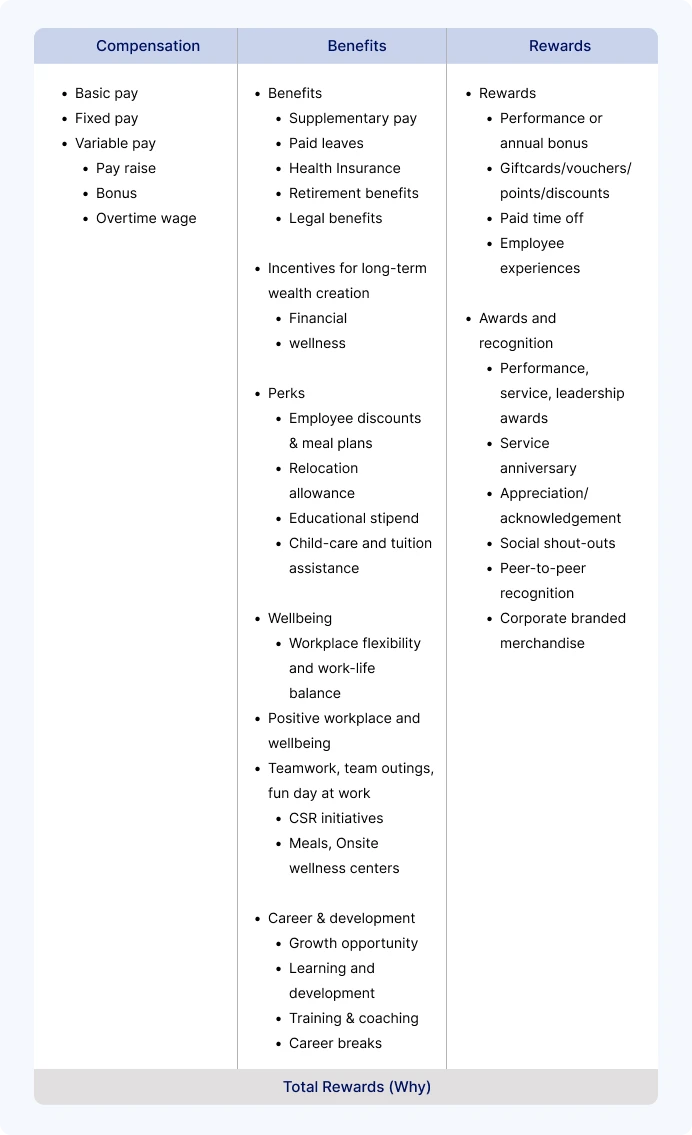
How do you know you have got your total rewards package right? When it reflects every part of your employee value proposition and people feel they have a great deal, candidates want to join and employees want to stay. Designing that package requires understanding its three main components, and compensation comes first because it is the foundation the others build on:
1. Compensation
Compensation is what an employee is paid in exchange for their talent, time and services. It has three parts:
- Basic pay: The base rate agreed between employer and employee, hourly, monthly or annual. It does not include bonuses, raises, benefits or other monetary compensation.
- Fixed pay: The guaranteed amount on the payslip each month. In many countries, including India, it combines basic salary with fixed allowances such as house rent allowance (HRA), leave travel allowance (LTA), medical and conveyance allowances.
- Variable pay: Also called pay at risk, this part must be earned by meeting or exceeding defined goals. It includes performance bonuses, commissions, profit sharing, overtime and pay raises tied to results.
2. Benefits
Benefits are the non-wage part of the package. Every company designs its own, and they show how employee-centric an organization is. Benefits usually include:
- Core benefits: Health insurance, paid leave, retirement plans and legally mandated benefits such as social security or provident fund contributions. See the guide to employee benefits for a full breakdown.
- Long-term wealth incentives: Stock options, retirement matching and financial wellness programs that tie employees' future to the company's success.
- Perks: Extras such as employee discounts, meal plans, relocation allowances, education stipends and childcare support. They vary by industry and budget, and many employee perks cost little but are highly valued.
- Well-being: Workplace flexibility, mental health support, wellness programs and a positive work environment. Protecting employees' physical, mental and emotional health makes sense because people are a company's most valuable asset.
- Career development: Apart from good pay, this is what employees look for most. A promotion, a stretch role or a funded course can matter as much as a pay rise, and companies that invest in development see it in performance and productivity.
3. Rewards
Compensation and benefits are tangible, measurable and mostly monetary. Rewards are more about experience: what the company offers in return for passion, dedication and contributions beyond the job description. They build an engaged, motivated workforce through emotional well-being and frequent appreciation.
- Rewards: What used to be an occasional performance bonus or an annual day out has become structured programs with measurable goals. Rewards can be monetary or not, including gift cards, points, experiences and extra time off, and today's multi-generational workforce wants them tailored to individual preferences.
- Awards and recognition: Performance, service and leadership awards, work anniversaries, peer-to-peer recognition and social shout-outs. Recognition can be tangible, such as an award, or intangible, such as public appreciation. Either way, employees who feel appreciated perform better and stay longer.
To compare these categories side by side, see the guide to the difference between benefits, perks, gifts, awards, incentives and rewards, and for a CHRO-level view of reward mixes, the guide to types of rewards.
The total rewards model
A total rewards model is a framework that groups everything employees receive into a few elements so HR can design, budget and communicate them as one system. The most widely used is the WorldatWork Total Rewards Model, in use since 2000 and updated over time. Its current version names five elements, and the table maps each to the three components above:
| WorldatWork element | What it covers | Where it sits in the three components |
|---|---|---|
| Compensation | Base pay, variable pay, bonuses, commissions, equity | Compensation |
| Benefits | Health, retirement, insurance, paid time off, perks | Benefits |
| Well-being | Physical, mental, financial and social health, flexibility | Benefits |
| Careers | Learning, development, promotion paths, internal mobility | Benefits |
| Recognition | Awards, peer and manager recognition, service milestones, rewards | Rewards |
Older versions of the model used work-life and development as separate elements. The shift to well-being and careers reflects what employees now ask for. Whichever model you use, the point is the same: every element is a lever, and the right mix depends on your workforce and business strategy.
Total rewards example: what a package is really worth
A total rewards statement shows employees the full value of what they receive, not just their salary. Here is a simplified example for an employee with a base salary of $60,000:
| Component | Example | Annual value |
|---|---|---|
| Base salary | Fixed annual pay | $60,000 |
| Variable pay | Target bonus of 8% | $4,800 |
| Health insurance | Employer share of premiums | $7,200 |
| Retirement | 4% employer match | $2,400 |
| Paid time off | 15 days of vacation and 10 holidays | $5,770 |
| Well-being and development | Wellness stipend and learning budget | $1,500 |
| Recognition and rewards | Points-based recognition program | $600 |
| Total rewards | $82,270 |
In this example, the employee receives about 37% more than their salary alone. Sharing a statement like this each year helps people see the whole deal, which matters when a competitor offers a higher base salary. For the calculation behind each line, see this guide to calculating employee benefits, and for how total compensation differs from salary, read total compensation vs salary.
Reimagining the total rewards experience
Redefine your total rewards to address the preferences and needs of a diverse, multi-generational workforce. A total rewards package should create the feelings of accomplishment and satisfaction that make people want to come back tomorrow. When rewards are missing or feel unfair, the result is frustration and anxiety, and people make career-changing decisions because of it.
A note of caution: when you create or change a total rewards package, assess its risks and its effect on morale, and measure whether it is well received. A benefit nobody uses or a reward that feels unfair can do more harm than good. Ask employees what they value through surveys, check utilization data and adjust.
Total rewards centers on the psychological contract between employee and company: the unwritten expectations each side has of the other. Getting it right means the package is fair, visible and personal. Three practices help:
- Personalize: Offer choice, such as flexible benefits or reward catalogs, so each employee can pick what matters to them.
- Make it visible: Share total rewards statements and celebrate recognition publicly so employees see the full value.
- Keep it frequent: Recognition and rewards work best close to the moment, not once a year.
How Empuls supports your total rewards program
Enhancing the psychological contract and nurturing talent is easier when the non-salary parts of total rewards live in one place. Empuls, Xoxoday's employee engagement platform, brings them together:
- Recognition and rewards: Peer and manager recognition, awards and milestone rewards redeemable from a global rewards catalog.
- Benefits: Flexible benefits, including employee discounts, lifestyle spending accounts and tax-saving benefits.
- Well-being: Wellness programs and fitness challenges that support physical and mental health.
- Listening: Employee surveys that show which rewards employees value and where the gaps are.
With every reward visible in one platform, employees see the full value of what you offer and HR sees what is working.
Total rewards is the whole employee deal
Total rewards is a holistic view of what you offer employees: pay, benefits, well-being, careers and recognition working together. Organizations that treat it as one system, rather than separate budgets, attract better candidates, keep their best people longer and get more value from every dollar spent.
Start by mapping what you offer against the five elements, show employees the full value, and ask them what they would change. Then build the plan with this guide to total rewards strategy.
Book your Empuls demo
Frequently asked questions
Total rewards means everything an employee receives from an employer in return for their work. It covers compensation such as salary and bonuses, benefits such as health insurance and retirement plans, well-being support, career development and recognition. The term emphasizes that the employee deal is much larger than a paycheck and should be designed as one system.
The WorldatWork Total Rewards Model names five components: compensation, benefits, well-being, careers and recognition. Compensation covers fixed and variable pay. Benefits include insurance, retirement and paid time off. Well-being covers physical, mental and financial health. Careers covers learning and advancement. Recognition covers awards, appreciation and rewards for contributions.
Compensation is the money an employee is paid, including base salary, bonuses and commissions. Total rewards is broader: it includes compensation plus benefits, well-being programs, career development and recognition. Compensation answers what you earn, while total rewards answers everything you get for working at a company, including non-financial value.
A total rewards strategy is an organization's plan for how it combines pay, benefits, well-being, career growth and recognition to attract, retain and engage the people it needs. It sets priorities, budgets and communication for each element based on business goals and employee needs, and it is reviewed regularly using data on cost, utilization and engagement.
An employee earning a $60,000 salary might also receive a target bonus, employer-paid health insurance, a retirement match, paid time off, a wellness stipend, a learning budget and points from a recognition program. Added together, the total rewards value could exceed $80,000. A total rewards statement shows employees this full value each year.
A total rewards statement is a personalized document that shows an employee the full value of their package, including salary, bonuses, employer benefit contributions, paid time off, well-being programs and rewards. It helps employees see what they receive beyond take-home pay, which improves appreciation of benefits and helps retention when competitors offer a higher base salary.
Total rewards matters because employees value more than pay. Benefits alone are about 30% of US private employers' compensation costs, and recognition is strongly linked to retention. Managing all elements together helps organizations spend wisely, compete for talent without relying only on salary and give employees a clear picture of what they receive.
Total rewards is usually owned by HR, often by a total rewards or compensation and benefits team that reports to the CHRO. Finance helps set budgets, managers deliver recognition and development day to day, and leadership approves the overall philosophy. In smaller companies, an HR generalist typically manages total rewards alongside other duties.





































































































































































































































































































































































































































































































































































