
Key Takeaways
A sales incentive program is a structured system that rewards salespeople for meeting or exceeding targets such as quota, revenue or new customers, on top of base pay and commission.
Creating a sales incentive program takes eight steps: objective, KPIs, budget, structure, written rules, communication, a piloted launch and ongoing measurement.
Model the payout at 80%, 100% and 120% attainment before launch so the total incentive cost stays inside the budget.
Cohort-based and KPI-linked programs lift the middle of the team, which is where most incentive programs fail to reach.
Reps need a worked example and live visibility of their earnings, because a plan they cannot calculate cannot motivate them.
Here is how to create a sales incentive program: set one clear business objective, pick the few KPIs that drive it, fix a budget, design the reward structure, write the rules down, launch it with real-time tracking and review it every cycle. The steps below walk through each decision, with a ready-to-use program template and a worked payout example you can copy.
A sales incentive program is a structured system that rewards salespeople for meeting or exceeding specific targets, such as sales quotas, revenue goals or customer acquisition metrics. It sits on top of base pay and commission and steers effort toward the results and behaviors the business needs right now. Knowing how to create a sales incentive program well matters because the stakes are high: most sellers are behind target, and a poorly built plan rewards the wrong things.
What a sales incentive program is and why it matters
A sales incentive program gives sales professionals rewards and recognition for measurable performance. Its job is to create a competitive, results-driven environment while keeping effort pointed at the outcomes that matter most to the business, whether that is new logos, renewals, margin or a product launch.
Sales incentive programs matter for two reasons. First, they provide a clear framework for defining and rewarding desired behaviors and outcomes, so the team spends its time on activities that drive growth and profitability. Second, they lift motivation and morale: the prospect of earning rewards and recognition encourages people to go beyond the minimum.
The need is real. The Ebsta and Pavilion 2025 GTM benchmark report found that 78% of sellers missed quota, and Salesforce's 2026 State of Sales research of 4,050 sales professionals found the average seller spends only 40% of their time actually selling. Plan design is under pressure too: in the Alexander Group 2025 Sales Compensation Trends Survey, 44% of firms named setting accurate quotas as a top sales compensation challenge.
78%
of sellers missed quota
Ebsta and Pavilion, 2025
40%
of a seller's time is spent selling
Salesforce State of Sales, 2026
44%
of firms struggle to set accurate quotas
Alexander Group, 2025
45%
less likely to leave after two years
well-recognized employees, Gallup, 2024
Why sales incentive program design deserves real attention
Benefits of a well-designed sales incentive program
Implementing a well-designed sales incentive program drives performance, builds a positive sales culture and improves how the team works together. These are the five benefits most teams see first:
- Increased sales and revenue: Motivating salespeople to reach their targets contributes directly to revenue, especially when rewards are tied to the deals and products that matter most.
- Improved morale and motivation: Incentives create excitement and healthy competition, which keeps energy up through the middle of a quarter, not just the last week.
- Sharper focus on key objectives: A program aligns the team's effort with company priorities, so everyone works toward shared goals instead of whatever is easiest to close.
- Talent attraction and retention: Well-structured incentives help you hire strong sellers and keep high performers. Recognition plays a big part: Gallup's 2024 research with Workhuman found well-recognized employees were 45% less likely to have left after two years.
- Better data for decisions: Programs depend on tracking performance data, which gives sales leaders insight for forecasting, coaching and the next plan design.
For a deeper look at why retention and incentives are linked, see these sales team retention strategies.
Run your sales incentive program without spreadsheets
Build plans in a no-code builder, simulate payouts and give every rep live earnings.
Talk to our ExpertTrusted by 5,000+ companies
How to create a sales incentive program in 8 steps
There are eight steps in sales incentive program design, and they run in order because each decision depends on the one before. Spend the most time on steps 1 to 3: a program with a fuzzy objective, the wrong KPIs or no budget ceiling cannot be rescued by attractive rewards.
1. Define clear objectives
A sales incentive program needs a strong foundation, starting with a clearly defined objective. Are you trying to increase deal closures, shorten sales cycles, grow average deal size, push a new product or expand into a new market? Without a clear direction, even the most attractive incentives fail to deliver results.
Write the objective as one measurable sentence with a deadline, for example "Grow Q2 new-customer revenue by 20% without lowering average margin." Then check that it supports the company plan for the year. One primary objective per program keeps the message simple; if you have three goals, you probably need three short programs or one plan with clearly weighted measures.
2. Identify the key performance indicators
The success of a program depends on choosing the right performance metrics. Clear, measurable KPIs tell sales reps what they need to achieve and how their effort contributes to growth. Common KPIs for sales incentive programs include:
- Total revenue generated: Encourages overall sales growth.
- New customer acquisition: Directs effort toward expanding the customer base.
- Deal size and value: Rewards high-value sales rather than volume alone.
- Upsell and cross-sell rates: Motivates reps to grow revenue per customer.
- Sales cycle length: Rewards efficiency in closing deals faster.
- Customer retention and renewals: Encourages long-term relationship building.
- Lead conversion rates: Improves pipeline efficiency from first meeting to closed deal.
Use no more than three KPIs per role. Outcome KPIs (revenue, new logos) should carry most of the weight, with one leading indicator (qualified meetings, demos, opportunities) where reps need help building pipeline. Pull every KPI from your CRM or ERP so there is one source of truth and no argument about the numbers.
3. Set the budget and the return you expect
Most guides skip this step, and it is where many programs go wrong. Decide what you can afford to pay at target and at stretch before you design any rewards. A simple way to frame it is incentive ROI: the incremental gross profit the program generates, minus the cost of rewards and administration, divided by that cost.
For example, if a quarter's program is expected to add $400,000 in revenue at a 30% gross margin, that is $120,000 of incremental gross profit. If rewards and administration cost $30,000, the expected ROI is ($120,000 minus $30,000) divided by $30,000, or 3 to 1. Model the payout at 80%, 100% and 120% attainment so finance knows the worst case before launch. To estimate what manual calculation and payout errors cost you today, try the sales incentive ROI calculator.
4. Design the incentive structure
An effective incentive program goes beyond offering rewards: it is structured to drive the right behaviors while keeping the whole team engaged. The key is a balance of monetary and non-monetary incentives, because people respond to different motivators. Types of sales incentives to consider:
- Monetary rewards: Commissions, bonuses, profit sharing or tiered incentives based on performance.
- Non-monetary rewards: Recognition, career development, merchandise and experiences such as travel or VIP events.
- SPIFs (sales performance incentive funds): Short-term rewards that boost one specific outcome, such as closing deals faster or selling a high-margin product.
- Team-based incentives: Rewards for groups that hit a shared target, which builds collaboration.
- Milestone-based rewards: Recognition for consistent performance over time rather than one-off results.
Reward value matters, but only up to a point. The Incentive Research Foundation's 2025 study of 500 reward-eligible employees and channel partners found that willingness to put in extra effort rises with reward value only up to a threshold, and that clear, achievable objectives, personalization and reward choice also strengthen a program's appeal. For a full menu of reward ideas, see these sales team incentives, and for how commission and bonus differ, read commission vs bonus.
5. Write the rules down
A one-page program document prevents most disputes. It should answer the questions reps and finance will ask before they ask them:
- Eligibility: Which roles, regions and tenure levels qualify, and how new hires and leavers are treated.
- Timeframe: Start and end dates, and when performance is measured.
- Crediting: When a deal counts (booked, invoiced or paid) and how split deals are credited.
- Payout timing: When rewards are paid and through which route, such as payroll or a rewards catalog.
- Clawbacks and adjustments: What happens if a deal is cancelled, and how targets change for leave or territory moves.
- Disputes: Who to contact, and how quickly disputes are resolved.
6. Communicate the program clearly
Even the best-designed program falls flat if it is not communicated clearly. Sales reps need to understand how it works, what they need to do to earn rewards and how their performance is tracked. Confusion or a lack of transparency leads to disengagement and reduces the program's effect.
- Clarity on goals and rewards: Define exactly which behaviors and achievements will be rewarded, with a worked example.
- Multiple channels: Use team meetings, email, dashboards and one-on-ones so nobody misses the details.
- Real-time visibility: Let reps track earnings, progress toward targets and leaderboard standings at any time.
- Regular updates and reminders: Share standings and upcoming opportunities through the cycle, not only at launch.
7. Launch with the right tools, and pilot first
A well-designed program needs seamless execution. Announcing incentives is not enough: reps need the tools and resources to perform, and managers need the data to coach. Key steps for a smooth implementation:
- Training and sales resources: Make sure reps have current collateral, pitch decks and product knowledge for the products the program targets.
- Fit with sales processes: Build the program into existing workflows and pull data from the CRM, so participating does not disrupt daily work.
- Manager support: Give managers performance insight so they can coach reps and address problems as they arise.
- Immediate performance tracking: Reps should see achievements, pending rewards and targets as deals close.
Before a full rollout, run the new plan in parallel with the old one for one cycle, or pilot it with one team. A simulation on last quarter's data shows who would have earned what and exposes loopholes before real money is at stake.
8. Monitor, adjust and measure success
A sales incentive program is not a set-and-forget initiative. Regular monitoring keeps it driving the right behaviors as the business changes. Without ongoing analysis, structures become outdated, which leads to disengagement or unintended consequences. Track these signals every cycle:
- Performance trends: Which incentives drive the biggest impact, and where adjustments are needed.
- Before and after comparison: Revenue growth, deal size and conversion rates compared with the period before launch.
- KPI achievement rates: How many reps meet or exceed target. If only the top 10% ever earn, the targets are too steep for everyone else.
- Incentive ROI: Reward spend compared with incremental revenue and gross profit.
- Retention and engagement: Whether high performers stay longer, and what reps say in short surveys or one-on-ones.
Adjust targets, payout levels or reward types between cycles, not in the middle of one, unless the rules you wrote in step 5 allow it. For the warning signs of a plan that has drifted, read why sales incentives fail.
12 sales incentive program ideas and how to set each one up
Here are 12 sales incentive program ideas, grouped by the problem each one solves. Cohort-based and KPI-linked programs come first because they lift the most people, not just the top performers, which is where most programs fall short.
1. Cohort-based incentive programs
Cohort-based programs classify sellers into groups such as top, middle and tail-end performers. A common split is roughly the top 10%, the middle 30% and the remaining 60% of the team. Each group has a different mindset and capability, so each gets its own targets.
- Map your team into performance cohorts using last quarter's results.
- For each cohort, find the average and maximum performance. To have a business impact, the program must push the cohort above its own average.
- Create milestones between the cohort average and 105% to 120% of the cohort maximum, so even the best people in the group have something to chase.
- Offer incremental or fixed incentives at every milestone.
| Milestone | Revenue for the quarter | Reward |
|---|---|---|
| Slab 1 (cohort average) | $40,000 | Badge and public shout-out |
| Slab 2 | $48,000 | $150 reward points |
| Slab 3 | $56,000 | $300 reward points |
| Slab 4 (cohort maximum) | $60,000 | $500 reward points |
| Slab 5 (115% of maximum) | $69,000 | $800 reward points and a seat at the quarterly leadership lunch |
2. Role-specific incentive programs
A one-size-fits-all program does not work when the team includes SDRs, account executives and account managers. Role-specific programs reward each role for its own contribution: SDRs for qualified meetings booked, account executives for closed revenue above quota, account managers for renewals and expansion. Review the data each cycle to keep each role's measures relevant.
3. Split sales incentive programs
Many deals involve several people, from lead generation to closing. A split program rewards every contributor and builds teamwork instead of internal competition. For example, the SDR who sourced the lead receives 10% of the deal's incentive, the account executive who closed it 70% and the sales engineer who ran technical discussions 20%. Automate the tracking so splits are applied the same way every time and disputes are rare.
4. KPI and micro-KPI linked programs
Incentives usually reward final sales, but intermediate outputs drive those sales. Demos lead to opportunities and opportunities lead to closed deals, so micro-incentives on demos and qualified opportunities change behavior earlier in the funnel. Set each micro-KPI target between the team's average and its best result last period, often around the top quarter of results, then create sequential milestones with fixed or incremental rewards. This guide to how to calculate sales incentives shows how to weight several KPIs in one payout.
5. Badge-based incentive programs
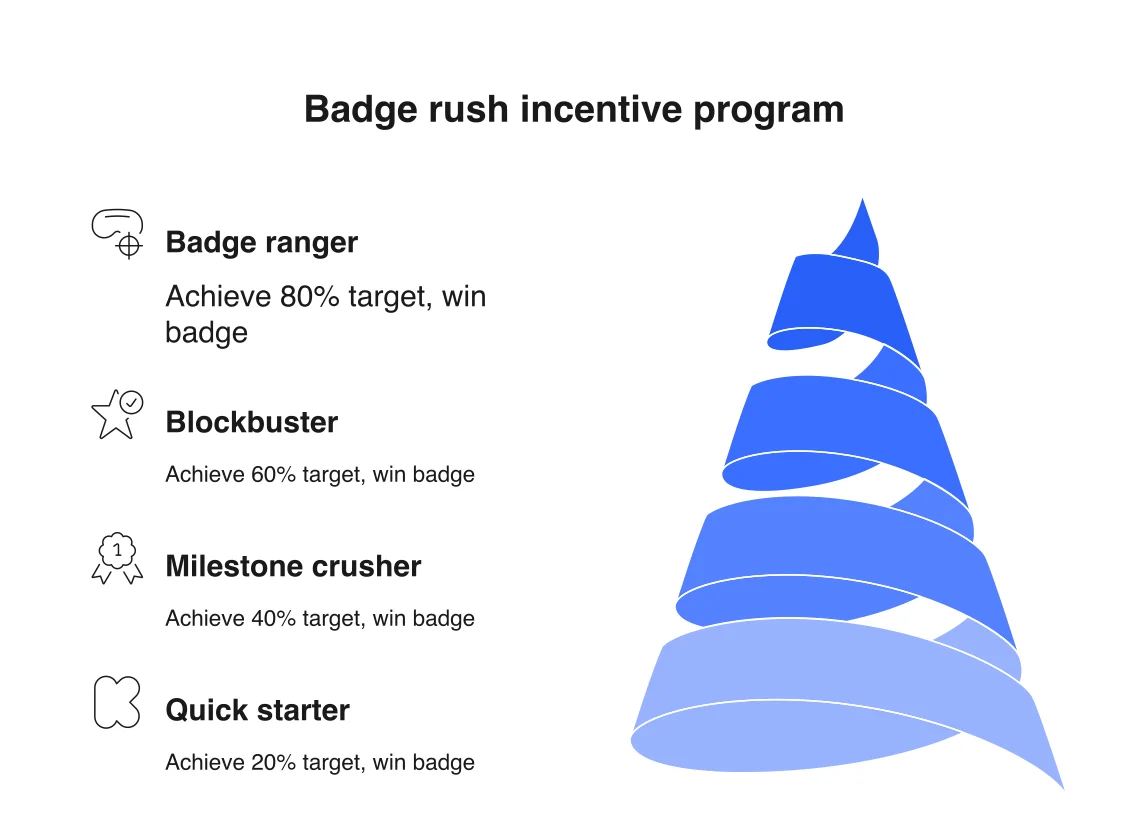
Badges and certificates are a low-cost way to recognize progress, especially in the first weeks of a cycle when the first cash milestone still feels far away. Identify milestones such as 20%, 40%, 60% and 80% of target, attach a badge to each and celebrate them publicly.
6. Hierarchy-based incentive programs
Sales organizations often run from regional teams to zone heads, geography heads and a national head. Rolling incentives out at every level keeps each layer motivated. A typical hierarchy program is a cohort-based or KPI-based program mapped to each level with its own targets, where managers earn on their team's roll-up results.
7. Behavior-based incentive programs
Some teams stall on specific ratios, such as demo-to-close, cross-sell or upsell rates. A behavior-based program targets the ratio itself: identify the stuck ratio, set a stretch range above the team's current level and reward each milestone. This works well when revenue is fine but the pipeline is inefficient.
8. Seasonal or time-based incentive programs
Many businesses have quiet weeks and peak seasons. Time-based programs smooth volume across a month or year, or concentrate effort during the busiest selling season when the market potential is highest. Short SPIFs and contests fit this format well.
9. Team-based incentive programs
Team programs build a sense of togetherness, often by geography or by manager. A typical design is a KPI-based program where an overall team target is broken into milestones and everyone shares the reward when the team gets there.
10. Beat-the-champion incentive programs
Beat-the-champion programs set last period's top results as targets. Identify the top four rank holders, make their results the milestones and reward anyone who beats each one. This gives middle and lower performers a concrete, visible bar to aim for. For more contest formats, see these sales gamification ideas.
11. Personalized goal-setting programs
Not every rep is motivated by the same target. Let reps choose from a predefined set of goals, such as revenue, deal count, new customers or upsell percentage, and pay more for harder goals. Provide ongoing tracking and celebrate each achievement with recognition, badges and leaderboard rankings.
12. Experiential reward programs
Monetary incentives are not the only way to drive motivation. Experiential programs offer memorable rewards such as travel, VIP events or exclusive access, unlocked through tiered achievement levels. Publicly recognize winners and share their stories to inspire the rest of the team.
Which sales incentive program fits which goal
Use this table to match the program to the problem you are trying to solve. Most teams run one core program for the quarter and add one short-term program on top, rather than launching several at once.
| Program | Best for | Primary measure | Typical reward |
|---|---|---|---|
| Cohort-based | Lifting the middle and tail of the team | Revenue against cohort average | Incremental rewards per milestone |
| Role-specific | Mixed teams of SDRs, AEs and account managers | Meetings, closed revenue, renewals | Fixed bonus or commission by role |
| Split sales | Deals that need several contributors | Shared deal revenue | Percentage split of the deal incentive |
| KPI and micro-KPI | Weak pipeline or low activity | Demos, opportunities, conversions | Small rewards per milestone |
| Badge-based | Early-cycle momentum | Progress to target | Badges and recognition |
| Hierarchy-based | Multi-level field sales | Team roll-up results | Manager override or bonus |
| Behavior-based | Stuck ratios such as cross-sell | Conversion or attach rate | Fixed or incremental rewards |
| Seasonal | Uneven demand or peak season | Revenue in the window | SPIF or contest prize |
| Team-based | Collaboration across a region | Shared team target | Team reward or experience |
| Beat-the-champion | Raising the bar for mid performers | Results against last period's leaders | Reward per champion beaten |
| Personalized goals | Diverse motivations | Rep-chosen goal | Reward scaled by goal difficulty |
| Experiential | Top-performer stretch | Tiered achievement | Travel, events, experiences |
Sales incentive plan template with a worked example
Most sales incentive plan examples stop at a list of rewards. This sample sales incentive plan is a template you can copy for a quarterly program. It combines a commission, two bonuses, a team reward and recognition, and the worked example below shows exactly what two reps would earn.
| Plan element | What to fill in | Example |
|---|---|---|
| Program name | A short, memorable name | Q2 Sales Performance Incentive Plan |
| Objective | One measurable goal with a deadline | Grow revenue 20% and add new customers |
| Eligibility | Roles and regions included | All account executives and account managers |
| Duration | Start and end dates | April 1 to June 30 |
| Commission | Rate and tiers | 5% on revenue up to the $75,000 quota, 7% on revenue above it |
| Stretch bonus | Threshold and amount | $1,000 at 115% of quota ($86,250) |
| New-customer bonus | Threshold and amount | $1,000 for 10 or more new customers |
| Team reward | Shared goal and reward | Weekend retreat for everyone if the team hits 20% growth |
| Recognition | Non-monetary rewards | Top Performer of the Quarter award with a $500 gift card, mentorship for the top three |
| Tracking | Data source and visibility | CRM data, live dashboard and leaderboard |
| Reviews | When the plan is checked | Mid-quarter and end-of-quarter reviews, monthly pulse survey |
Here is how the plan pays two reps with different results at the end of the quarter:
| Calculation | Rep A | Rep B |
|---|---|---|
| Quarterly revenue | $90,000 | $70,000 |
| New customers | 12 | 6 |
| Commission at 5% on revenue up to $75,000 | $3,750 | $3,500 |
| Commission at 7% on revenue above $75,000 | $1,050 | $0 |
| Stretch bonus (115% of quota) | $1,000 | $0 |
| New-customer bonus (10 or more) | $1,000 | $0 |
| Total incentive | $6,800 | $3,500 |
| Incentive cost as a share of revenue | 7.6% | 5.0% |
For commission formulas beyond this example, read how to calculate sales commissions, and for a side-by-side view of plan structures, see these sales commission and incentive plans.
Common sales incentive program challenges and fixes
Even well-designed programs hit obstacles. These four come up most often, and each has a practical fix that should be part of your sales incentives best practices:
- Unclear incentive structures: If reps cannot work out what they will earn, engagement drops. Publish a worked example and give every rep a live view of earnings and progress.
- Low participation: Some reps are not motivated by traditional incentives, especially those far from the first milestone. Cohort targets, badges and leaderboards scoped to similar peers give the middle of the team something reachable.
- Lack of adaptability: Markets change and static programs go stale. Review results every cycle and refresh short-term programs at least quarterly.
- Delayed or wrong payouts: Manual commission calculations lead to errors, delays and disputes. Automating calculation and payouts protects trust, as covered in this guide on why to automate the sales commission process.
For a longer list of design mistakes and what they cost, read about the bad sales incentive plan and how to avoid one.
How Empuls helps you run a sales incentive program
Empuls includes sales incentive and commission management that covers the program from plan design to payout. Admins build commission, target and milestone plans in a no-code plan builder, with tiers, slabs, splits and clawbacks, and an estimator and simulation show the payout impact before a plan goes live. Calculations run on data from your CRM, ERP and HRMS, and every result can be traced back to the data and rules behind it.
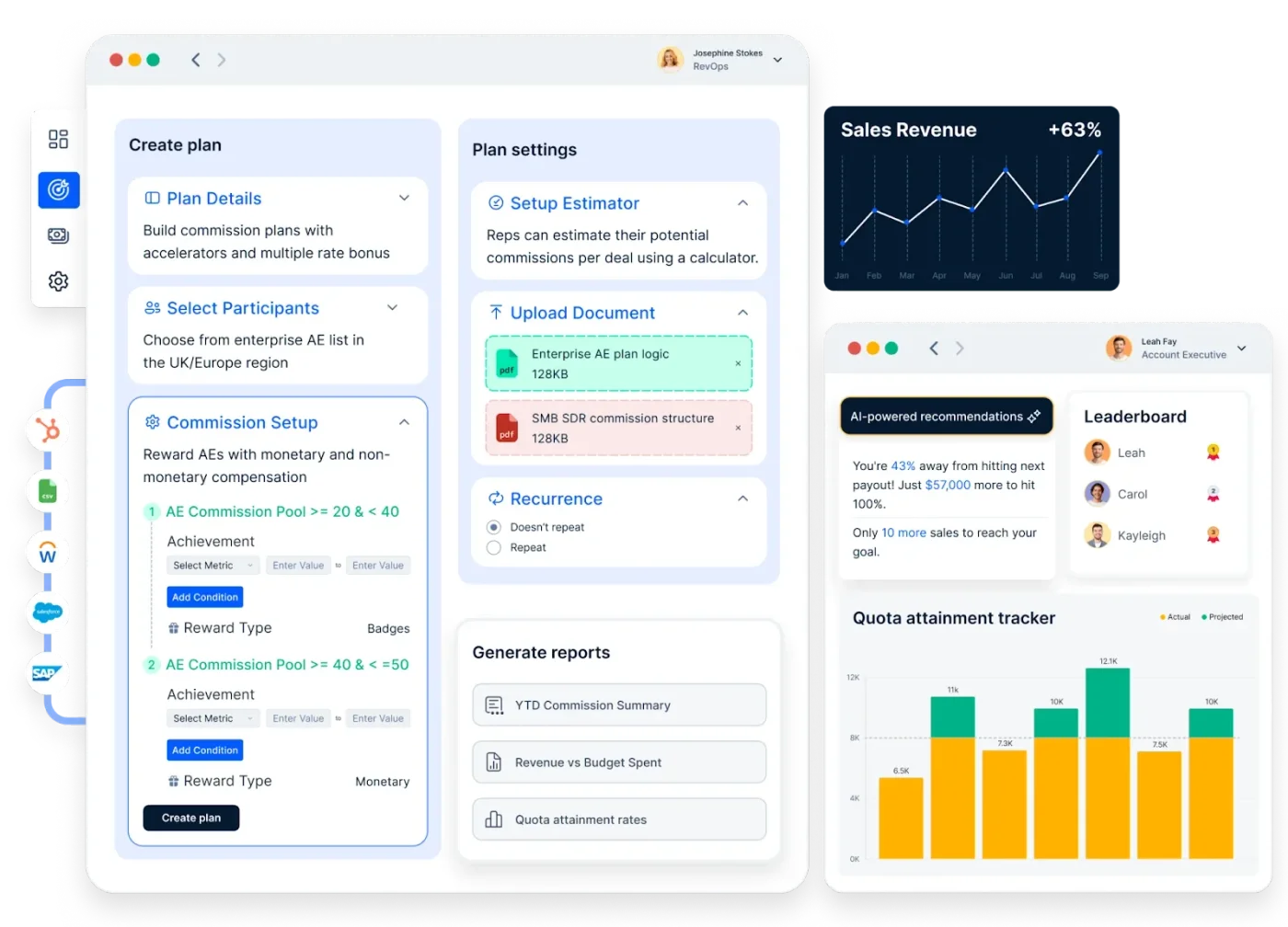
Sales professionals get a KPI scorecard, an earnings estimator, a leaderboard and nudges on how far the next slab is, while managers see team attainment and a dispute log. Approved incentives can be paid through payroll, bank transfer, UPI or rewards in 50+ currencies. Mercedes-Benz India used it to automate incentives across 33 franchises with 99.9% calculation accuracy, as described in the Mercedes-Benz India case study.
Explore Empuls sales incentives, the plan builder and calculations, leaderboards, SPIFs and contests and payouts and disbursal.
Build the program, then keep improving it
A well-designed sales incentive program increases sales, lifts engagement and gives you better data on what drives results. Start with one objective, a few KPIs and a budget you have modeled, write the rules on one page and show every rep a worked example.
Then treat the program as a living system: review it every cycle, use rep feedback and data to adjust it, and celebrate wins in public. When you are ready for more ideas, these strategies to incentivize a sales team build on the program you have just created.
Book your Empuls demo
Frequently asked questions
The key components are a clear objective, two or three KPIs per role, a budget, a reward structure, written rules and a tracking method. The rules cover eligibility, timeframe, deal crediting, payout timing, clawbacks and disputes. Add a communication plan and a review schedule so the program stays effective after launch rather than drifting.
The most effective mix combines monetary rewards, such as commissions, bonuses and SPIFs, with non-monetary rewards such as recognition, experiences and career growth. Cash drives results on core targets, while recognition and experiences keep motivation up between payouts. Research from the Incentive Research Foundation shows clear objectives, personalization and reward choice matter alongside reward value.
There is no single right figure. Work backward from incremental gross profit: estimate the extra revenue the program should generate, apply your margin and set reward spend so the return is comfortably positive, often several times the cost. Then model the payout at 80%, 100% and 120% attainment so finance knows the worst case before launch.
Core incentive plans usually run for a quarter or a year, aligned with quotas. Short-term programs such as SPIFs and contests work best over two to eight weeks, because a short window keeps urgency high. Review the core plan at least once a year and refresh short-term programs every quarter so they do not become routine.
Design for the whole team. If only the top 10% can realistically earn, the rest of the team disengages. Cohort-based targets, milestone rewards, badges and team goals give middle and tail-end performers something reachable, while accelerators and experiential rewards keep top performers stretching. The aim is broad participation with the biggest rewards for the best results.
A rep who misses target earns no reward for that measure, but the program should still help them improve. Use the data to find where the funnel breaks, provide coaching, and consider milestone or badge-based rewards for progress. If a rep misses repeatedly, a structured improvement plan with weekly goals makes expectations clear and fair.
Compare revenue, deal size and conversion rates before and after launch, track the share of reps meeting target and calculate incentive ROI as incremental gross profit minus program cost, divided by cost. Also watch retention of high performers and rep feedback, because a program that hits revenue but burns out the team will not last.
Yes. Linking sales incentives to a recognition program creates one rewards system that celebrates both sales results and other contributions, such as helping a colleague close a deal. Public recognition on a company feed, badges and milestone awards add visibility to cash incentives, and they cost far less than raising commission rates.





































































































































































































































































































































































































































































































































































