
Key Takeaways
Employee communication is how information, ideas and feedback flow between leaders, managers and employees, and between employees themselves.
The four types of employee communication are downward, upward, horizontal and diagonal, and upward communication is the one most companies underinvest in.
In Grammarly's 2024 research, every knowledge worker surveyed reported miscommunication at least weekly, and one in five leaders said poor communication had lost them business.
Gallagher's 2026 report found 61% of organizations have no formal approach to change communication, so a simple plan with owners, channels and cadence is a real advantage.
Fewer, clearer messages in one predictable place, plus a visible feedback loop, do more for engagement than adding new channels.
Employee communication is how information, ideas and feedback flow between a company's leaders, managers and employees, and between employees themselves. Done well, it keeps people informed, aligned with company goals and confident that their voice is heard. Done badly, it shows up as missed updates, rumors, rework and disengaged teams.
Poor communication rarely stays a small problem. Ineffective or poor employee communication can wreak havoc on multiple aspects of a business, including employee engagement levels, employee turnover, customer service, project delivery deadlines, litigation costs and shareholder returns. From an organizational perspective, five lessons stand out:
- Effective employee communication is vital: It is the foundation of an engaged workforce.
- Poor communication slows growth: Missed messages turn into missed deadlines, sales and opportunities.
- Company-wide updates need a plan: Significant news has to reach everyone, not just the people at headquarters.
- The right platform matters: A central place for updates and conversation stops information getting lost in inboxes and chat threads.
- Communication is two-way: Employees need a way to ask questions and give feedback, not just receive announcements.
Today, the quality of employee communication in the workplace dictates how operations run and the return a business sees on its people. This guide covers the types of employee communication, the benefits of effective employee communication, ten best practices with company examples, and a ready-to-use internal employee communication strategy template.
What is employee communication
Employee communication means sharing ideas, feelings and information between the employees and employers of a company. It covers everything from a CEO's town hall and a policy update to a manager's one-on-one and a peer's message in a team channel.
Before the pandemic, employees relied on real-time collaboration and synchronous communication with their peers. That is no longer the case. Since remote and hybrid working environments are here to stay, employers need to:
- Rethink their employee communication strategies
- Adopt asynchronous communication
- Keep employees well informed
- Eliminate cross-departmental silos
- Improve the employee experience
- Reduce information overload
- Give employees a social intranet where they can stay connected
Employee communication is vital for a business's success. It is the glue that holds a company together. An effective communication strategy helps improve employee productivity, employee engagement and workplace collaboration, and all of these build a strong company culture.
How you communicate your company's vision, values and strategy directly shapes how employees feel about your company. Employee communication and internal communication are often used interchangeably; internal communication usually refers to the function and channels that carry company-wide messages, while employee communication includes every conversation people have at work. For the principles that make any of these conversations work, see our guide to the pillars of effective communication in the workplace.
Types of employee communication
There are four main types of employee communication, defined by the direction a message travels. Upward communication is the one most companies underinvest in, and it is the type that tells leaders what is really happening on the ground.
| Type | Direction | Examples | What it is for |
|---|---|---|---|
| Downward | Leaders and managers to employees | Town halls, CEO updates, policy announcements, team briefings | Sharing strategy, decisions, priorities and expectations |
| Upward | Employees to managers and leaders | Pulse surveys, one-on-ones, suggestion channels, skip-level meetings | Surfacing feedback, ideas, risks and concerns |
| Horizontal | Between peers at the same level | Team channels, stand-ups, project groups, peer recognition | Coordinating work and sharing knowledge |
| Diagonal | Across teams and levels | Cross-functional projects, communities of interest, open forums | Breaking silos and speeding up decisions |
Each of these can be verbal (meetings, calls), written (email, intranet posts, chat), visual (charts, dashboards, digital signage) or nonverbal (tone, body language). Messages can also be synchronous, where people respond in real time, or asynchronous, where they respond when it suits them. A healthy mix matters more than any single channel, and people's preferences vary, which is why it helps to understand the different workplace communication styles on your team.
The cost of poor communication is exceptionally high
The shift to remote and hybrid work has cemented a digital reality, but the workforce faces new challenges. Poor communication is a serious issue, and many leaders still do not realize what it costs.
Research by The Harris Poll and Grammarly shows how widespread the problem is. In Grammarly's 2024 State of Business Communication report, every knowledge worker surveyed said they experience miscommunication at least weekly, and one in four said it happens multiple times a day. Knowledge workers reported spending 88% of their workweek communicating across channels, and about one in five business leaders said they had lost business because of poor communication.
100%
of knowledge workers experience miscommunication at least weekly
Grammarly and The Harris Poll, 2024
83%
of HR and communications professionals say information overload is a growing problem
Gallagher, 2026
61%
of organizations have no formal approach to change communication
Gallagher, 2026
Why employee communication needs a strategy
Volume is part of the problem. Microsoft's 2025 Work Trend Index research on the infinite workday found the average worker receives 117 emails a day, most skimmed in under a minute, and the most heavily pinged employees are interrupted about every two minutes. Gallagher's 2026 Employee Communications Report links higher message volume to a 30% rise in leader trust risk and a 24% rise in burnout risk.
A breakdown in communication frustrates employees and creates a domino effect on:
- Employee engagement
- Employee productivity
- Customer experience
As the workforce evolves, communicating with outstanding clarity, and sending fewer but better messages, is imperative.
Benefits of effective employee communication
Building a good internal culture is like building a house: if the foundation is weak, it will eventually collapse. There are seven benefits of effective employee communication, and engagement comes first because most of the others flow from it.
1. Boosts employee engagement
Employee engagement is the lifeline of a company. Employees who are not engaged are less productive, and their stress can seep into their overall wellbeing. They are more frustrated and unable to give their best at work, which dampens the spirit of the business.
Gallup's State of the Global Workplace 2026 press release reports that only 20% of employees worldwide were engaged in 2025, and that low engagement cost the global economy an estimated $10 trillion in lost productivity in 2024. Manager engagement fell from 27% to 22% in 2025 alone, which matters because managers carry most day-to-day communication.
When businesses get internal communication right, they improve employee engagement. While some employees are proactive in seeking information and talking regularly, not all employees are the same. It is the responsibility of managers and senior leaders to put effort into regular communication. Good internal communication helps employees feel valued and important.
2. Ensures organization-wide transparency
Effective employee communication ensures transparency in an organization, and openness builds trust. Employees do not want to learn about a big announcement through a third person or external sources. They want to hear it from their company leaders.
Employees want to understand how their organization works and how decisions are made. Transparency enables employees to trust their leaders, and this fosters accountability. Internal communication can bridge the transparency gap so employees trust leadership and work toward common company values and mission. Our guide to transparency in communication covers eight practical ways to build it.
Internal communication enables swift delivery of information, whether from senior leaders or between employees. This flow of information keeps every employee on the same page and helps build a strong workplace culture.
3. Keeps employees informed and updated
Internal communication aims to keep employees up to date with the information they need. Employees are eager to know what is happening in their organization, and knowing it helps them work better and improves their relationships with colleagues.
An effective internal communication strategy keeps employees in the loop about company news. For instance, any change in company policy, work culture or business performance must be communicated to employees, ideally before they read about it anywhere else.
4. Helps in times of crisis
Internal communication is central to crisis management. In an ideal world, organizations would not experience problems, but reality is far from it. Mergers, acquisitions, economic downturns, pandemics and political events keep happening. An organization might need to lay off employees or make other unpleasant decisions in a crisis.
In some cases, teams have to restructure. A crisis can affect a business of any size, and its people need precise information about what is happening. Internal communication helps manage the situation and ensures there is no misinformation.
Rumors spread quickly and can create toxicity in the workplace. People may lose trust and disengage when internal communication is poor. Organizations with a proper internal communication strategy can hold together even in tough times.
Internal communication can make difficult conversations easier, so employees understand the complete picture and why something unpleasant, such as layoffs, is taking place. This helps employees respect their organization and creates an environment for open discussion.
5. Helps with external communication
Internal and external communication are often seen as separate, but they are not. Employees who are well informed and proud of where they work are far more likely to become brand advocates.
Think about it. Employees are company insiders. When they say anything about the company, good or bad, it carries more weight because they are part of the organization. This can have positive or negative effects depending on what they say.
When internal communication is done right, employees know what is happening and feel like part of the team. Employees with these positive feelings say good things about the organization, whether on social media or with family and friends.
In this way, satisfied employees become credible ambassadors. Employees who deal directly with customers benefit too: how they feel about the company is reflected in how they speak to customers.
6. Fosters company culture and values
A strong workplace culture helps businesses attract and retain the best talent, which positively affects business outcomes. Top candidates look for employers whose culture they can see and believe in.
Internal communication can foster a positive work culture and profoundly impact the bottom line. Company culture and values woven into internal communication help employees feel good about working there and support a healthy work environment.
A thriving workplace culture helps align employees with organizational goals. Internal communication enables employees to clearly understand their importance in the bigger picture, encouraging them to work together as a team.
Internal communication helps people work together effectively and efficiently. Without it, the workplace environment can turn toxic, pushing good employees to leave the organization. Internal communication has the power to shape work culture and improve the overall workflow.
7. Enables feedback and innovation
Effective collaboration is required to run smoothly and reach business goals. Internal communication facilitates that and creates a place of openness where employees can discuss and pitch their ideas.
Employees can put their views forward so senior leaders understand them better. This two-way communication strengthens relationships between all stakeholders and supports a culture of innovation.
Feedback lets employees share what they think about how work flows or how they are expected to work. Employees who feel their opinions matter are more likely to feel connected to the company.
This increases engagement and boosts productivity. A solid internal communication strategy makes feedback and discussion a routine part of the business. For practical wording, see our employee feedback examples, and for the bigger picture, our guide to building a culture of feedback.
Get every update to every employee, desk or frontline
Run town halls, groups, polls and recognition in one social intranet your people actually open.
Talk to our ExpertTrusted by 5,000+ companies
Effective and ineffective employee communication
Effective communication creates positive connections between people, whereas ineffective communication creates confusion, conflict, low morale and frustration. The two lists below show what each looks like in practice, starting with the effective version so you have a clear target.
What effective employee communication looks like
Good communication in the workplace is not just about preventing conflict, although that is a key advantage. It is crucial for building solid relationships, team effectiveness, employee engagement and business profitability. The secret to effective communication in the workplace is not just talking; it is understanding. It shows up in four ways:
- Effective conflict management: Information is conveyed clearly to avoid misinterpretation, policies explain how conflicts are reported and managed, and employees and leaders are trained to handle conflict.
- Enhanced employee engagement: Values and vision are communicated so everyone can align with them, job expectations are clear, and the environment fosters collaboration and healthy relationships.
- Inclusive workplace culture: Employees are involved in decisions and asked for their opinions, the right message goes out at the right time through the right channel, and people feel free to share thoughts and ideas.
- Better employee and customer experience: The employee experience is on par with the customer experience, employee feedback is acted on so people feel heard, and teams are reminded to listen to and act on customer feedback.
What ineffective employee communication looks like
Effective employee communication takes time and effort to establish, while ineffective communication grows like a weed when no attention is given. It stems from a poorly aligned strategy, a failure to execute, the wrong channel, bad timing and even nuances such as word choice or tone of voice. It increases misunderstandings, damages relationships, breaks trust and raises hostility. It shows up in four ways:
- No or poor communication strategy: When an organization does not create a communication strategy, or fails to drive it, the result is a domino effect of poor morale, frustrating communication, higher absenteeism, lower productivity, higher turnover and smaller profits.
- Bad communication practices: An organization that tolerates an improper tone and negative language comes across as promoting them. That creates conflict, unhappiness and stress, and employees may simply feel defeated.
- Poor collaboration: An organization that does not foster peer and cross-team collaboration suffers from information silos and stalled innovation. Silos breed conflict, distrust and resentment, and instant messaging and email alone are not enough to make people work well across functions.
- Poor customer relations: Employees may pass the poor experience they receive at work on to customers. Those without guidance from leadership, or locked out of conversations about their day-to-day struggles, are less likely to know how to satisfy customers.
10 employee communication best practices for teams
These ten employee communication best practices are drawn from how well-known companies run their teams. Start with regular check-ins and a feedback loop: together they make every other practice on the list easier to sustain.
1. Regular check-ins
Regular team meetings and check-ins keep everyone on the same page, share updates and address concerns. These interactions promote transparency and alignment within the team.
Microsoft is known for regular check-ins between managers and employees. Its "Connects" process encourages managers to hold consistent one-on-one conversations with their team members. This fosters a culture of feedback and ensures employees feel heard and supported in their roles.
Tip: Keep a shared agenda for each check-in so both sides can add topics in advance.
2. Clear and concise messaging
Communicating ideas and information clearly and concisely reduces misunderstandings and confusion. Clear messaging is especially crucial in written communication and presentations.
Amazon is recognized for clear internal messaging. The company maintains a set of Leadership Principles that serve as a framework for decision-making and communication. These principles are straightforward to understand, helping employees align with the company's culture and values.
Tip: Put the main point or the action needed in the first line of every update.
3. Active listening
Active listening involves hearing what someone says and understanding their perspective, emotions and underlying message. This skill promotes empathy and effective collaboration.
Zappos, the online shoe and clothing retailer, is recognized for its customer-centric approach and active listening. Its customer service representatives are encouraged to listen carefully, understand customers' needs and provide personalized solutions, which has earned the company a reputation for exceptional service and strong loyalty.
Tip: Summarize what you heard before you respond, and ask one clarifying question.
4. Use of collaboration tools
Digital tools and platforms enhance team communication by providing a central space for sharing documents, tracking progress and collaborating on tasks.
Atlassian, known for products like Jira and Confluence, relies on its own collaboration tools for workplace communication. These tools let teams collaborate on projects, share information and track progress in real time, which streamlines the exchange of ideas, centralizes project information and supports remote work.
Employees can access and contribute to project content easily, which improves transparency, reduces email clutter and creates a more efficient, productive work environment.
Tip: Agree which tool is for what (chat for quick questions, a shared space for decisions and documents) so information is easy to find later.
5. Feedback and constructive criticism
Giving feedback constructively and respectfully fosters continuous improvement and helps team members develop their skills.
Netflix is known for candid feedback. Employees at all levels are encouraged to give open and honest feedback to colleagues and managers, including through written 360-style reviews. This helps individuals understand their strengths and weaknesses and promotes a culture of improvement and accountability.
It improves workplace communication by creating a safe space for honest conversations, where feedback is seen as a valuable tool for personal and professional growth. Learn how to structure it in our 360-degree feedback guide.
Tip: Describe the situation, the behavior and its impact, and keep it about the work, not the person.
6. Regular updates and status reports
Regular updates and status reports keep everyone informed about ongoing projects, tasks and milestones. This promotes transparency and prevents surprises.
IBM has a long tradition of town hall meetings where leadership shares updates on the company's performance, strategy and vision, backed by an intranet that distributes information and reports across the organization.
These updates align employees with company objectives, keep them informed about significant developments and ensure everyone is on the same page. They also promote a sense of belonging and shared purpose.
Tip: Use a consistent format and cadence, such as a short weekly note with progress, risks and decisions needed.
7. One-on-one meetings
Individual meetings between team members and their managers or colleagues create space for deeper discussion, personal concerns and stronger relationships.
Asana, the work management software company, prioritizes regular one-on-one meetings between managers and employees. These sessions allow open discussion of performance, feedback, challenges and aspirations.
By fostering these conversations, Asana ensures alignment, removes roadblocks and promotes a transparent, supportive culture where employees feel valued.
Tip: Let the employee own most of the agenda; the meeting is for them, not a status update for you.
8. Visual communication
Visual aids such as charts, graphs, diagrams and presentations simplify complex information and make it easier to understand, especially when content is data-heavy.
Apple is well known for visual communication in product design, marketing and presentations. Its design philosophy, with simple, intuitive interfaces, clear product images and iconic campaigns, relies heavily on visual elements.
This approach makes information more accessible and understandable for both employees and customers. Visual communication simplifies complex ideas and increases engagement, contributing to a culture of clarity and innovation.
Tip: For frontline teams without a desk, use screens, posters or mobile updates rather than long emails.
9. Crisis communication plan
A well-defined plan for communicating during emergencies or crises helps teams respond quickly, manage uncertainty and give stakeholders accurate information.
Johnson & Johnson is a classic example of crisis communication. In 1982, when some of its Tylenol products were tampered with, the company quickly recalled the products, engaged with the public and communicated transparently.
This helped the company regain public trust and showed employees a commitment to ethical values, transparency and openness during a crisis.
Tip: Decide in advance who speaks, which channels you use and how quickly employees will hear from leadership.
10. Feedback loop
A continuous feedback loop encourages ongoing improvement by letting team members give feedback on processes, communication and collaboration.
Amazon is known for its feedback loop in fulfillment centers. Its "Voice of the Associate" board lets employees share feedback and questions about their work environment, safety and processes, and get responses from managers.
This gives employees a channel to express concerns and suggestions. It fosters continuous improvement, and employees feel their input is valued, which leads to a safer and more productive workplace. Short, regular pulse surveys are one of the simplest ways to build the same loop.
Tip: Close the loop publicly: share what you heard and what changed as a result.
Remember that communication strategies should be tailored to your team's needs, culture and projects. A genuine commitment to open, respectful and transparent communication will make your team more productive and harmonious.
Internal employee communication strategy template
An internal employee communication strategy turns the practices above into a plan anyone can follow. Work through the five steps below, then fill in the template for every recurring message; the audience and feedback columns are the ones most often left blank.
- Set goals: Decide what communication should achieve this year, for example faster awareness of policy changes or higher pulse survey participation.
- Map your audiences: List groups by location, role, shift pattern and access to email or a desk. Frontline and remote employees often need different channels.
- Choose channels and owners: Match each message type to one main channel and one accountable owner, so employees always know where to look.
- Set a cadence: Agree how often each message goes out. Fewer, predictable messages beat a constant stream.
- Measure and adjust: Track reach, reads and replies, and ask employees every quarter whether they get the information they need.
| Message type | Audience | Owner | Main channel | Cadence | How employees respond |
|---|---|---|---|---|---|
| Company strategy and results | All employees | CEO and leadership team | Live town hall plus recording and intranet post | Quarterly | Live Q&A and anonymous questions |
| Policy and benefits changes | Affected employees | HR | Intranet announcement and email | As needed, two weeks before effective date | FAQ thread and HR contact |
| Team priorities and progress | Team members | Line manager | Team meeting and team channel | Weekly | Discussion and one-on-ones |
| Recognition and milestones | All employees | Managers and peers | Recognition feed and wall of fame | Ongoing | Comments and reactions |
| Employee feedback | All employees | HR and managers | Pulse survey | Monthly or quarterly | Survey plus shared action plan |
| Crisis or urgent updates | All or affected employees | Leadership and communications | Push notification, SMS, screens and email | Immediately, then regular updates | Dedicated Q&A channel |
To check whether the plan is working, ask employees a few questions each quarter, for example: "I get the information I need to do my job well," "I hear about important changes from the company before I hear about them elsewhere," and "I know how to share feedback with leadership." Track the scores over time alongside reach and read rates.
Communication failure examples to learn from
Here are two real-life stories that show how even well-known brands misjudged their internal and external communication. The first is a publishing slip; the second is a failure of honesty that brought down a company.
Walmart's costume category controversy
What happened: In 2014, just before Halloween, Walmart's website listed plus-size costumes under the heading "Fat Girl Costumes." The insensitive phrase drew a wave of complaints on social media and widespread press coverage, and the brand's reputation took a hit.
Walmart apologized publicly, saying the category never should have been on its site, that it was unacceptable, and that its teams were removing it and making sure it would not happen again.
How it could have been prevented: Whether intentional or not, the slip pointed to a gap in internal accountability. Clear, regularly reinforced guidelines for anyone publishing on the company's behalf, and a simple review step, would have caught it before customers did.
The Enron scandal
What happened: Enron, once one of the biggest energy companies in the U.S., went bankrupt in 2001 after off-the-books accounting and fraud came to light. The collapse affected thousands of employees and shook the stock market.
Enron's leaders were dishonest with their workforce and failed at one of the most critical tasks: transparent communication between employees and management. They did not listen to their employees, ignored problems and hid the truth.
How it could have been prevented: Enron shows how a situation can go from bad to disaster. Red flags were raised internally, and leaders ignored them. Two-way communication is essential for management and employees to be effective and transparent, and safe channels that let employees raise concerns anonymously, without fear of retribution, help stop problems before they grow.
How Empuls improves employee communication
Empuls, the employee engagement platform from Xoxoday, brings company updates, conversation, recognition and feedback into one place. Its social intranet acts as a digital hub where employees collaborate, share updates and take part in discussions.
- Updates that do not get lost: Company news, policy changes and customer wins go out through a central feed and town hall announcements, with key messages spotlighted, instead of scattered emails and chat threads.
- Connection across teams and locations: Groups for departments, projects, locations and interests give people a place for cross-functional conversation and knowledge sharing.
- Two-way conversation: Polls and quizzes and pulse surveys let employees share views and ask questions, and leaders see what to act on.
- Reach beyond the desk: A mobile app and digital signage bring announcements and recognition to frontline teams, and announcements can also be pushed through Slack, Microsoft Teams or email.
- Culture people can see: Celebrations, a wishboard and peer recognition turn milestones and good work into shared moments.
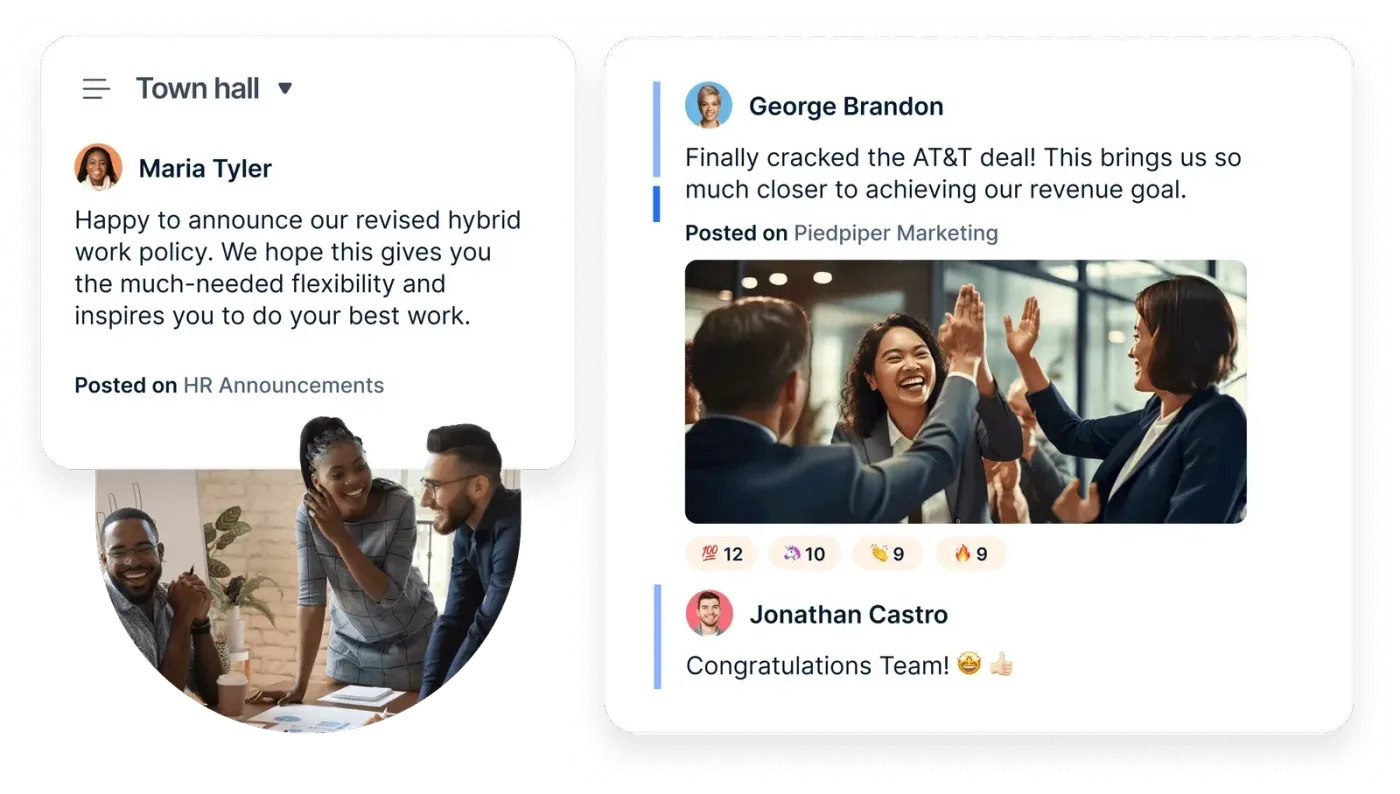
The whole point is to turn your company into a thriving community, inside and out. Start with the practices and template above, listen as carefully as you speak, and when your entire company begins to operate as one unit, you have a powerful force the industry must reckon with.
Book your Empuls demo
Frequently asked questions
The four types are downward communication from leaders to employees, upward communication from employees to managers and leaders, horizontal communication between peers, and diagonal communication across teams and levels. Each can be verbal, written, visual or nonverbal, and synchronous or asynchronous. A healthy workplace uses all four, with clear channels for each.
The terms are often used interchangeably. Internal communication usually refers to the function, strategy and channels that carry company-wide messages, such as town halls, newsletters and the intranet. Employee communication is broader and includes every conversation at work, from manager one-on-ones to peer messages and feedback shared with leadership.
Employee communication keeps people informed, aligned with company goals and confident their voice is heard. It drives engagement, builds trust and transparency, helps companies manage change and crises, and supports culture and retention. Poor communication leads to rework, missed deadlines, rumors and lost business, so it has a direct effect on results.
An employee communication strategy should include clear goals, a map of audiences, the main channel and owner for each message type, a set cadence, and a way for employees to respond. It should also define how you measure success, such as reach, read rates, survey scores and participation, and how you will communicate during a crisis.
Combine channel data with employee feedback. Track reach, open or read rates, attendance and replies, then ask employees in pulse surveys whether they get the information they need, hear about changes from the company first, and know how to share feedback. Compare results by team, location and role to find gaps.
Everyone has a role, but ownership is shared. Leaders set direction and explain decisions, HR and internal communications teams own the strategy and channels, and managers carry most day-to-day communication with their teams. Employees contribute through feedback and peer conversation. Clear owners for each message type prevent gaps and duplication.
Use channels that do not depend on a desk or a corporate inbox, such as a mobile app, SMS, digital signage and short shift briefings. Keep messages brief and visual, record town halls for people on other shifts or time zones, and give everyone a simple way to ask questions and share feedback.
The 7 Cs are a checklist for clear messages: clear, concise, concrete, correct, coherent, complete and courteous. Applied to employee communication, they mean stating the purpose up front, using plain language, giving specific facts and next steps, checking accuracy, keeping a logical flow, answering likely questions and using a respectful tone.





































































































































































































































































































































































































































































































































































