
Key Takeaways
An employee referral program rewards employees when someone they recommend is hired, turning the workforce into a trusted recruiting channel.
Ashby's 2025 data shows 40% of referred candidates reach interview versus 3% of inbound applicants, though referrals are only about 1% of applications.
A written policy covering eligibility, duplicates, validity, payout timing and tax prevents the disputes that stall referral programs.
Tiered rewards by role difficulty, split payouts after start and 90 days, and a choice of cash or non-cash rewards keep the program fair and motivating.
Track referral-to-hire rate, share of hires, time to fill, cost per hire, participation and retention to prove the program's value.
An employee referral program turns your employees into recruiters by rewarding them when someone they recommend is hired. It works because referred candidates arrive pre-vetted by people who know the job and the culture, so they move through hiring faster and convert to offers far more often than other applicants. This guide shows you how to build an employee referral program step by step, with a reward structure template, policy checklist, campaign ideas, examples and the metrics that prove it works.
Most great hires come through people you already know. When employees recommend someone from their network, they are not just passing on a resume; they are vouching for that person's skills, attitude and cultural fit. With the right structure, a referral program becomes a reliable engine for high-quality candidates and gives employees a meaningful way to contribute to the company's growth.
What an employee referral program is
An employee referral program is a structured initiative that encourages employees to recommend people from their personal or professional networks for open roles, usually in exchange for a reward when the candidate is hired. It turns team members into brand advocates and helps HR discover talent that job ads would miss.
Unlike traditional recruiting, referrals are built on trust. When an employee puts someone forward, there is already a layer of credibility for both the referrer and the candidate. Effective programs share four elements:
- Clear eligibility rules for who can refer and which roles qualify.
- A simple way to submit and track referrals.
- Transparent updates on where each referral stands.
- Defined rewards, with clear timing, that motivate participation.
Why referrals work: the data
Referrals are a small share of applicants but punch far above their weight in hiring. Ashby's 2025 analysis of more than 38 million applications across 93,000 jobs found that referrals made up about 1% of applications, yet 40% of referred candidates moved from application to interview, compared with 3% of inbound applicants and 25% of sourced candidates.
40%
of referred candidates
reach interview, vs 3% of inbound applicants (Ashby, 2025)
16%
of interviewed referrals
reach an offer, vs 6% for inbound and sourced (Ashby, 2025)
1%
of applications
come from referrals, so there is room to grow (Ashby, 2025)
Referred candidates convert at much higher rates than other sources
The same analysis found that 16% of interviewed referral candidates reached the offer stage, against 6% for inbound and sourced candidates. The gap shows why the real challenge is volume: most companies get too few referrals, not too many. A well-run program fixes that by making referring easy, visible and rewarding.
Benefits of a well-structured employee referral program
A thoughtfully designed referral program does more than fill open roles. These six benefits explain why it deserves budget and attention, with speed and quality of hire usually the first to show.
- Faster hiring: Referred candidates usually move through the pipeline quicker because they are pre-vetted and hiring managers trust them more.
- Higher-quality candidates: Employees understand the job and the team, so their referrals are more likely to be qualified, as the conversion data above shows.
- Better cultural fit and retention: Referrers explain the culture and expectations honestly, so referred hires tend to settle in faster and stay.
- Lower cost per hire: Referral rewards usually cost far less than agency fees or sustained job ad spend.
- Stronger engagement: When employees feel their input in hiring is valued, they become more invested in the company and the people who join it.
- Proactive talent sourcing: Employees start thinking about people in their network who would fit, which builds a pipeline for current and future roles.
One caution: if your workforce lacks diversity, referrals can reproduce that. Balance the program with targeted campaigns and other sourcing channels so it widens your talent pool rather than narrowing it.
How to build an employee referral program in eight steps
This is how to build an employee referral program from scratch or rebuild one that has stalled. Follow the steps in order, because the goals and rules you set first shape the rewards, tools and campaigns that follow.
- Set goals and metrics: Decide what the program should achieve, such as filling hard-to-fill roles faster or raising the share of hires from referrals, and set targets for referral volume, referral-to-hire rate and time to fill.
- Write the policy: Define who can refer, which roles qualify, how duplicates are handled and when rewards are paid. The checklist below covers every rule to include.
- Design the rewards: Set reward tiers by role difficulty, mix cash with non-cash options and decide the payout milestone.
- Make referring easy: Give employees a referral link or short form on mobile, in Slack or Teams and on your intranet. Every extra field lowers participation.
- Brief recruiters and hiring managers: Agree service levels, such as contacting every referred candidate within a few days and updating the referrer at each stage.
- Launch with a campaign: Announce the program with clear rules, priority roles and a launch incentive. See the campaign plan further down.
- Recognize every contribution: Thank people for every qualified referral, not only for hires, and celebrate successful referrers publicly.
- Measure and refresh: Review the metrics monthly, refresh priority roles and run a new themed campaign each quarter.
Employee referral program policy checklist
A written policy prevents the disputes that kill referral programs, such as two people referring the same candidate or confusion about when a bonus is paid. Make sure your policy answers each of these ten questions before launch.
| Policy element | Question to answer | Common choice |
|---|---|---|
| Eligibility to refer | Who can submit referrals? | All employees except recruiters, HR on the role and the hiring manager |
| Eligible roles | Which openings qualify for a reward? | All roles, with boosters for priority or hard-to-fill roles |
| Eligible candidates | Who cannot be referred for a reward? | Former employees within 12 months and candidates already in the pipeline |
| Ownership and duplicates | Who gets credit if two people refer the same person? | The first complete referral by timestamp |
| Validity window | How long does a referral stay valid? | 6 to 12 months from submission |
| Reward amount | What does each role level earn? | Tiered by role difficulty |
| Payout milestone | When is the reward paid? | Split: part at start date, the rest after 90 days |
| Employment condition | Must the referrer still be employed at payout? | Yes, at the time of each payout |
| Tax treatment | How are cash and gift card rewards taxed? | Processed through payroll or a compliant rewards platform |
| Updates and appeals | How are referrers kept informed and disputes resolved? | Stage updates at each step and a named HR contact |
Check local rules before you finalize. In the US, for example, the IRS states that cash or cash equivalent items provided by an employer are never excludable from income, so cash bonuses and general-purpose gift cards are taxable.
Reward every successful referral in a click
Trigger referral rewards from a hire event and let referrers choose from a global catalog, with tax handled.
Talk to our ExpertTrusted by 5,000+ companies
Structuring employee referral program rewards
How you structure rewards influences participation as much as how much you pay. The five principles below make rewards feel meaningful, fair and timely, starting with tiers that reflect how hard a role is to fill.
1. Define reward tiers by role complexity
Not every referral takes the same effort, so your reward structure should reflect role level and difficulty. The template below shows one common structure with illustrative amounts; set your own figures relative to your cost per hire and local pay levels.
| Role tier | Illustrative reward | Payout timing | Booster option |
|---|---|---|---|
| Entry-level and hourly roles | $500 to $1,000 | 50% at start, 50% after 90 days | Double during peak hiring seasons |
| Mid-level professional roles | $1,500 to $3,000 | 50% at start, 50% after 90 days | Extra reward for referrals hired within 30 days |
| Senior and leadership roles | $3,000 to $5,000 | After 90 days or probation | Non-cash experience added for the referrer |
| Hard-to-fill or niche skill roles | 1.5 to 2 times the tier amount | 50% at start, 50% after 90 days | Time-limited double reward with a deadline |
2. Mix monetary and non-monetary rewards
Cash bonuses are the most common incentive, but non-cash rewards are often more memorable. Good employee referral bonus ideas include:
- Gift cards the referrer chooses from a wide catalog.
- Wellness experiences, spa vouchers or fitness memberships.
- Travel, staycations or experience vouchers.
- Charitable donations in the referrer's name.
- Extra paid time off, lunch with the CEO or premium company swag.
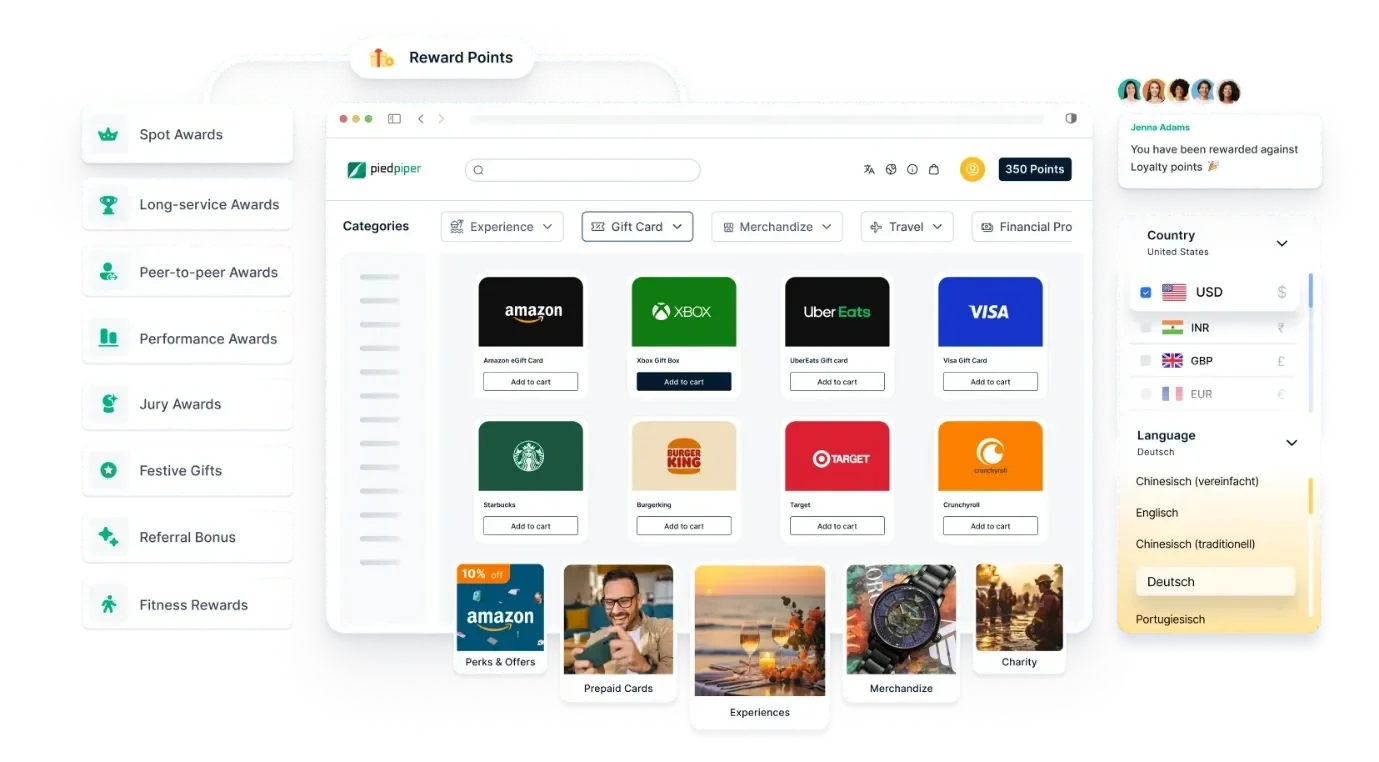
Letting employees choose from a catalog solves the problem that no single reward suits everyone, especially across countries and currencies.
3. Make the reward timeline clear
Transparency about when rewards are paid is crucial. Most companies pay once the referred candidate accepts the offer, starts work or completes 30, 60 or 90 days, and splitting the payout keeps employees motivated while protecting against early turnover. State the timeline upfront and automate milestone reminders so nobody has to chase HR for their bonus.
4. Keep rewards fair and compliant across locations
Keep rewards consistent across departments and locations. For global organizations, adjust amounts for local cost of living and currency, and make sure every reward is processed in a tax-compliant way. Inconsistent rewards between teams undermine trust in the whole program.
5. Recognize effort even when there is no hire
To keep morale high, offer small rewards or public thanks for referrals that reach a defined stage, such as the final interview, even if the candidate is not hired. Employees then feel valued for quality referrals rather than for luck. For more ways to appreciate people beyond money, see our guide to employee recognition programs.
Creative employee referral program ideas
The most successful programs feel exciting rather than administrative. These eight ideas lift participation, with gamification and hard-to-fill boosters usually delivering the quickest results.
- Gamify referrals: Award points at each stage a referral clears, such as shortlist, interview and offer, show a live leaderboard and reward top referrers each quarter.
- Double rewards for hard-to-fill roles: Offer a time-limited boost, such as "refer a data engineer before the end of the month and earn double", to create urgency.
- Run themed campaigns: Give campaigns a seasonal identity and align posters, emails, Slack banners and giveaways for consistency.
- Reward social sharing: Encourage employees to share openings on their own networks and reward qualified applicants or interviews, not only hires.
- Try mystery rewards: Tell employees every successful referral earns a surprise, such as a smartwatch, a staycation or a high-value gift card, revealed after the candidate joins.
- Add team-based rewards: When a referred hire completes probation, reward the referrer's whole team with a lunch or outing, so everyone has a stake in hiring.
- Build a referral hall of fame: Feature top referrers each month on your intranet or digital signage, with stories about the people they brought in.
- Hold a quarterly referral week: Spend one week each quarter on referrals, with priority roles, recruiter Q&A sessions, mini-contests and daily updates.
Employee referral program examples
Successful referral programs tend to follow one of five models. Each example below describes a model in use at many organizations, so you can pick the one that matches your hiring needs and culture.
| Model | How it works | Best for |
|---|---|---|
| Tiered cash program | Fixed rewards by role level, paid in two parts after start and 90 days | Companies hiring across many role levels |
| Hard-to-fill booster | Double or extra rewards for niche roles during a set period | Tech, healthcare and skilled trades hiring |
| Gamified leaderboard | Points for each stage plus quarterly prizes for top referrers | Large workforces that need sustained participation |
| Choice and charity model | Referrers pick a reward from a catalog or donate it to a cause | Values-driven and global organizations |
| Frontline quick-pay | Small rewards paid fast, often after 30 days, with a mobile referral link | Retail, hospitality, logistics and contact centers |
Across all five models, the lesson is the same: success depends on clear communication, a simple process and making employees feel like trusted partners in recruitment, not just on the size of the bonus.
Must-have features in employee referral software
A spreadsheet and an email thread cannot sustain a referral program at scale. Employee referral software, often a module of your applicant tracking system, should offer these seven features, with ease of use first because it drives participation.
- Simple submission: Employees refer in a few clicks on desktop, mobile, Slack or Teams.
- Real-time tracking: Referrers and HR see where each referral stands and when rewards are due.
- Automated communication: Notifications, thank-you messages, stage updates and reward alerts without manual follow-up.
- ATS integration: Referrals flow into your applicant tracking system so they are processed like other candidates, without duplicate entry.
- Campaign tools: Targeted campaigns for priority roles, seasonal drives or diversity hiring.
- Rewards management: Automated, compliant delivery of cash, points or gift cards across countries and currencies.
- Analytics: Referral-to-hire rate, reward spend, participation and campaign performance.
When comparing tools, test ease of use with real employees, check admin controls for rules and approvals, confirm integrations with your ATS, HRMS and collaboration tools, and ask how rewards are delivered and taxed in each country you hire in.
Launching an effective employee referral campaign
Even a well-designed program needs a strong launch to gain traction. These six steps create excitement, educate your workforce and keep participation going after the first week.
- Set goals and success metrics: Decide whether the campaign should fill specific roles, raise referral volume or improve quality of hire, and track referrals submitted, referral-to-hire rate, time to fill and participation by department.
- Promote priority roles: Spotlight high-priority openings with short role summaries and the profile of the ideal candidate. The more context you share, the better the matches.
- Make it visual: Use catchy taglines, consistent graphics, short videos, polls or quizzes across email, posters and your social intranet.
- Communicate rewards upfront: Explain amounts, eligibility and payout timing clearly, and share success stories from past referrers.
- Keep the process simple: Employees should submit in a few clicks, track progress and get notified when their referral moves forward.
- Keep the energy up: Share weekly updates, celebrate top contributors, nudge quiet teams and add flash rewards mid-campaign.
Measuring the success of your referral program
Measure the program to improve it and prove its value to leadership. Track these six metrics monthly, starting with referral-to-hire rate because it reflects both quality and process.
- Referral-to-hire rate: Hires from referrals divided by referrals submitted. A low rate may point to unclear role briefs or rewards that encourage volume over quality.
- Share of hires from referrals: Referral hires as a percentage of all hires, the clearest measure of program reach.
- Time to fill: Days to fill referred roles compared with other sources.
- Cost per hire: Referral rewards and program costs per referral hire, compared with agency and advertising costs.
- Participation rate: The percentage of employees who submitted at least one referral in the period.
- Quality of hire and retention: Performance ratings and 90-day and first-year retention of referred hires compared with other channels.
Use this simple formula to show return on investment: Referral program ROI = (cost per hire from other sources minus cost per referral hire) multiplied by referral hires. For example, if an agency hire costs $8,000, a referral hire costs $2,500 including the reward and program costs, and you make 20 referral hires a year, the program saves $110,000. These figures are illustrative; use your own costs.
Strong onboarding protects that investment by helping referred hires settle in quickly. Our new employee onboarding checklist covers every step from preboarding to the first year.
How Empuls rewards referrals that turn into hires
Empuls handles the reward side of your referral program, so a successful referral gets thanked quickly without spreadsheets or payroll workarounds. You can approve a referral reward directly in Empuls or push the hire event from your own systems through the Empuls REST API to trigger the reward automatically.
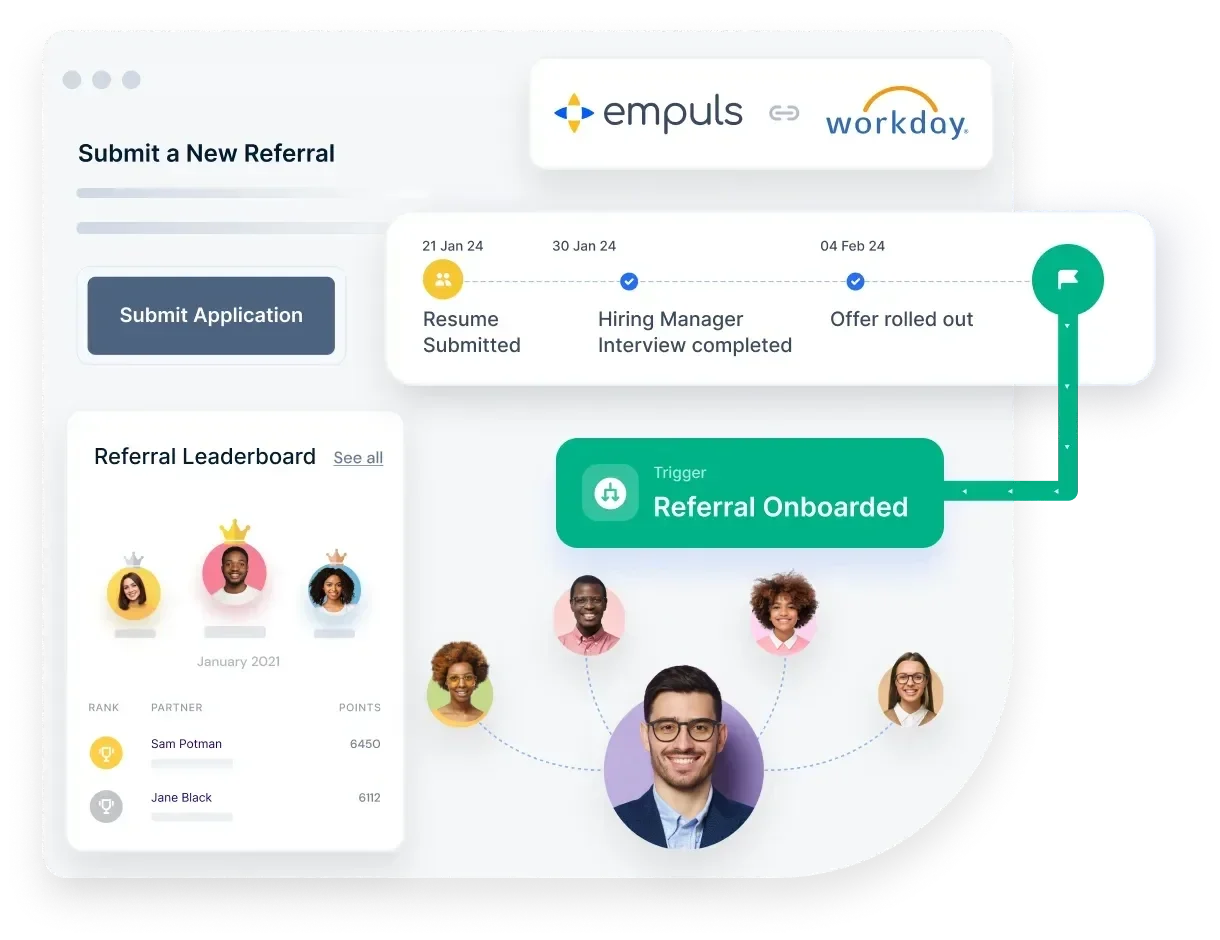
- Rewards people want: Points or gift cards from a catalog of more than 10 million options across 150+ countries, with local currency and tax handled.
- Delivery anywhere: Rewards land in Slack, Teams or email, and even referrers without an Empuls account can redeem through a secure link.
- Public recognition: Celebrate successful referrers on the social feed so others are inspired to refer.
See how Empuls referral rewards work, explore the wider milestone rewards program and use Empuls recognition to thank every quality referral, not only the ones that end in a hire.
Making your referral program a lasting hiring engine
A well-designed employee referral program is one of the most effective ways to bring in top talent. It builds on trust, boosts engagement and taps networks your employees already have. To make it work, you need more than a rewards budget: clear rules, a simple process, rewards that are fair and timely, regular campaigns and metrics that show what is working. Get those right, recognize every contribution, and referrals become a steady pipeline of quality hires who fit your culture from day one.
Book your Empuls demo
Frequently asked questions
There is no single right amount. Many companies tier bonuses by role level, with smaller rewards for entry-level and hourly roles and larger ones for senior or hard-to-fill roles. Set amounts relative to what you currently spend per hire through agencies or advertising, so the program still saves money, and adjust for local pay levels.
Most companies pay after the referred candidate starts or completes 30, 60 or 90 days. Splitting the payout, for example half at the start date and half after 90 days, keeps referrers motivated while protecting against early turnover. Whatever you choose, state it clearly in the policy and automate reminders.
In most countries, yes. In the US, the IRS treats cash and cash equivalents provided by an employer as taxable income, so cash bonuses and general-purpose gift cards are taxable wages. Process referral rewards through payroll or a rewards platform that handles tax compliance, and check local rules in every country you operate in.
Most programs let all employees refer, but exclude recruiters, HR staff involved in the hire and the hiring manager for that role, to avoid conflicts of interest. Many also exclude candidates already in the pipeline and former employees who left recently. Some companies extend referrals to alumni, contractors or customers with a separate reward.
Make referring take a few clicks, share priority roles regularly, update referrers at every stage and pay rewards on time. Add campaigns such as hard-to-fill boosters, leaderboards and quarterly referral weeks, and recognize every quality referral publicly, not only the ones that result in a hire.
They can if your workforce is not already diverse, because people tend to refer others like themselves. Reduce the risk by running targeted campaigns that encourage referrals from wider networks, tracking referral hires by demographic where lawful, and using referrals alongside other sourcing channels rather than relying on them alone.
It varies by role and company, so benchmark against your own other sources rather than a universal number. Ashby's 2025 data shows referred candidates reach interview at 40% versus 3% for inbound applicants, so referrals should convert noticeably better than your job board applicants. If they do not, review your role briefs and reward rules.
An employee referral program rewards staff for recommending job candidates who get hired. A customer referral program rewards customers for recommending new customers who buy. Both rely on trust in personal recommendations, but they differ in goals, reward rules, tax treatment and the teams that run them.





































































































































































































































































































































































































































































































































































