
Key Takeaways
Employee attrition is the gradual loss of employees through resignation, retirement, dismissal or other exits when the roles are not filled again.
The employee attrition rate formula is the number of employees who left divided by average headcount for the period, multiplied by 100.
The five types of employee attrition are retirement, voluntary, involuntary, internal and demographic-specific, and voluntary attrition is the most common and most preventable.
Gallup found that 42% of voluntary leavers say their manager or organization could have kept them, with pay, manager relationships and career growth topping the list.
Replacing an employee can cost from 40% of salary for frontline roles to 200% for leaders, so preventing avoidable attrition pays back quickly.
Employee attrition is the gradual loss of employees from a company, through resignations, retirements, dismissals or other exits, when the roles they leave are not filled again. You measure it with the attrition rate: exits divided by average headcount, times 100. Reducing it comes down to finding out why people leave and fixing the causes you control, such as pay, manager conversations, growth and recognition.
Some movement of people in and out of a business is natural. But exits still dominate the labor market. In the US alone, the Bureau of Labor Statistics JOLTS release for 2025 counted 62.8 million separations, and 38.0 million of them, roughly 60%, were quits. Every one of those exits costs the employer time and money in recruiting, onboarding and lost productivity.
There are many reasons behind both attrition and turnover, and employers often misunderstand them. With so many options available, modern employees are ready to move on if they are not satisfied, or simply because they see greener pastures. High rates of loss are unsustainable over the long term. This guide covers what employee attrition means, how it differs from turnover, the employee attrition rate formula, the types of employee attrition, what it costs and how to reduce employee attrition step by step.
What employee attrition means
Employee attrition refers to the gradual reduction in a company's workforce as employees leave the organization, voluntarily or involuntarily, without those positions being filled. It happens when staff resign, retire, move on for personal reasons or pass away, and the company chooses not to replace them, at least not right away.
A little attrition is healthy. It lets a business shrink costs gently, reshape teams and make room for new skills without layoffs. Over time, though, high attrition hurts productivity, morale and overall business performance, because the people who leave take knowledge, relationships and momentum with them.
Employee attrition vs employee turnover
The terms attrition and turnover both describe employees leaving an organization and are often used interchangeably. Both cost the organization money, time and effort, but by definition they are different: the real difference is whether the role gets filled again and why the person left.
Attrition often comes from life events rather than anything happening inside the company. An employee may retire, move to be with family, go back to school or pass away. Turnover usually means a role is vacated and then backfilled, and when turnover is high it tends to reflect negatively on the organization, because it often points to problems with managers, pay, workload or culture.
| Factor | Employee attrition | Employee turnover |
|---|---|---|
| What happens to the role | Left vacant or eliminated | Backfilled with a new hire |
| Typical causes | Retirement, relocation, education, restructuring, hiring freezes | Resignations for better offers, poor management, dismissals |
| Effect on headcount | Shrinks the workforce over time | Headcount stays roughly the same |
| What it signals | Often planned or natural; a problem when concentrated in one team or group | Often a sign of engagement, pay or culture issues |
| Main cost | Lost capacity and knowledge | Recruiting, onboarding and ramp-up time |
In practice, most HR teams track both. If you want a deeper look at the turnover side, our employee retention strategies guide covers why people actually leave and what it costs.
Employee attrition rate formula and how to calculate it
The employee attrition rate measures how many people left a company compared with the average number employed over the same period. It is how organizations find the percentage of employees leaving over a set period and track whether things are improving. The standard employee attrition rate formula is:
Attrition rate (%) = (Number of employees who left ÷ Average number of employees) × 100
Although some attrition is part of every employee's natural lifecycle, a high or rising rate is a concern for managers and HR professionals. To calculate your annual employee attrition rate, follow these steps:
- Record how many employees your company had at the start of the year (the first day of Q1).
- Track how many employees left the company for any reason during the year.
- Keep a record of how many people were hired that year, so you can reconcile headcount.
- Conduct a final headcount at the end of the year (the last day of Q4).
- Calculate the average number of employees for the year: add the starting headcount to the final one and divide by two.
- Divide the number of employees who left by the average from step 5, then multiply by 100 to get your attrition rate as a percentage.
Worked example: You start the year with 400 employees and end with 380. During the year, 60 people left. Average headcount is (400 + 380) ÷ 2 = 390. Your attrition rate is 60 ÷ 390 × 100, or about 15.4%.
A few variations help you read the number properly:
- Monthly or quarterly rate: Use exits and average headcount for that month or quarter to catch problems early instead of waiting for the annual figure.
- Annualized rate: To project a full-year rate from a partial year, divide year-to-date exits by average headcount, then scale by 12 divided by the number of months elapsed.
- Voluntary attrition rate: Count only resignations. This is the rate your engagement and retention work can move most directly.
- Segmented rate: Calculate the rate by team, manager, tenure band, location and demographic group. A healthy company-wide rate can hide one team that is losing people fast.
For a step-by-step view of using these numbers in an HR analytics routine, see the playbook to reduce employee attrition.
See attrition risk before people resign
Empuls surveys, eNPS and recognition help you spot and fix the causes of attrition early.
Talk to our ExpertTrusted by 5,000+ companies
5 types of employee attrition
There are five main types of employee attrition, and they are listed below from the most natural to the most worrying. Voluntary attrition usually carries the most weight because it is the most common and the most preventable, while demographic-specific attrition needs the fastest response because it can point to fairness or inclusion problems.
To improve retention, companies first need to understand the reasons behind each exit, so classify every departure into one of these buckets.
1. Attrition due to retirement
As employees reach the end of their working lives, they retire and leave. This is natural and expected, and in small numbers it barely moves your attrition rate. However, retirement should not be ignored. If a sizable group of experienced people retires around the same time, you can lose critical knowledge and client relationships in one go.
The drivers are not only age-related. Some people retire early for involuntary reasons such as illness, while many choose to because they can afford it. Others, after decades of experience, leave to work as independent consultants, using their industry knowledge with more flexibility. Succession planning, phased retirement and mentoring programs help you capture that knowledge before it walks out of the door. Our guide on how to retain tenured employees covers this group in detail.
2. Voluntary attrition
In voluntary attrition, the employee initiates the exit and decides to leave of their own accord. It is the most common type of attrition. Perhaps they did not like the work environment, felt overworked and underappreciated, or got a better offer elsewhere.
Some employees are still working out what they want from their careers and are willing to move until they find job fulfillment. They are not afraid to leave if they do not get it. The good news is that much of this is within your control: Gallup's research on preventable turnover found that 42% of employees who voluntarily left their organization said their manager or organization could have done something to keep them.
3. Involuntary attrition
Involuntary attrition is a decision made by the company rather than the employee. Many factors can drive a business to reduce its workforce, including but not limited to:
- Mergers and acquisitions
- Structural reorganization
- Layoffs
- Reduction in workforce
- Job position elimination
In other cases, an employee may have shown workplace misconduct or persistent underperformance and is asked to leave. Involuntary exits are sometimes necessary, but they still affect the people who stay, so communicate the reasons clearly and treat departing employees with respect.
4. Internal attrition
Internal attrition can be driven by the company or the individual. Here, employees leave their job in one department to join another within the same business. If one department sees a high rate of internal attrition, it is worth investigating, because it may mean the team is failing in some respect:
- Is the manager inadequately skilled or supported?
- Is there a hostile or stressful environment?
- Is the team struggling to meet its targets?
HR can investigate and find solutions. In some cases, though, internal attrition is a positive sign. It can route talent toward more valuable areas of the business and improve employee job fit over the long run, which keeps people inside the company instead of losing them to a competitor.
5. Demographic-specific attrition
Demographic-specific attrition happens when people from one group leave at a noticeably higher rate than others. This is a particular concern for companies, because diverse teams drive innovation and growth. An equal-opportunity workplace should investigate quickly if large numbers of a specific group are resigning, such as women, ethnic minorities, veterans, older professionals or people with disabilities.
No one should feel uncomfortable at work because of who they are, and when they do, it reflects poorly on the company. Start by segmenting exit and survey data to find the root cause, then work toward a more inclusive culture. Our guide to inclusion and diversity in the workplace has practical steps.
What employee attrition really costs
Attrition, whatever the reason, can be extremely expensive. Gallup estimates that replacing an employee costs a share of their annual salary that rises steeply with the seniority and complexity of the role:
40%
of salary
to replace a frontline employee
80%
of salary
to replace a technical professional
200%
of salary
to replace a leader or manager
Source: Gallup, estimated cost of replacing an employee
The financial hit is only one side of it. Attrition also does real damage to the employees who stay. The main costs of losing an employee include:
- Hiring costs: Advertising, sourcing, interviewing, screening and hiring a replacement.
- Onboarding costs: Training a new employee and the management time it takes to bring them up to speed.
- Lost productivity: A new hire can take months to reach the productivity of the person who left, and the gap is longer in complex roles.
- Lost engagement: Remaining employees often disengage and lose productivity when they see teammates leave, and they pick up extra workload while the role is open.
- Customer service and errors: New employees take time to settle in and may take longer to solve customer problems or make more mistakes.
- Lost training investment: Every course, certification and hour of coaching you invested in the departing employee leaves with them.
- Cultural impact: Whenever someone leaves, others start asking why, and a wave of exits can quickly become a story people tell about your company.
A high attrition rate cuts much deeper than the visible costs. That is why it is so important to have a robust employee retention strategy that limits the damage attrition can do.
Common causes of employee attrition
Most voluntary attrition traces back to a handful of causes, and pay and manager relationships carry the most weight. When Gallup asked voluntary leavers what would have kept them, their answers fell into the categories below, ranked by share:
The same Gallup study found that 45% of voluntary leavers said no manager or leader talked with them about their job satisfaction, performance or future in the three months before they left. Engagement is part of the picture too: Gallup's State of the Global Workplace 2026 reports that only 20% of employees worldwide were engaged in 2025, and only 22% of managers. Disengaged people are easier to lure away, so it is worth knowing the signs of employee disengagement before they turn into resignations.
How to reduce employee attrition: 10 strategies
If there is one thing to remember when you set out to reduce employee attrition, it is that little things matter. The 10 strategies below start with diagnosis, because you cannot fix what you have not measured, and engagement and recognition carry the most weight once you know where the problems are.
Understanding what drives people to leave helps you address problems before they cause substantial damage. Here are proven employee retention strategies that will help you significantly reduce employee attrition rates:
1. Analyze your workforce
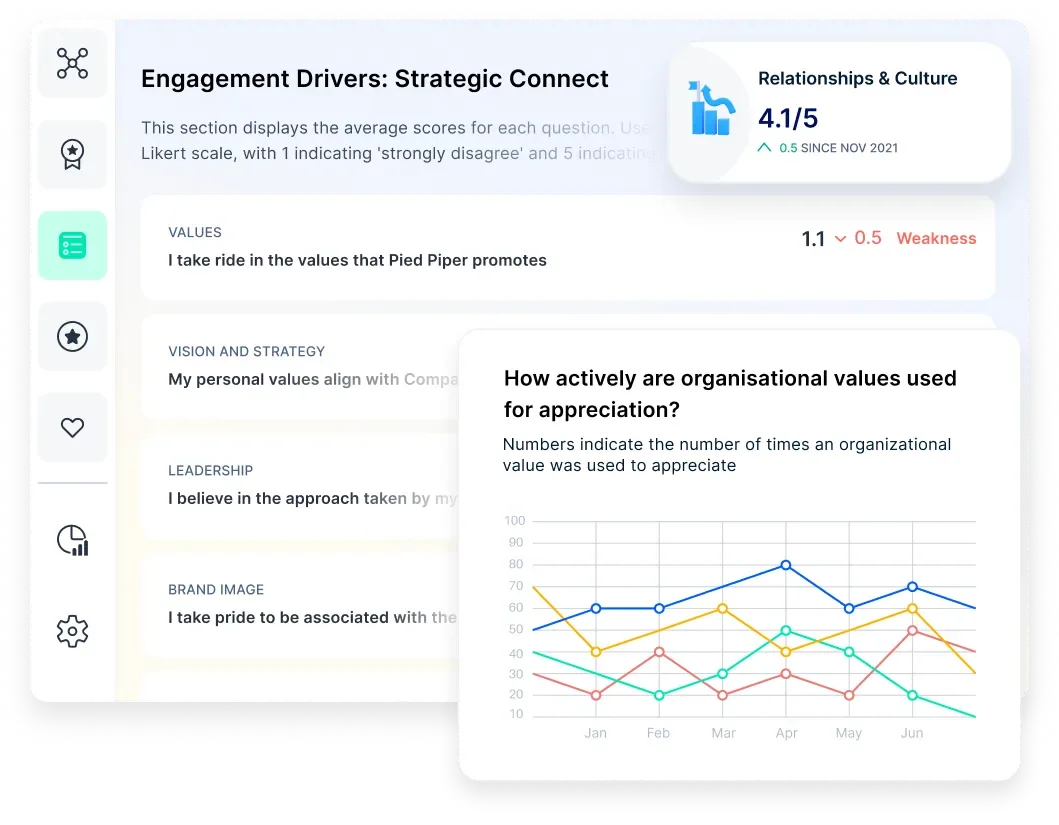
We use technology for almost everything at work, so apply it to understanding your workforce too. Collect feedback and run polls and surveys across teams to learn what employees want and where the gaps are in the work environment. Find out how people feel about their workplace and teams, whether they face specific challenges and whether a recent policy or event has upset them.
You can also see which teams have high attrition and which have strong retention. Hold structured one-on-one meetings with managers and employees to get the exact pulse of each team. With this analysis in place, it becomes much easier to spot early signs of attrition and act before damage is done. Regular pulse surveys keep this signal current instead of relying on a single annual survey.
2. Build teams based on employee personalities
Every organization has a range of personalities. Some people are natural leaders, some are careful perfectionists and detail-oriented taskmasters, some are risk-takers, and some are innovators buzzing with ideas. When people with different traits work together, they can pull each other up and achieve far more. Understanding how people work and what motivates them helps you build stronger teams and get better results, and people who fit well with their team are far less likely to leave.
3. Rethink your HR policies
Work moves quickly now. If your HR policies still reflect the industrial era, today's workforce will not value them much. Rigid, outdated policies make it hard to engage and retain employees. Review your HR policies regularly and reframe them to be people-centric and suited to a dynamic workforce, covering leave, flexibility, wellbeing, parental support and career moves.
4. Offer fair pay, flexibility, perks and benefits
Employees move on when their job no longer meets their financial needs, and compensation and benefits top Gallup's list of fixable reasons for leaving. Offering competitive salaries in line with current market trends is a must. Exclusive perks and benefits tailored to where and how your people work make a strong addition, such as discounts on groceries, dining, travel, health and wellness, gadgets and apparel. You can see what this looks like in our guide to employee perks.
Flexibility is another valuable perk. It can mean remote or hybrid work, flexible hours, time off for family needs, generous parental leave or a sabbatical to complete education. A flexible work environment also shows that managers trust their teams to get the work done even when life gets in the way, which goes a long way in building a strong employer-employee relationship.
5. Make internal movement easy
One of the most common reasons employees quit is that they want to change career paths. Often, people realize they do not fit a particular role, or they develop an interest in a different field. Giving employees the option to switch departments and career paths within the organization reduces overall attrition. Clear internal mobility policies, open internal job postings and manager support for moves make this work, and they keep skills inside the business.
6. Create a pleasant workplace
We spend a large part of our lives at work, so creating an environment where employees are happy, engaged and productive matters enormously. Make sure people have chances to socialize with colleagues, opportunities to learn and grow, recognition for their work and a voice that is heard. Each of these plays a big role in improving retention. A strong positive company culture ties these elements together.
7. Engage and recognize your employees
Most managers put a lot of thought into hiring, hoping the new employee is intrinsically motivated and driven to achieve great results. But employees struggle to deliver when goals and expectations are unclear. A clear conversation about goals and expectations adds a lot of clarity to each role.
Check in regularly about challenges and the support people need, and appreciate their efforts through rewards and recognition. Morale and engagement rise, and people stay longer. Recognition works best when it is frequent and specific, which is why many companies pair peer-to-peer recognition with spot awards from managers. For a full set of ideas, see these employee engagement strategies.
8. Optimize recruitment
From the start, set out clear and specific requirements for each job: goals, tasks and responsibilities. That way, new hires know exactly what to expect, and you avoid early disappointment and wasted recruiting spend. Realistic job previews, structured interviews and a strong onboarding plan all help you hire the right candidates and improve retention in the first year, when attrition is often highest.
9. Improve working conditions
Top-performing companies provide development opportunities, good benefits and a positive working culture. Working conditions are one of the most important factors in whether an employee stays or leaves. Invest in them so people feel their needs are respected: reasonable workloads, adequate staffing, safe and comfortable spaces, flexible schedules, remote work options and assistance programs. Benefits and incentives tied to these conditions improve motivation because people feel valued.
10. Invest in growth and development
If talented employees feel they have no chance to progress and expand their skills, they will look elsewhere. Career advancement is one of the fixable reasons for leaving in Gallup's research. Provide training, stretch assignments and constructive feedback so people can improve and see professional success, and make career paths visible.
Without growth and engagement, employees feel bored and unproductive. Do everything you can to build a positive, open environment where people collaborate and develop their skills, and fewer of them will resign because they feel stuck or undervalued.
Metrics to track alongside your attrition rate
Your attrition rate tells you how many people left, but not why or what comes next. Track these related metrics to see the full picture:
- Voluntary vs involuntary attrition: Separates the exits you can influence from planned reductions.
- Regrettable attrition: The share of leavers who were high performers or in critical roles.
- First-year attrition: Exits within 12 months of hire, which point to hiring or onboarding gaps.
- Retention rate: The share of employees at the start of a period who are still with you at the end.
- eNPS and engagement scores: Leading indicators that usually fall before resignations rise.
- Exit and stay interview themes: The reasons behind the numbers, grouped so you can act on them.
How Empuls helps reduce employee attrition
High attrition is not just an HR metric. It is often a cultural red flag that points to deeper engagement issues. To reduce its cost and impact, organizations need to go beyond exit interviews and focus on real-time listening, recognition and support. Empuls, Xoxoday's employee engagement platform, brings these together:
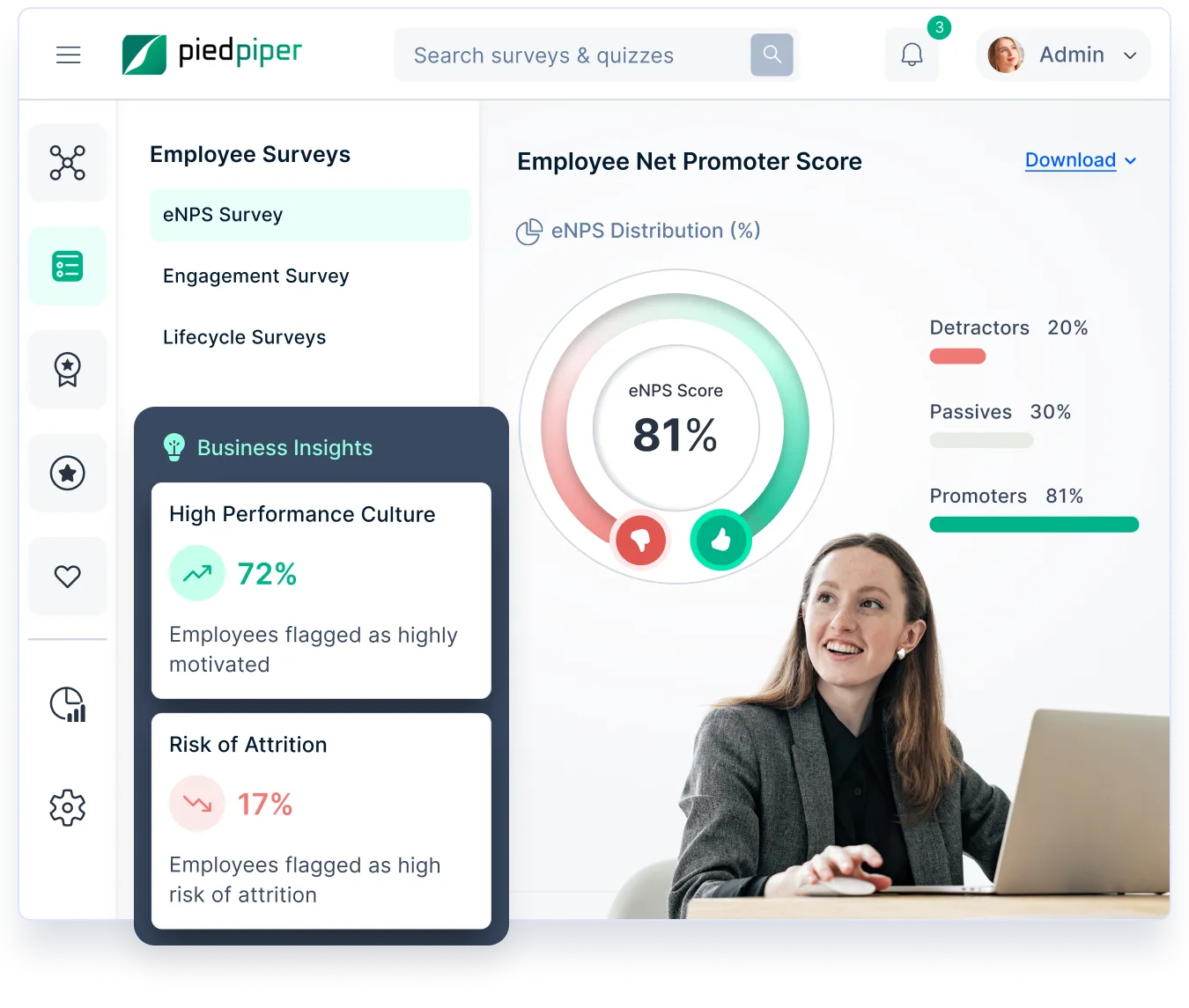
- Spot attrition patterns early: Employee surveys include eNPS, engagement, pulse and lifecycle surveys plus AI sentiment analysis, so HR can segment feedback by department, tenure or manager and see where friction exists.
- Act on what you hear: Survey action plans assign each theme to an owner and track closure, so employees see their feedback lead to change.
- Recognize and reward in the flow of work: Recognition covers peer shoutouts, spot awards and nominations, with rewards redeemable across 175+ countries and integrations with tools like Slack and Microsoft Teams.
- Offer benefits people value: Empuls benefits include employee discounts, lifestyle accounts, learning budgets and financial wellness support such as earned wage access.
- Celebrate milestones: Service awards and career milestones make tenure visible, which matters for retaining experienced people.
Attrition is a signal worth listening to
Employee attrition is natural, and some of it is healthy. It becomes a problem when it is high, rising or concentrated in one team or group, because that usually points to a flaw in the system. Investigate each pattern carefully, since the root cause is not always obvious, then fix what you control: pay, manager conversations, growth, flexibility and recognition.
The golden rule is to communicate with and engage your employees. A respectful, appreciative workplace is far less likely to see a steady loss of talent. If you are building a structured approach, our guide to running an employee retention program is a good next step.
Book your Empuls demo
Frequently asked questions
There is no single good employee attrition rate, because healthy levels vary widely by industry, role type and region. Retail, hospitality and contact centers run much higher rates than finance or government. The most useful benchmark is your own trend over time and comparable companies in your sector. Focus on voluntary and regrettable attrition, since those are the exits you can actually influence.
Divide the number of employees who left during the month by the average headcount for that month, then multiply by 100. Average headcount is the number of employees at the start of the month plus the number at the end, divided by two. Tracking the monthly rate helps you spot spikes early instead of waiting for annual numbers.
No. Both describe employees leaving, but attrition usually means the role is not filled again, so headcount shrinks over time. Turnover means the role is vacated and then backfilled with a new hire. Attrition often comes from retirement or restructuring, while high turnover tends to signal problems with pay, managers, workload or culture.
The main causes of employee attrition are below-market pay and benefits, poor relationships with managers, limited career growth, heavy workloads or understaffing, lack of recognition and frustrating organizational issues. Life events such as retirement, relocation or further study also drive attrition. Exit interviews, stay interviews and regular surveys help you separate the causes you can fix from the ones you cannot.
Voluntary attrition happens when an employee chooses to leave, for example to take another job, retire or return to study. Involuntary attrition happens when the employer ends the relationship through layoffs, restructuring, role elimination or dismissal for performance or misconduct. Track them separately, because engagement and retention programs mainly influence voluntary attrition.
HR can predict employee attrition by watching leading indicators: falling engagement or eNPS scores, rising absenteeism, fewer recognitions given or received, stalled promotions, pay below market and sudden changes in behavior. Combining survey data with HR records by team and tenure shows where risk is building. Regular manager check-ins then confirm the signal and give a chance to act.
Not always. Some attrition is natural and even useful, such as retirements, planned restructuring or the exit of consistent low performers. It becomes a problem when it is rising, concentrated in one team or demographic group, or includes many high performers. Those patterns usually point to issues with managers, pay, growth or culture that need attention.
Quick fixes such as better manager check-ins, more frequent recognition and fixing obvious pay gaps can show results within a few months. Deeper changes, like career paths, culture and leadership development, usually take 12 to 24 months to move the attrition rate. Track monthly voluntary attrition and engagement scores so you can see progress early.





































































































































































































































































































































































































































































































































































