
Key Takeaways
Active listening in the workplace means giving full attention, understanding the words and feelings behind them, and confirming that understanding before responding.
Employees are interrupted about every two minutes during the workday, according to Microsoft's 2025 Work Trend Index, so listening well takes a deliberate choice.
The core active listening techniques are removing distractions, not interrupting, paraphrasing, asking open questions, noticing non-verbal cues and summarizing next steps.
Employees who receive valuable feedback are five times as likely to be engaged, and valuable feedback starts with listening to what people actually mean.
Organizations scale listening beyond one-on-ones with continuous check-ins, pulse surveys and sentiment analysis, then show employees what changed as a result.
Active listening in the workplace means giving a colleague your full attention, understanding both their words and the feeling behind them, and showing that understanding before you respond. It is the difference between hearing someone and actually taking in what they mean, and it is one of the fastest ways to cut misunderstandings, build trust and help people feel valued at work.
Technical skill is only part of what makes someone good at their job. Whether you are a writer, an HR professional or an executive making high-stakes decisions, your growth depends on how well you connect with and understand other people. This guide explains what active listening is, why it matters at every stage of your career, the active listening techniques that work, the barriers that get in the way and a practical plan for how to improve active listening, with a phrase bank and self-check you can use this week.
What is active listening
Active listening is a communication technique in which the listener concentrates fully on the speaker, works to understand their message and emotions, and confirms that understanding through reflection, questions and body language. Psychologists Carl Rogers and Richard Farson introduced the term in the 1950s, and the idea has become a core part of management, coaching and counseling ever since.
This description can be confusing at first: when you hear what people say, are you not listening already? Here is an example that shows the difference.
We have all had conversations with someone who hears and responds to what you are saying but does not seem fully engaged. They glance around the room, check their phone or appear to take in only some of what you say. When the conversation is over, you do not feel they understood your perspective or your feelings, even though they responded adequately.
When you talk to someone who is listening actively, you have their full attention. They make steady eye contact, avoid interrupting and often reword what you told them so you know they understood. Active listening does not mean agreeing with everything someone says. It means taking the time to comprehend another person's perspective and emotions, not just the words they speak.
| Passive or partial listening | Active listening |
|---|---|
| Hears the words, waits for a turn to talk | Listens to understand, not to reply |
| Splits attention with a phone, inbox or chat | Gives undivided attention for the length of the conversation |
| Assumes meaning and jumps to solutions | Checks meaning by paraphrasing and asking open questions |
| Ignores tone, pauses and body language | Notices non-verbal cues and names the emotion gently |
| Ends the conversation with nothing agreed | Summarizes what was heard and agrees on next steps |
Why active listening matters in the workplace
Many workplaces are short on attention, and listening is one of the first things to suffer. Microsoft's 2025 Work Trend Index found that employees are interrupted by a meeting, email or chat about every two minutes during the workday, and 57% of meetings are ad hoc calls without a calendar invite. Listening well in that environment is a deliberate choice.
Being heard also has measurable effects. In research by Gallup and Workhuman, only one in four employees strongly agreed they receive valuable feedback, yet those who do are five times as likely to be engaged and 48% less likely to be looking for another job, according to Gallup's 2024 analysis. Feedback only feels valuable when it is grounded in what the other person actually said and meant, which is where active listening starts.
2 min
between interruptions
for the average employee (Microsoft, 2025)
1 in 4
employees
strongly agree they get valuable feedback (Gallup, 2024)
5x
more likely to be engaged
when feedback is valuable (Gallup, 2024)
22%
of managers engaged
worldwide in 2025 (Gallup)
Why listening at work needs deliberate effort
Active listening matters in every role you hold, and it becomes more important as your responsibility grows. Here is how it helps at each stage of your career.
As an individual contributor
Listening actively to your peers and your manager serves you well as an individual contributor. You learn more about what matters to your manager in one-on-one conversations, you catch requirements the first time instead of in rework, and you collaborate more effectively with peers on shared projects.
As a manager
Active listening becomes even more important when you manage people. A good manager knows what is going on with the team: where tasks and projects stand, and how people are handling their workload and stress. Listening helps you understand what motivates and engages each person, and it is the foundation for useful feedback. That matters because managers are under strain themselves: Gallup's State of the Global Workplace report found manager engagement fell to 22% in 2025, down nine points since 2022.
As a leader
In leadership, it is easy to make decisions using only your own experience. You become a more effective and empathetic leader when you take in information from executive peers, managers and individual contributors alike. You make better decisions when you understand what is happening across the organization and weigh other people's perspectives before you commit.
Benefits of active listening at work
Active listening is not just about hearing someone out. It is about being present, understanding what is said and responding with intention, which creates a culture built on clarity, empathy and mutual respect. These are the six benefits of active listening at work that teams notice first:
- Clarity and fewer errors: Listening carefully means instructions and expectations are understood the first time, which saves time and rework.
- Trust and respect: When people feel heard, they are more likely to speak up, share ideas and raise problems early.
- Emotional intelligence: Active listening replaces assumptions with understanding, which helps teams handle sensitive situations well.
- Better conflict resolution: Restating each side's position calmly lowers the temperature and moves a disagreement from who is right to what will work.
- Stronger collaboration: When everyone feels included and understood, teamwork across functions becomes smoother.
- Better decisions: Leaders who listen spot underlying issues and employee needs sooner, so they act on real information rather than guesses.
Over time, these benefits compound into a workplace where people communicate openly, solve problems faster and support each other. Active listening is one of the foundations of strong employee communication and one of the pillars of effective communication in the workplace.
Listen to every employee, not just the loudest
Run continuous check-ins and pulse surveys that show managers what their teams really think.
Talk to our ExpertTrusted by 5,000+ companies
10 active listening techniques to practice
Active listening is a skill you can practice every day, and everyone can get better at it. The 10 techniques below start with attention, because nothing else works without it, then move to understanding and finally to how you respond.
- Stay present: Meetings and one-on-ones are full of distractions: a phone pings, an email arrives, someone walks past. You cannot understand someone unless you pay full attention, and they will not open up to someone who is only halfway there. Focus on the other person's words and body language, and use short mindfulness practice to train your attention on one thing at a time.
- Avoid multitasking: Checking your phone, scanning email or drafting a to-do list during a conversation signals that the person in front of you does not have your focus. Close unnecessary tabs, silence notifications and turn away from your screen. On video calls, keep your camera on and the chat panel closed.
- Do not interrupt: Letting someone finish their thought is a sign of respect, and it makes them more comfortable speaking freely. Interrupting usually means you were planning your reply instead of listening. You can still find a natural pause to ask a question, but it should be rare.
- Notice non-verbal cues: Active listening includes noticing what people do not say out loud. A set jaw, crossed arms or a shift in tone can tell you more than the words. When the words and the cues do not match, ask a gentle clarifying question.
- Use positive body language: Nod occasionally, keep an open posture and lean in slightly. Avoid crossing your arms, glancing at your watch or looking around the room, which signal disinterest even when you do not mean them to.
- Ask open-ended questions: Questions that invite more than yes or no, such as "Can you tell me more about that?" or "What was your thinking behind that decision?", show curiosity and stop you from filling gaps with assumptions.
- Paraphrase and clarify: Repeat the key points back in your own words, such as "So the main blocker is the vendor delay, not the budget?" The speaker can correct you if you misunderstood. Do not get defensive when they do, because that is exactly what clarifying is for.
- Empathize: The goal is understanding, not agreement. Make an active effort to see things from the other person's position and name the feeling you notice: "That sounds frustrating." Empathy is especially important with someone who has less experience in the topic than you.
- Practice patience: Conversations do not always move at your pace, especially when emotions are involved. Allow silence when someone is thinking. Resist the urge to fill every pause or steer the conversation somewhere new too quickly.
- Reflect before responding, then summarize: Take a brief moment to process what was said before you answer, so you respond rather than react. Close important conversations with a short summary and agreed next step, so both of you leave with the same understanding.
A simple way to remember the core loop is RASA, a model popularized by sound expert Julian Treasure: Receive (pay attention), Appreciate (small signals such as "I see"), Summarize (play back what you heard) and Ask (follow up with questions).
Common barriers to active listening and how to fix them
Most people do not fail at listening because they do not care. They fail because a few predictable habits get in the way, and each one has a simple fix.
| Barrier | What it looks like | Fix |
|---|---|---|
| Digital distraction | Glancing at notifications or typing during a call | Silence notifications, close the laptop or switch to full-screen video |
| Rehearsing your reply | Planning your answer while the other person talks | Paraphrase before you respond, which forces you to listen first |
| Jumping to solutions | Offering a fix before the problem is fully explained | Ask "Do you want ideas, or do you want me to listen first?" |
| Assumptions and bias | Filling gaps based on role, seniority or past experience | Ask an open question to check the assumption |
| Emotional triggers | Getting defensive when you hear criticism | Pause, take a breath and summarize the point before replying |
| Time pressure | Rushing a sensitive conversation between meetings | Reschedule to a time when you can give full attention |
Active listening phrases you can use at work
Knowing the techniques is one thing; having the right words ready in the moment is another. Use this phrase bank in one-on-ones, feedback sessions and tense meetings until the patterns feel natural.
| Goal | Phrases to try |
|---|---|
| Encourage the speaker | "Go on." "Tell me more about that." "What happened next?" |
| Paraphrase | "What I am hearing is..." "So, if I have this right..." |
| Clarify | "When you say 'soon', what timeline do you have in mind?" "Can you give me an example?" |
| Reflect feelings | "It sounds like that was frustrating." "You seem concerned about the deadline." |
| Explore | "What do you think is causing this?" "What options have you considered?" |
| Check what they need | "Would it help if I shared ideas, or would you rather think it through?" |
| Summarize and close | "Let me recap what we agreed..." "What is the one next step we should take?" |
Phrases work best when they are sincere. If a phrase sounds scripted in your mouth, adapt the wording until it sounds like you. For more examples of how to give feedback once you have listened, see these employee feedback examples.
Active listening examples in the workplace
These three short examples show how the same moment plays out with and without active listening. The first is the most common in daily work, which is why it comes first.
- A one-on-one check-in: An employee says the project is "fine, just busy." A passive listener moves on. An active listener notices the flat tone and asks, "Busy in a good way, or is something piling up?" The employee mentions an unclear handoff from another team, and the manager fixes it in a day instead of discovering it at the deadline.
- A customer escalation: A support lead hears a customer's complaint, paraphrases it back, and names the frustration before offering a fix. The customer feels understood, and the lead learns that the real issue is the billing date, not the product.
- A disagreement in a meeting: Two team members argue for different launch dates. The facilitator summarizes each position and the reason behind it, then asks what risk each one is protecting against. The conversation shifts from positions to a shared plan.
Listening is also the first half of feedback. Teams that build a culture of feedback rely on managers who listen before they advise, and a 360-degree feedback process works only when the person receiving it is ready to hear it.
How to improve active listening skills in 30 days
Active listening skills grow through repetition, not reading. This four-week plan builds one habit at a time, starting with attention because the later habits depend on it.
- Week 1, remove distractions: In every one-on-one, put your phone out of sight and close your inbox. Notice how often you want to check it.
- Week 2, paraphrase once per conversation: Before you answer in at least one conversation a day, summarize what you heard and ask if you got it right.
- Week 3, ask one more question: When you feel ready to respond, ask one open question first. Track how often it changes your answer.
- Week 4, ask for feedback: Ask two colleagues, "When I am in conversations with you, do you feel heard? What could I do better?" Then rate yourself again with the self-check below.
Managers can run the same self-check as a team exercise, then compare scores with how their team actually feels about being heard. If you work with distributed colleagues, our guide on how to engage remote employees covers listening rituals for video-first teams, and the guide to workplace communication styles helps you adapt your listening to different people.
How Empuls supports active listening in the workplace
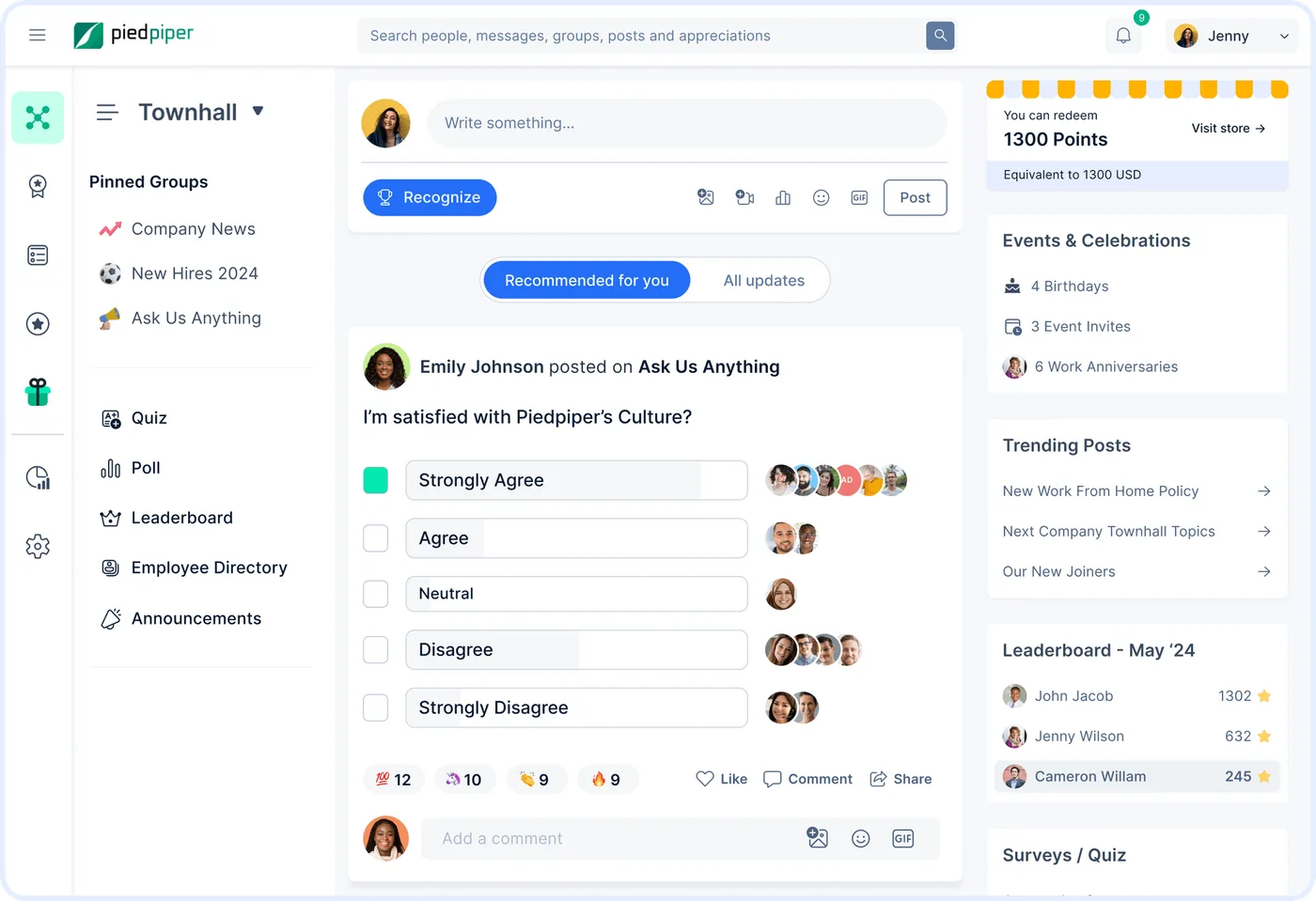
Individual listening skills matter most in one-on-one conversations, but organizations also need a way to listen at scale. Empuls is an employee engagement platform that helps HR teams and managers gather feedback, understand sentiment and act on what employees say, so listening becomes continuous rather than a once-a-year survey.
- Continuous listening: Empuls continuous listening runs ongoing, personalized check-ins across the employee journey and meets employees on Slack, Teams, WhatsApp and email.
- Pulse and lifecycle surveys: Pulse surveys and lifecycle surveys capture feedback from onboarding to exit.
- Sentiment analysis and action plans: AI sentiment analysis surfaces mood and emerging concerns by team or location, and action plans help managers close the loop on what they heard.
- Social intranet: The social intranet gives employees a place for open conversations, polls and peer recognition.
Make listening a daily habit
Active listening in the workplace builds stronger relationships and better teams. It takes focus, empathy and a real effort to understand others, not only what they say but how they feel. Whether you contribute individually, manage a team or lead an organization, strong listening leads to better collaboration, higher engagement and more thoughtful decisions.
Start small: one distraction-free conversation, one paraphrase, one extra question a day. The more consistently you listen, the stronger your connections, culture and team performance become.
Book your Empuls demo
Frequently asked questions
The five key elements of active listening are paying attention, showing that you are listening, providing feedback by paraphrasing and asking questions, deferring judgment, and responding appropriately. Together they move a conversation from simply hearing words to understanding the speaker's meaning and feelings, which is what makes the other person feel heard.
A manager in a one-on-one hears an employee say the project is fine but notices a flat tone. Instead of moving on, the manager asks whether something is piling up, learns about an unclear handoff and fixes it early. Noticing the cue, asking an open question and acting on the answer is active listening in practice.
You are likely a good active listener if people bring problems to you early, rarely need to repeat themselves and leave conversations with clear next steps. A quick self-check helps: rate how often you remove distractions, let people finish, paraphrase, ask open questions and summarize. Asking two colleagues for honest feedback gives you the most accurate picture.
People struggle with active listening mainly because of distraction, the urge to plan a reply while the other person talks, and the habit of jumping to solutions. Time pressure, assumptions about the speaker and emotional reactions to criticism also get in the way. Each barrier has a simple fix, such as paraphrasing before responding.
In virtual meetings, keep your camera on, close chat and email, and use full-screen view so the speaker's face is your focus. Use brief verbal signals because nods are harder to see, paraphrase key points before responding and use names when you ask follow-up questions. Leave a short pause before speaking to avoid talking over people on lagging connections.
No. Active listening means understanding another person's view and feelings, not agreeing with them. You can paraphrase someone's position accurately, acknowledge how they feel and still disagree. In fact, people accept disagreement more readily when they believe they were heard first, which makes active listening valuable in negotiations and conflict resolution.
Most people notice a difference within three to four weeks of deliberate practice, such as removing distractions in every conversation, paraphrasing once a day and asking one extra open question. Like any skill, active listening keeps improving with repetition, and asking colleagues for feedback every few months shows whether the habits are sticking.





































































































































































































































































































































































































































































































































































