
Key Takeaways
An employee engagement action plan turns survey results into a few specific actions, each with an owner, a deadline and a metric.
The nine action planning steps run from scanning the internal and external environment to gap analysis, strategy choice, measurement and corrective action.
Scoring each root cause on impact and ease, then sorting by the total, shows which engagement gaps to fix first.
Managers account for at least 70% of the variance in team engagement, so team-level action planning matters more than company-wide initiatives.
Plans fail when they chase too many priorities, skip communication back to employees or have no regular review.
An employee engagement action plan is a documented, time-bound set of actions that turns engagement survey results into specific changes, each with an owner, a deadline and a metric. A good plan focuses on two or three priorities, is built with the teams it affects and is reviewed every quarter, so employees can see that their feedback leads to action.
A well-structured employee engagement plan is no longer a nice-to-have. It is a strategic necessity for organizations that want to boost morale, improve retention and drive performance. Whether you're designing an employee engagement program from scratch or fine-tuning an existing one, a clear action plan makes the difference between a survey that changes things and one that fades into a slide deck.
This guide explains who owns engagement action planning, walks through nine employee engagement action planning steps, gives you an employee engagement plan template and shares employee engagement action plan examples you can adapt.
Why an employee engagement action plan matters now
Engagement is falling, and the drop is concentrated where action plans are carried out. Gallup's State of the Global Workplace 2026 report found that only 20% of employees worldwide were engaged in 2025, the lowest level since 2020, and that manager engagement fell from 27% to 22% in a single year. In the US, Gallup's engagement indicator shows 29% of employees engaged and 18% actively disengaged as of August 2026.
The answer is not to chase employee happiness or satisfaction alone, but to deliberately plan for engagement. Employee engagement is a key driver of organizational success: engaged employees are more motivated, more enthusiastic and more aligned with the company's goals. That alignment shows up in results. Gallup's research on engagement and productivity found that teams in the top quartile of engagement achieve 23% higher profitability and 78% lower absenteeism than teams in the bottom quartile.
Engaged employees also act as ambassadors for the organization. They are more likely to speak positively about their workplace, which strengthens your employer brand and helps attract top talent. If disengagement is already visible on your teams, start by understanding its causes and warning signs.
Who is responsible for employee engagement action planning
Employee engagement action planning is a collaborative effort involving several stakeholders. The structure varies from one organization to another, but these eight groups are usually involved, and frontline managers carry the most weight because Gallup's engagement indicator shows managers account for at least 70% of the variance in team engagement.
- Leadership and the management team: Top executives and senior leaders set the tone for the organization's culture and are responsible for creating an environment that fosters engagement. They also fund the plan and remove blockers.
- Human resources (HR): HR usually leads and facilitates engagement initiatives. HR teams run surveys, analyze data and work with other departments to build action plans based on feedback.
- Managers and supervisors: Frontline managers have direct contact with employees. They understand individual and team dynamics, give feedback and put team-level actions into practice.
- Employee engagement teams or committees: Some organizations set up dedicated committees with representatives from different departments and levels to champion engagement.
- Employees: Engagement is a two-way street. Employees' input, feedback and involvement in planning and implementation are essential for success.
- Internal communication teams: They make sure information about engagement efforts is clear and reaches every employee, including deskless and remote staff.
- Training and development teams: If surveys identify skills or career growth as gaps, L&D teams design and run the programs that close them.
- Diversity and inclusion teams: They check that engagement initiatives are inclusive and meet the needs of a diverse workforce.
Together, these stakeholders give you a holistic view of engagement, with different perspectives on the organization's unique challenges and strengths. Write their roles into your plan so ownership is never ambiguous.
Turn survey results into action plans
Run pulse surveys, assign actions to owners and track progress by team in Empuls.
Talk to our ExpertTrusted by 5,000+ companies
How to create an employee engagement plan in nine steps
The nine steps below take you from diagnosis to corrective action, and each one ends with a clear output that feeds the next. Steps 4 and 5, gap analysis and choice of strategy, carry the most weight, because a plan aimed at the wrong root cause fails however well it is executed.
Step 1: Scan the internal environment
Scanning the internal environment means studying how the organization's employees, managers, stakeholders, business strategy, culture, resources and capabilities interact with each other.
For instance, what touchpoints does leadership have with employees? Which productivity tools do teams use? How is business strategy communicated and implemented? Which employment benefits are offered? How often does the leadership team run outreach programs? HR needs to frame questions that are unique to the organization, then honestly evaluate how well the organization performs on each.
Tools you can use for this study:
- Group discussions and focus groups
- Employee and stakeholder interviews
- Engagement surveys, pulse surveys and eNPS
- HR data such as turnover, absence and internal mobility
- Performance reviews
- Ongoing feedback channels
Expected outcome: The strengths and weaknesses of the organization's people practices, backed by data.
Step 2: Scan the external environment
The external environment covers the competitive, economic, political, socio-cultural and technological landscape your organization operates in. These factors shape the effectiveness of every strategic initiative, so they belong in your annual employee engagement program.
Author Abhijit Bhaduri argued in The Digital Tsunami that emerging technology would reshape job simulation and the employee experience. Today that means watching how AI is changing roles, how hybrid and flexible work norms are evolving, what competitors offer in pay and benefits and how new regulation, such as labor law changes, affects your workforce. Keeping an eye on these benchmarks helps you reinvent programs before they go stale.
Tools you can use for this scan:
- Market research
- Benchmarking against industry engagement data
- Competitor analysis of employer brand and benefits
- Trend analysis
Expected outcome: The opportunities and threats facing your people strategy.
Step 3: Set your employee engagement objectives
Goal setting means defining what the organization wants to achieve on the people front: culture, capability, policies and so on. Your strengths, weaknesses, opportunities and threats from steps 1 and 2 give you the context.
For example, an insight such as "Our competitors use employee referrals as a strong source of talent, and referred hires tend to be the best and most retained in the industry" is a threat that could lead you to set "Improve employee referrals" as an HR goal.
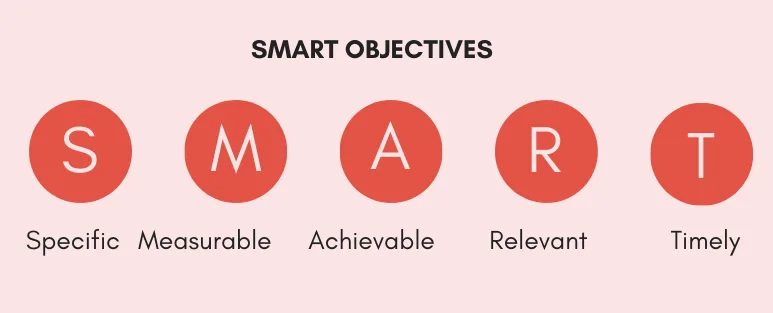
The SMART method keeps each objective concrete. Using the referral example, the goal needs to be:
- Specific: "We aim to improve our employee referrals."
- Measurable: "We aim to raise referral hires from X% to Y% of total hires."
- Achievable: "We are already at X%, so reaching Y% is practical."
- Relevant: "Referrals help us recruit and also signal how willing employees are to recommend us."
- Time-bound: "We will reach this within the current financial year."
Expected outcome: A timeline and a prioritized list of SMART goals. Keep it short: two or three goals per year are easier to deliver and to communicate than ten.
Step 4: Run a gap analysis
With objectives set, identify where you are today and how far you need to go. A fishbone (Ishikawa) analysis is a simple, effective way to drill down to the exact issues behind a goal:
- Organize a cross-functional focus group.
- Ask the group to identify the root causes (gaps) that stand in the way of the goal.
- Group the root causes under headings such as people, processes, policies, culture and work environment, then drill further into each.
- Ask "why" up to five times for every cause to reach the real root cause.
- List the final set of root causes.
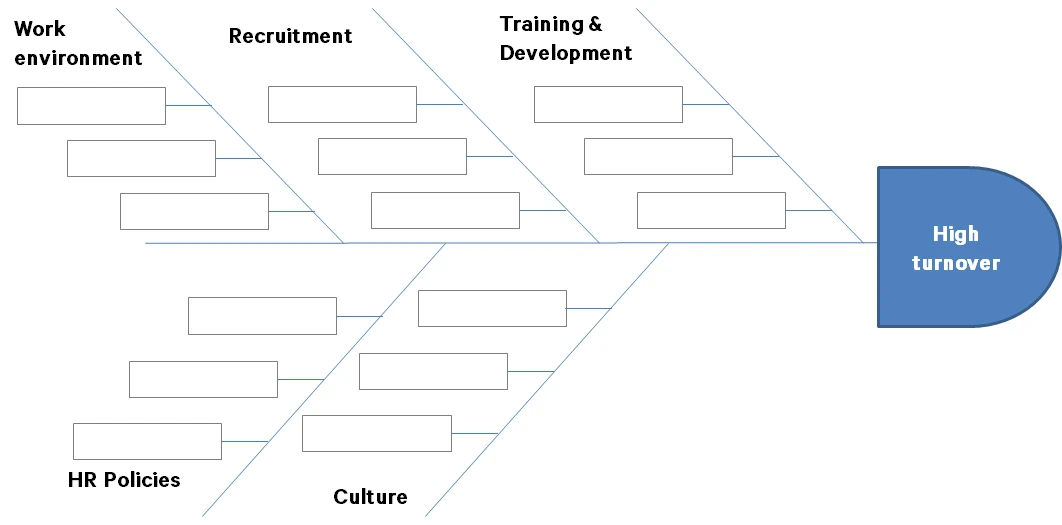
For example, a fishbone analysis of low employee referrals might surface root causes such as pay inequities, a lack of employee insurance and insufficient feedback mechanisms.
Expected outcome: A list of qualitative and quantitative gaps in the current process.
Step 5: Choose the strategy for your action plan
There are usually several paths to a goal, so the gaps need to be prioritized before you act. Score each root cause on two questions:
- Impact: How much would solving this gap move the goal? Rate it from 1 (low impact) to 10 (high impact).
- Ease: How financially feasible and simple is it to solve? Rate it from 1 (very difficult) to 10 (very easy).
Add the two scores and sort the root causes from highest to lowest, Pareto style. Here is how the referral example might look:
| Root cause | Impact (1 to 10) | Ease (1 to 10) | Total | Decision |
|---|---|---|---|---|
| Insufficient employee feedback mechanisms | 6 | 9 | 15 | Act this quarter |
| No referral rewards for referring employees | 7 | 8 | 15 | Act this quarter |
| Lack of employee insurance | 7 | 4 | 11 | Plan for next budget cycle |
| Pay inequities | 9 | 2 | 11 | Phase in with leadership sign-off |
A gap such as pay inequity has high impact but low ease because of its cost, while weak feedback mechanisms are cheap to fix with moderate impact. Depending on budget and business priorities, leaders choose the right mix of quick wins and longer-term fixes.
Expected outcome: Your employee engagement program: the list of strategies that address the top-priority gaps.
Step 6: Build the team
The team that leads implementation is critical to success. Depending on the expertise each action needs, bring in people who can actually deliver it.
For example, "Create a robust employee feedback mechanism" needs questionnaire design expertise, technology support if you plan to automate it and HR leadership to implement it in a way that raises engagement. Name an action owner for each goal, ideally someone other than the manager, who reports progress to the team every month or quarter so accountability is shared.
Expected outcome: A list of team members and their roles for each high-priority action.
Step 7: Measure performance
The measurable part of each SMART goal tells you which metric to watch. For the goal "Increase employee referrals from X% to Y%", the metric is the share of total hires that came through referrals.
Track a leading indicator alongside each lagging one. Pulse survey scores and recognition activity move within weeks, while turnover and referral rates take months. For a single score you can benchmark over time, see how to calculate an employee engagement index.
Expected outcome: The current value of each metric, compared against its target.
Step 8: Analyze the variance
Calculate the variance between actual and target performance to find gaps in implementation. If the strategies did not deliver the expected Y% referrals within the timeline, they need to be re-evaluated.
Expected outcome: A clear view of which actions are on track, which are behind and by how much.
Step 9: Take corrective action
Re-evaluation should revisit the whole flow, from setting goals to selecting strategies. A plan may fail because of a wrong assumption made anywhere along the way. If the referral goal is not being met, the reasons could include:
- The target was set wrong, and Y% was too high.
- The timeline was too short.
- The fishbone analysis missed a major factor, such as referral rewards for referring employees.
- The impact analysis was off, for example the effect of pay inequities was lower than assumed.
- The team lacked a skill needed for implementation, such as questionnaire design.
Expected outcome: A revised plan, and a short update to employees on what changed and why. Telling people what you learned is part of the action.
Employee engagement plan template
Use this employee engagement plan template to capture each priority on a single row. Keep the whole plan to one page so managers and employees can see it at a glance:
| Survey finding | SMART goal | Action | Owner | Timeline | Success metric |
|---|---|---|---|---|---|
| Recognition score 12 points below benchmark | Raise the recognition score by 8 points by Q4 | Launch peer recognition and a monthly values award | HR business partner with team action owners | Launch in 30 days, review quarterly | Recognition score, share of employees recognized in 90 days |
| Low confidence in career growth | 70% of employees have a development plan by year end | Manager-led career conversations and an internal job board | Department heads with L&D | Two quarters | Share of employees with a plan, internal move rate |
| High workload stress in one function | Cut weekly overtime by 20% in six months | Rebalance workloads and pause two low-value projects | Function head | Six months | Overtime hours, burnout pulse item |
Add a status column (not started, on track, at risk, done) and review it in the same meeting each month. A shared, visible plan is the simplest way to show employees that their survey answers led somewhere.
Employee engagement action plan examples
The four employee engagement action plan examples below cover the gaps that most often show up in engagement surveys. Recognition comes first because it is the fastest to fix and the evidence behind it is strong: a Gallup and Workhuman study of nearly 3,500 employees found that well-recognized employees were 45% less likely to have turned over after two years.
- Low recognition: Set up peer-to-peer recognition, give managers a small monthly reward budget and tie awards to company values. Measure the share of employees recognized in the last 90 days. For program design, see this guide to building an employee recognition program.
- Weak manager communication: Introduce fortnightly one-to-ones with a simple agenda, share team-level survey results with every manager and run a short action planning session with each team. Measure the manager-related survey items each quarter.
- Limited career growth: Publish career paths for the largest roles, post internal vacancies before external ones and ask every manager to hold one development conversation per employee per half year. Measure internal mobility and the growth survey item.
- Burnout and workload: Audit workloads in the hardest-hit teams, protect focus time, make sure leave is actually taken and add wellbeing support. Measure overtime, unplanned absence and the stress items in your pulse survey.
Whatever you choose, connect each action to the wider employee engagement strategies your organization is pursuing, so team-level plans add up to a company-level result.
Common action planning mistakes to avoid
Most engagement action plans fail for predictable reasons, not because the survey asked the wrong questions. Avoid these:
- Too many priorities: Ten actions spread effort thin. Pick two or three per team and finish them.
- HR owns everything: When managers and employees aren't involved, actions feel imposed and stall. Build plans with the teams they affect.
- No communication back: If employees never hear what changed, participation drops in the next survey. Share results and actions within a few weeks.
- Once-a-year listening: An annual survey is too slow to show whether actions work. Add short pulse surveys between cycles, and read why annual employee surveys often fail on their own.
- No follow-up review: Plans without a monthly or quarterly check-in drift. Put the review in the calendar when you write the plan.
How Empuls supports your employee engagement action plan
Digital tools help you create and grow a high-engagement culture, but they work best when the plan emphasizes recognition and feedback and helps employees feel connected to the organization's mission and values. Empuls, Xoxoday's employee engagement platform, supports each phase of the plan, from diagnosis and goal setting to implementation and measurement:
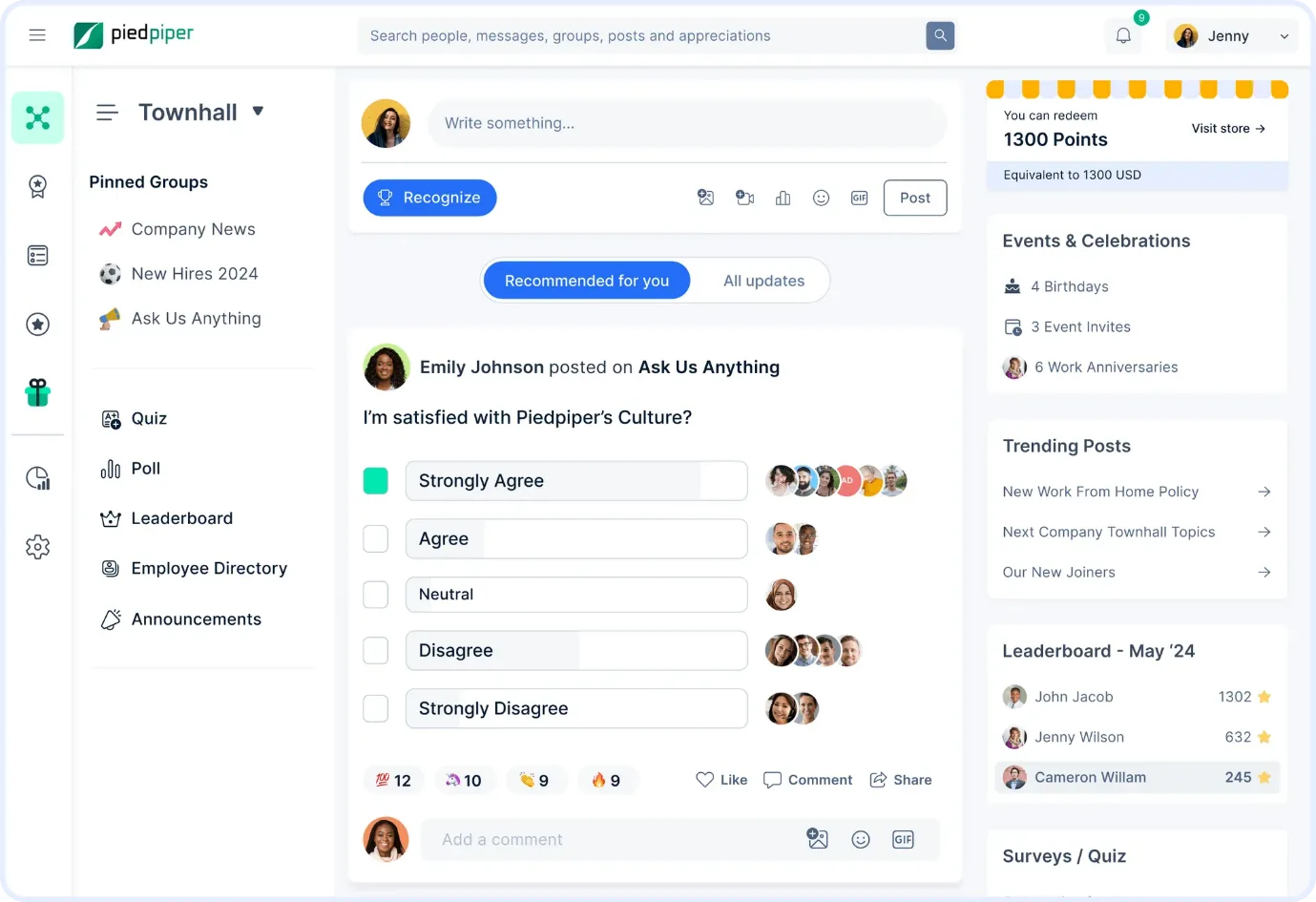
- Listen and diagnose: Run anonymous engagement surveys, pulse checks and eNPS, with AI sentiment analysis that surfaces themes from open comments.
- Plan and assign: Turn survey results into action plans with owners and timelines, so every manager knows what their team committed to.
- Recognize and reward: Automate peer-to-peer and manager recognition and rewards that reinforce the behaviors your plan targets.
- Support wellbeing and connection: Add wellness programs, a social intranet and celebrations for onboarding, birthdays and work anniversaries.
- Measure progress: Track engagement trends and program impact in reports and analytics, by team, location and manager.
Book your Empuls demo
Frequently asked questions
An employee engagement action plan is a documented set of actions that responds to engagement survey results. It names the gaps you will fix, sets SMART goals, assigns an owner and a deadline to each action and defines the metric that shows progress. It is usually built at both company and team level and reviewed every quarter.
A practical process has nine steps: scan the internal environment, scan the external environment, set SMART engagement objectives, run a gap analysis, choose a strategy by scoring impact and ease, build the delivery team, measure performance, analyze the variance against targets and take corrective action. Each step produces an output that feeds the next one.
A useful employee engagement plan template includes the survey finding, a SMART goal, the specific action, the owner, the timeline, the success metric and a status column. Keeping each priority on one row and the whole plan on one page makes it easy for managers and employees to see what was promised and how it is going.
Most teams should choose two or three priorities per survey cycle. Fewer priorities mean more focus, faster progress and a simpler story to communicate back to employees. Company-wide plans can hold a few more, but each one still needs a named owner, a deadline and a metric, or it will drift and erode trust in the next survey.
Review progress monthly at team level and quarterly at company level. Pair the reviews with short pulse surveys between annual or semiannual engagement surveys, so you can see whether actions are working within weeks rather than waiting a full year. Share a brief update with employees after each quarterly review to keep trust high.





































































































































































































































































































































































































































































































































































