
Key Takeaways
Sales compensation software, or incentive compensation management software, covers quotas, territories, plan modeling, commissions, bonuses and commission accounting.
Alexander Group's 2026 survey found 97% of companies changed their sales comp plans and 57% find it hard to set accurate quotas.
CaptivateIQ's 2026 State of Sales report found 71% of sellers start the fiscal year without assigned quotas.
Under ASC 340-40, a $12,000 commission on a three-year contract is typically capitalized and expensed at $333.33 a month.
Choose a full planning suite when quotas, territories and pay must live together, and an incentive platform when accurate global payouts on complex plans matter most.
Sales compensation software is the system that plans, models, calculates and accounts for everything a sales team earns: quotas and territories, commissions, bonuses, SPIFs and the accounting entries behind them. It goes further than a commission calculator, because it connects how you set targets with how you pay on them. This guide compares 10 sales compensation tools on that full scope and gives you a planning calendar and an ASC 606 worked example to use with whichever you choose.
Motivating and rewarding your sales team has to be a top priority in a fast-changing market, yet manual compensation management leads to mistakes, late payouts and demotivated sellers. This is where sales compensation software comes in. It can:
- Automate: Calculate, manage and distribute commissions and incentives for sales teams from predefined rules and sales data.
- Replace manual work: Swap spreadsheets and email approvals for automated calculations, so compensation is accurate and on time.
- Inform strategy: Give leaders insight into sales performance and plan cost, so they can optimize compensation and keep sellers motivated.
What sales compensation software is
Sales compensation software, also called incentive compensation management (ICM) software, is a technology platform that automates how an organization designs, manages and calculates sales compensation plans. It provides one place to define, track and administer quotas, incentives, commissions, bonuses and other compensation components for sales teams.
Traditionally, sales compensation management relied on manual calculations, spreadsheets and tedious administration. Sales compensation software automates those calculations from predefined rules and parameters, which removes errors and makes pay transparent. It typically covers five areas:
- Plan design and modeling: Create and customize compensation plans by sales targets, quotas, performance metrics and payment structures, and model scenarios to see the impact of a change before it goes live.
- Quota and territory management: Set quotas, align them with territories and compensation plans, track progress and adjust targets when territories or people change.
- Performance tracking and analytics: See individual and team attainment in real time, with reports that help optimize strategy and identify top performers.
- Calculation and payout automation: Calculate commissions, bonuses and incentives automatically and pay them accurately and on time, which supports motivation and morale.
- Integration and data management: Connect to CRM, ERP, HRMS and payroll systems to keep data consistent and minimize manual entry.
Why sales compensation needs more than a commission calculator
Most compensation problems start before a single commission is calculated: in late quotas, plans that change every quarter and targets nobody trusts. Two recent surveys show how widespread that is.
Alexander Group's 2026 Sales Compensation Trends Survey found that 97% of companies changed their sales compensation plans for 2026, only 21% rated their 2025 plans very effective and 57% find it hard to set accurate quotas. On the seller side, CaptivateIQ's 2026 State of Sales report, a survey of 500 US sales professionals, found that 71% begin the fiscal year without assigned quotas and 42% wait a month or longer for them.
97%
of companies
changed their sales comp plans for 2026 (Alexander Group)
57%
of companies
find it hard to set accurate quotas (Alexander Group)
71%
of sellers
start the fiscal year without assigned quotas (CaptivateIQ)
Why planning and pay belong in the same system
That is the case for sales compensation management tools that cover planning as well as payout. If you want to go deeper on running compensation across a large organization, see our guide to enterprise compensation management.
Factors to consider while choosing sales compensation software
Seven factors decide whether a platform fits your compensation program. The first two matter most for this category, because they separate true compensation platforms from commission calculators.
- Planning coverage: Check whether the tool handles quota setting, territory design and capacity planning itself, connects to a planning tool you already use or leaves planning to spreadsheets.
- Modeling: Make sure you can model a plan or quota change on real data and see its cost before rollout.
- Scalability and flexibility: The software should adapt to your company and changing compensation needs without losing efficiency.
- Compliance and accounting: Look for commission accounting under ASC 606, audit trails and strong data security that protect sensitive pay data.
- Integration capabilities: Pick software that integrates with your current CRM, HRMS and finance systems for real-time data synchronization.
- Reporting and analytics: Choose comprehensive reporting on attainment, payout distribution and incentive spend against revenue.
- User-friendly and mobile access: An easy interface speeds adoption, and mobile access lets sellers check their compensation on the go.
Model your next comp plan before it goes live
See how Empuls simulates plan and target changes on your own data and shows what each plan pays against the revenue it drives.
Talk to our ExpertTrusted by 5,000+ companies
Sales compensation software compared: planning and pay coverage
The table shows where each of the 10 tools covers the full compensation cycle, based on what each vendor states on its current website. Use it to check whether a tool will also replace your quota and territory spreadsheets or only your commission ones.
| Software | Quota and territory planning | Plan modeling | Bonuses, SPIFs, MBOs | Commission accounting |
|---|---|---|---|---|
| Xoxoday Empuls | Mid-cycle quota relief, live attainment by team and region | Simulation on your own data | SPIFs, contests, milestone and target plans | ASC 606 records and audit trail |
| Varicent | Quota, territory and capacity planning | Advanced simulations | Incentive plan design with AI | Not stated on main pages |
| Xactly | Separate Xactly Plan product | Scenario modeling, Plan Optimization | MBOs | Commission Expense Accounting add-on |
| Anaplan | Territory, quota, capacity and segmentation | Attainment Modeling, what-if scenarios | Bonus and equity, SPIFs, MBOs | Amortization schedules, ASC 606 and IFRS 15 |
| CaptivateIQ | Territory Management, capacity and quota planning | Real-time scenario modeling | SPIFs, draws, Bonuses and MBO Management | Not stated on main pages |
| Everstage | Capacity, territory and quota planning | Time Machine, quota scenarios | Conditional and multi-year rules | ASC 606-ready reporting |
| Forma.ai | Forma Architect territory and quota planning | Modeling engine | Incentive programs via Forma Operator | Not stated on main pages |
| Salesforce Spiff | Not stated on its ICM page | Not stated | Accelerators, tiers and triggers | ASC 606 and IFRS 15 expense reporting |
| Qobra | Not stated | Sandbox simulation | SPIFs, draws, ramp-ups | Accrual and ASC 606 data |
| QuotaPath | Not stated | Plan Modeling (Premium) | Leaderboards and contests | Ledger and ASC 606 support |
The 10 best sales compensation software tools
The tools below run from full sales performance management suites to lighter platforms for growing teams. Each write-up covers what the tool does across planning, modeling, incentives and accounting, so you can match it to the scope you need.
1. Xoxoday Empuls
Empuls is an enterprise sales incentive and commission platform that turns your biggest sales expense into a measurable growth lever. It calculates any plan from CRM, ERP and HRMS data, pays out through payroll in any country and shows leaders how each plan performs against the revenue it produced.
- Plan design: Commission plans that link achievement to quota with multipliers and bonuses, target plans where each participant picks a goal and milestone plans that reward progress, plus SPIFs and contests on top of the base plan.
- Quotas and attainment: Live attainment by team, region and plan, off-pace alerts for managers and quota relief that adjusts targets mid-cycle with a record of every change.
- Modeling and AI: Simulate a changed plan or target on your own data, and get AI plan recommendations by role and rule tuning that watches cost curves and payout skew.
- Compliance: Commission records and a full audit trail that support ASC 606, with tax-compliant payouts in 150+ countries.
Consider: Empuls manages quotas and attainment within incentive plans but does not position itself as a territory design tool, so pair it with your planning process if you redraw territories each year.
2. Varicent
Varicent is a sales performance management suite that combines Incentives with Sales Planning for quota, territory and capacity planning, including territory balancing. Its incentive module supports AI-assisted plan design and outcome modeling before rollout, and Seller Insights guides sellers toward quota attainment.
Best for: large enterprises that want territory, quota and incentive decisions in one platform, with embedded AI and advanced simulations.
3. Xactly
Xactly Incent creates, automates and manages incentive payments from simple to complex, while territory and quota planning sit in a separate Xactly Plan product. Incent's Plan Optimization benchmarks your compensation structures against more than 21 years of data, and scenario modeling tests changes before you implement them.
Accounting: the Commission Expense Accounting add-on automates amortization schedules and true-ups for ASC 606 and IFRS 15, and Incent supports MBOs for goals beyond standard quotas.
4. Anaplan
Anaplan connects incentive compensation to territory, quota, go-to-market capacity and segmentation planning on one platform, which suits companies that already model finance in Anaplan. Its tools include Attainment Modeling, plan design comparison, plan ROI evaluation and compensation expense forecasting.
- Automated crediting with credit rule what-if analysis and manual credit adjustments.
- Bonus and equity management, plus channel incentives, SPIFs and MBOs.
- Amortization schedules for ASC 606 and IFRS 15, and a Sales Analyst AI agent that recommends actions.
5. CaptivateIQ
CaptivateIQ pairs its Incentives product with a Planning product, so territory management, sales capacity and quota planning sit next to commission calculation. Territory Management handles automatic account assignment and boundary adjustments, and quota planning compares scenarios side by side.
Incentive scope: tiers and accelerators, bonuses, SPIFs, draws and eligibility rules, with Bonuses and MBO Management for non-sales plans. Its Catalyst machine learning layer predicts quota attainment.
6. Everstage
Everstage started as a commission platform and now adds Everstage Planning. Capacity planning checks whether the team can carry a target after attrition, ramp and productivity; territory planning designs territories by geography, segment or product; and quota scenarios split targets down the hierarchy with over-assignment and seasonality.
On the pay side: Time Machine shows how a rule change affects every rep's payout before it ships, and ASC 606-ready reporting supports finance.
7. Forma.ai
Forma.ai describes itself as AI-powered enterprise sales compensation software. Forma Architect handles territory and quota planning, a modeling engine tests and financially models changes before you deploy them, and Forma Operator designs, launches and tracks incentive programs, including calculations and payouts.
Good to know: plans are built from a library of components with guided workflows, and AI can create new plan components from a plain-language description.
8. Salesforce Spiff
Salesforce Spiff focuses on the execution side of compensation for Salesforce customers. It automates accelerators, tiers, triggers and exceptions, recalculates when deals change and gives leaders a dashboard for team pacing and attainment.
Accounting: Spiff produces audit-ready commission expense reporting for ASC 606 and IFRS 15 using general ledgers and expense portfolios. Territory and quota planning are not part of its incentive compensation product page.
9. Qobra
Qobra is a no-code compensation platform for companies of all sizes, with tiers, accelerators, SPIFs, draws, ramp-ups, true-ups, clawbacks and multi-country, multi-currency plans. Its sandbox runs payouts on historical data before rollout, so you can see the cost of a plan change in advance.
Finance support: accrual and ASC 606-related data for budgeting, plus an Architect AI agent that builds plans from plain-language descriptions.
10. QuotaPath
QuotaPath helps growing revenue teams handle variable compensation with manager and team-based plans, leaderboards and contests, and ledger and ASC 606 support from its Growth plan upward. Its Premium plan adds Plan Modeling, and the top Strategic tier includes Atlas, an AI compensation strategist.
Best for: smaller teams that want compensation modeling and commission accounting without an enterprise planning suite.
Annual sales compensation planning calendar
Use this calendar to run the yearly compensation cycle, assuming a January fiscal year; shift the months to match yours. The aim is to have quotas and signed plans in sellers' hands before the year starts, which most companies currently miss.
| When | Activity | Output | Software support to look for |
|---|---|---|---|
| July to August | Review plan performance and payout distribution | What to keep, fix or drop | Attainment and plan cost analytics |
| September | Set the top-down number and capacity | Target by segment and region | Capacity planning |
| October | Design territories and allocate quotas | Balanced territories and draft quotas | Territory and quota planning |
| November | Design and model plans | Final plan rules and expected cost | Plan modeling and simulation |
| December | Approve, document and distribute plans | Signed plan documents | Approvals, plan documents and e-signature |
| Monthly | Calculate, approve and pay | Accurate payouts and statements | Calculation, approvals and payroll push |
| Quarterly | Run SPIFs, grant quota relief, review accruals | Mid-year course corrections | SPIFs, quota relief and ASC 606 reporting |
Worked example: commission accounting under ASC 606
Under US GAAP (ASC 340-40, the cost guidance that accompanies ASC 606), commissions that are incremental costs of obtaining a contract are generally capitalized and amortized over the period the contract benefits, rather than expensed when paid. A practical expedient lets you expense them immediately when that amortization period is one year or less.
| Item | Value |
|---|---|
| Commission paid on a new three-year contract | $12,000 |
| Amortization period | 36 months |
| Monthly commission expense | $12,000 / 36 = $333.33 |
| Expense recognized in year one | $333.33 x 12 = $4,000 |
| Asset remaining at the end of year one | $12,000 - $4,000 = $8,000 |
| Same commission on a one-year contract | Can be expensed immediately under the practical expedient |
How Empuls supports sales compensation planning and pay
Empuls connects how you set and adjust targets with how you pay on them. Plans are modeled on your own data before launch, quotas can be adjusted mid-cycle with a full record, attainment is live by team, region and plan, and incentive spend sits next to the revenue it produced, so you can see which plans pay off.
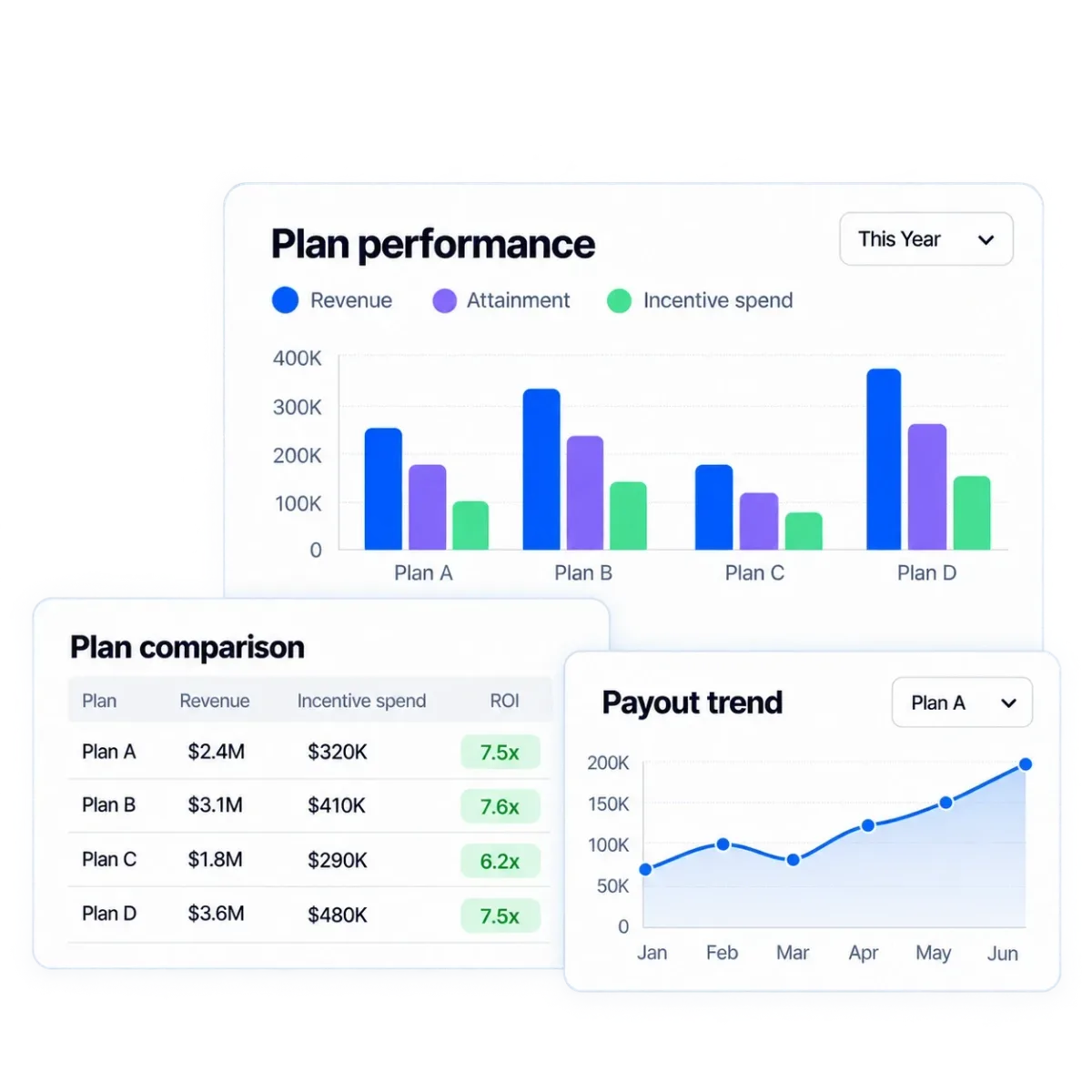
- Compare plan performance, attainment distribution and quota relief in Empuls sales intelligence.
- Get AI plan recommendations and overpayment guardrails with Empuls AI for sales incentives.
- Design commission, target and milestone plans in Empuls plans and calculations.
Choosing the best sales compensation software
The best sales compensation software for you depends on how much of the cycle you want in one place. If quotas, territories and pay all need to live together, look at full sales comp planning software such as Varicent, Anaplan, CaptivateIQ, Everstage or Forma.ai; if your priority is accurate, auditable pay on complex plans across countries, an incentive platform such as Empuls may fit better. Use the planning calendar to see where your current process slips, and choose the tool that closes that gap.
For a broader list by team size, see the best sales commission software. For approvals, disputes and audit, compare commission management software, and for rep-facing earnings visibility, see commission tracking software. If you also run non-cash rewards and channel incentives, our guide to incentive management software covers those platforms.
Book your Empuls demo
Frequently asked questions
Commission software focuses on calculating and paying commissions from deal data. Sales compensation software, or incentive compensation management software, covers a wider scope: quota and territory planning, plan modeling, bonuses, SPIFs and MBOs, approvals and commission accounting under ASC 606. Many vendors now sell both, often as separate planning and incentive modules.
The best plan typically combines a competitive base salary with performance-based incentives, such as commissions or bonuses, that align with company goals. This balance gives clarity, motivation and measurable targets, though the right mix varies by industry, role and sales cycle. Keep the plan simple enough that every rep can predict what a deal will pay.
OTE stands for on-target earnings. It is the total compensation a sales rep can expect to earn when they hit 100% of their target, combining base salary with the variable pay from commissions or bonuses. A rep with an $80,000 base and $40,000 variable at target has an OTE of $120,000 and a 67/33 pay mix.
Many organizations use sales performance management or incentive compensation management platforms, such as Empuls, Varicent, Xactly, Anaplan or CaptivateIQ, to calculate commissions, manage quotas and pay incentives accurately. Smaller teams often start with spreadsheets or lighter tools such as QuotaPath, then move to a platform as plans, payees and regions multiply.
Under ASC 340-40, which accompanies ASC 606, commissions that are incremental costs of obtaining a contract are generally capitalized as an asset and amortized over the period the contract benefits. If that period is one year or less, a practical expedient allows immediate expensing. Confirm your specific policy, including renewals, with your auditors.
Sales comp planning software helps you set targets and design plans before the year starts. It covers capacity planning, territory design, quota allocation and plan modeling, so you can test the cost and fairness of a plan on real data. Some tools also calculate and pay commissions, while others hand plans to a separate commission system.
Most companies review plans once a year and make targeted changes mid-year, such as SPIFs or quota relief, when strategy or territories shift. Alexander Group's 2026 survey found 97% of companies changed their plans for 2026. Frequent rule changes confuse sellers, so communicate every change in writing and model its cost before it goes live.
Yes, once you have more than a handful of reps, any tiers or accelerators, or regular disputes about pay. Small teams can start with lighter tools that publish their pricing and connect to common CRMs. The return comes from fewer errors, less time spent reconciling spreadsheets and sellers who trust their numbers.





































































































































































































































































































































































































































































































































































