
Key Takeaways
Enterprise compensation management is the structured approach a large organization uses to plan, pay and govern base pay, variable pay, commissions, benefits and rewards.
WorldatWork puts the actual 2026 US mean salary increase budget at 3.6%, so pay increases must be allocated deliberately to the people and behaviors that matter most.
Benefits make up 30% of private-sector compensation cost in the US, according to the Bureau of Labor Statistics, so pay strategy has to cover more than salary.
Pay transparency is now a legal duty in many places, including the EU Pay Transparency Directive, which had a transposition deadline of 7 June 2026.
Most enterprises run several tools: compensation planning for salaries, incentive compensation management for commissions, and separate platforms for benefits and recognition.
Enterprise compensation management is how a large organization plans, pays and governs everything it gives people for their work: base pay, variable pay, commissions, bonuses, benefits and rewards. Done well, it keeps pay fair internally, competitive externally, compliant everywhere you operate and tied to business goals. This guide covers what it includes, why it matters, 11 best practices, a step-by-step planning calendar, the KPIs to track and the software that supports it.
What is enterprise compensation management
Enterprise compensation management (ECM) is a strategic, structured and systematic approach to designing, deploying and maintaining every form of pay a business distributes across internal and external roles, including employees, channel partners and agents. It is an umbrella term that covers direct and indirect, fixed and variable, and monetary and non-monetary remuneration.
Overseeing compensation is complex, time-sensitive and demanding in most organizations. An enterprise compensation management program gives business owners, HR, finance and sales leaders control and accountability over that range of activity, and modern tools help them keep pace with a changing pay landscape. The discipline touches every element of the compensation structure:
| Component | Examples | Typical owner | Typical system |
|---|---|---|---|
| Base pay | Salary, hourly wages, pay ranges and bands | HR and total rewards | HRIS and compensation planning |
| Variable pay | Annual bonuses, profit sharing, team incentives | HR and finance | Compensation planning |
| Commissions and sales incentives | Commission plans, accelerators, SPIFs, channel incentives | Sales operations and finance | Incentive compensation management (ICM) |
| Long-term incentives | Equity, stock options, retention awards | Total rewards and the board | Equity management |
| Benefits and perks | Health cover, retirement, flexible benefits, wellbeing | HR and benefits team | Benefits platform |
| Rewards and recognition | Spot awards, service awards, peer recognition | HR and people managers | Recognition platform |
In a nutshell, enterprise compensation management involves planning remuneration policies; setting pay scales, incentive brackets and benefits packages; designing rewards and recognition initiatives; and staying competitive while keeping costs under control. If you want a primer on how these pieces add up for an individual, see our guide to total compensation vs salary.
Why enterprise compensation management matters
Compensation is a talent game with high stakes. Along with culture, it is one of the main reasons people join an organization or leave it, and it is usually the largest line in the operating budget, so small design errors get expensive fast.
72%
of employers struggle to fill roles
ManpowerGroup, 2026, 39,000+ employers
3.6%
average US salary increase budget
WorldatWork, actual 2026
70%
of private-sector compensation cost is wages
the other 30% is benefits, BLS, June 2026
Sources: ManpowerGroup 2026 Talent Shortage Survey; WorldatWork 2026-2027 Salary Budget Survey; US Bureau of Labor Statistics
ManpowerGroup's 2026 Talent Shortage Survey of more than 39,000 employers in 41 countries found 72% report difficulty filling roles. When talent is that scarce, compensation stops being a payroll function and becomes a strategic lever and a business edge.
Budgets, meanwhile, are tight. WorldatWork's 2026-2027 Salary Budget Survey, with data from 1,799 organizations, puts the actual 2026 US mean salary increase budget at 3.6%, with the same figure projected for 2027. With about 3.6% to spread across a whole workforce, every dollar has to be allocated deliberately to the people and behaviors that matter most.
The cost base is also bigger than salary alone. The US Bureau of Labor Statistics' Employer Costs for Employee Compensation release for June 2026 shows private employers spent $46.89 per hour worked on compensation, of which wages and salaries were 70% and benefits 30%. Managing pay without managing benefits misses almost a third of the bill.
Benefits of an enterprise compensation management system
An effective enterprise compensation management program delivers ten main benefits. The first three, linking pay to goals, proving fairness and controlling cost, matter most because they are the ones leadership and employees notice first.
- Links behavior to business goals: Ties pay to the KPIs that matter, guiding activity in the right direction.
- Establishes the worth of each role: Connects ability, contribution and impact to compensation, so people know what drives their pay.
- Controls cost: Built-in controls enforce guidelines, flag discrepancies as they happen and route exceptions for approval.
- Sets clear expectations and career paths: Helps people prioritize the right actions, which lifts performance.
- Builds market competitiveness: Attracts and retains top talent with a reputation for fair pay and generous recognition.
- Builds equity and trust: Bases decisions on competency, responsibility and market data instead of personal judgment, which guards against bias and discrimination.
- Optimizes budgets: Better forecasting, planning and allocation keep compensation spend healthy.
- Enables agile adjustments: A structured framework and modern tools make it faster to respond to market or internal change.
- Proves ROI: Lets leaders judge which pay, incentive and recognition investments actually work.
- Creates one source of truth: Centralizes employee profiles, pay data and performance metrics for HR, finance and leadership, with audit-ready workflows and compliance built in.
Automate the variable pay in your compensation
Empuls calculates commissions and incentives from your own data, routes approvals and pays out through payroll in any country.
Talk to our ExpertTrusted by 5,000+ companies
11 compensation management best practices
These 11 compensation management best practices apply across industries and company sizes. Start with data and pay for performance, because every later practice, from transparency to technology, depends on getting those two right.
1. Build a data-driven strategy
Granular, relevant and current data is the backbone of an effective enterprise compensation management strategy. Draw on industry and role-specific salary surveys, internal pay and performance data, and competitor benchmarks, then audit your current strengths and weaknesses against them.
Refresh market benchmarks at least once a year and before every planning cycle. Roles in high demand, such as AI, engineering and sales, can move faster than an annual survey, so watch offer acceptance rates and exit reasons for early signals.
2. Map performance to compensation
Your strategy must establish a quantifiable, unambiguous connection between effort and reward. That starts with how you measure performance: clear goal setting, individual and team objectives cascaded from company targets, balanced scorecard metrics that capture financial and non-financial results, and continuous feedback.
Then choose pay-for-performance models that fit each role: a merit matrix that maps increases to pay position and performance rating, tiered structures linked to goal attainment, bonuses, and sales incentives such as commissions and SPIFs. For sales roles, see how commission vs bonus structures change behavior.
3. Build a strategic compensation team
As compensation becomes a business edge, the team behind it needs new skills. Compensation professionals are no longer just administrators. They need to be data-smart analysts, forecasters and advisors who can model scenarios, explain trade-offs to the board and coach managers through pay conversations.
4. Make pay fair and transparent
Create performance KPIs that are unambiguous, built on rational premises and designed in consultation with teams so they reflect on-ground realities. Pay equity across gender, background and age deserves particular attention, and should be checked with a regular pay equity audit rather than assumed.
Transparency is increasingly a legal duty as well as a best practice. The EU Pay Transparency Directive had a transposition deadline of 7 June 2026 and requires pay ranges before hiring, a ban on asking candidates about pay history, and gender pay gap reporting for larger employers. A growing number of US states also require pay ranges in job postings.
5. Stay flexible
Compensation environments are in constant flux. Market benchmarks, competitor strategies and regulations change externally, while business goals, team mix, quotas and pay metrics change internally. Build in market pulse tracking, dynamic budgets and clear decision rules so you can adjust mid-year without rebuilding the whole plan.
6. Sync with HR and payroll systems
Whatever approach you adopt, compensation data must stay in sync with your HRIS, payroll and, for sales roles, your CRM. Integration protects data integrity, accuracy and consistency, and it removes the manual exports where most errors creep in.
7. Protect compensation data
Salaries and channel incentives are sensitive for both employers and employees. A breach can cause financial harm and lasting damage to your reputation with talent. Make security, confidentiality and privacy top mandates: role-based access, encryption, audit logs and compliance with data privacy laws in every country you pay people.
8. Build compliance into the workflow
Compensation must comply with minimum wage, overtime, equal pay, pay transparency and tax rules, and for commissions, with accounting standards such as ASC 606. Bake these checks into workflows and reports so leaders stay informed, the organization is protected against legal risk and documentation is ready for audits and annual disclosures.
9. Communicate simply
Explaining your compensation policy clearly is essential for trust and morale. Not everyone is comfortable decoding jargon, so explain how pay is set, what drives increases and how incentives are calculated in plain language. Give managers a short talking-points guide before every pay cycle, because most employees hear about pay from their manager first.
10. Manage the change
A new compensation strategy can look great on paper and still get a lukewarm response, with murmurs that the system is too complicated. That usually signals a change management gap, not a design flaw. Explain why the change is happening before you show how it works, pilot with one business unit and pair early adopters with skeptics.
11. Use the right technology
Enterprise compensation management spans pay structure variance, workforce diversity, data management, competitor moves, unions, compliance, budgets and complex approval processes. It is a high-stakes exercise with little room for error, where small gaps can snowball into legal claims, employee distress and lost competitiveness. Purpose-built software, covered below, replaces spreadsheets and legacy systems with tools built for accuracy, predictability and accountability.
Enterprise compensation planning: steps and calendar
Enterprise compensation planning works best as an annual cycle with clear owners and deadlines. The steps below come first; the calendar after them shows how a typical calendar-year organization spreads them across 12 months.
- Start with good data: Gather market benchmarks, internal pay data, performance ratings and budget guidance.
- Connect external factors with internal priorities: Build one roadmap that links pay strategy to business goals.
- Define the architecture: Set job levels, pay ranges and the policies and procedures that govern them.
- Design the performance and compensation matrix: Map performance ratings and goal attainment to increases, bonuses and incentives.
- Adopt a total rewards framework: Balance pay, benefits, recognition and growth in the context of your organization.
- Clarify progression rules: Outline time horizons for probation and promotion, progression criteria and recognition eligibility.
- Benchmark KPIs competitively: Check targets and pay mix against what leading industry players do.
- Communicate and train: Brief leaders and train managers on the rationale, rules and how to hold pay conversations.
- Deploy the right technology: Use platforms that track, automate and report on every step.
- Monitor and adjust: Listen to feedback, measure outcomes and build in mechanisms for agile changes.
| Quarter | Key activities | Owner | Output |
|---|---|---|---|
| Q1 (January to March) | Pay out prior-year bonuses; launch new sales incentive plans; run a pay equity audit | HR, finance, sales ops | Bonus payouts, signed plan documents, equity findings |
| Q2 (April to June) | Refresh market benchmarks; review job architecture and pay ranges; mid-year incentive check | Total rewards | Updated ranges, plan health report |
| Q3 (July to September) | Set next year's salary budget; model merit and incentive scenarios; draft sales comp plans | Finance, HR, sales leadership | Approved budget, draft plans |
| Q4 (October to December) | Run the merit and promotion cycle; calibrate ratings; finalize and communicate plans | Managers, HR | Approved increases, compensation statements |
Compensation management software and what it adds
Compensation management software replaces spreadsheets and email approvals with one system for planning, calculating, approving and reporting on pay. Most enterprises use more than one category of tool, so it helps to know which job each one does.
| Software category | What it manages | Key features to look for |
|---|---|---|
| Compensation planning | Salary budgets, merit and promotion cycles, pay ranges | Budget modeling, manager worksheets, pay equity analytics, HRIS sync |
| Incentive compensation management (ICM) | Commissions, sales incentives, SPIFs, channel payouts | No-code plan builder, CRM and ERP data connections, approvals, payroll integration, audit trail |
| Benefits administration | Health, retirement, flexible benefits | Enrollment, eligibility rules, carrier and payroll integration |
| Recognition and rewards | Spot awards, service awards, peer recognition | Budget controls, reward catalog, social feed, analytics |
Across these categories, the modern generation of compensation management software changes the work in the same ways:
- Accuracy: Formula-driven calculations and modeling tools handle complex KPIs, hybrid roles and variable pay without spreadsheet errors.
- Automation: Calculations, reporting, reviews and approvals run on pre-set permissions and version control instead of long email chains.
- Decision support: Interactive dashboards and on-demand reports show cost, equity and outcomes before decisions are final.
- Benchmarking: Market data helps keep pay competitive against external markets.
- Governance: Ownership rules, quality checks and validation protect data integrity and privacy.
- Self-service: Employees and sales reps track their own pay and earnings in real time, which builds fairness and cuts HR queries.
- Speed: Shorter planning cycles and fewer HR touchpoints reduce delays.
For sales roles specifically, compare dedicated tools in our guide to the best sales compensation software, which covers territory and quota planning, comp modeling and ASC 606.
AI in compensation management
Artificial intelligence, machine learning and natural language processing are taking enterprise compensation management further. Scenario modeling, real-time market data, pattern recognition, predictive analytics and smart recommendations are changing incentive personalization, compensation benchmarking, bias detection and budget optimization.
The practical rule is to let AI recommend and flag while people approve. AI can spot pay outliers, model the cost of a merit matrix or catch an overpayment before it is released, but every decision that changes someone's pay should still pass through a human approval and an audit trail. Our guide to AI in sales commission covers how this works for variable pay.
How to measure compensation management success
Measure your enterprise compensation management program from four angles: business impact, talent, efficiency and employee experience. Use this scorecard each cycle and track the trend, not just the number.
| Angle | KPI | How to calculate or measure |
|---|---|---|
| Business impact | Revenue per employee | Total revenue divided by average headcount |
| Business impact | Compensation cost ratio | Total compensation cost divided by revenue or operating expenses |
| Business impact | Incentive ROI | Incremental revenue or margin divided by incentive spend, by plan |
| Talent | Offer acceptance rate | Offers accepted divided by offers made |
| Talent | Regretted turnover | Voluntary exits of high performers divided by average headcount |
| Talent | Compa-ratio | Employee pay divided by the midpoint of their pay range |
| Efficiency | Payout error rate | Payouts corrected after release divided by total payouts |
| Efficiency | Planning cycle time | Days from budget approval to communicated increases |
| Employee experience | Perceived pay fairness | Share of employees who agree pay is fair in a pulse survey |
| Employee experience | Benefits utilization | Employees using a benefit divided by eligible employees |
Add qualitative signals too: manager satisfaction with tools, clarity of the compensation policy in surveys and the number of pay queries each cycle. A falling query count is often the earliest sign that communication is working.
Challenges in enterprise compensation management
The larger the business, the harder it is to keep pay fair, timely and compliant. Five challenges come up most often, and variance across regions and roles is usually the hardest because it touches every other one.
1. Variance and ambiguity
Compensation varies across geographies, cultures, currencies and roles. A practical answer is a globally harmonized compensation architecture with central governance, applied locally with room to adapt. Measuring individual impact is also hard when contributions are intangible or team-based, so combine individual and team metrics.
2. High costs
Compensation is usually the largest cost an organization has, and running a program to manage it adds more. Forecast revenue impact and ROI before committing to a new initiative, phase it in and adjust goals to fit budget constraints.
3. Bias and subjectivity
People make compensation decisions, so they are not immune to bias, and pay disparity is a common challenge worldwide. Counter it with clear policies shared across the organization, visible pay ranges with the reasoning behind them, calibration sessions for managers and regular pay equity analysis.
4. High expectations
Employees and managers often expect a new compensation program to solve every problem overnight. When results take time, disappointment can turn into frustration. Set expectations early, share the timeline and explain why some results take more than one cycle to show.
5. Resistance to change
Compensation is personal, and most people prefer familiar processes. A system overhaul can breed confusion and erode trust, especially for people who are less comfortable with new tools. Use tutorials, training and candid messaging, tell people why before you show them how and let early adopters help their peers.
How Empuls supports enterprise compensation management
Empuls is not a salary planning tool. It covers the variable pay, benefits and recognition layers of enterprise compensation management, and connects to the HRMS, CRM, ERP and payroll systems you already run.
- Sales incentives and commissions: Empuls sales incentives builds commission, target and milestone plans in a no-code plan builder, calculates them from CRM, ERP and HRMS data and gives sales, finance and leadership role-based views.
- Payouts and compliance: Payouts push approved incentives to payroll systems such as ADP, Workday and SAP SuccessFactors, with multi-level approvals, anomaly checks, a full audit trail that supports ASC 606 and disbursal in 50+ currencies.
- Flexible benefits: Empuls benefits runs flexible benefits and perks with rules you can configure by location, band or business unit.
- Recognition and rewards: Empuls recognition handles peer recognition, awards and rewards, so the non-monetary side of total rewards sits on the same platform.
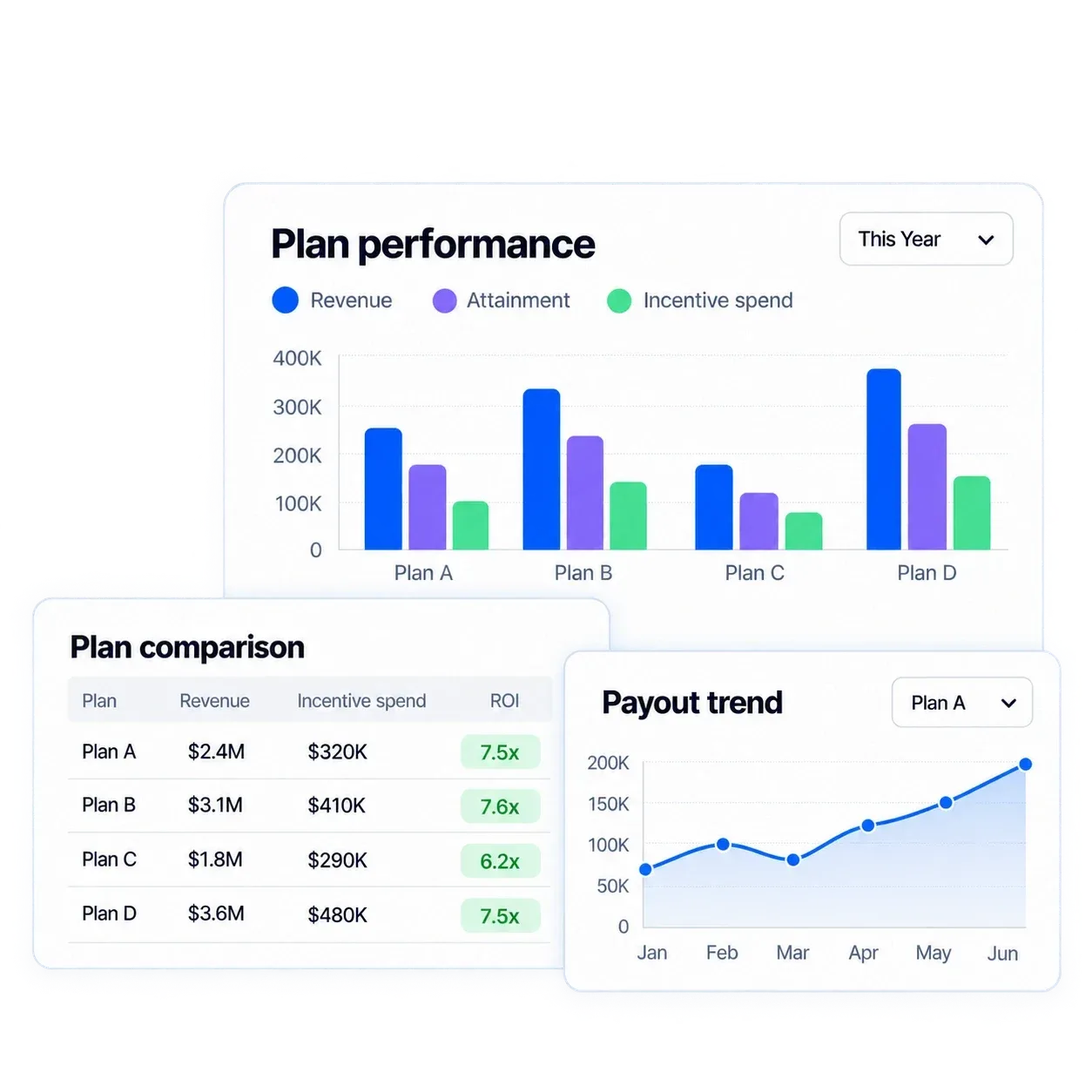
Plan comparison, payout trends and incentive spend against revenue are visible by team, region or plan, so leaders can see which incentive investments pay back.
Make compensation a competitive advantage
Enterprise compensation management turns pay from a cost center into a strategic tool. Strong programs rest on good data, a clear link between performance and pay, fairness and transparency, built-in compliance and technology that removes manual work.
Start by mapping your compensation components to owners and systems, adopt the planning calendar for your next cycle and track the KPI scorecard every quarter. For the non-cash side of rewards, see our non-monetary compensation examples.
Book your Empuls demo
Frequently asked questions
Compensation management is the process of planning, administering and reviewing what an organization pays its people, including salaries, bonuses, commissions, benefits and rewards. Its goals are to attract and retain talent, reward performance, keep pay fair and compliant and control cost. Enterprise compensation management applies the same discipline at scale across countries, business units and partner networks.
The main components are base pay, variable pay such as bonuses and profit sharing, commissions and sales incentives, long-term incentives such as equity, benefits and perks, and rewards and recognition. Each usually has a different owner and system, so enterprise compensation management connects them through shared data, policies, approvals and reporting so leaders see the full cost and impact.
Compensation management software replaces spreadsheets with one system for planning, calculating, approving and reporting on pay. Planning tools handle salary budgets and merit cycles, while incentive compensation management tools calculate commissions from CRM and ERP data. Good software integrates with HRIS and payroll, enforces approvals, keeps an audit trail and gives employees visibility into their pay.
Payroll pays people accurately and on time, handling deductions, taxes and filings. Compensation management decides what people should be paid and why: pay ranges, increases, bonuses, incentives and benefits strategy. Compensation management feeds payroll with approved amounts, so the two must be integrated, but they serve different purposes and are often owned by different teams.
Most enterprises review salaries once a year in a merit cycle, refresh market benchmarks at least annually and review sales incentive plans every year with a mid-year health check. Hot-skill roles may need more frequent market adjustments. Pay equity audits should run at least annually, and more often where pay transparency or gender pay gap reporting laws apply.
Pay transparency laws require employers to share pay ranges with candidates, and in some places to report pay gaps and explain pay differences. The EU Pay Transparency Directive and several US state laws are examples. Compensation teams need documented pay ranges, objective criteria for pay decisions and clean data so they can disclose and defend pay when asked.
Useful KPIs include revenue per employee, compensation cost as a share of revenue, incentive ROI by plan, offer acceptance rate, regretted turnover, compa-ratio, payout error rate, planning cycle time, perceived pay fairness and benefits utilization. Track them every cycle and look at trends by team, region and role rather than a single company-wide number.
AI helps compensation teams model scenarios, spot pay outliers and equity gaps, forecast incentive costs, recommend plan changes and catch overpayments before they are released. It can also answer employees' pay questions in plain language. The safest approach lets AI recommend and flag while people approve every change to pay, with each decision recorded in an audit trail.





































































































































































































































































































































































































































































































































































