
Key Takeaways
The core sales incentive formula is target incentive multiplied by payout percentage, plus any SPIFs, milestone bonuses or contest rewards earned in the period.
A payout curve converts attainment into payout with a threshold, a 1:1 range to target, an accelerator above target and a cap.
A weighted scorecard pays each metric separately, so strong revenue cannot hide a missed goal such as new customers or retention.
Gates such as a minimum customer satisfaction score protect quality without adding another metric to the payout math.
Showing reps every step of their incentive calculation prevents most payout disputes, which matters when 64% of companies report a payout error in a year.
To calculate a sales incentive, measure each rep's results against the plan's targets, turn that attainment into a payout percentage using the plan's payout curve, and multiply it by the rep's target incentive. Then add any SPIFs, milestone bonuses or contest rewards earned in the period. A rep with a $10,000 quarterly target incentive who reaches 110% of quota on a plan that pays 1.5 times above target earns $11,500.
A sales incentive is any variable reward, cash or non-cash, that a company pays for reaching defined sales goals. Commission is the best-known type, but most plans also include target bonuses, accelerators, SPIFs, team pools and contests. This guide explains how to calculate sales incentives step by step, with the sales incentive formula, a payout curve, a full worked example and a cheat sheet of incentive calculation examples for each type.
Importance of sales incentives for the employee and the company
Sales incentives tell employees, in the clearest possible terms, that their work is noticed and rewarded. They are also one of the main levers companies pull for growth: in CaptivateIQ's 2025 State of Incentive Compensation Management Report, a survey of more than 200 US B2B incentive compensation leaders, 59% of companies said they rely on incentive compensation to fuel growth. A well-calculated incentive plan does four things:
- Motivates the team to reach targets: Variable incentive programs give every rep a direct reason to push for the next deal.
- Rewards effort as well as outcomes: A good plan recognizes the behaviors that lead to sales, such as pipeline building and customer care, not only the closed deal.
- Recognizes high performers: Employees who go beyond their targets and set higher benchmarks should be rewarded more generously, which encourages others to follow.
- Builds collaboration and lowers attrition: Team incentives and transparent payouts support team spirit and help keep good reps. For more on this, see these sales team retention strategies.
A single, standard incentive cannot reward every kind of seller. The best programs are personalized and flexible enough to motivate low performers, core performers and high performers alike, so that all three groups strive to do better.
Types of sales incentives and how each is calculated
Commission is only one part of sales incentive plan calculation. The table lists the six incentive types most plans combine, how each one is calculated and when it fits best:
| Incentive type | How it is calculated | Best used for |
|---|---|---|
| Commission | Sales or margin × rate, often with tiers | Paying for every deal, especially in transactional sales |
| Target bonus | Target incentive × payout % from attainment | Rewarding progress against quota or a key goal |
| Weighted scorecard bonus | Sum of each metric's weight × payout % × target incentive | Balancing revenue with goals such as new logos, retention or customer satisfaction |
| Accelerator or milestone bonus | Higher payout rate, or a fixed amount, once a threshold is crossed | Pushing top performers past 100% of target |
| SPIF (sales performance incentive fund) | Units or deals that qualify × fixed amount | Short bursts of focus on a product, launch or quarter-end push |
| Team pool or contest | Pool × individual share, or points × point value | Collaboration, territory goals and gamified competitions |
If commission is the main part of your plan, start with this step-by-step guide on how to calculate sales commissions, which covers tiers, overrides, splits and clawbacks. The rest of this post focuses on the bonus, SPIF and contest side of the plan. For how the two differ in purpose, see commission vs bonus.
The sales incentive formula
The core sales incentive formula is: Incentive payout = Target incentive × Payout %, plus any SPIFs or contest rewards. Each part needs its own small calculation, and the payout curve is the one most plans get wrong, so it is shown in full below.
Target incentive: This is the variable pay a rep earns at exactly 100% of target. Multiply on-target earnings (OTE) by the variable share of the pay mix. A rep with $100,000 OTE on a 60/40 mix has a $40,000 annual target incentive, or $10,000 a quarter.
Attainment: This is the actual result divided by the target, times 100. A rep who sells $230,000 against a $200,000 target has 115% attainment.
Payout %: The plan's payout curve converts attainment into a payout percentage. A typical curve has a threshold (no payout below it), a 1:1 range up to target, an accelerator above target and a cap. Here is one example, applied to a $10,000 quarterly target incentive:
| Attainment | Payout rule | Example attainment | Payout % | Incentive |
|---|---|---|---|---|
| Below 50% | Threshold not met, no payout | 40% | 0% | $0 |
| 50% to 100% | Payout % = attainment % | 80% | 80% | $8,000 |
| Above 100% | 100% + (attainment − 100%) × 1.5 | 120% | 130% | $13,000 |
| Cap | Payout % never exceeds 200% (reached at about 166.7% attainment) | 180% | 200% | $20,000 |
Run bonuses, SPIFs and contests on one platform
Configure payout curves, weights and gates once, and give every rep a live view of their incentive.
Talk to our ExpertTrusted by 5,000+ companies
How to calculate sales incentives step by step
The nine steps below take you from setting objectives to reviewing the program, and steps 1 to 5 contain the actual math. To make each step concrete, they follow one rep, Maya, who has a $10,000 quarterly target incentive split across two weighted metrics, plus a SPIF.
1. Define clear objectives and metrics
Lay out the objectives the sales team must achieve and the metrics used to measure them. These metrics and target numbers form the framework of the incentive program, so communicate them clearly and make them simple enough for employees to calculate for themselves. For the full program design, from budget to launch, see how to create a sales incentive program.
A simple guideline might read: "A minimum of $10,000 in monthly sales with a customer satisfaction score of 95% or more qualifies for an incentive of 10% of base pay, rising by one percentage point for every $1,000 above $10,000." A rep with $4,000 monthly base pay who sells $13,000 with a 96% score earns 10% + 3% = 13% of $4,000, or $520.
Maya's plan: revenue carries 70% of her target incentive and new customers (logos) carry 30%. A customer satisfaction score of at least 90% is a gate she must pass to earn anything.
2. Set realistic targets
Targets must be achievable. Targets that are unrealistically high demotivate the team and can cause a dip in overall performance and team spirit. Reward the effort that makes a deal happen, not only the close, and track separate parameters for customer retention, repeat sales, customer satisfaction and referrals so reps look for new ways to improve. Maya's targets: $200,000 in revenue and 8 new logos for the quarter.
3. Determine the incentive structure
Choose the payout curve, weights, gates, caps and any SPIFs, and keep the structure simple enough that reps can compute their own incentive. Ambiguity confuses employees and makes them value the incentive less. Once leadership agrees the structure, the sales manager or HR team should walk employees through it and stay open to suggestions that improve it. Maya's structure: the payout curve in the table above for both metrics, and a $250 SPIF for every unit sold of a newly launched product.
4. Calculate individual sales performance
Using the objectives, metrics and structure, work out each person's performance for the period. Check overall turnover, individual target achievement and the percentage achieved above the minimum target. Maya's results: $230,000 in revenue (115% attainment), 6 new logos (75% attainment), a customer satisfaction score of 95% (gate passed) and 4 launch units sold.
5. Apply the incentive formula
Apply the plan's formula to each metric, then add them together. A plan can be as simple as 10% of sales turnover, or a fixed $25 for every product sold, so 120 units would earn $3,000. Maya's weighted plan takes three calculations:
| Component | Calculation | Result |
|---|---|---|
| Revenue (70% weight) | Attainment 115% → payout 100% + (15% × 1.5) = 122.5%. $10,000 × 70% × 122.5% | $8,575 |
| New logos (30% weight) | Attainment 75% → payout 75%. $10,000 × 30% × 75% | $2,250 |
| Launch SPIF | 4 units × $250 | $1,000 |
| Total incentive | $8,575 + $2,250 + $1,000 | $11,825 |
Each metric is paid separately on its own weight. Maya's revenue over-performance added $1,575 to that metric's $7,000 target share, while missing two new logos cost her $750 of the $3,000 set aside for them. That is the point of a weighted scorecard: one strong number cannot hide a missed goal, so reps stay balanced across the goals that matter.
6. Consider additional factors
Use more than one parameter to assess performance so that every valuable behavior is rewarded, not only the total. Common additional factors include:
- Customer satisfaction score
- Short sales cycle length
- Repeat purchases or orders generated
- Referrals gained
- Exceptional customer service
Hitting targets is not the only objective in sales. Making sure customers are happy and well cared for after the sale, and turning existing clients into repeat orders and referrals, matter just as much. Add these as weighted metrics, gates (as with Maya's satisfaction score) or small SPIFs, but limit any plan to three or four measures so it stays easy to follow.
7. Review and verify calculations
Before anything goes to payroll, managers and HR should verify every calculation to make sure no mistake was made and no parameter was overlooked. Check the source data, the attainment figures, the gates and the cap. This is also when HR can add other amounts due, such as incentives for full attendance or overtime, so the final payout is complete. Payout errors are common: CaptivateIQ's 2026 State of Incentive Compensation Management Report found that 64% of companies had at least one payout error in the past year.
8. Communicate incentives and provide feedback
Share each rep's incentive statement in person or by email, showing every metric, its attainment, its payout and the total. Discuss it, invite questions and correct any mistakes quickly. Sales employees should feel rewarded and appreciated, so managers must take feedback seriously. Statements that show the math, as in Maya's table, prevent most disputes before they start.
9. Monitor and evaluate the incentive program
An incentive program is not a fixed policy. Review it regularly against results, costs and industry practice, and update it when strategy changes. Review frequency pays off: CaptivateIQ's 2025 report found that companies reviewing performance weekly reported almost twice the rate of significant growth of those reviewing annually.
Not every incentive needs to be cash. Managers can reward team effort with lunches, team outings or experiences, and recognize high performers with gift cards, travel vouchers, extra paid time off or event tickets. In the US, remember that gift cards are taxable wages however small the amount, as IRS Publication 15-B makes clear. For more ideas, see these incentives to motivate your sales team.
Sales incentive formula cheat sheet
Use this cheat sheet as a quick reference when you build or check a plan. Each row gives the sales incentive formula for one incentive type and an incentive calculation example you can reproduce in a spreadsheet:
| Incentive type | Formula | Example | Result |
|---|---|---|---|
| Target bonus | Target incentive × Payout % | $10,000 target, 80% attainment on a 1:1 curve | $8,000 |
| Accelerated bonus | Target incentive × (100% + (Attainment − 100%) × Multiplier) | $10,000 target, 120% attainment, 1.5 multiplier | $13,000 |
| Weighted scorecard | Sum of (Target incentive × Weight × Payout %) for each metric | Maya's revenue and new-logo metrics | $10,825 |
| Slab on base pay | Base pay × (Starting % + Points earned above the slab) | $4,000 base, 10% + 3 points | $520 |
| Milestone bonus | Fixed amount for each milestone reached | $1,000 at 100%, another $2,000 at 120%; rep reaches 125% | $3,000 |
| SPIF | Qualifying units or deals × SPIF amount | 4 units × $250 | $1,000 |
| Team pool | Pool × (Individual result ÷ Team result) | $15,000 pool; rep sold $90,000 of the team's $300,000 | $4,500 |
| Points contest | Points earned × Point value | 12,000 points × $0.01 | $120 in rewards |
Spreadsheets handle these formulas well for a few reps. As plans multiply, the risk of broken formulas grows quickly; this guide to incentive calculation in Excel covers the common problems and fixes, and this post explains when replacing Excel for commission calculation makes sense.
How Empuls helps you calculate sales incentives
Empuls includes sales incentive and commission software that runs every type of incentive in this guide on one platform, from the plan to the payout. Instead of rebuilding formulas each cycle, sales operations configure them once and the calculation runs the same way every period. It helps in four ways:
- Commission, target and milestone plans: The no-code plan builder supports flat, tiered, milestone and product-mix weighted plans. Lookups map tiers or performance bands to a fixed amount or a formula, a percentage buffer lets a result just short of a milestone still qualify, and targets can be adjusted mid-cycle for leave, transfers or ramp.
- Accurate data in, traceable results out: Sales data from your CRM, ERP and HRMS is validated on the way in, and every calculation run, plan change and approval is logged, so any payout can be traced to its data and rules.
- SPIFs, contests and gamification: Run contests, leaderboards, badges, streaks and milestone journeys tied to your real plans with sales gamification, and reward winners with gift cards, travel or merchandise from the rewards marketplace.
- Approvals and payouts: Incentives pass through the approval levels you set, then pay out through payroll, bank transfer or UPI in 50+ currencies.
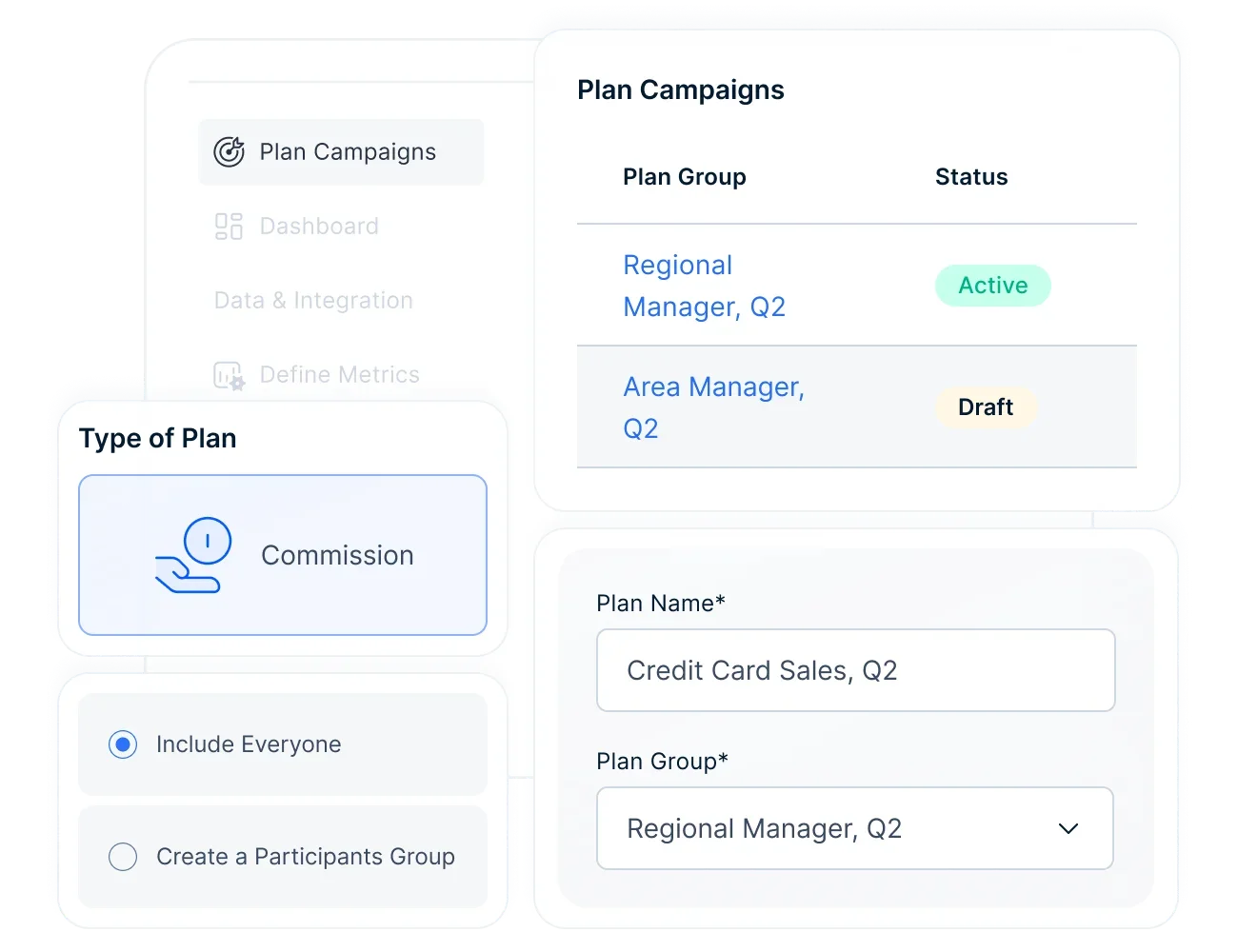
Transparency changes behavior. When Chaipoint gave its 120+ sales users real-time visibility into their incentives, the number of reps qualifying for incentives rose 115% in under six months, as described in the Chaipoint case study.
Book your Empuls demo
Frequently asked questions
The basic formula is incentive payout = target incentive × payout percentage. The target incentive is the variable pay a rep earns at 100% of target, and the payout percentage comes from the plan's payout curve based on attainment. Add any SPIFs, milestone bonuses or contest rewards on top to get the total incentive for the period.
Divide the actual result by the target and multiply by 100 to get attainment. Then read the payout percentage from the plan's curve and multiply it by the target incentive. For example, 80% attainment on a 1:1 curve with a $10,000 target incentive pays $8,000. Above 100%, an accelerator usually raises the payout faster than attainment.
Commission is one type of sales incentive: a percentage or fixed amount paid on each sale. Sales incentives also include target bonuses, accelerators, SPIFs, team pools, contests and non-cash rewards. Commission pays for volume as it happens, while bonuses and other incentives often reward reaching a goal or a specific behavior.
A SPIF, or sales performance incentive fund, is a short-term reward for a specific sales behavior, such as selling a new product or closing deals before quarter end. It is usually a fixed amount per qualifying unit or deal, so a $250 SPIF on 4 units pays $1,000. Keep SPIFs short and clearly time-bound so they do not distort the main plan.
Set a team pool, then divide it by each member's contribution. Multiply the pool by the individual's result divided by the team's total result. With a $15,000 pool, a rep who sold $90,000 of the team's $300,000 receives 30%, or $4,500. Some plans pay the pool equally instead, which builds collaboration but rewards top contributors less.
In the US, yes in most cases. IRS Publication 15-B says cash and cash equivalents such as gift cards are never excludable as a de minimis benefit, no matter how small, so they are taxable wages. Tangible awards can qualify for limited exclusions under specific rules. Tax treatment differs by country, so confirm local rules with payroll.
Match the payout frequency to the sales cycle and the behavior you want. Monthly or quarterly payouts suit most transactional and mid-market teams, because the reward arrives while the effort is still fresh. Annual bonuses suit long enterprise cycles or company-level goals. SPIFs and contests work best when paid out soon after they end.
A cap limits the most a rep can earn, which protects the budget against windfall deals but can stop top performers pushing further. Many plans use a high cap, such as 200% of target incentive, or no cap with decelerated rates above a very high threshold. Whatever you choose, model the cost of over-performance before the plan launches.





































































































































































































































































































































































































































































































































































