
Key Takeaways
Organizational culture is the shared set of values, assumptions and everyday behaviors that shapes how people in a company work, decide and treat each other.
Culture cannot be copied, faked or forced; it is built through what leaders model, reward and tolerate every day.
Two widely used frameworks describe the types of organizational culture: the eight-style integrated culture framework and the four-type competing values framework.
Only about 20% of US employees strongly feel connected to their organization's culture, and those who do are 4.3 times as likely to be engaged, according to Gallup.
Culture decides and engagement influences: culture sets the rules of the game, and engagement shows whether people are investing themselves in it.
Organizational culture is the shared set of values, beliefs, assumptions and everyday behaviors that shapes how people in a company work, decide and treat each other. If you want to cut a long story short, culture is an organization's HOW: how it works, how it transacts, how it hires. It is what happens when nobody is looking.
It is “the accepted way of doing things” or the “appropriate way to make things happen” in that company. Organizational culture is usually an offshoot of why teams do what they do, what the organization does “for a living” and whom the business serves through its products, services and experiences. This guide answers what is organizational culture from several angles, then covers its characteristics, the main types, real examples and how to build organizational culture on purpose.
What is organizational culture
A company derives its distinct identity from the way its people think, act and behave, attributes that are directly influenced by its culture. That is why the origin of the word is useful: “culture” comes from the Latin “cultus”, which means care or cultivation. Culture is something you tend, not something you install.
Workplace culture has a profound impact on the end result of the work teams do. Desired business outcomes usually depend on the coherence between three things: strategy, operating model and culture. When one of them pulls in a different direction, the other two struggle to deliver.
Organizations increasingly define their raison d'être through culture manifestos. Google publishes its “ten things we know to be true,” Netflix's “freedom and responsibility” memo has been read by millions and LinkedIn describes its people as a tribe. Culture taglines can be more powerful than brand punchlines, because employees, candidates and customers all read them.
Despite widely varying opinions of what organizational culture is, ranging from the dismissive “it's about beanbags and foosball tables” to the romantic “culture is the arts elevated to a set of beliefs” (a line attributed to novelist Thomas Wolfe), one thing is certain: everyone is curious about it and everyone wants to get a measure of it.
One reason is that we are usually uncomfortable with what we don't “get.” The other is that understanding something lets us rework it to our advantage. Leadership wants a “hang of the culture” so it can predict and influence behavior. Jobseekers want to understand it so they can fit in. Clients want to decode unsaid signals, and fans want to know a company's position on climate, equality and inclusion before they follow it online.
Organizational culture definition from different perspectives
Workplace culture entered public discourse in the early 1980s, first drawing debate from managers, academics and sociologists. Today the literature is enormous, yet the term remains overused and frequently misunderstood, so a single organizational culture definition rarely satisfies everyone.
The most cited academic definition comes from MIT's Edgar Schein, who described culture as the pattern of shared basic assumptions a group learns as it solves its problems, which works well enough to be taught to new members as the correct way to think and feel. Schein saw three levels: visible artifacts, espoused values and the deep, unspoken assumptions underneath. The iceberg model of culture explains those visible and hidden layers in detail.
Below are four practical perspectives that capture the truth of culture. They run from identity to enforcement, and the first one, culture as identity, carries the most weight because the other three follow from it. Feel free to run with your favorite.
1. Culture is who you are
Culture is coded into the psychological fabric of a team. It combines an inner personality (one revealed only to the mirror) and the persona that engages with the outside world.
Think of it as the unwritten social order of an organization: the way it structures, positions and carries itself, both with employees and internal teams (a dimension often called workplace culture) and with the external ecosystem of customers, partners, investors and stakeholders (often called corporate culture). In short, culture tells you what is okay to do.
2. Culture cannot be copy-pasted
Two teams or companies can have the same strategy (which, incidentally, is the other power lever leadership has for competitive edge, alongside culture), but not the same culture.
Just as every human has a unique fingerprint, every organization's culture is its very own: a signature that can be imitated but never quite replicated. In a landscape of uncertainty and me-too competition, a thoughtfully modeled, reinforced and rewarded culture is an unassailable edge and the surest compass for navigating change. It is also why generic market benchmarks alone are a poor way to understand your own culture.
3. Culture can only be sensed
For something that lives in unspoken rules and rites, culture is surprisingly loud and evident in the emotions and experiences that crisscross a workplace on an average day.
It shows up in the warmth you feel as a customer, the welcome that greets you as a new joiner, the sensitive candor you get as a client and the regard you receive as a vendor, frontline associate or channel partner. Many companies use cross-functional teams to spread it. Unlike furniture or intellectual property, culture is the asset that connects with people at a level and in a language they understand.
4. Culture cannot be force-fitted
You can integrate programs into your workflows that nudge employees to experience your culture and take part in it more readily. You can set up tests and methods to calibrate and refine it. But you cannot force culture into the psyche of your people.
Forcing it goes against the grain of the concept and gives you a false sense of the pulse of your people. When employees are not syncing with your culture code, there are better routes: introspection, open dialogue and, lastly, parting ways. What you should not do is abandon your core values to win over people who will never share them.
Why organizational culture matters
Culture lends an organization its distinct personality and flavor, and contributes to the social character and psychological temper we identify it with. When two businesses meet, at the deal table or in a long partnership, their cultures size each other up first, often without the people involved being aware of it.
A team will often rise or fall by its culture. When it clicks, culture unlocks extraordinary tribe power and turns 2 + 2 into 10. In the wrong hands, it turns passionate people off their jobs and sends business vitals into a tailspin. Current data shows how much room most companies have to improve:
20%
of US employees strongly agree they feel connected to their organization's culture
Gallup, May 2026
4.3x
as likely to be engaged when employees do feel connected
Gallup, February 2025 data
62%
less likely to feel burned out very often or always
Gallup
Culture connection and its effects, from Gallup's organizational culture indicator
According to Gallup's organizational culture indicator, employees who feel connected to their culture are also 47% less likely to be watching for or actively seeking another job. For the full business case, read these reasons why organizational culture is important.
Characteristics of organizational culture
Culture is evident in the big and little habits, behaviors, rituals, customs, norms, traditions, artifacts, voice, symbols and reward systems that team members practice as second nature, day in, day out. From the mission statement to boss-worker relationships, transparency with shareholders, how conflict is resolved, how feedback is shared, how birthdays and new joiners are celebrated and how people are hired and let go, nearly every aspect of an organization is driven by its culture.
Five characteristics show up in every healthy culture:
- Culture cannot be faked: An organization either has a certain kind of culture or it doesn't. Culture cannot be turned on and off at will; your teams cannot glow with a certain vibe four days a week and switch mode for the other three. At its finest, culture is implicit, hardcoded into people's instincts.
- Culture is pervasive: You cannot quarantine a department or role from the overall culture. It flows across spaces and teams, so your sales, R&D and café crew all dance to the same tune.
- Culture is a long-haul game: Culture takes time to take root and needs strategic intervention and patient support. Like a flywheel, the more consistently you endorse, practice and reward it, the stronger it becomes.
- Culture is enduring: Culture is rooted in subconscious routines, so it does not change easily. You cannot undo it at will, which is why you should be deliberate about what you embed.
- Culture is dynamic: Hard to change is not impossible to change. Culture's real power shows when companies must reinvent themselves without losing their core, as many did during the pandemic. Edgar Schein argued that culture evolves in two ways: through a clear and present crisis, or through managed evolution under a skilled leader.
Every culture also sits somewhere along a few spectrums. Where an organization lands on each is a function of its culture, and it in turn reinforces that culture:
| Dimension | One end | Other end |
|---|---|---|
| Degree of hierarchy | Respect for tradition, structure, authority and rules | Flexibility, experimentation and decentralized power, where people are encouraged to challenge convention |
| Degree of urgency | Fast decisions, quick execution and high agility | Cautious, detail-oriented teams that favor consensus and consistency |
| People-first vs task-first | People are paramount in performance and productivity decisions | Efficiency and outcomes come first, and people are treated as a means to the end |
| Function orientation | One function, such as R&D or sales, dominates the approach | Functions carry balanced influence, set by goals, history and brand perception |
Turn your values into everyday behavior
Recognize values in action, listen through pulse surveys and connect every team on one engagement platform.
Talk to our ExpertTrusted by 5,000+ companies
Types of organizational culture
There is no single official list of the types of organizational culture, but two research-backed frameworks are widely used: the eight-style integrated culture framework published in Harvard Business Review and the four-type competing values framework. The first is better for describing your culture in detail, and the second is the one most HR teams use for quick diagnosis, so it pays to know both.
The integrated culture framework: eight styles
In “The Leader's Guide to Corporate Culture” (Harvard Business Review), Boris Groysberg, Jeremiah Lee, Jesse Price and J. Yo-Jud Cheng propose two primary dimensions of culture that apply regardless of organization type, size, industry or geography:
- People interactions: Independence vs interdependence.
- Response to change: Flexibility vs stability.
Plotted on a simple two-by-two grid, these dimensions form the integrated culture framework. The authors then place eight culture styles on that grid according to how strongly each reflects the two dimensions.
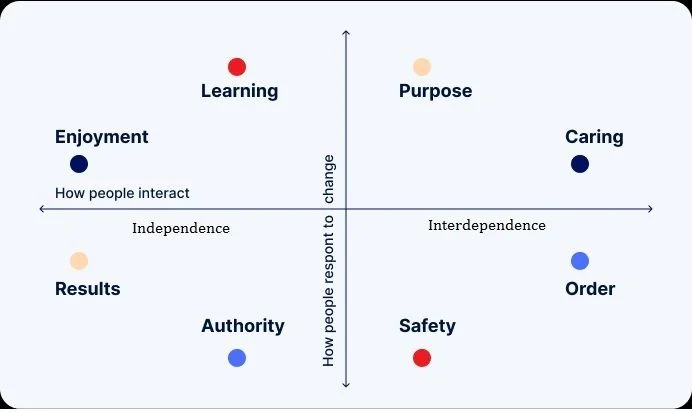
- Caring: The focus is trust, collaboration, relationships, teamwork and positivity. People look after each other and are united by empathy.
- Purpose: The focus is a noble cause that goes beyond the everyday and the transactional, and prioritizes the betterment of the community.
- Learning: The focus is curiosity, innovation and discovery. Outcomes come from repeated exploration, creativity and serendipity.
- Enjoyment: The focus is playfulness, stimulation and spontaneity, and people are encouraged to do what makes them happy.
- Results: The focus is achievement and winning, and people are driven to deliver on KPIs.
- Authority: The focus is strength, decisiveness and confidence. People aim to lead and to dominate the competition.
- Safety: The focus is watchfulness, caution and preparedness. Teams hedge against risk, prioritize stability and plan realistically.
- Order: The focus is method, respect and shared norms. People play by the rules, follow structure and keep long-standing customs.
For workplace designers, the interplay between these styles matters. Neighboring styles such as safety and order co-exist easily, while styles far apart on the map, such as authority and purpose, pull against each other. Some organizations mix distant elements like safety and learning, but that needs judgment because it can confuse employees. At its core, a culture should have a clear focus that people can understand and practice without a list of clauses and conditions.
The competing values framework: four types
The competing values framework, developed by Kim Cameron and Robert Quinn at the University of Michigan, sorts cultures by whether they look inward or outward and whether they favor flexibility or control. It produces the four types of organizational culture you will see most often in HR writing:
| Type | Orientation | What it values | Where it shows up |
|---|---|---|---|
| Clan | Internal and flexible | Collaboration, mentoring, loyalty and a family feel | Founder-led companies, close-knit teams, many nonprofits |
| Adhocracy | External and flexible | Innovation, experimentation and calculated risk | Startups, product and R&D-led businesses |
| Market | External and controlled | Results, competition, targets and customer wins | Sales-driven firms, professional services |
| Hierarchy | Internal and controlled | Structure, process, efficiency and predictability | Government, banking, manufacturing, healthcare |
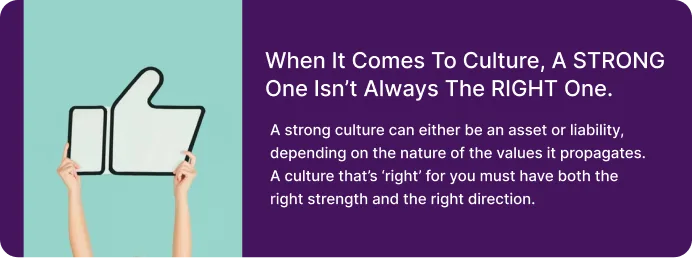
Most organizations are a blend of all four, with one or two dominant. The useful question is not which type is best but whether your dominant type fits your strategy. A hierarchy culture will struggle with a strategy that depends on rapid experimentation, and an adhocracy will struggle in a heavily regulated market.
How subcultures shape the whole
Culture often spawns subcultures within internal pockets and divisions. These are tribes of employees who practice their own norms and rituals.
Those rituals may not map directly to the dominant culture, but a closer look usually reveals that they are anchored in it. Subcultures can be shaped by region, market or a charismatic leader, and they are a fascinating study in reinvention driven by necessity, creativity or habit.
Smart organizations work with subcultures rather than against them. When employees build micro-cultures for their teams, it shows in how they run meetings, share workload, make decisions, give feedback and respect individual styles. The result is greater efficiency, innovation and impact, as long as the micro-cultures stay true to the shared core values.
Organizational culture examples
Strong cultures are often built in the image of their founders. In each of these organizational culture examples, the leader's convictions became a central part of the culture:
- Replacements, Ltd.: Founder Bob Page had felt like an outsider and had to hide his sexuality earlier in his career. When he built the company, he made sure it accepted diversity, not just of lifestyle but of thought, and invested in its community.
- The Body Shop: Anita Roddick founded the business as an environmentally conscious company that reflected her own activism, and its campaigns against animal testing became part of how employees understood their work.
- SAS: Co-founder Jim Goodnight's commitment to work-life balance, from on-site childcare to a reasonable working week, became a defining feature of the software company's culture.
- General Electric: Jack Welch's commitment to being the best created a culture of excellence and intense performance management that many companies copied, for better and for worse.
For six more detailed profiles, from HubSpot and Adobe to the Mumbai Dabbawalas and the NHS, see these companies with great organizational culture.
Culture is a skill you can build
We tend to think of culture as a group thing, something in our DNA that ignites when similar people are put in the same room. In his bestselling book “The Culture Code”, Daniel Coyle offers a different view.
Coyle visited eight highly successful groups, including a special operations military unit, an inner-city school, a professional basketball team, a movie studio and a comedy troupe, and concluded that their cultures were created by a specific set of skills. He describes three:
- Build safety: Signal through everyday behavior that people belong and are safe to speak.
- Share vulnerability: Leaders admit what they don't know, which invites others to cooperate honestly.
- Establish purpose: Tell clear, repeated stories about where the group is going and why it matters.
According to Coyle, these skills work in sequence: they first build group connection, then channel it into action.
Organizational culture and employee engagement
Culture and engagement are often mixed up, used interchangeably in meetings and measured in place of each other. They are closely related yet conceptually distinct: culture decides, engagement influences. Culture sets the context and the accepted behaviors, and engagement shows whether people are investing themselves in the work.
Put another way, culture introduces the rules of the game and engagement proves whether your people are enjoying the sport. When employees approve of your cultural stance, they identify with business goals more readily, get involved more spontaneously and find more satisfaction in their work. That is a classic picture of high engagement, with higher morale, better productivity and more value for customers. For the full comparison, read culture vs engagement.
The elements that make up an organization's culture
Culture is the result of several elements: a distillation of the history, vision, beliefs, values and assumptions shared by everyone on board. The three groups below build on each other, and shared values carry the most weight because they are where assumptions turn into daily behavior.
Shared assumptions
Some of the big assumptions that guide how an organization perceives its own culture are:
- The company's relationship with its environment: What does the business stand for? How do its products and services affect the community? What social goals does it serve?
- Human nature: Are people inherently proactive or reactive, self-centered or empathetic? Are they driven mainly by money or by other motivations?
- Emotional dynamics: Which emotions should the workplace champion, and which mindsets must it overcome?
Shared values
Shared values are the strongest pillars of a culture's structure. Common value orientations include:
- People: The welfare and empowerment of individuals and teams come first. Fairness, inclusion, growth and fun at work go hand in hand.
- Outcomes: Performance, achievement and impact matter most, and effort is optimized for the end result.
- Psychological safety: A mental safety net that lets people take risks and be creative, knowing they won't be punished for speaking their minds.
- Innovation: Staying ahead of the curve, setting trends and delighting customers with new experiences. Radical creativity is prized.
- Empathy: Sensitivity to markets, the community and the environment drives decisions. Nothing energizes this team like the chance to change the world.
- Integrity: Trust, transparency and accountability lead thought and action across rank and role, with commitment and respect as natural by-products.
- Teamwork: The watchwords are synergy and collaboration. Cross-department workshops and cross-functional training help people see situations from their peers' perspective.
- Risk: The appetite for following instinct and taking leaps of faith. The flip side is a premium on stability, safety and consistency.
- Competitiveness: The drive to outperform rivals and dominate the market. Taken too far, it slides into aggression and coercion.
- Attention to detail: A pursuit of precision and differentiated products and experiences that dot every i and cross every t.
The big idea behind institutionalizing these values is not to impress fans and markets. It is to connect the organization's thinking, actions and decisions with its fundamental values, which gives it the best chance of thriving in a volatile world. If you want to turn values into daily behavior, a values-based recognition program is one of the most direct levers.
Other ingredients
Business climate, economic trends, nationality, company size, the nature of the product and the industry all leave their mark on an organization's culture. Culture is also actively upheld by culture bearers, and top leadership plays the lead role among them.
How to build organizational culture
You cannot prevent culture from evolving in your workplace. It is an autonomous phenomenon that will plant itself and branch out whether you like it or not. You do, however, get to choose whether what grows under your nose is fungus or flower.
Alert leaders treat culture as a strategic management tool worth investing in, not as a source of frustration. They know that the best way to transfer the spark is to walk the talk visibly, and that healthy cultures start with the commitment of the CEO. As Ann Rhoades, co-founder of JetBlue and former people chief at Southwest Airlines, has put it, you have to show people what the values are through your behavior, starting at the top. Here is how to build organizational culture step by step:
- Run a values blueprinting exercise: Bring leadership and the heads of every group together to work out the culture you want. Turn each value into two or three observable behaviors, so people know what it looks like on a Tuesday afternoon.
- Model it from the top: Leaders lay out the culture vision in plain language and demonstrate it at every turn. You cannot define behaviors for everyone but the CEO.
- Hire and onboard for it: Take a personal interest in hiring and role fit, then help new joiners acclimatize through real experiences of the culture, not just a slide deck.
- Reward the behaviors you want: Create a work environment that encourages involvement and rewards achievement. Recognition tied to specific values is the clearest signal of what the culture prizes.
- Keep people learning: Make room for regular training and retraining, so the culture keeps pace with new realities.
- Hold everyone accountable: Hold people accountable for both wins and losses, and apply the same standard to leaders.
- Communicate openly and often: Root for the common spirit on chat, intranet and social channels, and give people a voice in two-way conversations.
- Listen and adjust: Form a small culture council that keeps the letter and spirit aligned and reports regularly to leadership on the health of the culture.
Bold leadership, open communication and meaningful delegation are the three pillars available to any leader. Great leaders sidestep micromanagement by trusting their teams to uphold the culture, and they blend their intentions with the knowledge of frontline people to create something more robust. For tactics to fix a culture that has drifted, see how to improve organizational culture, and for the traits to aim for, read about positive company culture.
A word of caution: intervention from the top is essential but double-edged. Leaders with strong personalities and charisma leave a lasting legacy on culture, consciously or not, and it is often, but not always, for the better.
Common mistakes that undermine culture
Most culture problems come from a handful of predictable errors. Avoid these:
- Copying another company's culture: What works at a famous tech company grew from its own history and people. Borrow practices, never identities.
- Treating culture as an HR project: When leaders leave culture to fester on the back burner or hand it to HR, they give away a powerful competitive advantage.
- Saying one thing and rewarding another: If the values poster says collaboration but bonuses reward lone heroes, people will follow the bonus.
- Mixing incompatible styles: Asking teams to be both maximally cautious and maximally experimental, without explaining where each applies, breeds confusion.
- Forcing culture on people: Mandated fun and compulsory enthusiasm give you a false sense of the pulse of your people.
How to measure organizational culture
Because culture can only be sensed, measure it through several signals rather than one score. Combine what people say with what they do:
| Signal | What to look at | How to collect it |
|---|---|---|
| Connection to culture | Share of employees who feel connected to the culture and believe leaders live the values | Pulse and engagement surveys |
| Values in action | How often recognition references each company value, and in which teams | Recognition platform data |
| Psychological safety | Whether people feel safe to raise problems and admit mistakes | Survey items, skip-level conversations |
| Retention and attraction | Regretted attrition, offer acceptance rate, employee referrals | HRIS and recruiting data |
| Consistency | Gaps in scores between teams, locations and levels | Segmented survey analytics |
Empuls: turning culture into everyday engagement
A company's success is not built on strategy and profit alone. It thrives on the strength of its culture, which lives in daily interactions more than in policies. Empuls, Xoxoday's employee engagement platform, gives organizations the tools to turn values into actions:
- A culture of recognition: Peer-to-peer and manager recognition, with awards and rewards that can be tied to company values.
- Open communication: A social intranet with groups, walls of fame, polls and leaderboards that strengthens connections across teams.
- Real-time employee insights: Pulse, lifecycle and sentiment surveys with action plans that help you measure culture and act on what you learn.
- Moments that matter: Automated celebrations for service anniversaries, birthdays, onboarding and career milestones, so no contribution goes unnoticed.
Together, these make culture a shared responsibility rather than a leadership-only initiative. See how teams use Empuls to build culture and values.
Culture is your GPS for what comes next
As organizations adapt to new ways of working, from hybrid teams to AI-assisted roles, culture offers a reliable pivot. Beyond explaining the present, it is the best handle leaders have on what comes next.
Culture custodians now need to identify and accelerate the behaviors that give them an edge in this new reality, while neutralizing the attitudes that create headwinds. Do that consistently, and culture becomes the gene of your engine: the thing that drives sustainable competitive advantage long after strategies change.
Book your Empuls demo
Frequently asked questions
Organizational culture is the way things are really done in a company. It is the mix of shared values, beliefs, unwritten rules and habits that shapes how people work, make decisions, treat each other and serve customers. It shows most clearly in what people do when nobody is checking.
The competing values framework by Kim Cameron and Robert Quinn describes four types of organizational culture: clan (collaborative and people-focused), adhocracy (innovative and risk-taking), market (competitive and results-driven) and hierarchy (structured and process-driven). Most organizations blend all four, with one or two types dominant.
Edgar Schein described three levels of organizational culture. Artifacts are the visible elements such as office layout, dress code and rituals. Espoused values are the stated values and strategies. Basic underlying assumptions are the unspoken beliefs people take for granted, and they drive behavior most strongly.
Yes, but slowly. Culture is rooted in habits and assumptions, so it changes when people repeatedly see new behaviors modeled by leaders, rewarded through recognition and pay, and reinforced in hiring, onboarding and everyday decisions. Change usually comes either through a crisis or through steady, deliberate management over several years.
Everyone shapes culture, but leaders carry the most responsibility because their behavior signals what is truly valued. The CEO and senior team set the tone, managers translate it into daily team habits, HR designs the systems that reinforce it, and employees keep it alive through how they treat each other.
Measure culture with several signals instead of one score. Use pulse surveys to track whether employees feel connected to the culture and safe to speak up, recognition data to see which values show up in daily work, and HR data such as regretted attrition and referrals. Compare results across teams to spot inconsistent subcultures.





































































































































































































































































































































































































































































































































































