
Key Takeaways
A multi-benefit card is one employer-issued prepaid card with separate wallets for meals, fuel, telecom, books and gifts, each with its own limit.
From 1 April 2026, India's Income-tax Rules treat meals up to ₹200 per meal and gifts below ₹15,000 a year as nil-value perquisites.
For an employee-owned car used partly for work, fuel and running costs reimbursed by the employer are taxable only above ₹5,000 a month (₹7,000 for larger cars), plus ₹3,000 for a driver.
A multi-benefit card raises take-home pay without changing cost to company, and an employee in the 30% slab can save tens of thousands of rupees a year.
Successful programs start with employee needs, a documented tax policy for each wallet and clear communication before the financial year begins.
A multi-benefit card is a single prepaid card, issued by an employer, that holds separate wallets for allowances such as meals, fuel, telecom, books and gifts, so employees spend each benefit like a normal card while the employer controls limits and stays tax-compliant. In India, it is the most common employee benefits card for delivering tax-free allowances, and the Income-tax Rules, 2026 raised key limits such as meals to ₹200 per meal and gifts to ₹15,000 a year.
As employee expectations evolve, so must the way companies offer benefits. Modern teams do not just want flexibility, they expect it, especially in how they access and use their perks. A multi-benefit card lets employers consolidate allowances into one easy-to-use card, which simplifies benefits management and gives employees freedom of choice in how they use their entitlements.
This guide explains how a multi-benefit card for employees works, what each wallet covers under the 2026 rules in India, how much it can save, the benefits for employers and employees, and how to implement a program step by step.
What a multi-benefit card is and how it works
A multi-benefit card is a payment instrument issued by employers to their employees that gives access to a range of benefits through a single card. It consolidates several benefits into one convenient form of payment, offering employees more flexibility and ease of use than separate vouchers, cards or reimbursement claims.
Employees receive a multi-benefit card, typically a prepaid card linked to an app, that works online and in stores. In India, these cards are issued as prepaid payment instruments (PPIs) under the Reserve Bank of India's Master Directions on Prepaid Payment Instruments. The flow is simple:
- The employer sets the policy: HR or finance decides which wallets to offer, the monthly or annual limit for each and who is eligible.
- Employees choose their split: Where the policy allows, employees restructure part of their salary into the wallets they will actually use.
- The employer loads the card: Each wallet is funded from payroll, usually every month.
- Employees spend: The card checks the merchant category, so the meal wallet works at restaurants and food apps, the fuel wallet at fuel stations, and so on. Bill-based wallets, such as telecom, are credited after employees upload bills.
- Finance gets the records: Every transaction is logged by wallet, which supports payroll tax treatment and audits.
Outside India, the same card format is common for other benefit accounts. In the US, for example, health savings and flexible spending accounts often come with a debit card, while lifestyle spending accounts are usually paid as taxable wages. Tax rules differ by country, so see our guide to non-taxable employee benefits for the US, UK and India.
Multi-benefit card wallets and the 2026 tax rules in India
A multi-benefit card can carry six common types of wallet, and each follows its own tax rule. The meal wallet comes first because it is the most used and has the clearest exemption, while the later wallets depend more on documentation or on your policy. The rules below come from the Income-tax Rules, 2026, which apply from 1 April 2026.
1. Meal wallet
The meal wallet is one of the most used and loved features of a multi-benefit card. It lets employees pay for meals at restaurants, cafes, cloud kitchens and food delivery platforms without carrying cash or using their own cards, which brings convenience to lunch breaks and long workdays.
Under Rule 15 of the Income-tax Rules, 2026, free food and non-alcoholic beverages provided during working hours at the office or through paid vouchers usable only at eating joints are not a taxable perquisite up to ₹200 per meal. That is four times the earlier ₹50 limit. Tea and snacks during working hours are also excluded.
2. Fuel and driver's salary
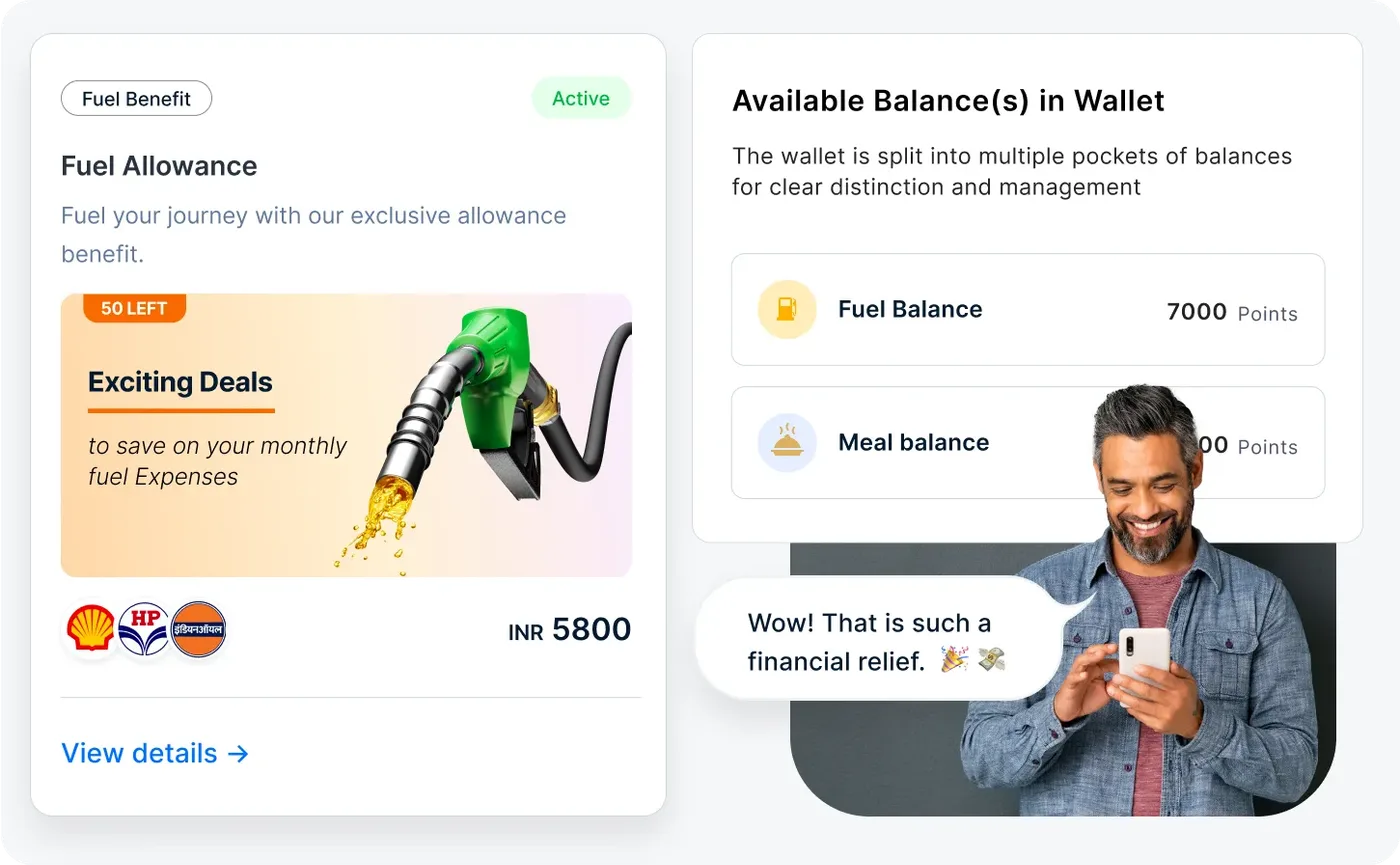
Fuel costs are a real burden for employees who commute or drive for work. A fuel and driver's salary wallet helps cover daily transport costs, whether employees drive their own car or use a driver.
For a car the employee owns that is used partly for work and partly for personal travel, the employer's reimbursement of running costs is taxable only above a fixed amount: ₹5,000 a month for a car up to 1.6 litres or an electric vehicle, or ₹7,000 a month for a larger car, plus ₹3,000 a month if a driver is reimbursed, provided journey records and an employer certificate are kept. For a two-wheeler used partly for work, the amount is ₹3,000 a month. If the car is used wholly for official duties and the records are kept, there is no taxable value.
3. Telecom services
Remote and hybrid work have made phone and internet bills part of every employee's monthly essentials. A telecom wallet covers mobile recharges, data packs and broadband subscriptions.
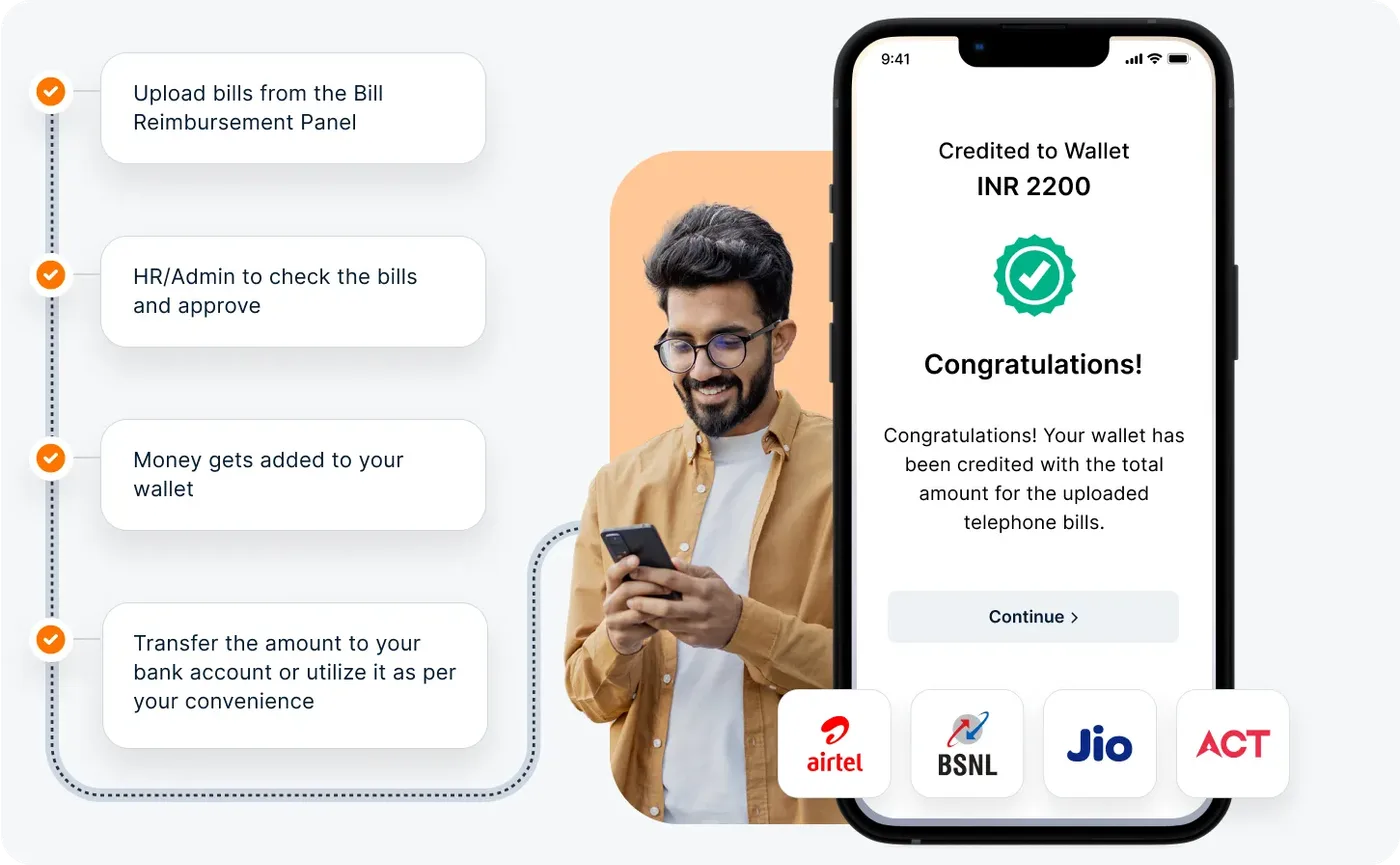
Rule 15 excludes expenses on telephones, including mobile phones, from the general valuation of other benefits, so employer-paid telecom bills are not a taxable perquisite. Employees usually upload their bills, HR or the platform validates them, and the amount is credited to the wallet.
4. Books and periodicals
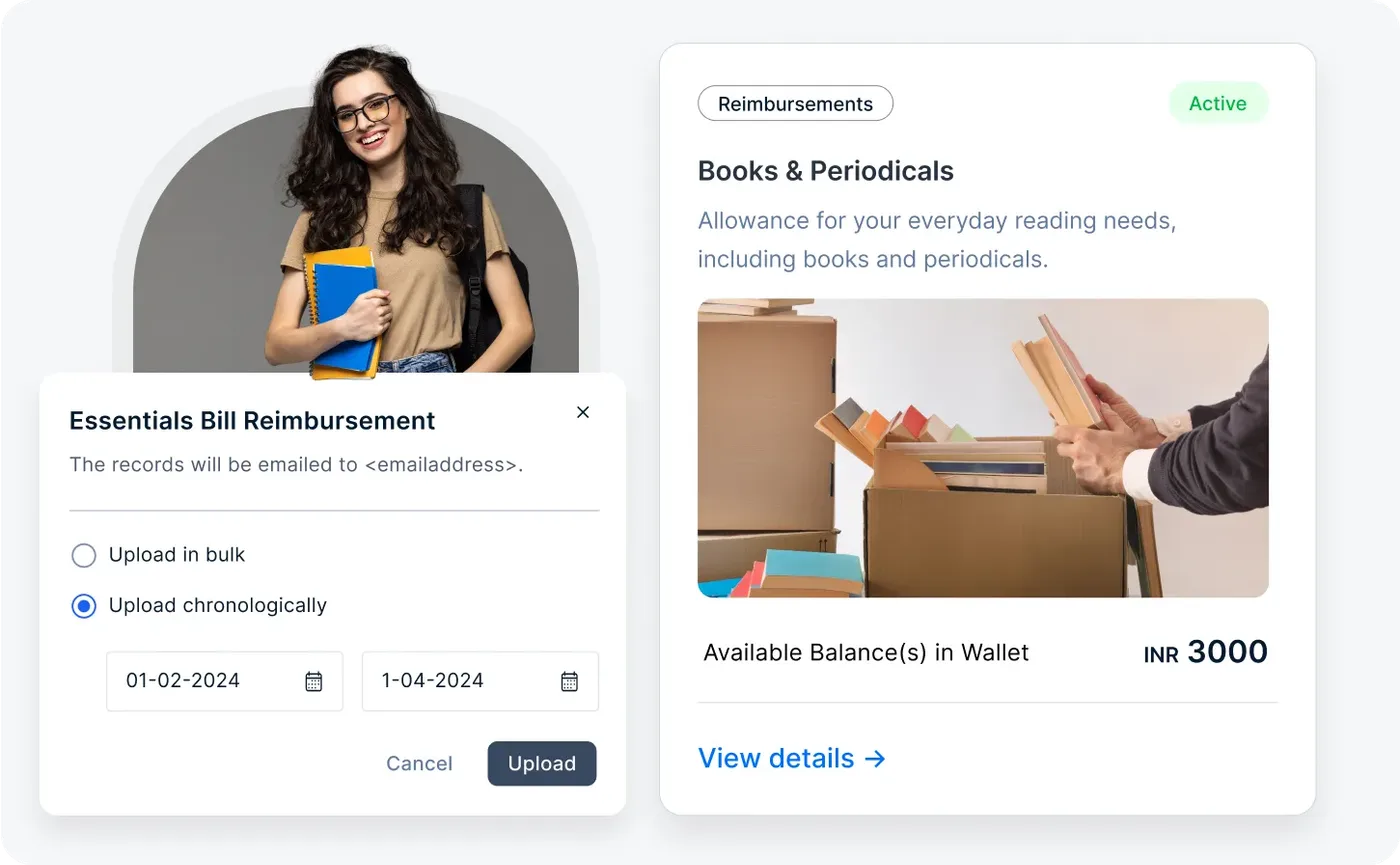
Encouraging continuous learning has never been more important. A books and periodicals wallet lets employees buy books, journals, e-magazines and digital library subscriptions for upskilling.
The Income-tax Rules, 2026 do not list books and periodicals as a separate exemption. Reimbursement of books and journals used for work is commonly treated as a business expense rather than a perquisite when it is backed by bills, so keep receipts and confirm the treatment with your tax advisor before you set a limit.
5. Gifts
A gift wallet lets you send festival, birthday or milestone gifts on the same card. Under Rule 15, the value of gifts, vouchers or tokens an employee receives from the employer is nil when it is below ₹15,000 in aggregate during the tax year, up from ₹5,000 earlier. Anything above that is a taxable perquisite.
6. Financial wellness and additional benefits
Financial stress affects focus and productivity. Many employers pair the card with earned wage access, which lets employees draw earned but unpaid salary before payday instead of taking high-interest loans. Every workforce is different, so the card can also extend to fitness, wellness, childcare support or merchant employee discounts. These extras are usually taxable or are simply savings, so treat them as perks rather than tax-saving wallets.
| Wallet | Tax rule in India (Income-tax Rules, 2026) | Key condition |
|---|---|---|
| Meals | Not a perquisite up to ₹200 per meal | During working hours, at the office or via vouchers usable only at eating joints |
| Fuel and driver (own car, mixed use) | Taxable only above ₹5,000 a month (₹7,000 above 1.6 litres), plus ₹3,000 for a driver | Journey records and employer certificate |
| Telecom | Telephone and mobile expenses excluded from perquisite valuation | Bills for the employee's connection |
| Gifts and vouchers | Nil below ₹15,000 in aggregate per tax year | Above the limit, the full value is taxable |
| Books and periodicals | No separate exemption in the Rules | Treat as work expense with bills; confirm with your advisor |
Raise take-home pay with one card
Empuls puts 16+ tax-exempt wallets on one RBI-compliant card, with limits enforced automatically.
Talk to our ExpertTrusted by 5,000+ companies
How much a multi-benefit card can save: a worked example
The saving comes from moving part of the salary into wallets that are not taxed, so the employee's cost to company does not change but take-home pay rises. Here is an illustration for an employee taxed at the 30% slab, plus 4% cess, who restructures part of their salary:
| Wallet | Monthly | Annual |
|---|---|---|
| Meals (one ₹200 meal on 22 working days) | ₹4,400 | ₹52,800 |
| Fuel and driver (own car up to 1.6 litres, mixed use) | ₹8,000 | ₹96,000 |
| Telecom (actual bills) | ₹1,500 | ₹18,000 |
| Gifts (festivals and milestones) | ₹15,000 | |
| Total moved out of taxable salary | ₹1,81,800 | |
| Approximate tax saved at 31.2% | ₹56,722 |
Your numbers will differ with the employee's slab, regime, surcharge, actual bills and your policy, so use this as a planning estimate, not tax advice. To model it for your team, try the Empuls employee benefits calculator.
Multi-benefit card vs reimbursements and paper vouchers
Many companies still run allowances through monthly bill claims or paper meal coupons. A multi-benefit card replaces both:
| Factor | Bill reimbursements | Paper or single-use vouchers | Multi-benefit card |
|---|---|---|---|
| Employee effort | Collect and submit bills every month | Carry coupons, limited outlets | Tap or pay online; bills only for bill-based wallets |
| Wallets | One process per allowance | Usually one benefit | Many wallets on one card |
| Compliance | Manual checks | Hard to track usage | Merchant category and limit checks built in |
| HR and finance effort | High | Medium | Low, with real-time reports |
| Employee experience | Slow, delayed money | Dated | Instant and mobile |
Benefits of a multi-benefit card for employers
Employers adopt multi-benefit cards to cut administrative work and offer more value without raising cost to company. The main advantages are:
- Simplified administration: Managing many benefit programs is complex and slow. One card for every allowance reduces paperwork, errors and the overhead of benefit administration.
- Cost efficiency: Consolidating benefits spending into one program and one provider gives better terms and clearer budgets, without cutting the scope of benefits.
- Higher employee satisfaction: A comprehensive, convenient benefits package helps attract and retain talent, and employees appreciate accessing multiple benefits through one card.
- Competitive advantage: Higher take-home pay at the same cost to company is a strong message in hiring and retention conversations.
- Compliance and reporting: Wallet-level transaction records and reports make audits and payroll tax treatment straightforward.
- Flexibility and customization: You can add wallets, adjust limits or change eligibility by grade, role or location as your workforce changes.
Benefits of a multi-benefit card for employees
For employees, the card turns allowances they often ignored into money they actually use. The main advantages are:
- Convenience and accessibility: All benefits sit on one card and one app, so there is no need to juggle multiple cards, coupons or claim forms.
- Flexibility in using benefits: Employees choose the wallets and amounts that fit their lives, whether that is dining out, commuting or upskilling.
- Higher take-home pay: Tax-free wallets raise net income without a pay rise.
- Peace of mind: Knowing that meals, transport and phone bills are covered reduces financial stress and helps people focus at work.
- Personal and professional growth: Learning and books wallets make it easier to invest in skills.
- Better work-life balance: Less time spent on bills and claims means more time for life outside work.
How to implement a multi-benefit card program
Rolling out a multi-benefit card is mostly a policy and communication project, not an IT one. Follow these steps:
- Assess employee needs: Survey employees to learn which wallets they would use. A team that commutes by car values fuel, while a remote team values telecom and learning.
- Select a provider: Look for an RBI-compliant PPI card, enough wallets for your policy, automatic merchant category and limit checks, a good employee app, HRMS and payroll integration and dedicated onboarding support.
- Design the policy with finance and tax: Set wallets, limits and eligibility by grade or role, decide how unused balances are handled at year end and document the tax treatment for each wallet.
- Communicate with employees: Explain how the card works, how much they can save, how to choose their split and any changes to existing allowances.
- Provide training and support: Share short guides and videos and make support easy to reach for card activation, PIN and bill uploads.
- Monitor and evaluate: Track wallet utilization, unused balances and employee feedback every quarter.
- Adjust as needed: Add or remove wallets, change limits or update features as needs and tax rules change.
- Promote engagement: Run information sessions before the financial year starts, when employees declare their salary structure, and remind them of unused balances.
How the Empuls multi-benefits card works
The Empuls tax-saving multi-benefits card brings all your tax-saving allowances together in one fully digital, compliant solution, so you can offer higher take-home pay without adding HR overhead. Here is what it includes:
01 · Wallets
16+ tax-exempt wallets
Meals and fuel, telecom and books, learning and gym, gifts and travel, each mapped to its tax head with caps enforced automatically.
02 · Compliance
RBI-compliant PPI card
Employer-funded only, with merchant category and limit checks that keep every spend traceable to an eligible category.
03 · Experience
Online and offline
Contactless tap, chip and PIN in stores and card details in the app for online checkout, with one-tap freeze if a card is lost.
04 · Control
Configurable policy
Set limits by grade or role and choose whether year-end balances roll forward, move to another wallet or lapse.
Beyond tax wallets, the same card can run corporate wallets for milestone rewards, festival gifts or custom wellness budgets, alongside lifestyle spending accounts and recognition in the Empuls app. For the bigger picture on tax-efficient pay, read about tax saving benefits for employees.
One card for every employee benefit
A multi-benefit card is a practical upgrade to how companies deliver benefits. It consolidates allowances into one card, raises employees' take-home pay through tax-free wallets and simplifies administration and compliance for HR and finance.
With the 2026 rules raising meal, gift and vehicle limits in India, now is a good time to review your salary structures. For more ways to build a package employees value, explore these employee benefits ideas and how to calculate employee benefits.
Book your Empuls demo
Frequently asked questions
A multi-benefit card is a prepaid card that an employer issues to employees, holding separate wallets for allowances such as meals, fuel, telecom, books and gifts. Employees spend each wallet like a normal card at eligible merchants, while the employer sets limits, funds the wallets from payroll and gets transaction records for tax and audit purposes.
A multi-benefit card saves tax by moving part of an employee's salary into allowances and perquisites that are exempt or valued at nil under tax rules. In India from 1 April 2026, examples include meals up to ₹200 per meal, gifts below ₹15,000 a year, telecom bills and limited car running costs. The employee's taxable salary falls, so take-home pay rises.
Yes, employees under the new regime can use a multi-benefit card, but not every wallet saves tax for them. The Income-tax Rules, 2026 value perquisites such as meals and gifts without a separate new-regime condition, while exempt allowances are restricted for new-regime employees and leave travel concession is an old-regime benefit. Confirm each wallet with your tax advisor.
From 1 April 2026, free food and non-alcoholic beverages provided by an employer during working hours, at the office or through paid vouchers usable only at eating joints, are not taxable up to ₹200 per meal under Rule 15 of the Income-tax Rules, 2026. The earlier limit was ₹50 per meal. Amounts above ₹200 per meal are a taxable perquisite.
The terms are often used interchangeably. A flexible benefits card usually lets employees choose how to split part of their salary across benefit categories, and a multi-benefit card is the payment instrument that holds those categories as separate wallets. In India, both usually refer to an RBI-regulated prepaid card that carries tax-saving allowances such as meals, fuel and telecom.
Yes. Many employers add wellness, fitness, learning or childcare wallets to a multi-benefit card, and some cards also carry discounts. These extras improve the benefits experience, but they usually do not have a specific tax exemption, so they are treated as taxable perks or simple savings. Keep tax-saving wallets and perk wallets clearly separated in your policy.
It depends on your policy and provider. Some programs let unused monthly balances roll forward through the year, while year-end balances can be carried forward, moved to another wallet or allowed to lapse. Set this rule with finance before launch and remind employees of unused balances so they get the full value of their benefits.
Choose a provider that issues an RBI-compliant prepaid card, supports all the wallets in your policy, enforces merchant category and limit rules automatically, offers a simple employee app with bill uploads, integrates with your HRMS and payroll, provides wallet-level reports for audits and gives dedicated onboarding and employee support.





































































































































































































































































































































































































































































































































































