
Key Takeaways
Employee gifting is a planned program of gifts that thanks employees and marks their personal and professional milestones.
Choice and personalization matter most: most employees value a gift more when it is personalized and prefer picking from options over a one-size-fits-all gift.
A clear gift policy prevents favoritism: gifts should flow down or across the hierarchy and never cluster just before performance reviews.
Budget per occasion and per employee, plan for tax and keep about 15% in reserve for unexpected moments worth celebrating.
Automating predictable occasions such as birthdays and work anniversaries frees managers to focus on spontaneous, personal recognition.
Employee gifting is the practice of giving employees gifts to thank them, celebrate their milestones and mark the moments that matter in their working and personal lives. It works when gifts are personal, fair and well timed, and it fails when they are generic, late or tone-deaf. This guide covers what to give, when to give it, how to budget and how to run employee gifting at scale.
Shark Tank investor Robert Herjavec once put it simply: whatever your business does today, it will not be doing the same thing in a year. Employee gifting is a good example. What employees value has moved from essentials to goods to experiences and, now, to choice, and the way companies give has moved from boxes on desks to digital rewards delivered anywhere in the world.
What employee gifting is
Employee gifting is a planned program of gifts from an employer to its employees, given as appreciation for loyalty or excellent work and to mark special personal and professional events. Though it is not a rule, employee gifts are usually not branded, which is what separates a gift from company swag.
Corporate gifting for employees sits alongside recognition and rewards. Recognition is the thank-you, rewards are tied to performance, and gifts mark occasions and relationships. In practice, the best programs connect all three so that a gift always carries a reason. For a wider view of how these terms differ, read our guide to benefits, perks, gifts, awards, incentives and rewards.
How employee gifting has evolved
Corporate gifting dates back to medieval trade, when precious stones, rare animal skins and costly fruits changed hands between merchants. The 20th century changed it. During the two world wars, business and employee gifts reflected shortages and were mostly essentials. After the wars, gifts moved from necessity to comfort: new gadgets, foods that were still a rarity, quality stationery and fine clothing.
Charles Dickens's A Christmas Carol, published at Christmas 1843, helped shape holiday gifting at work. Ebenezer Scrooge's transformation from a calculating businessman into a generous employer was received so warmly that it helped turn Christmas into a season of generosity, especially toward employees.
Globalization then made goods ubiquitous and less exciting, and employees began to want experiences instead: adventures, travel, great food and events. That shift is still under way. TD Bank's 2024 Merry Money survey found that 45% of US consumers planned to gift experiences over physical items, led by Gen Z (68%) and millennials (61%). The latest step is choice: rather than guessing, employers increasingly let employees pick their own gift from a catalog.
What employees want from employee gifts
Employee gifting looks simple until a gift falls flat, and research shows the gap between what employers give and what employees want is real. The six findings below start with expectations and the cost of getting gifts wrong, then move to the gift types employees ask for most, so you can see both the risk and the fix.
1. Employees expect gifts and notice when they are missing
Gifts are part of how employees judge whether they are valued. In the 2025 Custom Ink employee holiday gift survey of 1,051 US workers, 41% worried they might not receive a gift from their employer that year. Gallup's research with Workhuman also found that only 22% of employees say they get the right amount of recognition for their work.
2. Bad gifting has a lingering impact
A gift that misses tells employees you do not know them. The common themes in bad gifts are lack of understanding of the person, little attention to detail and no thought about how the gift will be used. In the Custom Ink survey, stationery was the least favorite gift category and 38% ranked office products among the gifts they wanted least. For employers, a flat gift also means wasted time and money.
3. Charitable donations
Many employees value a donation made in their honor, especially when they can choose the cause. Let employees pick from a list of charities, or let them convert a gift into a donation, so the gesture reflects their values rather than yours. It also fits well with workplace giving programs.
4. Digital gifts delivered in a thoughtful mix
With hybrid and remote work now standard in many companies, digital gifts are the most reliable way to reach every employee on the same day. They avoid shipping delays and supply chain problems, and they let employees use the gift how and when they want. Mix them with physical gifts for moments where something to hold matters, such as a long-service award. Our comparison of digital rewards and physical gifts covers the trade-offs.
5. Experiential gifts
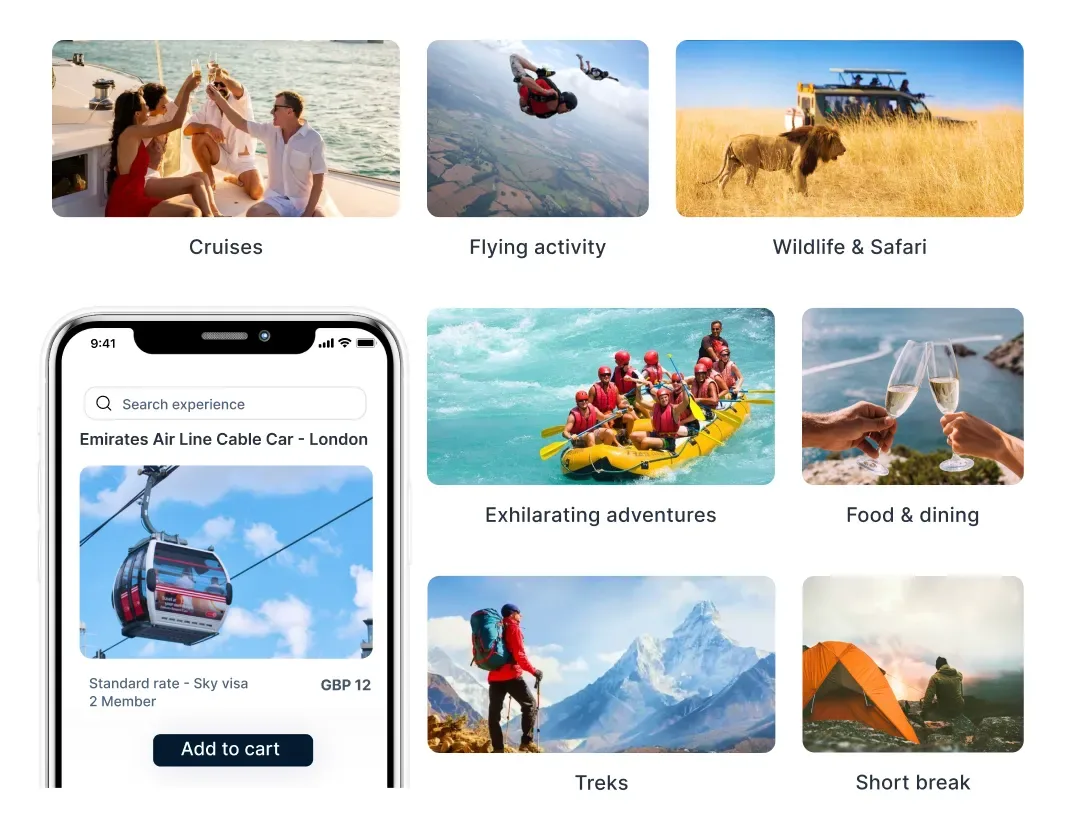
Things as gifts have not lost their shine entirely, but in a world where almost any object is a click away, an unforgettable experience stands out. Experiences can include museum tickets, guided tours, resort stays, cooking classes, concerts and wellness or fitness sessions, and virtual experiences work for distributed teams. One example: a team lead at DailyPay ran an online mixology session for her team and sent each participant a box with every ingredient they needed. See our guide to experiential rewards for more ideas.
6. Gift cards and choice
Gift cards remain the most requested employer gift because they let people shop when and how they want. Gift cards were among the most popular categories in the Custom Ink survey, and 52% of respondents preferred choosing among several gift options, compared with 31% who preferred the same gift as everyone else. According to the Incentive Research Foundation's Industry Outlook for 2025, gift cards account for at least 43% of all incentives in North America. Personalize them with the employee's name, a custom card design and a specific message. Our guide to running an employee gift card program covers budgets, delivery and tax.
Employee gifting ideas by type
The best employee gifting ideas match the gift type to the moment. Use this table as an employee gift guide when you plan your calendar; most companies use three or four of these types, with gift cards or a choice catalog as the default.
| Gift type | Best for | Why it works | Watch out for |
|---|---|---|---|
| Gift cards and reward links | Spot awards, birthdays, holidays, remote teams | Instant, flexible and easy to budget | Single-brand cards can go unused; offer choice |
| Experiences | Milestones, top performers, team wins | Memorable and personal | Booking windows and local availability |
| Curated hampers and gift boxes | Festivals, weddings, new babies | Something to open and share at home | Dietary needs, shipping and customs |
| Wellness gifts | Busy seasons, burnout recovery | Shows care for health | Avoid gifts that imply judgment about bodies |
| Learning gifts | Promotions, career milestones | Supports growth | Should feel like a gift, not homework |
| Charity donations | Purpose-driven teams, holidays | Reflects employee values | Let employees choose the cause |
| Personalized keepsakes | Long service, retirement, farewell | Lasting reminder of the relationship | Lead time for engraving or printing |
For specific gift lists, see our roundups of corporate gifting ideas, employee reward gift ideas and employee milestone gift ideas.
The ethics of employee gifting
Employee gifting can be like skating on ice. The risks are not only administrative or budgetary; a badly judged gift can raise ethical questions that damage trust inside the company and your reputation outside it. Because gifting reflects the values you stand for, the safest approach is a clear employee gift policy that anticipates problems before they happen.
A comprehensive employee gift policy should:
- State whom an employee can accept a gift from, including vendors and clients
- Spell out the circumstances under which employees may accept or give a gift
- Set value limits and say which gifts are and are not appropriate
- Explain how gifts are taxed and who pays any tax
- Say who approves exceptions
Four guidelines make the policy work in practice. The first two prevent gifts from looking like favoritism, which is the most common ethical problem, and the last two make sure gifting builds an inclusive culture.
1. Avoid gifts to superiors
A reliable rule of thumb is that gifts flow down or across the hierarchy, not up. A manager or HR leader may give gifts to their team, and colleagues can exchange gifts with each other, but employees gifting their supervisors is best avoided. A gift from a senior person reads as encouragement; the opposite can look like flattery or an expectation of something in return. Leaders should be recognized by their peers or their own leaders. If teams want to mark a boss's birthday, a group card or a small shared gift keeps it safe.
2. Do not give gifts just before performance reviews
Timing reveals intent. Giving gifts to a few employees right before annual reviews sends the wrong signal and, however pure your intentions, will look like favoritism. The same applies in reverse: an employee planning to apply for an internal role should not be sending gifts to the hiring manager or HR.
3. Aim for complete inclusion
Gifts motivate people, and they also show whether everyone belongs. Make sure no employee is left out, and avoid gifts with sexual, religious or political overtones or anything that makes fun of a group. Unless you are marking a specific day, such as International Women's Day, avoid gender-specific gifts. Remember the many differences within a team when you choose gifts:
- Work patterns: Seniority, department, hourly or salaried, remote, hybrid or on-site
- Personal life: Marital status, children, dietary needs such as vegan, vegetarian, halal or kosher
- Background: Nationality, language, race, religion and cultural festivals
- Preferences: Interests, thinking style, dress and how they like to be recognized
Without a strong foundation of inclusion, employees from underrepresented groups may be unable to perform at their best, unhappy in their roles and thinking about leaving. Our guide to diversity and inclusion in the workplace goes deeper.
4. Reward virtues, not only results
Festivals and achievements are natural gifting moments, but you can also send a clear message by setting aside gifts for behavior you want to see: integrity, kindness, mentoring and living your company values. Celebrating character as well as output raises your standing with current employees and makes your company more attractive to candidates. Our guide to a values-based recognition program shows how.
Automate meaningful gifts for every employee moment
Celebrate birthdays, anniversaries, festivals and wins with gifts employees choose from 10M+ options.
Talk to our ExpertTrusted by 5,000+ companies
How to budget for employee gifting
A gifting budget has to make employees feel valued without straining the company's finances. Employee gifting has two main streams, occasional gifts throughout the year and holiday gifts, and the seven steps below cover both, starting with your needs and ending with a buffer for the moments you cannot predict.
1. Identify your organization's needs first
Decide which types of gifts and gifting will help your organization most, and what stands in the way. Pain points range from HR spending too much time managing gifts manually to not knowing which gifts employees value. The best gifts are timely, informed by listening to employees and aligned to business goals, so start with a short survey of employee preferences.
2. Allocate the budget early
Once you know the types of gifts and how you will give them, set a number. As a rough benchmark, the Incentive Research Foundation's recognition budgeting toolkit suggests 1.5% to 2% of payroll for a social recognition program, covering platforms, administration and small rewards. Then split the budget across the costs most programs include:
- Service and long-service awards
- Peer-to-peer recognition
- Manager-to-employee recognition
- Occasion gifts: birthdays, life events, holidays, onboarding and farewells
Choose a platform that adapts to your budget rather than forcing you to buy a large block of reward points before you have worked out what you need.
3. Integrate multiple programs into one
Gifting is a vital part of your culture, and it loses meaning if it only covers a few occasions. Bring recognition, wellness challenges, safety and training milestones and celebrations into one program and one budget. It makes budgeting far easier and lets you reward different behaviors and occasions from a single platform.
4. Calculate the specifics
Count how many people you will gift in the year, including expected new hires and temporary staff on critical projects. Then estimate spend per person from last year's costs and your most popular gifts, add about 10% as a buffer for price increases and multiply by headcount. A simple traditional recognition budget of $200 per employee might look like this:
| Line item | Annual cost per employee |
|---|---|
| Long-service award (for example, at 5 years) | $100 |
| Peer-to-peer recognition | $50 |
| Manager-to-employee recognition | $50 |
| Total | $200 |
Occasion gifts sit on top. For teams in India, for example, new joiner gifts often fall between INR 500 and 2,000, festive gifts for Diwali, Eid or Christmas between INR 500 and 3,000, and retirement gifts between INR 1,000 and 3,000 depending on seniority. In the US, the IRF 2025 outlook found employee programs mostly use $25, $50 and $100 gift cards.
5. Form a budget for the whole company
After estimating per-employee spend, plan company-wide moments: holiday gatherings, team celebrations, company breakfasts and milestone parties. Put a firm cap on each to cover food, decorations and entertainment.
6. Plan for tax
Gifts to employees are usually taxable income. In the US, the IRS Publication 15-B for 2026 treats gift cards and other cash equivalents as wages at any value, while small, occasional non-cash items such as a holiday turkey can be tax-free de minimis benefits. The $25 business gift deduction limit in IRS Publication 463 applies to gifts to clients and other non-employees, not to your staff. In the UK, non-cash gifts of £50 or less can qualify as trivial benefits. Our global guide to employer gift tax laws covers other countries.
7. Keep a buffer for the unexpected
Underbudgeting is as harmful as overbudgeting. A surprise deal, or an employee going far beyond their role, deserves recognition on the spot. Keep about 15% on top of your budget for these moments. They do not have to be costly: a gift voucher or prepaid card that gives freedom of choice fits perfectly.
How to personalize employee gifting
Personalization is what turns a gift into a message. It works for two reasons: it signals exclusiveness, because in a world full of sameness the employee receives something meant only for them, and it signals thoughtfulness, because someone took the time to understand their likes and dislikes. Employees notice: 82% of workers in the Custom Ink survey said they would value a gift more if it was personalized.
Personal gifting and employee gifting carry the same message of appreciation; the only difference is that employee gifting is one-to-many. Three things form the kernel of meaningful gifts for employees, in order of how much they add:
- Know the recipient: Your workplace brings together people from different backgrounds, regions and cultures. Do you know their likes and dislikes, their hobbies, their idea of a good time and how they like to receive gifts? If your research is inconclusive, ask.
- Name the contribution: Writing a name and calling it a day creates a lukewarm feeling. Say what the gift is for, whether a trait such as "For outstanding positivity" or an achievement such as "Sales leader of the year."
- Say what the employee means to the company: Be specific about how the person helped, from growing sales to building culture or improving teamwork. Say it when you present the gift, or write it in a short handwritten note.
These simple ideas make personalization practical, even at scale:
- Search for inspiration: Personalizing does not mean designing from scratch. Sites like Pinterest are full of ideas for adding a personal touch.
- Add a name or monogram: One of the oldest ideas still works. Everyone likes to see their name on a gift, physical or digital.
- Use favorite colors or themes: Digital gifts arrive by email or message, so you can theme the card or template around a favorite color, film or game.
- Remember past conversations: I once mentioned that I wanted a Kindle so I could keep reading without worrying about book costs or shelf space. My HR team and manager remembered, and on my second work anniversary the first email I received said a Kindle was on its way.
- Let them choose: When you cannot know everyone well, a curated catalog with a personal message gives each person the gift they want.
For more on tailoring rewards at scale, read our guide to personalized employee rewards.
Gifts vs giveaways in employee gifting
Gifts and giveaways can involve the same objects, but the motive differs. A gift focuses on the receiver and is meant to strengthen the relationship; a giveaway focuses on the sender and promotes the brand. When an employee gift is really promotional, people treat it as a giveaway, so keep promotional items out of your employee gifting.
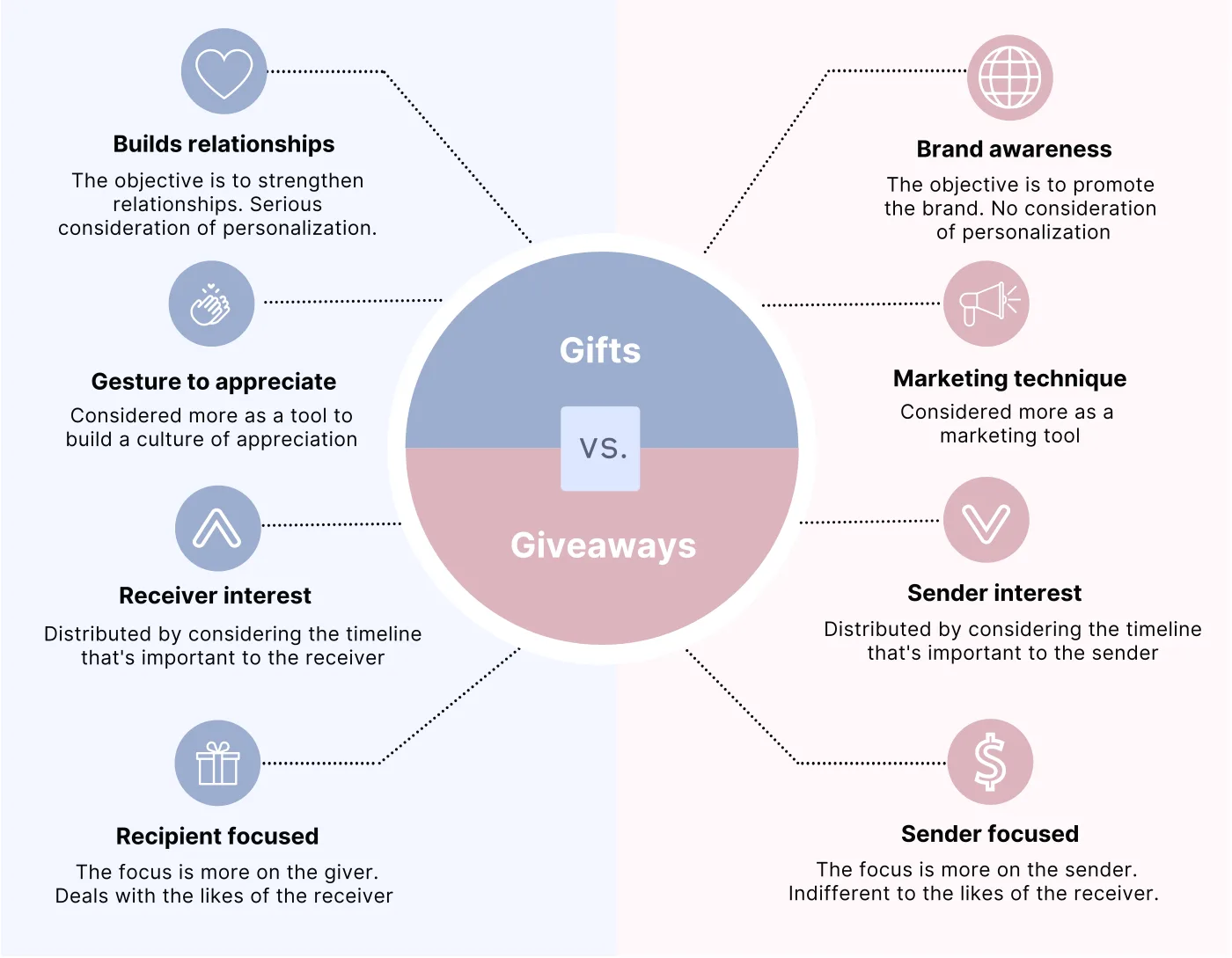
- Example of a giveaway: A travel mug or notebook printed with your company logo
- Example of a gift: The same travel mug or notebook printed with the employee's name, or one they chose themselves
Branded swag still has a place in onboarding kits and events. Our list of corporate swag ideas covers what employees actually keep.
When to send employee gifts
Every employee has a personal and a professional life, and each affects the other, so a strong gifting calendar covers both. The occasions below are grouped into universal moments that apply to everyone and milestones that are specific to each person; milestones carry the most weight because they show you noticed the individual.
Universal gifting moments
Every country is steeped in traditions, and festivals carry enormous cultural and emotional meaning. Beyond global festivals such as Christmas, Diwali and Eid, include regional celebrations such as Durga Puja in Bengal, Lunar New Year across East and Southeast Asia and cherry blossom season in Japan. Including them makes your gifting more culturally inclusive.
Key days also matter. Mother's Day, Father's Day, International Women's Day, Friendship Day and New Year's Eve let employees celebrate with the people who support them. Our corporate gifting calendar lists the dates worth planning for.
Personal milestones
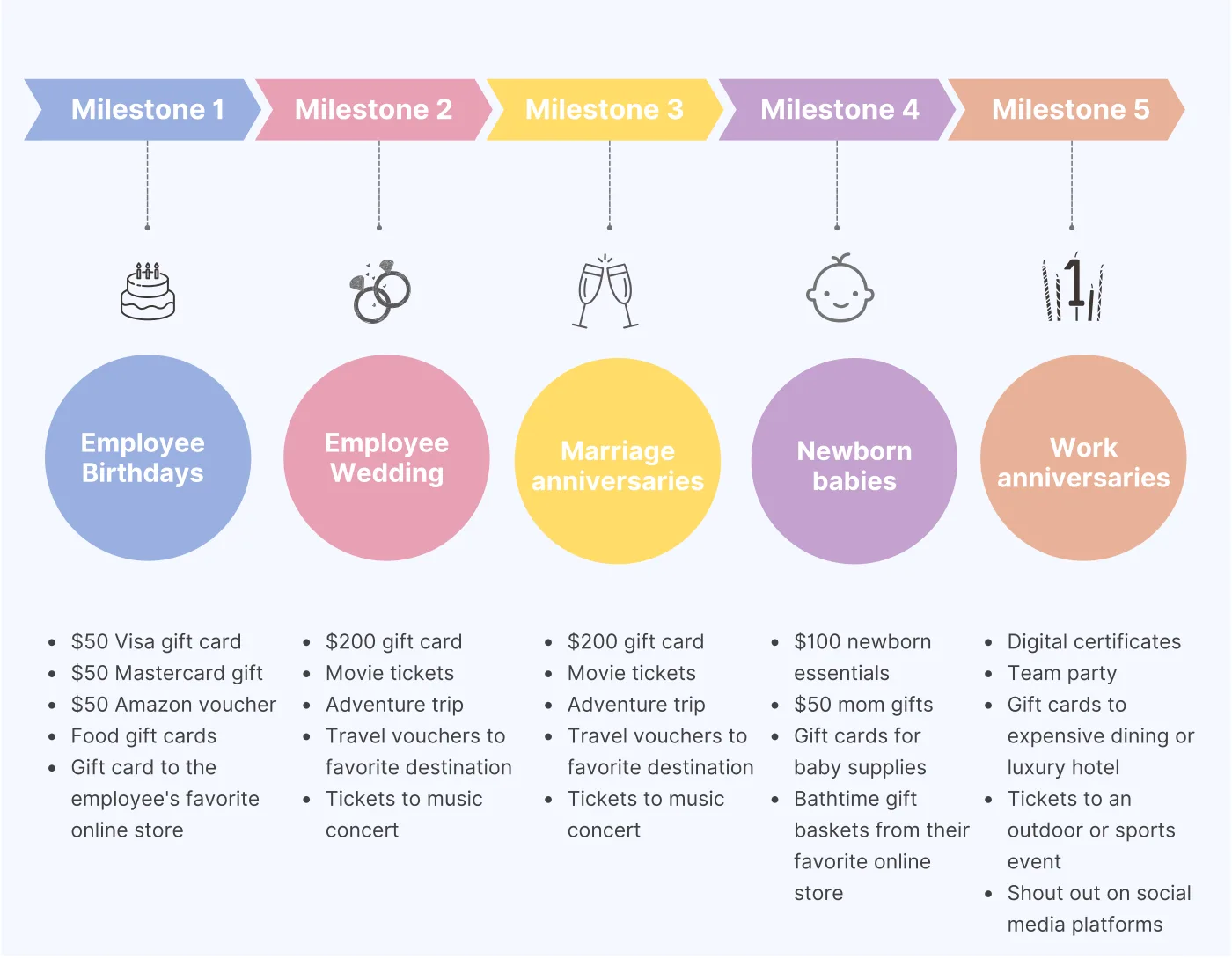
Your HR system already holds the dates that matter to employees, so you can automate gifts for birthdays, weddings, new babies and work anniversaries. Personal achievements outside work, such as running a marathon, publishing a book or speaking at a major event, deserve a gift too.
Professional milestones
Employees come to work to perform and to help the company reach its goals, so recognize the achievements that matter with a gift. Common moments include:
- Annual awards such as employee of the year or best sales performance
- Customer service excellence and the most customer recognition
- Innovation awards and the best example of company values
- Team collaboration wins and project completions
- Certifications, promotions and new responsibilities
Joining and leaving
The first day and the last day are two of the most memorable in any job. A welcome gift helps a new hire feel part of the team before they have met everyone; see our list of onboarding gifts for new hires. A farewell or retirement gift tells departing employees they made a lasting impact, and long-service awards deserve particular care, as our guide to long-service awards explains.
Elevate employee gifting with Empuls
Finding the right gift for every employee can feel overwhelming, and Empuls brings recognition, rewards and celebrations into one platform so employee gifting runs itself:
- Global rewards catalog: Employees choose from 10M+ options across gift cards, experiences, merchandise, wellness and charity, localized for 150+ countries, currencies and languages.
- Automated celebrations: Celebrations handles birthdays, work anniversaries, onboarding, life events, festivals and service awards automatically, with a message, e-card and gift for each.
- Recognition linked to gifts: Tie gifts to peer appreciation, spot awards and manager-led recognition, and to milestone rewards for targets and project completions.
- Budget control and analytics: Allocate budgets by team or manager, track redemption and see where recognition is and is not happening.
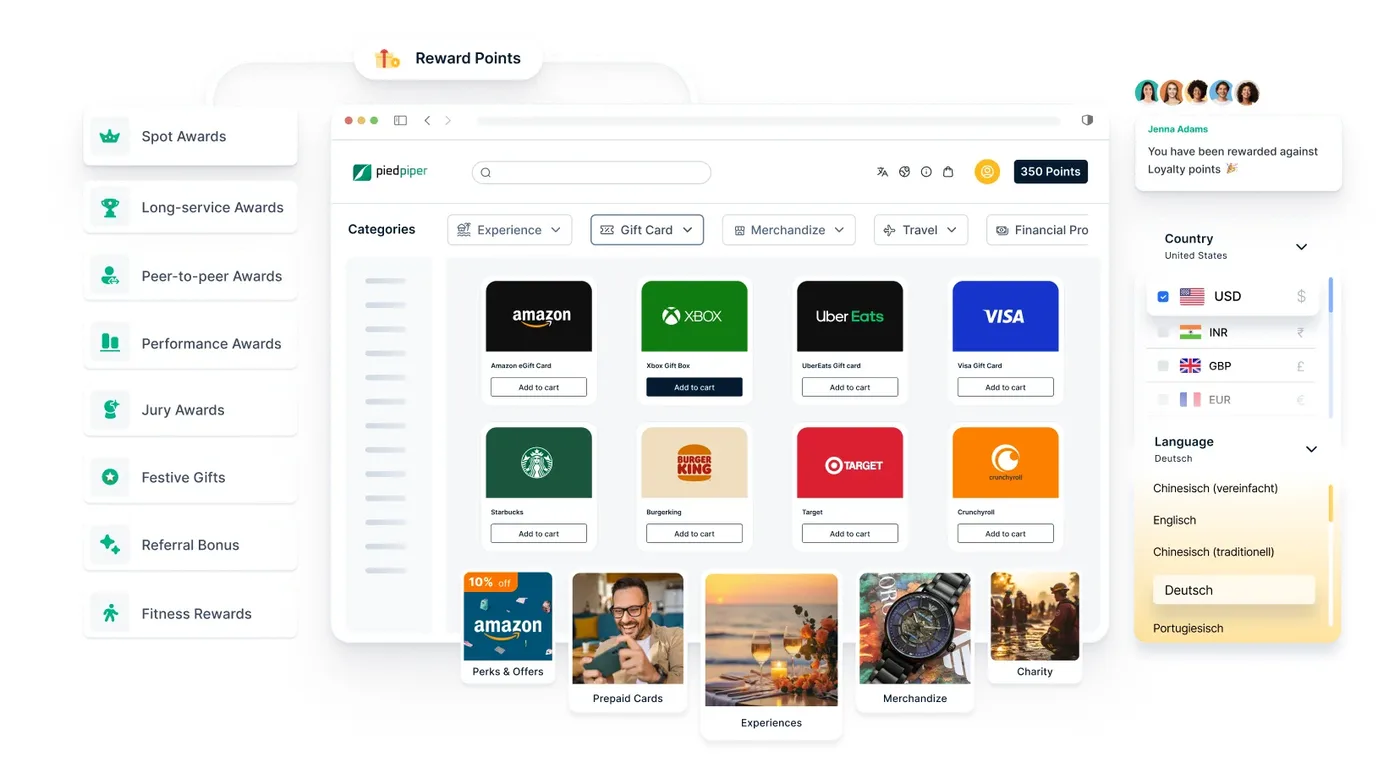
KPIT Technologies, a 5,000+ person mobility tech company, replaced physical gifting with Empuls and a global e-voucher catalog with multi-currency redemption, which let it scale recognition across the US, Europe, Japan, Korea and Thailand. If you also gift clients and partners, Xoxoday Plum runs those campaigns from the same catalog.
Thoughtful employee gifting leaves a lasting impact
Employee gifting is much more than a seasonal gesture or a box to tick. Done thoughtfully, it sparks genuine appreciation, builds stronger bonds and creates a sense of belonging that lasts well beyond the moment a gift is opened. Set a clear policy and budget, cover both personal and professional moments, personalize every gift with a reason and give employees choice. Choose gifts that reflect your company's spirit, your team's individuality and the journey you are building together.
Book your Empuls demo
Frequently asked questions
There is no fixed rule, but many companies budget around $100 to $200 per employee a year for recognition and gifts, with occasion gifts such as birthdays at $25 to $50 and milestones at $100 or more. As a broader benchmark, the Incentive Research Foundation suggests 1.5% to 2% of payroll for a social recognition program.
Usually, yes. In the US, gift cards and other cash equivalents are taxable wages at any value, while small, occasional non-cash items such as a holiday turkey can be tax-free de minimis benefits. In the UK, non-cash gifts of £50 or less can be tax-free trivial benefits if they are not a reward for work. Check local rules for other countries.
The best gifts for employees are the ones they would choose themselves. Gift cards, experiences, wellness gifts and curated hampers are consistently popular, while office products and generic branded items rank among the least wanted. When you cannot know every employee well, a catalog of options with a personal message from their manager works best.
It is best avoided. Workplace gifts should flow down or across the hierarchy, because a gift from an employee to a manager can look like flattery or an attempt to gain favor. If a team wants to mark a manager's birthday or farewell, a group card or a small shared gift with everyone contributing a modest amount keeps it appropriate.
Use digital gifts such as gift cards, reward links or experience vouchers delivered by email, Slack or Microsoft Teams, so remote employees receive them on the same day as office staff. Choose a catalog that localizes brands, currency and language by country, and collect delivery addresses in advance for any physical gifts to avoid customs delays.
An employee gift policy should state who can give and receive gifts, value limits, which occasions are covered, which gifts are inappropriate, how gifts from vendors and clients are handled, how gifts are taxed and who approves exceptions. Publish it where everyone can find it and review it once a year as your program and team change.
Cash suits bonuses and pay, but gifts are usually more memorable for recognition and celebrations because they feel like a treat rather than part of compensation. A gift with choice, such as a gift card or catalog, offers much of the flexibility of cash while keeping the emotional value of a gift. Both are generally taxable.





































































































































































































































































































































































































































































































































































