
Key Takeaways
A retail commission percentage only has meaning next to the base pay, the margin and the sales it applies to, so set your own rate rather than copying a published range.
The five retail commission percentage models are straight commission, base plus commission, tiered, gross margin and team pool commission.
To set a rate, divide the monthly commission you want a solid associate to earn by their expected sales: $800 on $40,000 of sales is 2%.
Paying a fixed share of gross margin produces a higher percentage of sales on high-margin goods, which is why retail commission rates differ so much between categories.
In the US, a commissioned retail employee is exempt from overtime under Section 7(i) only if commission is more than half of earnings and the regular rate exceeds 1.5 times minimum wage.
A retail commission percentage is the share of a sale, or of the gross margin on that sale, that a store pays the associate who made it. There is no single standard rate: it depends on whether the associate also earns an hourly wage, how large the average ticket is and how much margin the product carries. This guide compares five retail commission percentage models and shows how to calculate the right percentage for your stores, with worked examples.
Every retailer that pays commission spends real money on it, so the question is never only how much to pay but what each percentage point buys. Pay too little and your best associates leave for the store down the street. Pay too much, or on the wrong base, and commission eats the margin it was meant to grow. The right percentage sits between the two, and you can calculate it.
What a retail commission percentage is
A retail sales commission is variable pay calculated as a percentage of the sales an associate makes, sometimes only above a target set by the employer. The percentage can apply to the sale price, to the gross margin, or only to sales above a threshold, which is why two stores both advertising 5% commission can pay very different amounts.
Retail commission sits on top of a broader pay design. For the mechanics of how commission is credited, calculated and paid in stores, see this guide to how retail commission works. This post focuses on the percentage itself: which model to apply it to and how to set it.
Retail sales associate pay: what the data shows
Most retail associates are paid by the hour, and commission is added where selling skill moves revenue, such as furniture, appliances, jewelry, electronics and vehicles. Primary data on commission rates by category is scarce, but the US Bureau of Labor Statistics publishes pay and job figures that include commission:
$17.03
median hourly wage
retail salespersons, May 2025, including commissions and bonuses
4.27M
retail sales jobs
in 2025, including parts salespersons
550,600
openings a year
projected each year from 2025 to 2035, mostly to replace leavers
Source: US Bureau of Labor Statistics, Occupational Outlook Handbook
More than half a million openings a year in a field that is barely growing means most hiring is replacing people who left. Pay is one of the few levers a store controls, which is why the commission model matters for retention as much as for sales. This look at the retail turnover rate covers the other causes.
5 retail commission percentage models compared
Most retail commission structures fall into five models, and the difference between them is what the percentage applies to. The table compares them on one associate who sells $40,000 in a month, and the sections after it explain how each model works and how to set its percentage.
| Model | Percentage applies to | Example rate | Commission on $40,000 of monthly sales | Best for |
|---|---|---|---|---|
| Straight commission | Every dollar of sales | 6% of sales | $2,400 (all of pay) | High-ticket, consultative sales |
| Hourly or base pay plus commission | Every dollar of sales, on top of base pay | 2% of sales | $800, plus $2,400 base | Most specialty retail |
| Tiered commission | Sales within each tier | 1% to $25,000, 3% above | $250 + $450 = $700, plus base | Stores pushing associates past a target |
| Gross margin commission | Gross profit on each sale | 5% of margin | $900 at a 45% margin | Stores where associates can discount |
| Team pool commission | Total store sales, shared | 0.4% of store sales | $150 share of a $1,200 pool | Small stores, team selling |
1. Straight commission
A straight commission plan is the simplest form: associates earn a percentage of their total sales, with no separate base pay, so earnings are tied directly to performance. It suits high-ticket, consultative sales where one good conversation produces a large sale.
Formula: Commission = Sales × Rate. Example: 6% of $40,000 = $2,400. How to set the percentage: divide the monthly pay you want a solid associate to earn by the sales you expect from them: $2,400 ÷ $40,000 = 6%. In the US, commission-only employees must still earn at least the minimum wage for every hour worked, so check slow weeks, not just averages.
2. Base pay plus commission
This structure combines an hourly wage or salary with a commission on sales, offering a balance of security and incentive. Base pay provides a safety net, while commission motivates associates to exceed their targets. It is the most common model in specialty retail.
Formula: Pay = Base pay + (Sales × Rate). Example: 160 hours at $15 = $2,400 base, plus 2% of $40,000 = $800, for $3,200 in the month. How to set the percentage: because base pay covers most of the associate's earnings, the rate is low. Decide how much variable pay should be on top (here $800, a quarter of total pay) and divide by expected sales.
3. Tiered commission
Tiered commission structures pay increasing rates as associates reach higher sales levels. They motivate associates to push beyond their comfort zone and protect margin on the first slice of sales, which would happen anyway.
Formula: Commission = (Sales in tier 1 × Rate 1) + (Sales in tier 2 × Rate 2). Example: 1% on the first $25,000 ($250) plus 3% on the next $15,000 ($450) = $700. How to set the percentage: set the first threshold near what an average associate sells without extra effort, and make the higher rate meaningful enough to notice. State whether tiers are marginal (as here) or retroactive, because a retroactive 3% on all $40,000 would pay $1,200.
4. Gross margin commission
Commission is calculated on the gross profit of each sale instead of its price, so associates earn more for full-price sales and high-margin products, and discounting costs them as much as it costs the store.
Formula: Commission = (Sale price − Cost) × Rate. Example: $40,000 of sales at a 45% gross margin is $18,000 of margin, and 5% of that is $900. If the associate discounts and margin falls to 40%, commission drops to $16,000 × 5% = $800. How to set the percentage: decide what share of gross margin you can spend on selling pay. Vehicle sales are the classic example: salespeople are usually paid a percentage of the gross profit on the deal rather than the vehicle's price.
5. Team pool commission
A pool commission plan sets aside a percentage of total store or department sales and distributes it among the team, by hours worked, individual sales, role or performance. It fosters teamwork and shared responsibility, which suits stores where several people help each customer.
Formula: Associate share = (Store sales × Pool rate) × (Associate's hours ÷ Team hours). Example: a store sells $300,000 in a month, and 0.4% creates a $1,200 pool. An associate who worked 150 of the team's 1,200 hours (12.5%) receives $150. How to set the percentage: size the pool so that the per-person share is worth chasing; a pool too small to notice will not change behavior.
Residual commission, which pays a continuing percentage on repeat business, is a sixth option that works mainly where customers buy on contract or subscription, such as phone plans or service agreements. Most stores reward repeat business with a bonus instead, as in the ideas below. For formulas for every structure, see these sales commission structures.
Pay store commissions accurately, every pay period
Run tiered, margin and team pool commission across every store from one engine, with earnings associates can see.
Talk to our ExpertTrusted by 5,000+ companies
How to set the right retail commission percentage
Setting a retail commission percentage takes six steps, and the first two give you the rate; the other four check that the rate is affordable, fair and legal. This worksheet uses one associate with expected sales of $40,000 a month on an hourly-plus-commission plan:
| Step | What you calculate | Worked example |
|---|---|---|
| 1. Target commission | Monthly commission a solid associate should earn on top of base pay | $800 a month |
| 2. Base rate | Target commission ÷ Expected monthly sales | $800 ÷ $40,000 = 2% of sales |
| 3. Margin check | Commission ÷ Gross margin on those sales | $800 ÷ ($40,000 × 45%) = 4.4% of margin |
| 4. Store cost check | Total commission ÷ Total store sales | 10 associates × $800 = $8,000 on $400,000 = 2% of sales |
| 5. Stress test | Pay at weak and strong months | $28,000 sales pays $560; $52,000 pays $1,040 |
| 6. Legal check (US) | Minimum wage and overtime rules for commission pay | With $2,400 base, commission is under half of pay, so normal overtime rules apply |
If you want to pay on margin, work the other way: decide what share of gross margin to pay, and the percentage of sales follows. Revenue rate = Gross margin % × Share of margin paid. The table shows the result for three margin levels:
| Gross margin | Pay 5% of margin | Pay 10% of margin |
|---|---|---|
| 25% | 1.25% of sales | 2.5% of sales |
| 40% | 2% of sales | 4% of sales |
| 55% | 2.75% of sales | 5.5% of sales |
This is why the average commission for retail sales varies so much between categories: a store paying the same share of margin pays a higher percentage of sales on high-margin goods. It is also why a single retail commission rate across every product line usually overpays on low-margin items and underpays on the ones you most want to sell.
How retail commissions drive more sales
Retail commissions drive sales by motivating associates, rewarding performance and helping you attract strong sellers. Two benefits matter most, and both depend on associates understanding exactly how their percentage works.
- Motivated associates: A commission encourages retail sales associates to go the extra mile to meet or exceed targets, and it rewards the service that builds relationships with shoppers, because better conversations lead to bigger baskets.
- Pay that tracks performance: Rewarding top performers through a clear retail commission structure boosts morale and engagement, and makes associates more invested in the store's results.
Drawbacks of commission-based pay and how to fix them
Commission has three well-known drawbacks, and each has a design fix. The first is the most common reason retailers drop commission altogether, and it is also the easiest to solve:
- It complicates payroll: Calculating commission by transaction, tier, margin and returns takes precision every pay period. Fix: pull sales data straight from the point-of-sale system and automate the calculation rather than rebuilding it in a spreadsheet.
- It can create negative competition: Associates may chase customers or skip tasks that do not pay. Fix: add a team pool or store-level bonus on top of individual commission, and recognize collaboration publicly.
- It can crowd out development: When associates focus only on targets, skills such as product knowledge and customer relationships can slip. Fix: reward learning milestones and service scores alongside sales, which sales gamification makes visible.
7 steps to create a retail commission structure
Creating a retail commission structure takes seven steps. The first two, choosing the model and setting realistic targets, decide whether the plan works at all, and the worksheet above covers the math:
- Choose the commission model: Match it to the product and the complexity of the sale. One size rarely fits all, so departments with different margins may need different models.
- Set realistic targets: Base targets on the store's sales plan, footfall and headcount, and set them by month or quarter so associates can see progress.
- Communicate clearly: Retail teams turn over often, so new associates need the plan explained on day one, with a worked example of a typical month.
- Track sales accurately: Give associates a way to see their own sales and earnings daily, credited through the point-of-sale system, so there are no surprises on payday.
- Withhold tax correctly: Commission is taxable income. In the US, commissions are supplemental wages, and IRS Publication 15 lets employers withhold federal income tax on them at a flat 22% (37% above $1 million a year).
- Track performance and adjust support: Use the data to spot associates who need training and products that need a push, and adjust incentives or rewards accordingly.
- Improve continuously: Ask associates for feedback on the plan, compare your pay with competing stores and review rates at least once a year.
6 retail sales commission ideas to add on top
A base commission percentage does the steady work, and short-term ideas layered on top focus effort where you need it. These six are the most useful, starting with product-specific bonuses because they move margin fastest:
| Idea | How it works | Example |
|---|---|---|
| Product-specific bonus | Extra commission on a new or high-margin line for a set period | An extra 2% on the new mattress range this month: $3,000 sold earns $60 more |
| Gift card power-ups | Gift cards for reaching milestones or consistently hitting targets | A $50 gift card for beating the weekly target three weeks in a row |
| Experience-based rewards | Experiences instead of cash for top performance | Concert tickets or a spa day for the quarter's top associate |
| Customer retention bonus | A bonus on repeat business from customers the associate looks after | 1% of repeat purchases by customers the associate enrolled in the loyalty program |
| Team performance pool | A share of sales above the store target goes into a team fund | 0.25% of sales above target, split by hours worked |
| Upselling and cross-selling bonus | A fixed amount for each attached item or service | $5 for each protection plan or accessory added to a sale |
For more programs built for store teams, see these retail sales incentive ideas, and for how commission fits with every other kind of sales reward, the sales incentives guide.
How Empuls helps retailers manage sales commission
Managing commission across stores gets complex quickly, with tiers, margin rates, team pools and returns all in play. Empuls includes sales incentive and commission software that handles each of the models above from one engine, and it fixes the three drawbacks covered earlier:
- Accurate calculation: Build commission plans with flat, tiered, milestone-based or product-mix weighted rates by role, region or store, using sales data from your systems, and recalculate on demand when data changes.
- Fair team and individual rewards: Split credits, roll-ups for store managers and cascading plans let store, volume and individual plans roll up into one final incentive.
- Motivation on the floor: Run contests with leaderboards, badges and rewards through sales gamification, and pay out through payroll or rewards in 50+ currencies.
- Visibility for every associate: Associates track their own earnings and progress, while managers see who is performing and where to coach, including frontline teams without desks.
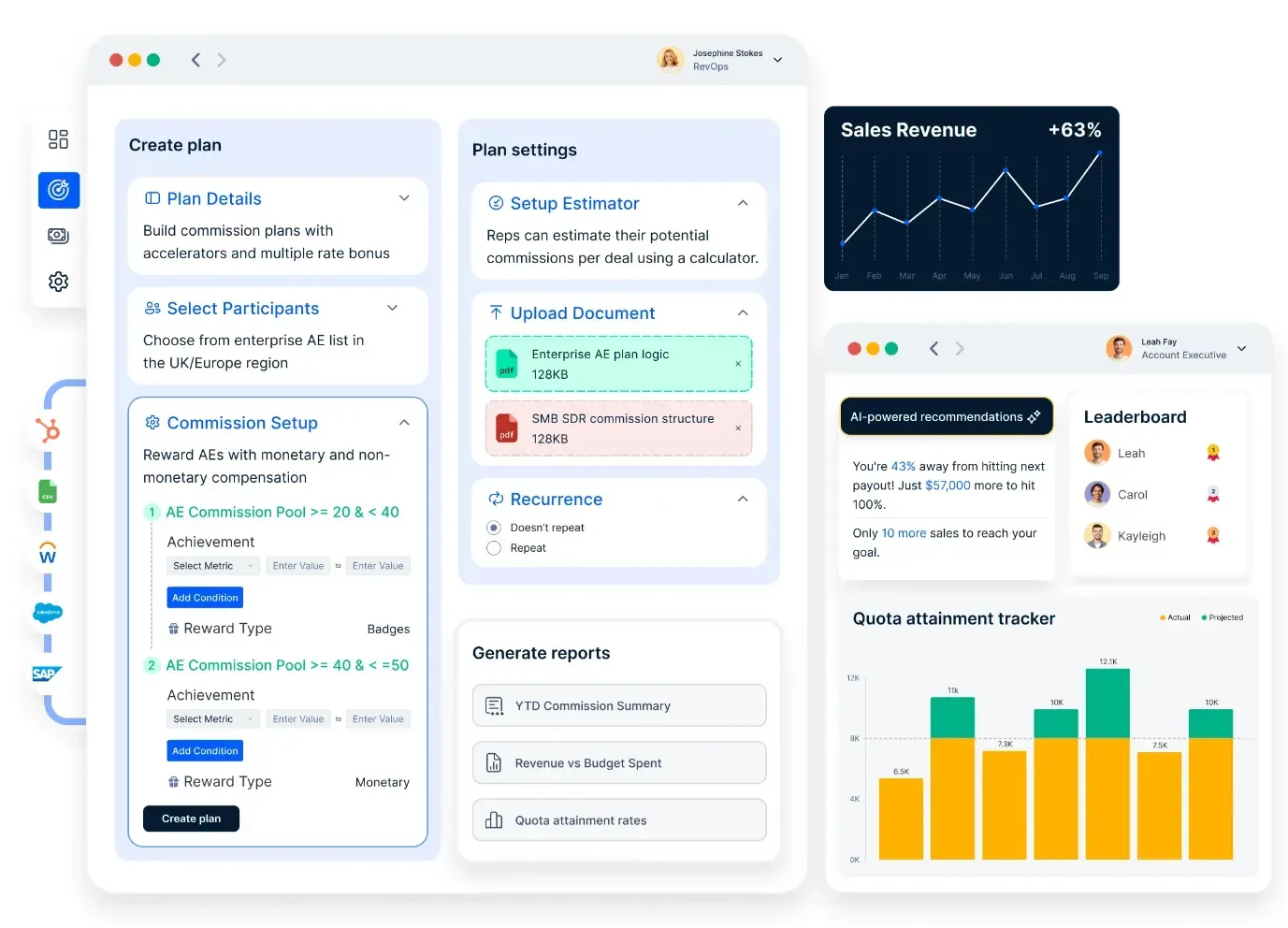
Retail and automotive networks already run incentives this way. Mercedes-Benz India automated quarterly incentives for its 33 franchises with 99.9% calculation accuracy, as the Mercedes-Benz India case study shows. To compare options, see these sales incentive platforms for retail brands.
Book your Empuls demo
Frequently asked questions
There is no reliable national average, because retail commission rates depend on base pay, average ticket and margin. Associates on hourly pay plus commission often earn a low single-digit percentage of sales, while commission-only roles in high-ticket categories need a higher rate to cover all pay. Calculate your rate by dividing target monthly commission by expected monthly sales.
A reasonable rate is one that pays a solid associate the commission you intend at expected sales, fits your gross margin and passes minimum wage and overtime rules. For example, if you want associates to earn $800 a month in commission on $40,000 of sales, the rate is 2%. Stress-test it at weak and strong months before launch.
Car salespeople are usually paid a percentage of the dealership's gross profit on the deal, not the car's price. If a $30,000 car produces $2,000 of gross profit and the salesperson earns 25% of gross, the commission is $500, not $7,500. Many dealerships also pay a flat minimum per vehicle, often called a mini, on low-profit deals.
Some do. Most retail salespersons in the US are paid by the hour, and commission is most common where selling skill drives large or high-margin sales, such as furniture, appliances, electronics, jewelry, cosmetics counters and vehicles. Many other stores use bonuses, team pools or sales contests instead of individual commission to reward performance without changing base pay.
Multiply the commission base by the rate. On a base-plus-commission plan with 2% of sales, $40,000 of monthly sales pays $800 on top of base pay. For tiered plans, apply each rate only to the sales in its tier, and for margin plans, multiply gross profit rather than sales by the rate. Deduct returns before calculating.
Both are common. Commission on sales is simpler to explain and track, so most specialty stores use it. Commission on gross profit suits stores where associates can negotiate price, such as furniture or vehicles, because it stops associates from earning the same commission on a heavily discounted sale. Some stores pay on sales with a reduced rate for discounted items.
Usually yes. Under the US Fair Labor Standards Act, a commissioned employee of a retail or service establishment is exempt from overtime only if their regular rate is more than 1.5 times the minimum wage and more than half their earnings in a representative period come from commission. Hourly associates earning a small commission on top typically remain eligible for overtime.
Not usually. A single rate across all products overpays on low-margin lines and underpays on high-margin ones, so associates steer customers toward whatever is easiest to sell. Many stores either pay commission on gross margin or set two or three rate bands by category, and add short-term bonuses for products they want to promote.





































































































































































































































































































































































































































































































































































